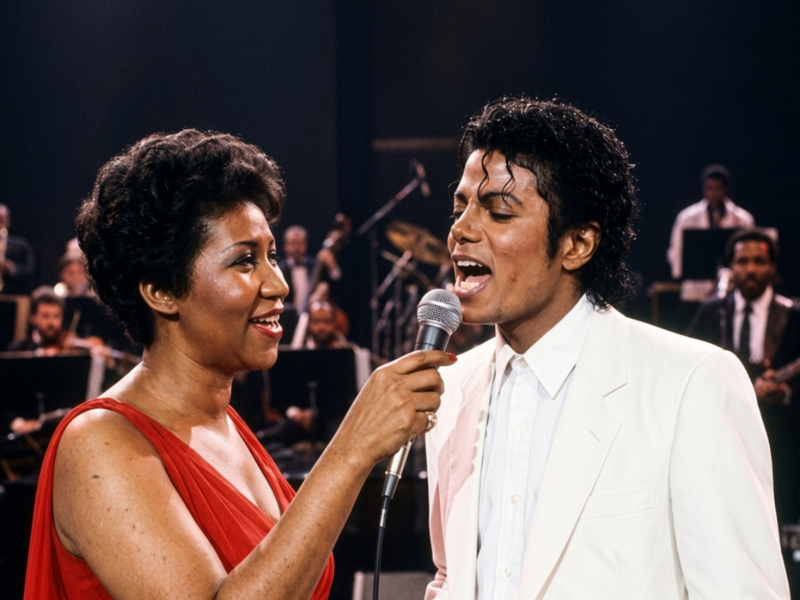
Aretha Franklin DARED Michael Jackson to Sing ‘Respect’ Live — 5 Seconds Later In Tears.
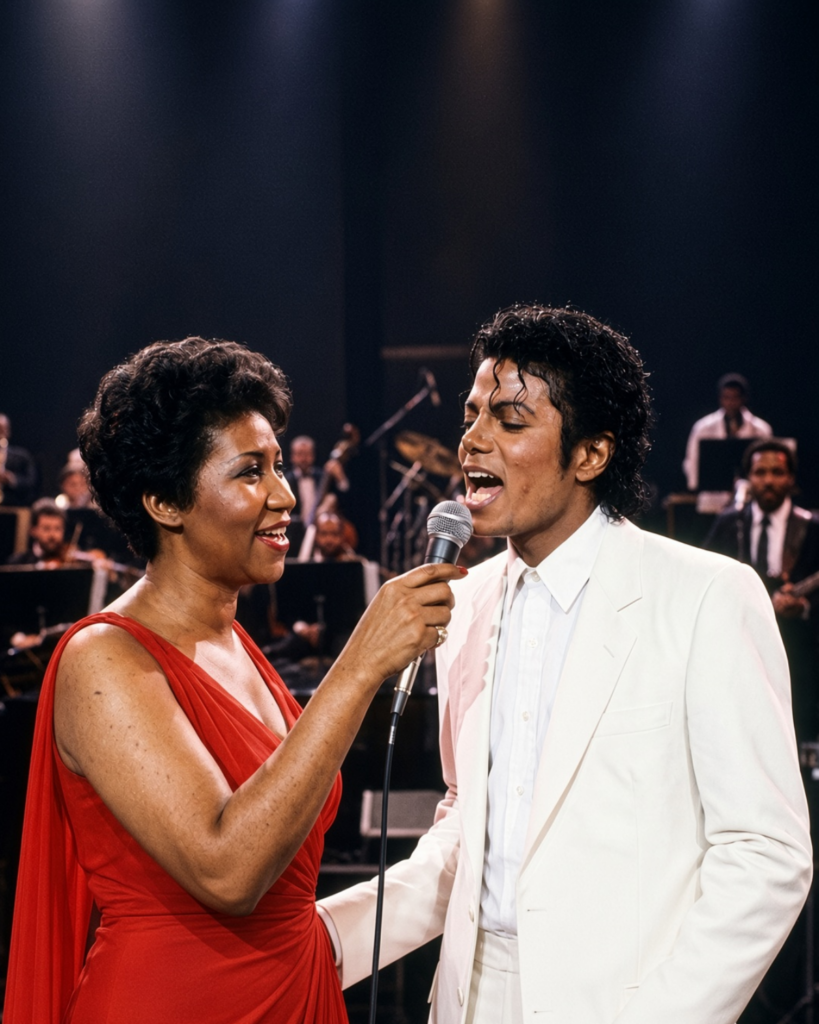
When the people handling Aretha Franklin’s estate began searching her home in the northern suburbs of Detroit in the autumn of 2018, they found many things one would expect to find in the house of the Queen of Soul.
There were gowns and garment bags occupying entire closets.
There were furs.
There were gold records leaning against the walls because she had run out of places to hang them years ago.
There was a grand piano in the living room with sheet music stacked on top of it in disarray.
And there were photographs everywhere—of presidents, preachers, her sisters, her sons when they were small.
On that piano, beneath a stack of hymnals, there was an album that didn’t seem to belong with everything else.
It was old and worn almost down to the cardboard.
It was not one of hers.
It was an album of sermons recorded in the early 1950s by her father, the Reverend C. L. Franklin—one of the dozens he released over the course of his life—and in and of itself, it would not have been unusual in that house.
She had copies of all of them.
What made the woman sorting through the items stop and pick it up was the back of the sleeve.
In the bottom corner, in pencil, in a careful, square, childlike hand, someone had written a first name and a year.
“Michael, 1968.”
And below that, in blue ink, in the looser handwriting of an adult man, there was a second line added much later.
“Where it belongs, 1986.”
Nobody in the family said much about it when it was brought to them.
One of her relatives, asked about it much later, simply stated that Aunt Ree had kept that record on the piano for thirty years, that she wouldn’t let anyone move it, and that if you asked her about it, she would tell you it was a long story and she was too tired to tell it properly.
Here is that story.
It happened on a hot night in the late summer of 1986 in an outdoor amphitheater outside Detroit, in front of more than 12,000 people who had come to hear Aretha Franklin sing and who had no idea that Michael Jackson was standing in the dark, just off the side of the stage.
It happened because of a few careless words Aretha had said about him a few months earlier.
Because of a record a ten-year-old boy had hidden from his own parents for eighteen years.
And because the Queen of Soul, in the middle of her own concert, did something no one in her band had ever seen her do.
She called another singer to the microphone, handed him the only song in the world that was hers and hers alone, and dared him to sing it.
And about five seconds after he opened his mouth, Aretha Franklin was crying so hard she had to hold on to the piano.
To understand why that night undid her the way it did, you have to start with a church on the west side of Detroit and a preacher whose voice could make a building full of grown men weep.
Aretha Franklin did not learn to sing in a music school.
She learned to sing at New Bethel Baptist Church on Linwood Street, where her father was the pastor and where, on a good Sunday, there could be more than 2,000 people packed into the pews and standing along the walls.
The Reverend Clarence LaVaughn Franklin was not an ordinary preacher.
In the 1950s, he was one of the most famous Black pastors in the United States.
His sermons were broadcast on the radio every Sunday evening, and he recorded them—dozens and dozens of them on a Chicago label—and those records sold by the hundreds of thousands in barbershops, beauty salons, and kitchens from Mississippi to Los Angeles.
People called him “the man with the million-dollar voice.”
What made him famous was the way he ended a sermon.
He started softly, almost like a schoolteacher, talking about a passage of Scripture, explaining his arguments one by one.
Then, slowly, somewhere after the middle, his voice began to change.
It started to rise and fall.
It picked up rhythm.
The sentences got shorter, and the breaths between them turned into something that resembled a musical note—a kind of hard, rising moan at the end of each line.
Preachers call it whooping.
By the end of a C. L. Franklin sermon, he wasn’t really speaking anymore.
He was singing, and the church was singing back, and the organ was following him everywhere he went.
His most famous sermon was called “The Eagle Stirreth Her Nest.”
It was about how a mother eagle tears apart the comfortable nest her young have grown soft in, to force them to fly.
He preached it many times, but the recorded version, made in the early ’50s, became one of the most famous sermon recordings ever made in America.
There were people who could recite the whole thing from memory, every move, every pause, every moan.
His daughter grew up listening to that sound.
She sat in the front pews listening to it before she could read.
She sang her first solo in that church when she was a little girl, standing on a chair so the congregation could see her.
By fourteen, she was traveling with her father on his gospel caravan, riding in the back of cars across the South, singing in churches and auditoriums before he got up to preach.
Her first recordings were gospel songs, recorded live at New Bethel itself—a teenager with a voice so powerful and so old that people who heard her records thought she was a grown woman.
It was her father’s style she was really learning.
People who knew her said it over and over throughout her life.
Aretha didn’t sing like other great soul singers.
She sang like a preacher.
She built a song the way her father built a sermon—starting low and plain, holding back, then rising, adding weight, taking a line and bending it, repeating it, pushing it higher each time until the whole room was with her.
The moan at the end of a phrase, that little catch and lift, came straight from Linwood Street.
In 1967, she walked into a recording studio in New York and recorded a song a young soul singer named Otis Redding had written and recorded a few years earlier.
His version was a good record—the complaint of a hard-working man—and it had done reasonably well.
Aretha took it and made it something completely different.
She changed the point of view.
She sped up the tempo.
She and her sisters, Carolyn and Erma, worked out the backing parts together, including the famous spelled-out chant everyone now knows by heart and the little shouted slogan that follows it.
When it came out that spring, it went to number one.
It won her two Grammy Awards.
It became an anthem for the civil rights movement, then for the women’s movement, and within a year it had turned a preacher’s daughter from Detroit into the Queen of Soul.
It was her song after that.
It didn’t matter that Otis Redding wrote it.
He said so himself, on stage at a festival that summer, laughing, that a girl had taken his song—and everyone in the crowd knew exactly which girl and which song.
For the rest of her life, other singers covered it on television and in concert all the time, and she almost never commented on any of those versions, good or bad.
People who knew her said you could guess what she thought by watching how long she stayed in the room while the music played.
Then came June 1979.
Her father was at home, in the house on LaSalle Boulevard where he had lived for years, when burglars broke in one night.
He was shot twice.
He survived, but he never really woke up.
He stayed in a coma—first in the hospital, then at home—for five years.
Aretha paid for round-the-clock nursing.
She made so many trips back and forth between Los Angeles and Detroit that her relatives stopped counting them.
She sat beside his bed and talked to him and sang to him, and he lay there with his eyes closed—the man with the million-dollar voice—without making a sound.
In 1982, she moved back to Detroit for good to be near him.
The following year, on a small propeller plane returning from a date, she had a flight so rough and so frightening that she decided she would never fly again—and she never did.
For the rest of her career, for more than thirty years, if you wanted Aretha Franklin to sing somewhere, it had to be somewhere you could get to by bus.
The Reverend C. L. Franklin died on July 27, 1984.
His funeral at New Bethel drew thousands, and the line to view his body stretched down Linwood Street and around the block.
Aretha, they remembered, held it together almost the whole time.
She sang, she greeted people, she thanked everyone—and then, for a long time afterward, she didn’t go back into that church if she could avoid it.
It was too much.
The building still echoed like him.
The strange thing was that her career, at the same moment, was taking off again.
In 1985, she released an album called Who’s Zoomin’ Who, filled with drum machines, synthesizers, and slick ’80s production, and it became her biggest hit in more than a decade.
“Freeway of Love” was all over the radio.
The video played on MTV on repeat, with pink Cadillacs and a whole new generation of kids who had never heard of her father discovering her for the first time.
By the summer of 1986, she was back on top, touring the Midwest by bus, playing big outdoor sheds and theaters to packed houses, and telling interviewers she felt wonderful.
The people who traveled with her knew it was more complicated than that.
A trumpet player who spent several years in her touring band said that when she sang the new hits, she had a blast—and when she sang the old gospel numbers, she still put on the show.
Sometimes she would finish and walk straight off to the side of the stage and stand with her back to the audience for a few seconds before coming back.
Nobody in the band ever asked her about it.
You didn’t ask Aretha about her father.
It was the woman who, in the spring of 1986, was giving a radio interview at a Chicago station when the disc jockey, making conversation, asked her what she thought of Michael Jackson.
At that moment, there was no one bigger on the planet.
Thriller had come out in late 1982 and by 1986 had become the best-selling album in the history of recorded music.
He had done the moonwalk on a Motown television special in 1983 and changed popular dance overnight.
He had toured stadiums with his brothers in 1984.
He had co-written “We Are the World” in 1985.
He had bought the Beatles’ song catalog.
His face was on lunchboxes and posters and magazine covers in every language in the world.
Asking a singer what they thought of Michael Jackson in 1986 was like asking them what they thought of the weather.
You weren’t really asking their opinion.
You were asking them to say something nice.
Aretha said something nice.
Almost all of it.
According to the station’s program director, who was in the booth that day and told the story years later, she said Michael was a beautiful talent, that she had known him since he was a little boy at Motown, that he could dance like nobody, and that he had a gorgeous voice.
And then, because Aretha Franklin never knew how to stop halfway through telling the truth, she added one more thing.
She said, “But I’ll tell you something—that child has never sung in a church. You can hear it. He sings pretty. He doesn’t sing from here.”
And the program director said she tapped her chest, just below the collarbone, the way her father used to tap the pulpit.
It went out live.
It was a throwaway remark, and she laughed right after she said it, and the DJ laughed, and they moved on to talk about her new album.
And mostly, nobody remembered it by the end of the week.
But this was 1986, and anything said about Michael Jackson traveled.
A music columnist picked it up.
A few papers ran it as a single line.
It got shortened and sharpened along the way, the way it always does.
By the time it reached Los Angeles, where Michael was spending most of his days that year in a recording studio working on the album that would become Bad, it had become something closer to this.
“Aretha Franklin says Michael Jackson has no soul.”
The people who worked with him that year said he didn’t react to it at all.
At least, not visibly.
It’s worth pausing here, because what almost nobody understood about Michael Jackson—even the people who knew him fairly well—was how much that particular remark would have landed.
Michael was raised as one of Jehovah’s Witnesses.
His mother, Katherine, had converted when he was a little boy, and she raised her children in that faith with real devotion.
As a child, Michael went door-to-door with The Watchtower and continued to do so in disguise well into adulthood, even at the height of Thriller.
Jehovah’s Witnesses have their own meetings in what they call Kingdom Halls, and they have their own songs, but they have nothing like a Black Baptist church on a Sunday morning.
There is no choir cutting loose, no organ swelling, no preacher whooping at the end of a sermon while the congregation pushes him higher.
Everything is quiet, orderly, and serious.
And when Michael was growing up in Gary, Indiana, the gospel music that poured out of the Baptist and Pentecostal churches all over that city was something he could hear through windows and car radios—but was not supposed to be part of.
He grew up as one of the most gifted singers of his generation, almost completely outside the tradition that had produced most of the great soul singers he admired.
Sam Cooke came out of gospel.
Aretha came out of gospel.
Marvin Gaye came out of his father’s church.
James Brown, Jackie Wilson, Stevie Wonder—all of them had that sound somewhere in their flesh, from Sunday morning.
Michael had studied all of them.
He watched James Brown from the wings when he was a little boy and copied every step.
But the church itself was something he had only ever heard from the outside.
He was aware of it.
He talked about it once, briefly, many years later, in a rare relaxed conversation with a producer he trusted.
He said that when he was young, the older musicians at Motown used to tease him a little, affectionately, saying he sang like an angel but he didn’t know how to holler.
And he said that it stayed with him longer than they probably meant it to.
So when a secondhand version of Aretha Franklin’s comment made its way to Westlake Studio in the spring of 1986, it wasn’t just the opinion of a famous singer.
It was the Queen of Soul herself—a preacher’s daughter—putting her finger on the one subject that had always privately nagged at him, and she had said it on the radio.
One of the engineers at the Bad sessions said that later that evening, long after most people had gone home, Michael sat alone in the lounge for a while listening to a gospel record he had asked someone to bring him.
He didn’t say anything about Aretha.
He didn’t say anything at all.
He just listened to the same side twice, then went back into the vocal booth and worked almost until dawn.
What the engineer didn’t know—and what no one in that studio knew—was that Michael had his own gospel record.
He’d had it since he was ten years old.
He had never played it for another living soul in eighteen years.
In July 1968, Joseph Jackson packed his five oldest sons into a van in Gary, Indiana, and drove them to Detroit for an audition with Motown Records.
That audition at the little house on West Grand Boulevard that everyone called Hitsville USA became one of the most famous moments in American pop music history.
The story of Berry Gordy watching a ten-year-old boy sing and dance and immediately understanding what he was seeing has been told many times.
What usually isn’t told is what happened on the drive.
It was a Sunday evening.
The boys had been rehearsing for days, and they were tense and nervous.
Joseph, who was not a man to waste a minute, had them running harmonies in the van across Indiana and Michigan.
When they got to Detroit, someone turned on the radio to find a station, and instead of music, the van filled with the voice of a preacher.
It was Reverend C. L. Franklin’s Sunday evening broadcast from New Bethel.
Joseph reached for the dial, and Michael, in the back of the van, asked him to leave it.
Just a minute.
Jermaine Jackson, years later, remembered that moment only vaguely, as a minor event in the middle of a very big day, but he remembered that it was strange.
Michael didn’t usually ask for anything, and he remembered that his father, for reasons nobody ever really understood, left it on.
Maybe he was tired.
Maybe he was lost and looking for road signs and didn’t care.
Whatever the reason, for about ten minutes, as they drove through the west side of Detroit looking for a place to stay the night, five boys from a Jehovah’s Witness family sat in silence in the back of a van and listened to C. L. Franklin bring a sermon home.
Michael never forgot it.
He told it once, long afterward, to the only person he ever ended up telling.
He said he didn’t understand most of the words.
He said he didn’t understand most of the words because it sounded like singing.
He said the man’s voice would rise and rise and then break at the top into this sound—this moan—and the whole church would answer him, hundreds of people at once, and it came through the metal of the van and went right through him.
He said, “That was the first time I heard a voice move a whole room without any band. I didn’t know one person could do that with just their voice.”
The next day at Hitsville, between takes, while the adults talked business in another room, Michael asked a woman working at the front desk if she knew who the preacher on the radio was.
She laughed at him.
Everybody in Detroit knew.
“That’s Aretha’s father,” she told him.
And because she was a kind woman, and because she thought it was cute that this little boy was asking, she went home that night and came back the next morning with one of the reverend’s old records from her own collection and gave it to him.
It was “The Eagle Stirreth Her Nest.”
Michael knew he couldn’t bring that record into his mother’s house and play it in the living room.
It wasn’t that anyone would have beaten him for it—though his father was certainly capable of that for smaller things.
It was that it would have hurt his mother, and he adored her.
A Baptist preacher’s sermon was not something a Witness family listened to for pleasure.
So he hid it.
He wrote his name and the year on the back in pencil so nobody would take it, and slid it between two Motown records in a stack in the boys’ room.
And when he got the chance—when the house was empty or everyone was asleep—he put it on the little record player, turned the volume down as low as it would go, and lay on the floor with his ear right next to the speaker.
When the family moved to California in 1969, the record came with him, still hidden between two other albums.
When they moved into the big house in Encino, it came too.
It followed him through every house he lived in for the next eighteen years.
For most of his life, he was surrounded by people—brothers, managers, security, fans—and there were very few things that were only his.
That record was one.
And over those eighteen years, lying on the floor with the volume almost off, a boy who had never been allowed to sing in a Baptist church taught himself, note by note and breath by breath, how C. L. Franklin brought a sermon home.
He learned the rise.
He learned where the breaths went.
He learned the exact shape of that rising moan at the end of each line—the catch of it, the way it broke at the top.
He learned it the way he had learned James Brown’s footwork: by copying it hundreds of times in private until his body did it without thinking.
He never used it—not on a record, not on a stage, not in rehearsal, not once.
It wasn’t his.
It belonged to a church he had never entered and a man he had never met.
Then, in the late summer of 1986, the Motown Museum gave him a reason to come back to Detroit.
The museum had opened in the old Hitsville house the year before.
Berry Gordy’s sister, Esther Gordy Edwards, had spent years salvaging everything she could from the early days—the old studio, the echo chamber, the candy machine, the tiny control room—and turning the building into a place people could visit.
She had written to Michael more than once asking him to come see it.
That summer, with a week off in the middle of shooting Bad, he finally agreed, on one condition: no press, no announcements.
He wanted to walk through the place where everything started as a regular visitor, and he wanted to do it quietly.
He flew to Detroit on a Friday with a very small group—a couple of security agents and an assistant.
He spent the afternoon at the museum with Mrs. Edwards, going through the old rooms.
The people who were there said he was quiet, happy, and a little overwhelmed.
He stood a long time in Studio A—the room where so many Motown records were made—without saying anything.
He asked to stand in the little hallway where his family had waited before their audition eighteen years earlier.
He asked if the secretary who had given him a record in 1968 still worked there.
She didn’t know.
She had retired years ago.
Mrs. Edwards didn’t know where she was.
And then, late in the afternoon, Esther Gordy Edwards mentioned, the way you mention the weather, that Aretha was playing at Pine Knob that night.
Pine Knob was a big outdoor amphitheater in the hills north of the city, and Aretha was headlining—a homecoming show for her Detroit fans at the height of her comeback.
Michael was quiet for a moment.
Then he asked if Mrs. Edwards thought Aretha would mind if he came to the show.
Mrs. Edwards knew exactly what had been said on that Chicago radio station.
Everyone in Detroit’s music world knew.
She looked at him for a second, then said, “Honey, I have no idea. Why don’t you find out?”
She picked up the phone in her office and called Aretha’s people.
The call reached Aretha’s tour manager, a tall, calm man who had worked for her for years and whose primary job, as he later described it, was to stand between Aretha Franklin and everything she didn’t want to deal with.
He told Mrs. Edwards he would ask.
He walked down the backstage hallway at Pine Knob, where Aretha was in her dressing room getting ready, knocked, and told her that Michael Jackson was in town and wanted to come to the show that night if she didn’t mind.
He later said she didn’t answer for a long moment.
Long enough that he thought maybe she hadn’t heard him.
Then she said, “He heard what I said.”
It wasn’t a question.
The tour manager told her he thought Michael had heard it.
“Yes, everybody heard it.”
“And he wants to come anyway,” she said.
“That’s what they said.”
She sat in front of her mirror for a few more seconds.
The tour manager said she had that look she got sometimes—the one the band had nicknamed among themselves.
They called it her deacon face, because it was the face the church ladies in the front pew made when the guest preacher was taking too long to get to the point.
Then she said, “Well, tell him to come. Put him in the wings, stage left. Don’t put him out front. These people will tear him apart.”
The tour manager went to call back.
As he was leaving, Aretha said one more thing, and he said it was the last thing she said to anyone about Michael before the show started.
“And tell him I’d like to see him before I go on.”
Michael arrived at Pine Knob a little after eight in the back of an ordinary sedan, wearing a hat, dark glasses, and a plain dark jacket, and was led through a loading entrance behind the stage.
There were crew members everywhere, and almost none of them noticed him at first.
The ones who did stopped what they were doing and just stared.
He was walked down a concrete hallway to the door of Aretha’s dressing room.
The tour manager knocked, opened it, and stepped aside.
There is no recording of what was said in that room, and the only two people who could have told us exactly are gone now.
But the tour manager stood in the doorway for the whole conversation, which lasted less than five minutes, and he told the story more than once over the years, and it never changed much.
Aretha was sitting at her makeup mirror, wearing a white dress.
She didn’t get up.
She looked at him in the mirror first, then turned her chair around.
“Michael,” she said.
“Hello, Miss Franklin.”
He took off his glasses and held them in both hands.
“You got tall,” she said.
“Last time I saw you up close, you were about this high, and your father was yelling at you in a hallway.”
She held her hand flat at about waist height.
He laughed a little.
“He still does that sometimes.”
“I bet.”
She looked at him for a moment.
“You came all the way here to hear me sing?”
“Yes, ma’am. I was at the museum today. Mrs. Edwards said you were playing. I hadn’t heard you live since I was little.”
“Mhm.”
She let that sit.
Then, because Aretha Franklin was never going to be the one to pretend nothing had happened, she said, “I suppose you heard what I said about you on the radio.”
The tour manager said the whole room seemed to freeze.
Michael’s assistant, standing just behind him in the hallway, looked at the floor.
“Yes, ma’am,” Michael said.
“I heard.”
“And?”
He thought about it.
“And I think you were probably right,” he said.
That was not what she expected, and the tour manager said you could see it.
She tilted her head slightly.
“You think I was right?”
“I never sang in a church,” Michael said.
“Not a church like yours. I was raised a Witness. We didn’t do that.”
“You were right. You can probably hear it.”
Aretha sat back in her chair and crossed her arms.
She looked at him for a long moment—not unkindly, the tour manager said, but very carefully, the way she looked at a new musician the first time they played with her.
Then she said, “Well, I didn’t mean it ugly. I know. But I meant it true.”
“That too,” he said.
She nodded slowly.
Then someone knocked on the door behind them.
“Fifteen minutes.”
She turned back to her mirror and picked up a brush, and that was the end of the conversation.
As Michael turned to leave, she said, still looking in the mirror, “Stage left, baby. Stay where I can see you.”
He didn’t understand what she meant by that.
Neither did the tour manager.
He figured she just wanted to keep an eye on him so nobody bothered him.
He found out about an hour later what she actually meant.
In the meantime, there was the waiting.
The tour manager walked Michael to the spot she had chosen for him—a little pocket of darkness just inside the left curtain, between a rack of spare guitars and a stack of road cases with his name stenciled on them.
He brought him a folding chair.
Michael didn’t sit in it.
He stood the whole time, and the tour manager, who was supposed to be handling a dozen other things, ended up standing next to him longer than he meant to, because every few minutes a crew member would walk by, see who it was, and freeze, and somebody had to wave them on.
Out front, the opening act was finishing.
The pavilion was filling up.
You could hear it through the curtain—that big murmur 12,000 people make when they’re finding their seats and buying beer and calling to each other across the rows.
Every once in a while, someone out on the lawn would start singing his name, and then it would spread, and then it would die down again.
Michael asked the tour manager how long he had worked for her.
“Eleven years,” the man said.
Michael asked him what she was like on the road.
The tour manager thought about how to answer that, and finally said, “She’s the boss. She’s the boss of the band, the boss of the bus, the boss of the menu. If the air conditioning is too cold, we hear about it. If the piano is out of tune, God help you.”
Then he added, “And she will feed anybody. Anybody. You travel with her for a week, you gain five pounds. She cooks on the bus when she can. She’ll call a diner in a town we’re passing through and order food for thirty people because somebody in the crew said they were homesick.”
Michael smiled at that.
He said, “Sounds like my mother.”
“I bet she’d take that as a compliment.”
Then Michael asked a question that surprised him.
He asked if the tour manager had ever been to New Bethel.
The man said he had, many times, back when the reverend was still preaching.
He had grown up in Detroit, and his aunt had been a member there for years.
He told Michael how on big Sundays, you had to get there an hour early just to get a seat.
How the ushers wore white gloves.
How the choir stand shook when the choir started.
How the reverend came out in his robe, like a king, and started so soft you had to lean forward to hear him.
He said, “By the end, you’d see grown men who’d worked at the Ford plant all week—big men—standing in the aisles, crying. I saw that every week. Every week.”
Michael listened to all of it without interrupting.
The tour manager said he had never had anybody listen to him that hard in his life.
When he was done, Michael asked one more question.
Did he ever finish the same way twice?
The tour manager had to think about that.
“No,” he finally said.
“Not exactly. It was always different, but it was always him. You could stand on the sidewalk and hear two seconds of it through the door and know it was him and nobody else.”
Michael nodded slowly, like that was the answer he was hoping for, and the tour manager said he only understood later why a California pop star cared so much about how an old Detroit preacher ended his sermons.
A few minutes before showtime, Erma—Aretha’s sister—came down the hallway on her way to the dressing rooms and saw him standing there.
Erma had sung on many of Aretha’s records and had had a hit of her own in the ’60s.
She had known Michael slightly for years.
She stopped, hugged him, and asked how his mother was.
Then she looked at him for a second and said, quietly, “You know, she’s been nervous all afternoon since they said you were coming.”
Michael looked genuinely shocked.
“Nervous? About me?”
“About the radio thing,” Erma said.
“She’s felt bad about it for months. She won’t say it—she’s too stubborn—but she’s felt bad.”
Then she patted his arm and went on down the hall.
Michael stood there a long moment looking at the dressing room door.
The tour manager said it was like watching somebody see something they didn’t expect to see.
Then the house lights went down, and the noise from the crowd came up like a wave hitting a seawall, and the band walked past them out onto the stage one by one.
The bass player, passing within a few feet of Michael in the dark, did such a big double-take that he almost dropped his instrument.
The drummer just stared and kept walking.
The organist—an older man who had played in Detroit churches his whole life—stopped, shook Michael’s hand, and said, “Welcome to Detroit, son.”
As if Michael had never been there before, and then went to his bench.
That night, Pine Knob held about 12,000 people between the seats under the pavilion roof and the big lawn that sloped up the hill behind it.
It was hot and a little humid.
The sky had gone deep purple above the trees when the band started playing.
And when Aretha Franklin walked out in a sparkling gown under the spotlights, with a Detroit crowd on its feet and hollering for her, everyone agreed she was in top form.
She sang the new hits.
She sang “Freeway of Love” with the whole lawn dancing.
She sang “Who’s Zoomin’ Who.”
She sat down at the piano—which she played beautifully and didn’t do often enough in public—and sang a slow ballad that had people holding on to each other out on the hill.
She talked to the crowd between songs the way she always did in Detroit, like she was talking to people at a church picnic.
She pointed out people she knew in the front rows.
She teased her band.
Michael stood in the dark just offstage left the whole time, behind the curtain line where the crowd couldn’t see him, with his hat pulled down.
A few of the band members had noticed him by then and kept stealing looks.
The bass player said later that he kept waiting for Michael to leave early—like stars sometimes did at other people’s concerts, slipping out before the end to avoid the crowd.
He didn’t.
He stayed through every song, and the bass player said he sang along with almost all of them.
About an hour into the set, Aretha sang a gospel number.
She did one in most of her shows at the time—usually something she had sung in her father’s church growing up—and this one was an old hymn she had recorded as a teenager at New Bethel.
She sang it sitting at the piano, alone, with the band pulled back, and the pavilion went completely quiet.
When she finished, she didn’t start the next song right away.
She sat at the piano with her hands in her lap for a moment, and then, instead of walking away and turning her back, the way the band had seen her do hundreds of times, she looked straight toward the left side of the stage—straight toward Michael.
She picked up the microphone from the piano and said, “Folks, we have a special guest tonight.”
The trumpet player said every member of the band turned and looked at each other.
There was nothing on the setlist.
There was never anything on the setlist with Aretha, not like this.
She didn’t bring people up.
She had guests on her records, sure, and on television, but in her own concerts, on her own stage, in front of her own fans, the band had never seen her call another singer up without warning.
“He’s a Motown baby,” she said.
“He came here, right here in this city, on Grand Boulevard, when he was knee-high. And he came to see me tonight. Michael, come here, baby.”
The sound that came out of those 12,000 people when Michael Jackson walked out from the wings into the lights, taking off his hat, was something the people who were there had trouble describing.
The tour manager said it wasn’t like cheering.
It was like a wall coming down.
People on the lawn were climbing onto each other’s shoulders.
People in the front rows had their hands over their mouths.
The security guys down at the front barrier turned around, alarmed, and then turned back and braced against the barricade.
Michael walked up to the piano, looking genuinely confused—like he had no idea what was happening—which he didn’t, the bass player said.
Aretha waited for the noise to come down enough that she could be heard.
It took a while.
Then she raised the microphone, looked at him, and said, loud enough to reach the whole pavilion, “Michael, I said something on the radio this spring that some people didn’t like. I said this child had never sung in a church.”
A murmur went through the crowd.
A lot of them had heard about it.
“And he came backstage tonight and told me I was right,” Aretha said.
“Isn’t that something? Most people would have come back and cursed me out.”
The crowd laughed, but it was a nervous laugh.
Michael stood there with his hat in his hands.
“So I’m going to find out,” Aretha said, “right here, in front of Detroit. I’m going to give you my song, baby—the one y’all know.”
She turned to the crowd.
“You know which one.”
Everybody knew which one.
The noise came back up so hard it covered her for almost half a minute.
When it came back down, she turned back to Michael, and the trumpet player said her voice had changed.
It wasn’t the show voice anymore.
It was quieter and harder.
“But not the way the band plays it,” she said.
“You start it by yourself. No drums, no horns, nothing. Just you and these people, and you sing it in my key. You don’t get to drop it down to be comfortable.”
She put the microphone in his hand.
“If you can make a crowd of Detroit church people feel that,” she said, “then I will go on the radio and take back every word. And if you can’t—well.”
She shrugged.
“Then we’ll all know I was right, won’t we?”
Then she turned to her band and made a small flat gesture with her hand—down and out.
“Y’all sit this one out.”
Every musician on that stage put their instrument down.
The bass player said later that he had never felt a silence like the one that came over Pine Knob in the seconds after that.
12,000 people who had been screaming a moment before went quiet all at once.
The lawn and the pavilion went quiet together, the way a church goes quiet when the preacher stands up.
You could hear crickets out beyond the hill.
You could hear a baby crying somewhere at the back of the grass, and the bugs buzzing around the stage lights.
Aretha sat at the piano with her arms crossed.
The trumpet player, standing a few feet from her, said she had her deacon face on.
She was waiting to see what he would do.
The whole band was waiting.
Most of them figured he would do what almost everybody did with that song.
They figured he would snap his fingers, count it off, and come in full-tilt—maybe with some of his famous moves, and try to take the crowd by storm, which he certainly could.
Every singer who covered it on television went for the strut, the attitude, the big opening line.
That was the song.
That’s not what happened.
Michael Jackson stood at the center of the stage with his eyes closed, holding the microphone against his chest.
For a few seconds, he didn’t sing anything at all.
Then, from somewhere very low, lower than anyone in the crowd had ever heard him sing, came a sound.
It wasn’t a word.
It wasn’t the first line of the song.
It was a moan—a long, low, rising moan that climbed slowly out of his chest, then caught, then broke at the top into a hard, rasping cry, and fell back down.
It wasn’t the sound of a pop singer, or a soul singer.
It was the sound of a preacher bringing it home, and not just any preacher.
Maybe two or three seconds into the moan, a woman in the front row of the pavilion let out a gasp that the people around her heard clearly over everything.
Then another woman a few seats over put both hands over her face.
Then a man a few rows back stood up out of his seat and said, out loud, “Lord. Lord. Lord.”
Because a lot of the people out in front of that pavilion were Detroit people—older Detroit people, church people—and some of them had been sitting in the pews of New Bethel Baptist Church on Linwood Street every Sunday for thirty years, and they knew that moan.
They had heard it thousands of times.
It was C. L. Franklin’s.
Not an imitation of preachers in general.
His.
His exact shape.
The exact place the breath went.
The exact catch before the top.
The exact pause on the cry.
The exact way it fell.
It was the end of “The Eagle Stirreth Her Nest,” note for note and breath for breath, coming out of the mouth of a man who had learned it lying on the floor of his bedroom with his ear against a speaker in secret for more than eighteen years.
The trumpet player said he turned to look at Aretha almost exactly when it hit him, and he never forgot what he saw.
Her arms came uncrossed.
Her whole body went rigid on the piano bench, and she stared at Michael with her mouth open like she had seen a ghost walk onto her stage.
And then, about five seconds after that first sound came out of him, her face broke.
There’s no other way to say it.
She put one hand flat on the piano like she needed it to stay up, and she put the other hand over her mouth, and she started to cry.
Not a few quiet tears.
She was sobbing—shoulders shaking—right there under the spotlights, in front of 12,000 people, the Queen of Soul at her own homecoming concert, crying so hard she had to hold on to the piano.
She hadn’t heard that sound since her father was shot, seven years earlier.
She had sat beside his bed for five of those years, listening to him breathe without ever making a sound, and now here it was, on her stage, coming back to her out of the dark, from the last person on earth she would have expected.
Michael didn’t open his eyes.
He didn’t see any of it.
He held the moan, let it fall, took a breath, and then, still in that low preaching register—slow and heavy like a hymn—he started to sing the first line of her song.
Not fast, not strutting, nothing like the record the whole world knew.
He sang it like it would be sung on its knees.
He took the words she had made famous as a demand and turned them, very gently, into something closer to a prayer.
A man asking, not telling.
He bent and stretched each line the way C. L. Franklin used to stretch a line of Scripture, landing on each phrase and then lifting the end of it into that little dip, that little catch of a cry—the preacher’s lift—then letting it fall.
And that church crowd did what a church crowd does.
They answered him.
Somebody in front of him called out, “Take your time.”
Somebody else, way out on the lawn, hollered, “Sing, baby.”
A woman three rows back stood up and raised one hand in the air, palm out, the way people do during a sermon when the preacher is talking right to them.
Then another hand went up.
Then a dozen.
Then, section by section, all over the pavilion, people started to stand—not to scream like they had when he came out, but quietly, with their hands up, some with their eyes closed, rocking, some crying too, calling back to him after every line, the way they had called back to the reverend a thousand Sunday nights.
The bass player said that was when he understood what Michael was doing.
He wasn’t singing the song to the crowd.
He was preaching it, and they had recognized it before the band did, because it was theirs.
Michael sang the whole first verse that way, completely alone, with nothing under him but the sound of 12,000 people answering.
He didn’t move his feet.
He didn’t do a single dance step.
He just stood there with his eyes closed and his free hand opening and closing at his side, sweat running down his face, his voice getting lower, rougher, and heavier than anyone had ever heard it on a record.
It wasn’t pretty.
That’s what every musician on that stage talked about afterward.
For the first time in his life, in front of an audience, Michael Jackson wasn’t singing pretty.
He was singing from the bottom.
When he reached the end of the verse, he opened his eyes for the first time, turned, and looked at Aretha.
She was still crying.
The tears were running down her face, and she wasn’t wiping them, but she was nodding at him—slowly, over and over—the way the church mothers used to nod at her father when he had gone somewhere.
And then she did something the band would talk about for years.
She put her hands on the piano keys.
She didn’t play the song the way it was written.
She didn’t play the famous opening.
She played a church chord—a big, slow, rolling gospel chord, like an organist holding up a preacher—and then another one under it, and the next.
She was accompanying him, not leading him.
For the first time, none of her musicians had ever seen Aretha Franklin play behind somebody else on her own song.
The drummer, who had played gospel as a kid, came in very softly on the cymbals—just cymbal washes, the way it’s done in church.
The organist picked up what Aretha was doing and filled it in.
The bass came in slow and deep.
And the song—her song—became something completely different: a slow, heavy, rocking gospel testimony, with Michael out front preaching it and the whole band behind him like a Sunday morning choir.
He sang the second verse with the band under him, rising now, building, pushing each line a little higher than the last, the way C. L. Franklin built toward the end of a sermon.
Then, at the place where the famous record hits the part everyone knows—the spelled-out chant that her sisters had helped her work out in 1967, the part every crowd in the world shouts along to—he stopped.
He turned all the way around and held the microphone out toward the piano, toward her.
Aretha looked at the microphone.
She looked at him.
The tears were still coming.
Then she got up off the piano bench, took the microphone out of his hands, and turned to face her hometown.
The trumpet player said what came out of her in the next minute was the finest singing he had ever heard her do in all the years he had been in that band, and he had been in it a long time.
She didn’t sing the chant the way she did on the record.
She sang it the way her father would have.
She whooped it.
She took the most famous part of the most famous song she ever sang and turned it into the end of a sermon—climbing, crying, breaking at the start of every line with the exact same moan Michael had moaned at the start, the moan she had grown up with, her father’s moan, and the whole pavilion came apart.
People were screaming.
People on the lawn were dancing in the grass, crying and dancing at the same time.
The horn section finally came in, all at once—not with the arranged parts from the record, but with long, wailing notes like a church band at a revival.
Michael stood beside her with his hands clasped in front of his face, shaking his head, and the bass player said he was crying too by then, the tears running down into his collar.
They sang the rest of it together, her voice and his, trading lines back and forth, going and coming.
She would take a phrase and holler it, and he would answer it higher, and she would take it back higher still, and he would come back under her.
At one point she grabbed his hand and raised it over their heads without stopping—like a preacher raising a new convert in front of the church.
It went on for nearly ten minutes.
The band had no idea where it was going and didn’t care.
Nobody in that pavilion was sitting down.
When it finally ended on one last long note that they held together until neither of them had any air left, there was a second—maybe two seconds—of complete silence.
12,000 people taking a breath at the same time.
Then the noise.
It went on so long that the tour manager said later he looked at his watch, and it was more than four minutes before the noise even started to fade.
It only stopped because Aretha finally raised her hand.
She was holding Michael’s hand with the other one.
She pulled him closer and brought the microphone to her mouth and, in a voice still ragged from crying, told the crowd, “Well, I guess I have to go back on the radio.”
And the whole pavilion laughed and screamed at the same time.
Then she turned to Michael and said something the front rows could hear but the microphone didn’t catch clearly.
The people closest to the stage said she asked him, very softly, “Where did you get that?”
He leaned in and said something in her ear.
Nobody in the crowd heard what.
Aretha put her hand back over her mouth and nodded.
Then she hugged him for a long time, rocking a little back and forth, right there in the middle of the stage.
Then she let him go, wiped her face with both hands, laughed, turned back to her band, and sang the next song like nothing had happened—because she was a professional and she had a show to finish.
Michael went back to stage left.
He didn’t wave.
He didn’t take a bow.
When he got behind the curtain, the tour manager said he sat down on the edge of a road case, put his face in his hands, and stayed there for the rest of the concert.
The show ended around eleven.
Aretha came offstage and walked right past the people waiting to congratulate her, right past her own dressing room door, and down to the end of the concrete hallway where Michael was still sitting on that road case.
She asked everyone to give them a minute.
The tour manager said he cleared the hallway and stood at the far end, far enough away that they could talk, close enough to see.
He said they talked for almost an hour.
He heard some of it, not all of it.
The first thing she said, sitting down heavily next to him on the case, still in her stage dress, was, “Tell me again. Slow this time. Where did you get my father’s voice?”
And Michael told her.
He told her about the van, about the Sunday night broadcast on the radio on the way to Detroit in July 1968, about asking his father to leave it on, about the woman at the front desk at Hitsville who gave him the record the next morning, about hiding it between two Motown albums because he couldn’t bring a Baptist sermon into his mother’s house, about writing his name on the back so nobody would take it.
About lying on the floor with the volume all the way down.
“How long?” she asked him.
“Since I was ten.”
“You’re twenty-eight now?”
“Yes, ma’am.”
She was quiet for a moment.
Then she said, “You’ve been listening to my father preach in the dark for eighteen years.”
“Most nights, I could. Yeah.”
“Yes, ma’am.”
“And you never told anybody?”
“No, ma’am. It wasn’t mine to tell.”
“It wasn’t mine at all.”
He looked down at the floor.
“I always felt like I was stealing it from you.”
Aretha laughed—a real laugh—and she said something the tour manager never forgot.
She said, “Baby, you can’t steal a sermon. That’s the whole point of a sermon.”
“It’s supposed to reach people. That’s why it’s there.”
“That’s why he put them on records in the first place—so a child he would never meet in a city he would never see could hear it and have it for himself.”
She shook her head.
“He would have loved you.”
“He would have just loved you.”
“You know, he would have put you up on that pulpit by the end of the first Sunday.”
Michael laughed, but his eyes filled up again.
Then she got quiet, and the tour manager said she told Michael something he had never heard her talk about to anyone outside her family.
She told him about the night her father was shot.
About the five years he lay in that bed.
About sitting next to him and singing to him—singing after him—the songs he had taught her, hoping something would get through, and he never answered, not once in five years.
She said, “The last time I heard that moan come out of a living person, it was him. I never thought I’d hear it again.”
“I stopped going to that church because the walls still sounded like him, and I couldn’t take it. And tonight, you walked out there, you opened your mouth, and he was there.”
She wiped her eyes.
“I thought I was losing my mind for a second,” she said.
“Truly. I thought he was up there.”
Michael didn’t say anything for a long moment.
Then he said, “I’m sorry. I didn’t mean to hurt you with it.”
“Hurt me?” Aretha said.
She took his face in both hands.
The tour manager said, the way a mother would.
“My child, you didn’t hurt me. You gave him back to me. For ten minutes, you gave me my daddy back.”
The tour manager said they sat there together for a while without talking.
Somewhere outside, the crowd was still spilling out of the parking lots, and you could hear car horns and people singing her song.
Some of them were singing it slow, the way Michael had.
Then Michael said something the tour manager wasn’t sure he heard right, because Michael said it so quietly.
He said, “You were right on the radio. I never sang in a church.”
And Aretha said, “Baby, you just did. 12,000 people. That was a church tonight. Don’t let anybody tell you different.”
“And especially not me.”
Before he left that night, he asked her to wait.
He went out to the car he had come in and came back a few minutes later with something flat under his arm, wrapped in a plain paper bag.
It was the record.
He had brought it with him on the plane to Detroit.
He had never traveled with it before—not once in eighteen years.
When the tour manager asked him about it later, walking him out to the car, Michael said he didn’t really know why he had brought it.
He had just had a feeling that morning in Los Angeles that he should bring it back to the city it came from.
He handed it to her.
She took it out of the bag, turned it over in her hands, and saw the pencil on the back.
“Michael, 1968.”
A child’s handwriting.
“You wrote your name on my father’s record,” she said.
“So my brothers wouldn’t take it.”
She was laughing and crying at the same time.
She tried to give it back to him.
She said it was his, that he had earned it, that he had kept it longer than anyone.
He wouldn’t take it.
He said it had always been hers, and he was the one keeping it safe.
Then he asked her for a pen, and on the back of the sleeve, under his own ten-year-old handwriting, he wrote three words and a year.
“Where it belongs, 1986.”
The tour manager walked him out to the loading dock.
Michael shook his hand by the car and thanked him for letting him stay in the wings.
Then, just before he got in, he turned back and said, “Is she all right?”
The tour manager said he told him the truth.
He said, “Mr. Jackson, I’ve worked for that woman for a long time. I don’t think I’ve ever seen her better.”
A few weeks later, Aretha Franklin went back on the radio.
It was the same station in Chicago.
The program director who had been in the booth for the first interview said she came in, talked about her tour for a while, and then, without being asked, said, “I owe somebody an apology. This spring I said something about Michael Jackson on this station—that he had never sung in a church. Well, I was wrong. I found out I was wrong. He sang in my church, and he sang it better than some preachers I know.”
And she laughed, and she didn’t say anything else about it.
And the DJ, who had no idea what she was talking about, moved on.
Very few people outside that pavilion understood what she meant.
There were no television cameras at Pine Knob that night.
It was a regular concert on a regular tour.
A few fans had hidden tape recorders in their bags, the way fans did back then, and for years there were rumors among Detroit collectors about a poor-quality cassette of the duet—muffled and full of crowd noise—but if it exists, it has never surfaced publicly.
The only people who truly knew what happened were the 12,000 who were there, a band full of musicians who didn’t talk to reporters, and two singers who, for their own reasons, almost never spoke of it again.
But some things happened afterward that are a matter of public record, and they make a lot more sense once you know what happened at Pine Knob.
In July 1987, less than a year later, Aretha Franklin did something she hadn’t done in fifteen years.
She recorded a gospel album, and she didn’t do it in a studio in Los Angeles or New York.
She recorded it live over three nights in the sanctuary of New Bethel Baptist Church on Linwood Street in Detroit—her father’s church, the building she hadn’t been able to bring herself to sing in since his funeral.
She brought in her sisters and the great gospel names she had grown up with, and her father’s old choir, and the church was packed every night.
The album was called One Lord, One Faith, One Baptism, and it won her a Grammy.
Many people who knew her said it was the most important thing she did all decade.
In interviews at the time, she said she felt it was time to come home.
She never said out loud what gave her the courage to walk back into that building and open her mouth.
But one member of the New Bethel congregation who sang in the choir those nights remembered, before the recording began on the first night, as the church was filling up.
Once she was standing, Aretha walked alone to the front of the sanctuary and set something on the organ, leaning it against the music stand where the organist could see it.
It was an old album.
She left it there all three nights.
A month later, in August 1987, Michael Jackson released Bad.
People noticed things about his voice on that record.
Critics wrote that it had a new roughness, a new edge, a new willingness to shout, to cry, to go past the edges.
On one of its songs, “Man in the Mirror,” he did something he had never done on a record before.
He brought in a full gospel choir—the Andraé Crouch Singers—and at the end of the song, as the choir rose behind him, he stopped singing lines and started calling, pleading, crying out, over and over, rising and catching at the start of every phrase in a way that had never been heard on a Michael Jackson record before.
It sounded, more than one person said, like a preacher bringing a sermon home.
Asked about that ending in an interview years later, one of the people who worked on the album said Michael had finished the vocal in only a few takes, late at night, with the lights off in the booth.
The engineer remembered asking him afterward where that came from, because he had never heard Michael sing like that.
Michael just smiled and said, “Detroit.”
They didn’t see each other very often after 1986.
She didn’t fly, and he rarely came to the Midwest, and their lives went in very different directions.
But when they crossed paths at awards shows and industry events over the years, people noticed that Aretha—who was known for being cool with other stars—always stopped what she was doing to hug him, and always said the same thing, loud enough for anyone standing nearby to hear.
She would say, “How’s my preacher?”
Nobody around them ever knew what it meant.
He would just laugh and hug her back.
Michael Jackson died on June 25, 2009, at the age of fifty.
Aretha Franklin learned the news at her home in Detroit.
A family member who was with her that afternoon said she didn’t make any statement for most of the day.
She sat at her piano in the living room.
At one point, she leaned over and picked up an old album from the piano, and held it in her lap for a long time, turning it over and reading the back.
She did release a statement later to reporters, which was short and gracious and said all the right things about his talent and his influence.
But the relative said the only thing she said out loud that afternoon, to no one in particular, sitting at that piano, was, “He could preach, that boy. Nobody ever knew he could preach.”
Aretha Franklin died on August 16, 2018, at her home in Detroit.
She was seventy-six years old.
Her funeral was held at Greater Grace Temple and lasted almost the whole day, with preachers and presidents and dozens of singers.
It was, as it should have been, as much a church service as a funeral, with more than one preacher bringing it home at the end with a moan that sounded a great deal like her father’s.
A few weeks later, the people sorting through her house found the record on the piano, under the hymnals, with two lines of handwriting on the back of the sleeve, eighteen years apart.
A child’s pencil, an adult man’s ink, a name and a year, and then three words.
“Where it belongs.”
The Queen of Soul never explained that record to anyone outside her family.
She never told the story of Pine Knob on television or in a book.
She let the people who were there keep it, and she kept the rest.
But the old members of New Bethel church who were in the front rows that night, the ones who were there, they recognized the moan before anyone else did, and they told the story for the rest of their lives.
And when they told it, they almost always ended it the same way.
They said Reverend C. L. Franklin used to preach that the mother eagle stirs the nest so the young ones learn to fly.
And that Aretha, of all people, had stirred a nest that night on the radio without ever meaning to.
With one careless remark about a young man who had never sung in church.
And that the young man, instead of getting angry, had walked out on stage and flown.









