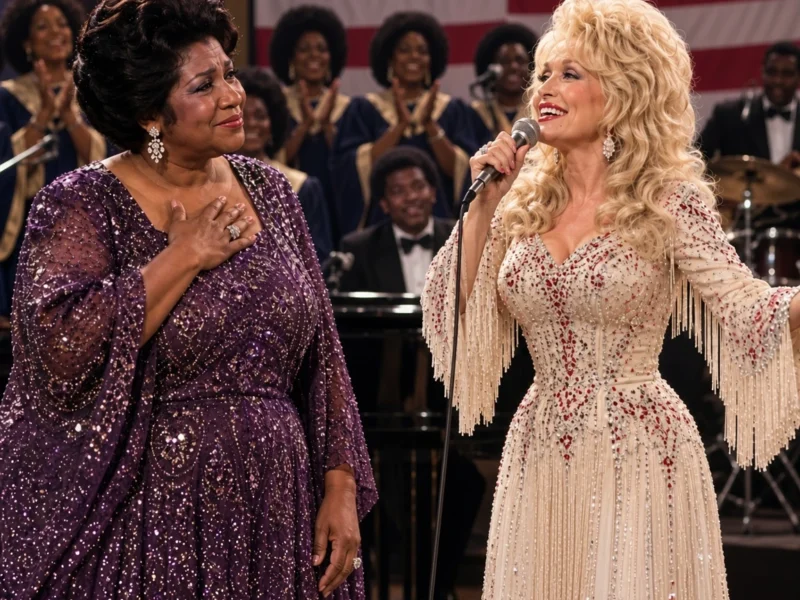
Aretha Franklin DARED Dolly Parton to Sing GOSPEL Live — Minutes Later, Aretha Was in Tears!
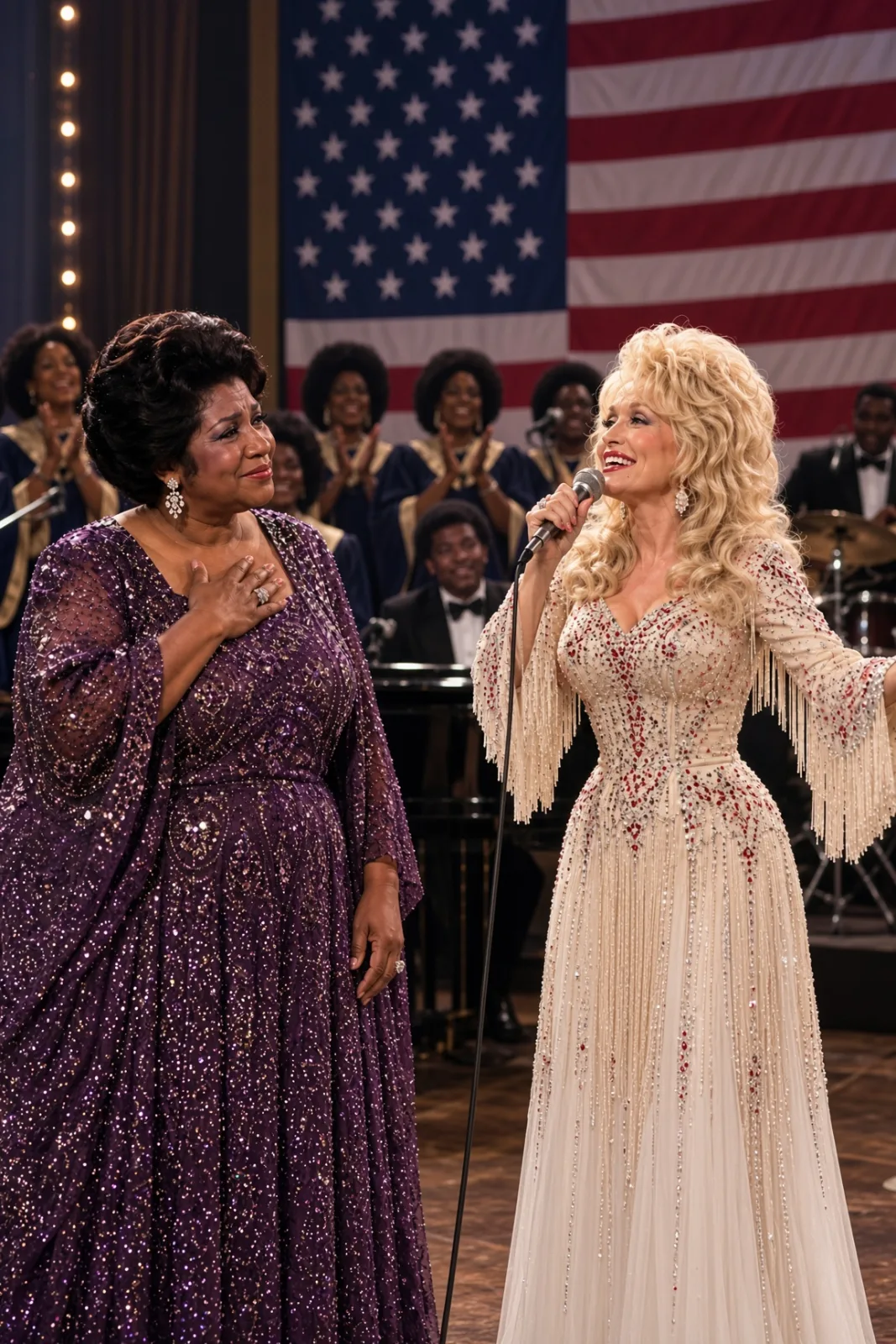
October 14th, 1976.
The Fox Theater, Atlanta, Georgia.
More than 4,000 people had settled into the red velvet seats of that old Moorish palace on Peachtree Street.
And above them, the painted ceiling glittered with its famous little stars.
The whole house dim and gold and waiting.
It was a benefit gala for the Martin Luther King Jr. Center for nonviolent social change.
The kind of evening where city councilmen sat beside church mothers in their Sunday hats.
Where the ushers wore white gloves.
And where nobody in the room expected to be surprised.
The bill was long and proud.
At the very top of it stood Aretha Franklin, the Queen of Soul.
34 years old and already larger than any stage that tried to hold her.
Far down the page in smaller print stood a name that had raised a few eyebrows in the planning meeting.
Dolly Parton.
30 years old, a country singer from Nashville with a brand new television show.
A wig the size of a hatbox and a laugh you could hear from the parking lot.
She had been booked for two light songs and a thank you.
Nobody in the building, not the producers, not the stagehands, not even Dolly herself, knew that before the night was over one woman would throw down a dare in front of 4,000 people.
And the other would answer it with a song so old and so plain that the Queen of Soul would have to lift her hand to her mouth.
This is a dramatized fictional story inspired by Aretha Franklin and Dolly Parton’s real lives and careers, not a documented historical event.
If you love hearing the nights Dolly Parton never got to tell the whole world about, this is the moment to hit that subscribe button here on Dolly Parton Diaries.
Because you are going to want to be sitting right here for the rest of this one.
Dolly pulled up to the stage door a little after 2:00 that afternoon, guitar case across her lap, garment bag hanging in the backseat, hair already piled high, and rhinestones catching the October light.
She had the doorman laughing before he finished asking her name.
By the time she reached the dressing room, she knew the head electrician’s wife was expecting in the spring, and that the stage manager took three sugars in his coffee.
That was Dolly.
She talked to a hallway the way other people talked to old friends.
But underneath all that sparkle, she was carrying a small, particular worry, and she had been carrying it for weeks.
Her own television show had just gone on the air that fall, and the papers had split down the middle about her.
Some were kind.
Some treated her like a novelty act, a sweet voice stuffed inside a costume, and she had read every one of those twice.
Never mind that she had written Jolene and I Will Always Love You herself.
Never mind years of songs that people hummed in their kitchens without ever knowing whose they were.
Some folks only saw the wig.
Miss Parton.
A pleasure.
The man who met her in the corridor was Harland Voss.
Producer of the evening’s program, tall gray suit, clipboard.
With a voice that always seemed to be speaking politely from a great height.
Two numbers, if you would, something bright.
Our audience tonight is, shall we say, discerning.
He said the word the way a man holds a fork he doesn’t quite trust.
Honey, bright is the one thing I’ve never had trouble with, Dolly said.
And gave him the smile that had disarmed bigger men than him.
He did not smile back.
He wrote something on his clipboard and walked away.
And Dolly stood there a moment with her case in her hand, feeling every one of her 5 ft and the wig on top of them.
A heavy silver-haired man in a stage manager’s headset had watched the whole exchange from the end of the hall.
He wandered over now with two paper cups of coffee and handed her one without a word.
Dutch, he said, I run the board 19 years in this house, Dolly.
And you take three sugars.
Who told you that?
Your stirring spoon, honey.
A man who stirs that long is fixing something.
Dutch let out a low laugh.
Don’t mind Mr. Voss.
He’s been planning tonight for 6 months.
And the thing he fears most in this world is a surprise.
He tipped his head toward the stage.
They say you can whisper at center stage and be heard in the last row of the balcony.
Built that way on purpose in 1929.
I never believed it until I tested it myself one night after everybody went home.
You don’t need a big voice to fill the Fox, Ms. Parton.
You just need a true one.
He winked and shuffled back toward his board.
Dolly stood in the corridor with the hot cup warming her hands.
And for some reason, she carried that sentence around with her all afternoon.
At 4:00, the band finished its sound check and the house crew drifted off to supper.
And for the first time all day, Dolly had the Fox to herself.
She walked out to center stage and looked up.
The ceiling was painted like a night sky, set with tiny lights that twinkled just the way the stars used to over the hills back home.
And something in her chest went quiet.
She sat down on a stool with her guitar across her knee.
And without ever deciding to, she began to hum.
It was an old mountain tune, the kind her mama, Avie Lee, used to hum over the dishpan when she thought nobody was listening.
Dolly had grown up inside that kind of music.
Her granddaddy, Jake Owens, preached in a little church of God up in Sevier County.
And she had stood on those plank floors singing before she was big enough to see over the pews.
She had never stopped loving those songs.
She had simply stopped singing them where people could hear.
Not because she’d outgrown them, because they were the one thing she owned that no record label, no television producer, and no critic had ever managed to put a price on.
And she meant to keep it that way.
She hummed it low with her eyes closed to a dark and empty house.
She figured nobody was listening.
She was wrong.
High in the stage left wings, on the iron stairs behind a velvet curtain, a woman in a camel coat had stopped with one hand on the rail.
Aretha Franklin had come in by the side door 40 minutes earlier, quietly.
With her road manager a step behind her and her coat still buttoned.
The people who knew her best could read her mood from across a room, and tonight it was weather.
A few days before, the chairman of the center’s board had made her a gentle request.
Would she close the evening with Precious Lord, Take My Hand?
It had been Dr. King’s favorite hymn.
On the last evening of his life, he had asked the musician to be sure and play it for him.
Mahalia Jackson had sung it at his funeral.
Aretha had told the chairman she would think about it.
She had been thinking about it for 6 days.
Her road manager, a patient man named Lewis, who had heard her say, I’m thinking about a great many things over the years.
had tried to help in the dressing room that afternoon.
What do I tell the chairman?
he asked.
Tell him I’m thinking, Miss Franklin.
You’ve been thinking since Saturday.
Then tell him I’m thinking harder.
She had turned toward the mirror and not looked at herself.
I’m not scared of a stage, Lewis.
I’ve never been scared of a stage.
It’s that one song.
It walks into a room and takes the whole room with it, and then I’ve got nowhere left to stand.
Lewis didn’t push.
He knew better.
He only said he’d be down the hall if she needed him.
And she went out the other door with her coat still on, looking for somewhere quiet to be unreachable, and found the iron stairs behind the stage left curtain.
The truth was that she had sung that same hymn at Mahalia’s own funeral in Chicago in January of 1972, and something in her had come loose that day that she had never quite fastened back.
Only a couple of weeks earlier, she had been in a church in Los Angeles with a choir and the Reverend James Cleveland, recording the Amazing Grace album, and it had been the happiest she had felt at a microphone in years.
Then she buried the woman who had taught her half of what was on it.
Since that day, she could stand in front of any crowd on Earth and sing “Respect” with her eyes closed.
But she had not once managed to sing that hymn all the way through.
Her mind kept traveling further back, the way minds do, to Detroit and the big house on Boston Boulevard where her father, the Reverend C. L. Franklin, filled New Bethel Baptist Church every Sunday, and whose sermons were sold on records across the country.
Mahalia Jackson and Clara Ward used to sit at that kitchen table eating and laughing.
While a skinny girl at the top of the stairs listened like they were angels who’d come down for supper.
Her mother Barbara was gone before Aretha turned 10.
People always asked how a child learned to sing as though she had already lived three lifetimes.
Aretha usually said she just did what the church taught her.
The truth was a little lonelier.
Church was the only place where the empty chair at the table didn’t show.
So when that hum floated down out of the dark, she stopped on the stairs and held her breath.
It wasn’t only the melody, it was the way the woman was singing it, not to anybody.
Not for applause or a paycheck or a man with a clipboard.
Just the way a person sings when she believes the whole world has left the building.
Aretha had spent her life learning the difference between singing for a room and singing for God.
And she knew in three bars which one she was hearing.
She stood there until it stopped.
Then she went back down the stairs on tiptoe and told no one what she had heard.
She told herself it was none of her business.
She was wrong about that, too.
By 8:00, the Fox was glowing.
The mighty Moog organ had played the crowd in.
The governor’s people were seated near the front.
And in the balcony, a few hundred more settled in with their programs open on their knees.
Dolly walked out to the kind of applause you give a stranger who’s holding the door.
She noticed a few heads leaning together behind the programs.
She had played enough rooms to know that whisper.
It said, “What is she doing here?”
She opened with “Love is like a butterfly, light as a handkerchief, and got about half the room tapping a foot.
Then she leaned into the microphone.
Now, I know what y’all are thinking, she said.
How in the world does she hold her head up with all that hair?
A little ripple of laughter moved through the seats.
Practice, honey, years and years of practice.
And the room let go.
By the time she reached her second number, The Bargain Store, the clapping had changed the way it does when people stop being polite and start being glad.
When she walked off, the applause followed her all the way into the wings.
And she was grinning like a girl who’d just been handed a present.
Harlan Voss was waiting there with his clipboard held against his chest.
Lovely, he said, very bright.
Thank you, Ms. Parton.
Your dressing room is at the end of the hall.
I thought I’d stay and watch Ms. Franklin from here.
If nobody minds, backstage during the headliner is generally reserved for I’ll stand real still, Dolly said.
I just want to see how it’s done.
A stagehand looked at Voss, then looked at the floor and shrugged.
Voss’s mouth tightened into a thin line.
Dolly stayed.
The roar when Aretha Franklin walked on was the kind that rattles the old plaster.
She sat at the piano in a long gown the color of dark wine and opened with Chain of Fools, then Think, then Respect.
And the Fox came up out of its seats like a congregation.
Dolly stood in the shadows with her guitar still slung on her back and her hand pressed flat against her chest.
She had heard those records a hundred times.
She had never been in a room with the engine that made them.
Then, right in the middle of the set, Aretha lifted her hands from the keys.
The band dropped away behind her, one instrument at a time.
She slid the microphone from its stand, sat back on the bench, and looked into the wings.
You all enjoyed our guest tonight.
Applause rolled back across the house, warm and genuine this time.
Good, she sang you two pretty songs, pretty enough that some of you forgot to be careful.
Laughter.
Aretha waited for it to fade.
But somebody in this building is hiding something, and I don’t like it when a person hides a gift in my presence.
Dolly Parton, come on out here, baby.
Dolly’s stomach dropped to the floor.
She looked at the stagehand.
The stagehand looked at her.
Voss had gone the color of paper.
She walked out into the light.
It was a long way across that stage.
Behind her guitar strap, her heart was going like a hammer.
Miss Franklin, she said, laughing a little, I believe I’m already finished for the night.
Not yet, you ain’t.
Aretha turned on the bench to face her.
She was smiling, but it wasn’t a social smile.
It was the look of a woman who had decided something.
I was standing on a staircase in this building at 4:00 this afternoon, and I heard somebody sing to an empty room.
She didn’t know I was there.
It wasn’t for me, wasn’t for a microphone, wasn’t for anybody.
The color rose in Dolly’s face all at once.
Nashville has shined you up real nice, Aretha said.
I mean that kindly.
But I know what a mountain church sounds like when it’s still living inside a person.
And it’s still living in you.
So, here is my dare.
She let the word hang there.
I’m asking you to sing it, right here, in front of God and the center and everybody.
Not the pretty songs.
The one you hummed.
A murmur went through the crowd, the particular murmur of 4,000 people leaning forward at once.
Dolly’s laugh came out thin.
Miss Franklin, with all respect, I’d sooner sing you the phone book.
This isn’t the room for it.
This is Atlanta.
This is your people’s music, your people’s church, and I’d be walking in with muddy boots.
I’d just be borrowing.
Borrowing?
Aretha said.
Yes, ma’am.
Baby, you can’t borrow what you were born in.
Aretha’s voice stayed low, but it carried like a bell.
Anybody who’s afraid to sing it in the wrong room can’t sing it in the right one, either.
And I’m telling you the wrong room is the only place it ever really matters.
Stay with me here.
Because the next few seconds are the reason people were still arguing about this night years later.
From high in the balcony, a man’s voice drifted down, loud enough to carry.
Or let her do some hee-haw, honey.
A few people laughed.
A few more shifted in their seats.
Up in the wings, Holland Voss closed his eyes like a man hearing a car crash he’d predicted.
Aretha did not laugh.
She did not even turn her head.
She simply looked up toward the balcony, and the whole theater felt the temperature drop.
Sir, she said, I’ll wait while you finish.
And after tonight, I’ll hold the door so you can say it to her face.
The laughter died.
Somewhere up in the dark, a chair creaked.
Nobody said another word.
Dolly stood in the quiet with her hand tight around the neck of her guitar.
She could feel 4,000 strangers waiting.
And underneath that, she could feel something older than the stage rising in her.
Something that had been asleep a long time and had just heard its name.
What song?
She asked, so softly the microphone barely caught it.
Aretha didn’t answer in words.
She lifted the mic a little closer and hummed four slow notes into it.
The first four notes of the tune from the afternoon, rolling out across the dark like a thread let down from aloft.
A tune with a long road in it.
Dolly closed her eyes.
I don’t know what it’s called.
Aretha said, You tell me.
For a long moment the Fox Theatre held its breath.
And then quietly, with the whole room leaning in, Dolly Parton said, It’s called Wayfaring Stranger.
The name moved through the theater like wind through wheat.
A few of the church mothers in the front rows nodded slowly.
The way people nod when they hear a name they’ve known since childhood.
Others glanced at their neighbors unsure.
It was not a title anyone expected to hear spoken on that stage that night.
Wayfaring Stranger.
Aretha repeated as if she were turning it over in her hands.
That’s a long road.
Yes, ma’am, it is.
Dolly’s voice had gone smaller than anyone had heard it all evening.
My mama hummed it at the sink.
My granddaddy preached on it.
I sang it for the first time before I could read the words because nobody ever wrote them down for us.
We just knew them.
She stopped and shook her head, almost laughing at herself.
I haven’t sung it in front of folks since I left the mountains.
Why not?
Because everything else I’ve got somebody’s paid for.
She said it plainly with no complaint in it.
That one nobody ever did.
I didn’t want to find out what it cost.
Aretha was quiet for a moment.
Her right hand rested flat against the lid of the piano.
The way a person rests a hand on a rail when the floor isn’t quite steady.
I’m not asking you to sing it for me.
she said, and I’m not asking you to sing it for them.
I’m asking you to sing it like it’s 4:00 in the afternoon and the house is empty.
Same as you did before.
If you can do that, you’ll have done something most people in this business can’t do at any price.
In the wings, Harlan Voss had finally found his voice.
He leaned toward the stage manager, a heavy, silver-haired man named Dutch, who had worked the Fox board for 19 years, and hissed through his teeth.
Cut the microphone.
Now, this is a disaster.
We have the governor’s people out there.
Dutch did not move.
He folded his arms over his belly and looked at Voss the way an old mule looks at a gate.
Mr. Voss, he said, I have run this board since before you could spell program.
I ain’t touching nothing.
I want to hear it.
That’s an order.
Then I’ll put it in writing, Dutch said.
After, on the stage, Dolly Parton slipped her guitar strap off her shoulder.
She held the instrument against her chest for a long moment, the way you hold a child that’s about to be carried across a river.
She was thinking of a summer morning in 1964, the day after her high school graduation, when she had climbed onto a bus for Nashville with a cardboard suitcase while her mama stood in the road.
Avie Lee had not cried.
She had pressed her hand against Dolly’s cheek and said in her plain way, Baby, the world will buy every last thing you’ve got if you let it.
You keep one thing back, just one.
Don’t ever put a price on it.
12 years later, Dolly had kept that promise.
It was the most stubborn, loneliest promise she had ever made.
And a woman she had known for exactly 1 hour was asking her to break it in front of 4,000 people.
Then she did something no one expected.
She looked straight up at the ceiling, at the painted sky, and spoke to a man she could not see.
Excuse me, sir, up there in the booth.
Could you all bring the house lights down?
All the way down, if it’s not too much trouble, and leave me them stars.
For half a second, nothing happened.
Then, one panel at a time, the great gold chandeliers faded to ember.
The curtains went to shadow.
The faces in the first rows dissolved into the dark.
Overhead, the tiny lights of the Fox’s ceiling sky came forward, hundreds of them, glittering over 4,000 heads as though the whole theater had been carried out of the city and set down in an open field.
Thank you kindly, Dolly said to the dark.
She waved the drummer and the bass player off with a small, grateful gesture.
Then she pulled up a plain wooden stool, sat down, and rested her boot on the rung.
She tuned a string, then another, her head tilted, listening to something only she could hear.
Aretha rose from the piano bench without a sound.
As she passed the stool, she paused, leaned down, and said so quietly that only Dolly could hear, 4:00.
Dolly gave the smallest nod.
4:00.
Aretha crossed the stage and slipped into the wings, into the exact spot where Dolly had stood an hour earlier.
And she stood there in her wine-colored gown, with her hands clasped in front of her like a woman in a pew.
Harlan Voss stood 2 ft away.
He tried once more.
Miss Franklin, if I could just She raised a single finger without turning her head, and he stopped as if she had closed a door on him.
She did not once look at him.
Out in the dark, a man in the balcony took off his hat.
Dolly closed her eyes, and when she opened them, the glitter was gone.
The wig, the rhinestones, the television show, the sharp little jokes, all of it simply stepped aside.
And what remained was a girl on a plank floor in Sevier County, very still, waiting for the first note to arrive.
She began to sing Wayfaring Stranger.
She sang it without any polish.
That was the first thing that reached the back rows.
This was not the voice from Butterfly.
It was thinner, older, strung tighter.
The voice of someone remembering rather than performing.
With long slides from note to note the way mountain people carry a tune.
And a crack right at the top of the phrase that she didn’t try to hide.
There was nothing under it but the quiet ring of the guitar.
The song is about a poor traveler passing through a world of trouble with no one to claim him on the road and no hurry to explain himself to anyone because he knows exactly where he is going.
Home is on the other side.
His mother is waiting there and his father, too.
He will cross over soon enough and he is not afraid.
Dolly sang the first verse to the floor.
For the first 30 seconds, the room did what rooms do.
A few people shifted.
Somewhere in the orchestra section, a woman whispered to her husband, is that it?
Is that all she’s going to do?
A program rustled.
The unspoken question moved across the dark.
Is she going to build it?
Is she going to give us the big finish?
But there was no big finish coming.
There was only a woman with a guitar telling the truth about a road.
One plain line after another, never hurrying, never reaching for the back wall.
And without anyone deciding it, the rustling stopped.
The whisper died unanswered.
People who had come to be impressed found themselves instead simply listening, which is a far harder thing to be made to do.
Halfway through it, a church mother in the third row, a woman in a white hat with a pearl pin, closed her eyes and began to sway very slightly.
She hadn’t meant to.
It was just what her body knew to do when a song like that came near.
Dolly sang the second verse to the stars.
Her voice had begun to warm now.
The crack was still there, but it had changed the way a rough place in a plank turned smooth with years of walking.
Somewhere in the middle of that verse, she stopped being in Atlanta at all.
She was 9 years old on her mama’s lap on the porch at Locust Ridge with 12 children’s worth of noise settled around them and the evening coming down blue over the hills.
And Avie Lee was humming that same tune against the top of her head.
She could feel the vibration through her mama’s chest.
She had been so small then.
She had thought songs were just a kind of weather that came through your family.
Her daddy, Lee, was out in the yard somewhere with the mule, a man who couldn’t read a word on a page and could tell you the weather 3 days ahead by the color of the hills.
He used to say a hymn was the only thing a poor man could own outright because nobody could take it off the shelf.
She had believed him then.
Standing under the foxes painted sky, she believed him again.
Up in the balcony, a young usher in white gloves lowered his flashlight and forgot what he’d been about to do with it.
In the pit, the organist who had been waiting all night to bring in the mighty Mo took his hands off the keys and laid them in his lap.
In the front row, the chairman of the center’s board had reached over without looking and taken his wife’s hand, and neither of them noticed.
By the third verse, there was no room left in that theater for anything but the sound.
The politicians had stopped checking their watches.
The photographers at the foot of the stage had lowered their cameras one by one as though a hand had pressed each of them down.
Somewhere in the dark, a woman was crying quietly into a handkerchief, and no one beside her turned to look.
Dolly’s voice climbed, not louder, but higher and truer.
And the crack that had started the song as a flaw became a light, the kind that shines through a split in a barn door.
It was not the sound of someone proving anything.
It was the sound of someone setting something down.
And in the wings, something was happening to Aretha Franklin.
At the first verse, she had stood straight, composed, the way she stood in front of everything.
By the second, her hands had come undone from each other.
She was hearing the song, and she was hearing something under the song.
For 24 years, she had been trying to remember what a mother’s voice sounded like.
And for 24 years, it had slipped a little further away each season.
Like a face in a train window.
She had chased it through every church she ever sang in.
Now, from a stool in the middle of a stage, from a white woman’s mountain throat she had never heard until that afternoon, she was getting the outline of it back.
Not the words, not the notes, the shape of the place where a voice used to be and the warmth that came with it.
Somewhere around the third verse, the queen of soul put her hand over her mouth.
The tears came without sound.
She did not wipe them.
Beside her, Harlan Voss glanced over to say something sharp, and the words died in his mouth.
He looked at Aretha’s face.
He looked at the stage.
He looked at the clipboard in his hand as though he had no idea how it had gotten there.
Then very slowly, he lowered it to his side.
Dolly reached the last verse.
And without planning to, she lifted her eyes and looked toward the wings.
She saw Aretha Franklin standing in the dark with her hand against her lips, and the tears running freely down her face.
Her whole body leaning a half step toward the stage as though the song were a hand she’d been offered.
And if this story is reaching you the way it reached that room, if you can feel the hair standing up on your arms right now, then this is the exact moment to tap that subscribe button and the like button here on Dolly Parton Diaries.
So you never miss another night like this one.
Because what happens next is the reason I’m telling it at all.
Dolly didn’t stop.
She understood, without a word of it passing between them, that stopping now would break something far bigger than a song.
So she sang the last verse straight at the Queen of Soul, quiet and unhurried, the way you’d sing to someone across a river to let them know you can see them.
She sang about the road finally ending, about the door at the other end of it standing open, about a mother’s voice calling the traveler by his name.
Then she let the last note go.
It hung under the painted stars for a long, long time, thin to a thread, and then it was gone.
Nobody clapped.
It was not that the room was unmoved.
It was that no one knew whether they were allowed.
4,000 people sat in the dark in a silence so complete that you could hear the old building breathe.
The chandeliers ticked as they cooled.
Somewhere far up in the balcony, a single seat creaked.
And then, out of that silence, the same man’s voice that had called down “He haw” a few minutes earlier came floating down from the top of the house.
It was hoarse now and cracked and had no mockery left in it anywhere.
God have mercy, he said.
Nobody laughed.
It was the truest thing anyone had said all night.
Dolly lowered her hands from the guitar.
She did not smile.
She didn’t bow.
She sat there on that wooden stool with her boot on the rung, shaking very slightly, and looked out into the dark like a woman who had just set down something heavy she had carried a long way.
Then, from the wings, there was movement.
Aretha Franklin stepped out into the light unhurried.
She did not wait for the applause to begin.
She did not reach for the microphone.
She crossed that wide stage in the soft glow of the painted stars.
Her wine-colored gown whispering over the boards, until she stood directly in front of the little wooden stool.
Her face was wet.
Her eyes were wide open.
She looked at Dolly Parton for a very long time.
Then, the queen of soul reached out and put both hands gently on either side of Dolly’s face.
For a moment, neither woman spoke.
The microphone on its stand beside the stool caught every breath.
24 years, Aretha said at last, very low.
I’ve been trying to remember my mother’s voice for 24 years.
Every winter it gets a little further off.
I’ve looked for it in every church I ever sang in.
Her thumbs brushed Dolly’s cheekbones carefully, as though the girl might break.
I couldn’t hold it, and tonight I heard the shape of where it used to be.
You gave me that.
I don’t know how, and I don’t need to know.
I just needed you to hear me say thank you.
Dolly’s own tears had started.
She didn’t try to stop them, either.
Miss Franklin, she said, I was so scared.
I was scared I’d get it wrong in front of your people.
Baby, Aretha’s smile broke open, wet and astonished.
You got it right in front of mine.
And that was when the fox let go.
It began in the third row with the church mother in the white hat.
She rose first, one hand on the seat in front of her for balance.
And then the woman beside her rose, and then the whole section.
Within seconds, 4,000 people were on their feet in the half-dark.
And the sound they made was not the roar that had greeted Aretha.
It was lower, deeper.
It sounded like a wave that had been gathering a long time out at sea.
Men in dark suits wiped their eyes without shame.
A city councilman stood with his fist pressed to his mouth.
In the pit, the organist simply sat there shaking his head.
Aretha bent, took the microphone from its stand, and turned to face them.
I want y’all to hear something, she said, and the house hushed at once.
There’s folks who’d say what we just heard belongs to Nashville, and folks who’d say it belongs to Detroit.
Well, she shook her head slowly, I heard a porch, one porch with one long road running out in front of it.
Two ends, that’s all.
And this lady just walked all the way down it with her shoes in her hand.
The applause crashed back up.
And sir, Aretha lifted her eyes toward the balcony, up there near the back.
I believe you said it better than I ever could.
There was a long pause.
Then from the dark, a single voice answered, and it was shaking.
Yes, ma’am.
I surely did.
A warm, wet ripple of laughter ran through the house, and some of the weight lifted at last.
Dolly pressed a hand over her mouth, laughing and crying together.
Up in the wings, Dutch, the stage manager, took out a red handkerchief the size of a dinner napkin and blew his nose like a trumpet.
Harlan Voss stood beside him stiff as a coat rack, and for the first time all night, he had nothing at all to say.
Aretha turned back to Dolly, and her face changed again.
From awe to something quieter and more careful, like a person approaching the edge of a high place.
She moved the microphone down to her side so that only the two of them, and perhaps the first few rows, could hear.
Dolly, I want to ask you something.
And before I ask it, I want you to know it isn’t a dare this time.
Dolly dragged the back of her wrist across her eyes.
All right, stay up here with me.
Aretha’s voice dropped almost to a whisper.
I’ve got one more song to sing tonight.
And I’ve been standing in the wings for 6 days trying to figure out how to do it by myself.
I can’t.
The applause thinned and then stopped, as if the whole house had sensed a change in the weather.
Dolly looked at the woman in front of her, this towering, unshakeable figure whose records she had worn out on a cheap record player when she was barely a grown woman, and saw for the first time how tired her eyes were.
What song?
Dolly asked.
The one they asked me to close with.
Aretha glanced toward the front row, where the chairman of the center’s board sat very straight with his wife’s hand in his.
Precious Lord, take my hand.
It was Dr. King’s favorite.
Mahalia sang it at his funeral right here in Atlanta, and she sang it like she was carrying him home on her back.
And 4 years ago this January, I stood in a church in Chicago and sang it at hers.
She said it plainly.
And the plainness cost her.
Dolly felt it in her own chest.
I haven’t been able to get through it since, Aretha said.
Not all the way.
I get to a certain place in the second verse and my throat just closes.
And I’m standing there with 4,000 people looking at me and nothing coming out.
I told the chairman I’d think about it.
I’ve been thinking about it for 6 days.
She tried to laugh.
It didn’t quite work.
Then this afternoon, I heard somebody in an empty theater go all the way to the end of a song without being afraid.
And I thought that one, that’s who I need to stand next to.
Miss Franklin, Dolly’s voice was very gentle.
I don’t know your way of singing it.
I grew up Church of God, not Baptist.
I’d be guessing at half of what you do.
Do you know the hymn?
Every church in the South knows that hymn.
Then you know enough.
Aretha shook her head.
I don’t want it done the way it’s always been done, baby.
I want it done the way it’s going to get done tonight.
Thomas Dorsey wrote that hymn the same week he buried his wife and his baby son.
Did you know that?
He wasn’t trying to write a masterpiece.
He was just a man in the dark asking to be held.
So that’s all we have to be.
Two women in the dark asking.
Dolly was silent for a moment, then she nodded.
What do you want me to do?
Stand next to me.
When I fall, don’t catch me.
Just keep the floor under me.
That’s all.
I can keep a floor, Dolly said.
I’ve been keeping one since I was 6.
Aretha laughed then, a real one, short and surprised.
She turned and spoke to the pit, her voice carrying warm and easy.
Mr. Organ Man.
Would you be so kind, the organist, a thin gentleman named Mr. Whitlock, who had been sitting with his hands in his lap since the third verse of the mountain song, blinked as though he’d been called from a dream.
Then he smiled, set his fingers on the keys, and the mighty Mo began to breathe.
Stay with me because what came next is the part that the people in that room talked about for the rest of their lives.
It wasn’t loud.
That was the first surprise.
The great organ came in soft as a held breath, one low chord, and then another, spreading under the stage like a river finding its bed.
Aretha settled onto the piano bench.
Dolly stood at her shoulder, one hand resting lightly on the curve of the piano, her guitar left behind on the stool.
In the dark, 4,000 people stopped fidgeting.
Aretha laid her hands on the keys, she closed her eyes, and she began.
Her voice was as controlled and dignified as it had been all night, a voice with a spine in it, deliberate and tall.
She sang the first line like a woman walking up a long flight of steps.
She sang the second line with her chin lifted.
You could feel her holding herself in hand over hand the way you climb a rope.
Dolly waited, and when the third line came, she slipped in beside her, not on top of her, just beside.
A plain high thread of harmony laid over Aretha’s voice like one hand laid over another.
It was a mountain sound, a little thin, a little nasal with the old Appalachian slide in the corners of the notes.
It had no business blending with that big, round, gospel Detroit voice.
And somehow, standing at the the edge of one another, they didn’t blend, they simply agreed.
A murmur ran through the audience.
It wasn’t surprise, it was recognition.
The first verse ended.
The organ swelled and settled.
The second verse began.
And every person in the building who had read the program that night knew what was coming.
Because Aretha’s shoulders tensed.
She sang one line.
She sang another.
She was getting close to the place where it always broke.
Her voice caught.
It didn’t crack.
It simply stopped in the middle of a phrase, like a clock that has run out of spring.
Her hands stayed on the keys, still holding the chord.
She stood there with her eyes squeezed shut and her mouth open and no sound coming.
And for one terrible moment, the whole Fox Theatre saw the thing she had been afraid of for four years.
Nobody breathed.
And then Dolly Parton did what she had promised.
She didn’t reach out.
She didn’t speak.
She stepped half a pace closer and took up the melody exactly where Aretha had let it drop.
As quietly as a person picking up a dropped glove.
She sang the line low and plain and slow.
She did not decorate it.
She did not try to be anyone.
She simply carried it one note after another.
The way she used to carry the tune for her little brothers and sisters on that crowded porch when their voices gave out.
Never rushing, never looking back.
Just walking the song steadily across the dark until the other side was in view.
On the bench, Aretha’s shoulders began to shake.
She did not stop playing.
Her left hand kept the bass going, steady as a heartbeat.
And as Dolly carried the second verse through, Aretha’s eyes opened wet and wide.
And she found her way back in on the last line of it, not leading now, but joining.
Her voice rough and cracked and utterly unguarded.
Riding in on Dolly’s like a boat finding a current.
When they reached the third verse, they were singing it together.
It wasn’t pretty anymore.
That was the thing.
It was something much better than pretty.
Aretha’s voice rose until it filled the old dome and the painted stars seemed to tremble.
Dolly’s rose beside it, higher and clearer.
The two of them climbing in a way neither would have found alone.
One from the Michigan church and one from the Tennessee hills.
Meeting somewhere in the air above the stage where the two roads had always been going to meet.
In the front row, the chairman put his face in his hands.
Somewhere in the dark, 4,000 people had started to hum very softly.
The way a congregation does when it doesn’t know it’s doing it.
Until the hum itself became a floor beneath the singers.
They held the last note together.
They held it until the organ faded out beneath them.
And then they held it a little longer because neither one wanted to be the first to let it go.
The silence that followed was the second silence of the night and it was longer than the first.
Then the fox came apart.
It wasn’t applause.
It was a sound like a levee giving way.
People were on their feet.
People were weeping.
People were calling out names and amen and Lord, yes.
And in the wings, Dutch had abandoned his board altogether and was standing in the open with his big red handkerchief pressed against his face.
Aretha rose from the piano bench on legs that did not entirely belong to her.
She turned and Dolly was already there.
And the two women held on to each other in the middle of that great gold stage while the sound rolled over them.
Where does a voice like that come from?
Aretha said into Dolly’s ear, barely audible under the roar.
I’ll tell you where it comes from, you.
You hear me.
Don’t you ever lose it.
I’ll try not to.
Dolly whispered back.
Not if you won’t.
Deal.
They stepped apart at last and faced the crowd.
Aretha held up Dolly’s hand with hers, and the noise grew, if that was even possible.
Backstage, Harlan Voss was waiting.
He stood by the stage door with his clipboard hanging forgotten at his side, and the look of a man who has rehearsed an apology and discovered it was the wrong size.
His gray suit was wrinkled.
His tie had come loose.
When the two women came off the stage, still holding on to each other like sisters at a funeral, he cleared his throat twice before any sound came out.
Ms. Parton, he swallowed, when I said that our audience was discerning, I believe I implied something I had no right to imply.
Dolly looked at him for a long moment.
There was no meanness in it, only the clear, level, unfooled look of a woman who has been underestimated by professionals.
Mr. Voss, she said, you said bright, and I gave you bright.
You just forgot that our light’s got to come from somewhere.
Voss opened his mouth.
Then he closed it.
Then, to everyone’s astonishment, he laughed, a short, unpracticed, helpless laugh that seemed to surprise him more than anyone.
I’ll remember that, he said.
I believe I’ll remember it for a very long time.
Aretha patted his shoulder as she passed.
Go sit down, Harlan.
You’ve had a night.
Later, after the final bows and the reluctant emptying of the house, the two of them ended up together in Aretha’s dressing room.
Two women in stage clothes on a worn velvet sofa, sharing a pot of tea that Dutch had somehow produced from nowhere.
The noise of the crew breaking down the stage came faintly through the wall.
Lewis had set Aretha’s coat on the chair and quietly gone away again.
For a while neither of them said anything.
It was the comfortable silence of people who have stopped needing to.
Can I tell you something?
Aretha said at last.
She was holding her cup in both hands, the way a person holds something warm in a cold room.
When I dared you, I’d like to say it was generosity.
It wasn’t.
Some of it was, but mostly it was pure selfishness.
I’d stood on those stairs and heard you sing to nobody, and I thought, I want to be that brave.
I want to be in a room with that.
And I figured if I couldn’t be that brave on my own, maybe I could stand close enough to catch it.
Dolly smiled into her tea.
Well, I’m glad you were selfish.
I would have gone to my grave with that song in my pocket.
Why did you keep it back all those years?
Dolly told her then about the bus to Nashville and the cardboard suitcase, about Evie Lee and the road, with her hand pressed against her daughter’s cheek.
You keep one thing back, just one.
She told it simply, without decoration, and Aretha listened with her head tilted, the way she must have listened at the top of those Detroit stairs.
Mama meant well, Dolly said.
I think I took her a little too literal.
I thought keep it back meant keep it hid.
12 years I’ve been hiding it.
Aretha was quiet.
Then she set down her cup.
My daddy used to tell me the opposite, she said.
He’d say, ‘Ree, the pulpit don’t care whose daughter you are.
It only cares whether you’re telling the truth.
Stand up there and be honest or sit down and let somebody else.
She shook her head slowly.
Seems to me they were both right.
Your mama and my daddy.
You keep it back so it stays clean and you bring it out so it stays alive.
Either one by itself will kill it.
Dolly turned her cup slowly in her hands.
Can I ask you about your mama?
You don’t have to answer.
Aretha was quiet so long that Dolly thought she wouldn’t.
Then she said, She used to hum while she ironed.
That’s the only piece I’ve got that’s whole.
A kitchen in Memphis or Buffalo or Detroit.
I can’t even tell you which anymore.
And a hot iron on a board.
And somebody humming under her breath like she didn’t know she was doing it.
She pressed her lips together.
I’ve spent 24 years trying to remember what she was humming.
Tonight you came close enough that I could almost hear the tune.
A voice doesn’t just vanish, you know?
Dolly said softly.
It goes into the people who heard it.
I think it lives in how you listen.
Whatever your mama was humming, you’ve been singing it back to her since you were a little girl whether or not you knew the name of it.
Aretha looked at her for a long time.
Where do you get so much sense?
Mountains.
Not a lot else to do up there but think.
They both laughed and Aretha wiped her eyes with the heel of her hand.
That’s good, Dolly said then, going back to the other thing.
I might steal that.
Take it.
Take all of it.
Aretha smiled.
Honest isn’t a style, baby.
It’s an address.
You can’t live there every day and still pay the rent.
But you’d better go home once in a while and check that the porch light is on.
Dolly was still turning that over in her mind when a knock came at the door.
Lewis put his head in looking a little embarrassed.
Ma’am, I’m sorry.
There’s a gentleman at the stage door asking for Miss Parton.
Says he won’t take a minute.
Says he’s got his hat in his hand and he’d rather not say what for.
Dolly and Aretha looked at each other and the same thought arrived in both their faces at the same moment.
Oh, I know who that is.
Aretha said.
They found him standing in the alley under a bare light bulb.
A stout man in his 50s with a gray mustache and a church suit that had seen a lot of Sundays.
He was turning a brown felt hat around and around in his hands as though trying to wear a hole in it.
When he saw Dolly, he straightened up like a boy called to the front of the class.
Ma’am, he said, I’m Walter Pruitt.
I’m the fool in the balcony.
I thought you might be I came to say something stupid tonight.
And I’d like to say something true instead if you’ll let me.
He took a breath.
My mother was a washerwoman in Macon.
She sang that song over a washboard every single day of my life.
And I haven’t heard it sung right since she died in ’61, not once.
Not in any church, not on any record.
And you sang it just like she did.
And I was sitting up there with my mouth open making jokes.
And I’ve been ashamed of myself every minute since.
His voice wobbled.
I owe you an apology.
And I owe her one.
Wherever she is.
Dolly crossed the alley in four steps and put her arms around him.
Wig and rhinestones and all.
He stood stiff with astonishment for a second and then he folded in around her and held on.
Honey, she said into his shoulder, you were right the first time.
I do have hee-haw hair.
She pulled back, wiping her eyes, and grinned.
But, your mama’s got a good boy.
Don’t you forget that.
You tell everyone she sent you behind them.
Aretha leaned against the stage door and laughed so hard she had to hold on to the frame.
The next morning, Dolly’s bus pulled out of Atlanta before the city was fully awake.
A note had been slipped under her hotel door in a strong, slanting hand.
There were only four words on it, and she kept the paper folded in her guitar case for years.
Porch lights on, Aretha.
No tape of that night has ever surfaced.
There is no album, no film reel, no photograph taken from the wings.
The stage lights went out at the Fox, and the stars on the ceiling kept on twinkling over an empty house, the way they have for almost a century, and the night belongs now only to the people who carry it.
That is how most of the best nights go.
They don’t live on film.
They live in the ones who were there, and in the ones who were told.
Years later, when she was asked what she’d learned from a life in front of a microphone, Dolly gave an answer that sounded simple and wasn’t.
Find out who you are and do it on purpose, she said.
Every time she told it, she told it with a little smile, as if she were remembering something that had happened to her once, a long time ago, on a stage under painted stars.
This is a dramatized, fictional story inspired by Aretha Franklin and Dolly Parton’s real lives and careers, not a documented historical event.









