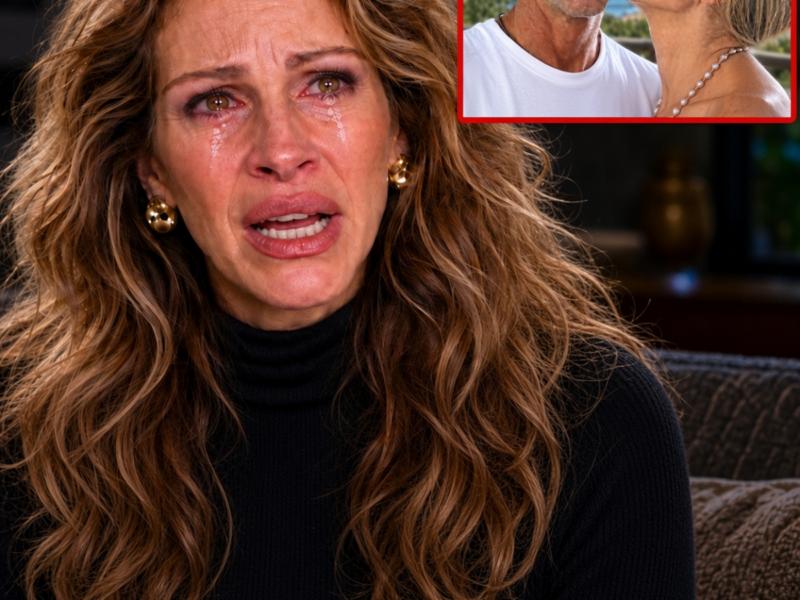
After Decades of Rumors, Julia Roberts Finally Speaks About Danny Moder.
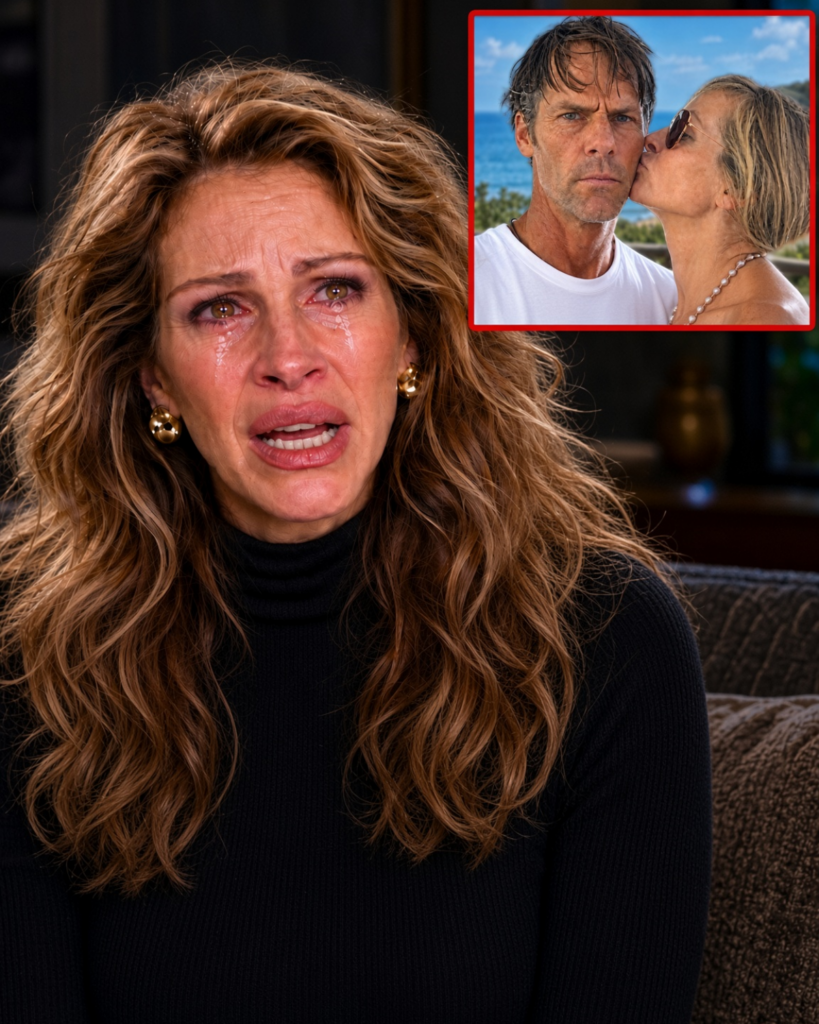
After Decades of Rumors, Julia Roberts Finally Speaks About Danny Moder
The rain had been falling on Malibu since before dawn, and Julia Roberts stood at the kitchen window with a cup of coffee going cold in her hands, watching the Pacific disappear into a gray curtain that made the whole world feel small and temporary.
It was October 2025, and she was fifty-seven years old, and somewhere in the house behind her, her husband of twenty-three years was still asleep with the covers pulled up to his shoulder in that way he had done since the first summer they spent together on the set of The Mexican in 2000.
She had been thinking about the interview she had given a few days earlier on the SmartLess podcast, the one where Jason Bateman, Sean Hayes, and Will Arnett had asked her the question she had spent two decades avoiding in ways both large and small.
“What’s the secret?” Sean had asked, and Julia had answered in that calm, certain voice she had developed over the years, the one that could deliver a line of dialogue worth millions and also deliver the truth about her marriage in six simple words: “Two bathroom sinks and lots of kissing.”
The world had laughed, and the tabloids had printed the quote in seventy-two-point type, and nobody had understood that she had just handed them the key to the whole thing.
She turned from the window and looked at the photograph on the refrigerator, a picture of Danny with his arm around Henry at a skate park in San Francisco, and she thought about the number 24, the number that would arrive in July 2026, the number that had seemed impossible when Vera Steinberg had called her a husband stealer and predicted the marriage would not last a year.
She thought about all the years she had spent running, from Smyrna, from her stepfather, from Kiefer Sutherland three days before a wedding that had been planned like a military operation, from Lyle Lovett after twenty-one months, from every relationship that had ended with a door closing or a plane taking off.
And she thought about the one thing she had never run from, the one person who had never given her a reason to run, the cinematographer standing behind the camera who had seen her when she was not smiling and had stayed anyway.
There was a version of Julia Roberts that the world had been telling for twenty-four years, and it went something like this: America’s Sweetheart married a nobody in a secret ceremony on the Fourth of July in 2002, and the marriage was a scandal, and then it was a mystery, and then it was a rumor, and then it was a sad story about two people living separate lives, and then it was over.
The tabloids had been predicting the divorce since the wedding night, and the predictions had never come true, and the gap between what the world believed and what was actually happening in a house in Malibu had grown wider with every passing year.
This is the story of how that gap was finally closed, not by a scandal or a leaked document or a tearful interview with a network anchor, but by a fifty-eight-year-old woman who decided that after two decades of silence, the truth was worth more than the protection her silence had provided.
And the truth, as it turned out, was simpler and stranger and more beautiful than anything the tabloids had ever printed.
It involved a Hindu temple in Los Angeles, a photograph of a guru that Julia had never explained, two bathroom sinks that represented something the world could not understand, and a man named Danny Moder who had never wanted to be a star.
But before any of that, before the twins were born in 2004 and Henry arrived in 2007, before the conversion and the meditation and the empty nest, there was a girl in Smyrna, Georgia, who learned to smile because her stepfather was an alcoholic and her father had died of throat cancer when she was ten years old, and smiling was the only thing that kept her safe.
That girl would grow up to become the highest-paid actress in Hollywood, a woman with a net worth of between $250 million and $300 million, a woman whose smile was insured for $30 million, and a woman who would spend her entire adult life running from exactly the kind of man she finally married.
The hook of that smile, the one that looked like happiness and was actually armor, would appear again and again in every story Julia Roberts ever told about herself, and it would appear most clearly in the story of how she stopped running and started staying.
Julia Fiona Roberts was born on October 28, 1967, in Atlanta, Georgia, and if you want to understand the marriage that would define her life, you have to understand the family that shaped her first.
Her parents, Walter Grady Roberts and Betty Lou Bredemus, were both actors and playwrights who co-founded the Atlanta Actors and Writers Workshop in Midtown, Atlanta, and they also ran an acting school for children in Decatur where the children of Martin Luther King Jr. once studied.
On the surface, it looked like the ideal artistic family, two creative people building something together in the heart of the American South, raising children who would grow up surrounded by stories and performances and the possibility of a life in the arts.
But in 1971, when Julia was four years old, her parents divorced, and the family split in a way that would mark her forever.
Her brother Eric, eleven years older, stayed with their father, while Julia and her sister Lisa moved with their mother to Smyrna, a suburban town outside Atlanta where the houses were modest and the streets were quiet and nobody knew what would become of the little girl with the big smile.
In 1972, her mother remarried a man named Michael Motes, who was, according to biographer James Spada, an alcoholic.
For eleven years, Julia both feared and despised that man, and the details of what he did, the neglect, the shoving, the humiliation, the way he treated his wife’s two daughters from her previous marriage, are the kind of details that biographers write about in careful sentences and that the people who lived through them rarely discuss at all.
Eric later said he was horrified to think about what his sisters had been forced to endure, and that sentence, coming from the brother who watched from a distance and could not protect them, carries the weight of everything that followed.
Then in 1977, her father Walter died of throat cancer, and Julia was only ten years old.
She lost her father before she had the chance to understand what kind of man he was, and the only man left in the house was the one she feared most.
There is a photograph taken around that time, eleven-year-old Julia standing beside her stepfather and smiling, a bright, radiant smile that would later become Julia Roberts’ trademark, and if you look at that photograph without knowing the story, you see a happy child.
If you look at it knowing the story, you see something else entirely.
You see a girl who had learned that a smile could be a shield, a survival strategy, a way of making herself invisible while standing in plain sight.
And perhaps that was also the first acting lesson she ever received, not in a classroom but from the need to hide her pain in order to survive.
She left Georgia as soon as she could, graduating from Campbell High School in 1985, attending Georgia State University before dropping out, following her brother Eric to New York, signing with the Click Modeling Agency, studying acting, and beginning to land small roles that would become the foundation of everything.
The rise of Julia Roberts was so rapid that it became a kind of legend, the kind of story that young actors in Los Angeles still tell each other in bars when they need proof that it can happen.
In 1988, she appeared in Mystic Pizza, and the following year she starred in Steel Magnolias alongside Sally Field and Shirley MacLaine, earning her first Oscar nomination at just twenty-two years old.
Then came Pretty Woman in 1990, the film in which she starred alongside Richard Gere, the film that grossed more than $460 million worldwide, the film that turned Julia into one of the biggest stars in the world virtually overnight.
A Golden Globe, an Oscar nomination, the title of America’s Sweetheart, and a smile the entire planet wanted to see.
But there was one strange thing that few people noticed, and it would become the central paradox of her life.
On screen, Julia Roberts was the perfect embodiment of romantic love, the woman who found her prince and rode off into the sunset, the actress whose entire career was built on the promise that love could work if you just believed hard enough.
In real life, she was literally a runaway bride even before starring in the movie of the same name, and the pattern appeared very early and kept repeating itself with a persistence that suggested something deeper than bad luck.
Julia became engaged to her Steel Magnolias co-star Dylan McDermott, then called off the engagement.
She dated Liam Neeson, but that relationship ended as well.
In 1990, she fell in love with Kiefer Sutherland on the set of Flatliners, became engaged to him, and planned what was supposed to be the wedding of the century at 20th Century Fox’s sound stage 14 with a guest list packed with celebrities.
But three days before the wedding, Julia called the whole thing off without offering an explanation.
Soon afterward, she was seen flying to Ireland with Jason Patric, Kiefer’s close friend, and the tabloids immediately exploded, and America’s Sweetheart became the center of Hollywood’s biggest scandal that year.
Her relationship with Patric also ended quickly.
Then Lyle Lovett came along.
Julia met the country music star in 1992, began dating him in early June 1993, and married him just three weeks later at a small church in Marion, Indiana, in a ceremony put together in only seventy-two hours.
The entire world was stunned, and the marriage lasted less than two years, and they divorced amicably in 1995 without drama.
Married after three weeks, divorced after twenty-one months.
The pattern was impossible to ignore.
After Lyle Lovett, Julia dated Benjamin Bratt from 1998 to 2001, and their relationship lasted four years and became one of the longest and most stable relationships she had ever had.
Bratt accompanied Julia to the 2001 Academy Awards, the night she won for Erin Brockovich at the absolute height of her career.
She stood on stage holding the golden statuette while Bratt sat below, applauding her, and it seemed as though the fairy tale had finally found its ending.
But in reality, things had already begun to crack before that Oscar night, and the crack had a name and a face and a job that nobody would remember.
Because in 2000, Julia walked onto the set of The Mexican in Mexico, and it was there, amid the film crew, the dust, and the desert sun, that she saw a man standing behind the camera.
He was not an actor, a director, or a producer.
He was a cinematographer named Daniel Richard Moder, and no one knew his name, and no one thought he would be the last man in her life.
Daniel Richard Moder was born on January 31, 1969, in Los Angeles, California, right in the heart of Hollywood, the son of Mike Moder, a veteran producer and assistant director who had worked in the film industry for decades before passing away in 2022.
Danny grew up watching his father work behind the camera rather than in front of it, and perhaps that shaped everything about the man he would later become.
Danny did not want to be a star.
He wanted to tell stories through light, camera angles, and images that audiences could feel but rarely noticed.
He studied psychology at the University of Colorado Boulder, a choice that might seem unusual for someone who would later become a cinematographer, but perhaps not so unusual when you consider that to shoot a film well, you first need to understand people and only then the technical side of filmmaking.
After graduating, Danny started at the very bottom, working as a production assistant on Crimson Tide in 1995.
A year later, he worked in the film production department before gradually moving into cinematography, starting with smaller projects such as Kid Quick, Grand Champion, and Border.
He was not famous, and his name did not appear on promotional posters, but among film crews, Danny was known as a hard-working quiet man with a good eye for visual aesthetics.
When Danny arrived on the set of The Mexican in 2000, he was thirty-one years old, doing the work he loved, and already married to Vera Steinberg, an Argentine makeup artist born in Buenos Aires in 1973.
Vera and Danny met while working in the Hollywood film industry, where she handled makeup and hair while he worked behind the camera.
They felt a connection from the moment they first met and married in 1997 in an intimate ceremony.
Five years, no children, a quiet marriage between two people who worked behind the scenes, until Julia Roberts appeared.
No one knows exactly when everything changed between Julia and Danny on the set of The Mexican.
No fairy tale story was ever told afterward.
No interview ever described a lightning bolt moment.
There was only one simple and brutal truth.
Julia was dating Benjamin Bratt.
Danny was married.
And somewhere between those two existing relationships, something else began to develop.
Rumors spread among the film crew before making their way outside, and then everything unraveled at once.
Julia and Benjamin Bratt ended their relationship after four years together, while Danny and Vera entered into a bitter divorce.
Vera Steinberg did not remain silent.
Speaking out fiercely through her pain, she called Julia Roberts a husband stealer, and in one interview, Vera said she would never forgive Julia, that Julia was desperate to get Danny down the aisle, and that the new marriage would never last.
Because if Danny had cheated on her to be with Julia, then he would cheat on Julia as well.
Vera’s words were as sharp as knives, and the tabloids gleefully seized upon them, and America’s Sweetheart, the woman adored across the country, was now being branded a homewrecker.
Then came the T-shirt.
In a candid photograph taken without her knowledge, Julia Roberts was spotted wearing a shirt bearing the words “A Low Vera,” a play on aloe vera that was clearly aimed at Danny’s former wife.
The photograph became a symbol of the scandal, revealing a Julia Roberts the public had never seen before, not the radiant, constantly smiling woman on screen, but a woman willing to fight, even if it was not pretty, to hold on to the man she wanted.
Public opinion immediately split.
Half believed she was cruel, and the other half said she was simply in love, but both sides agreed on one thing.
This marriage would not last a year.
Vera officially divorced Danny on May 16, 2002, and less than two months later, on July 4, 2002, American Independence Day, Julia Roberts and Danny Moder were married.
The wedding took place at Julia’s ranch in Taos, New Mexico, and was kept so secret that even the guests did not know they were about to attend a wedding.
The invitation simply said they were invited to celebrate Independence Day with Julia, but when they arrived, they were surprised to discover that it was actually a wedding ceremony.
No red carpet, no reporters, no television cameras.
There were only family, friends, and two people who had decided they had waited long enough.
Julia Roberts, who had once called off the wedding of the century to Kiefer Sutherland, who had married Lyle Lovett after just three weeks and divorced him twenty-one months later, now stood before a cinematographer who most people would not have recognized if they passed him on the street and recited her wedding vows.
The tabloids laughed.
Hollywood relationship experts shook their heads.
Vera’s curse still seemed to echo behind them.
This marriage would not last more than a year.
But one year passed, then two, and on November 28, 2004, Julia gave birth to twins, Hazel Patricia Moder and Phinnaeus Walter Moder, conceived through in vitro fertilization.
Julia was thirty-seven, Danny was thirty-five, and the world began to realize that perhaps this marriage was not what everyone had predicted it would be.
Julia gave her children Hindu names, Lakshmi for Hazel and Ganesh for Phinnaeus, names drawn from a faith she had begun exploring, and that small detail went almost unnoticed at the time, but it revealed something deeper.
Julia Roberts was changing, not in the way Hollywood expected, not through a new hairstyle or a new role, but from within, in a place the cameras could not reach.
Three years later, on June 18, 2007, their son Henry Daniel Moder was born, and Julia gave Henry the Hindu name Krishna Balram, and a family of five had taken shape.
And then the strangest thing began to happen.
Julia Roberts, Hollywood’s highest-paid actress, a woman who could earn between $20 million and $25 million for a single film, gradually began to disappear.
Not because of scandal or failure, but because she chose to.
She appeared in only one or two films every few years, attended fewer events, rarely appeared on talk shows, and did not post photographs of her children on social media.
Julia and Danny built a life in Malibu, while also maintaining homes in Taos, Hawaii, San Francisco, and New York City, and they kept moving, as though searching for a place where the noise of Hollywood could not catch up with them.
Julia once told Oprah Winfrey that she did not think her children truly understood just how famous their mother was, because she was at home so much that they did not realize she also had to go to work.
Those were not the complaints of a star basking in fame, but the words of a mother trying to protect her children from the very world that had made her famous.
Danny was the same.
He continued working as a cinematographer, taking on projects he liked, turning down those that did not suit him, and never using his wife’s name to gain an advantage in the industry.
In 2014, he received an Emmy nomination for his cinematography on the television film The Normal Heart, in which Julia also appeared.
In 2015, the two worked together again on Secret in Their Eyes, but outside those rare collaborations, Danny always kept his career separate from his wife’s shadow.
He did not give interviews, rarely appeared on the red carpet unless Julia needed him there, and did not seek attention in a city where almost everyone wanted to be seen.
Danny Moder seemed to have deliberately chosen a private life, and throughout those years, their marriage operated according to a rhythm that outsiders found difficult to understand.
They had separate lives.
Sometimes they were apart for weeks because of their filming schedules.
Julia would be in New York while Danny was in Los Angeles.
Julia would travel to Europe while Danny stayed home with the children, or vice versa.
It was not the kind of marriage People magazine wanted to write about, because it was neither sweet enough nor perfect enough, and precisely because their marriage was not as perfect as the public expected it to be, the tabloids began telling a different story, a story about cracks beginning to form.
But behind that quiet life, things no one could see were still happening, and the real question was not whether the marriage had problems, but whether outsiders truly understood how it worked.
To understand the marriage of Julia Roberts and Danny Moder, you have to understand the changes taking place within Julia during the years when she was gradually disappearing from the screen, and the answer lies in a place no one would have expected.
Hinduism.
The story began even before Eat Pray Love, before she traveled to India to film the movie in 2010.
Julia once said that she had been drawn to a photograph of the guru Neem Karoli Baba, also known as Maharaj-ji, a renowned Indian spiritual master who also influenced Steve Jobs and poet Allen Ginsberg.
Julia never explained exactly how that photograph came into her life, but she said it changed the way she saw everything, not suddenly, not through some explosive moment of enlightenment, but slowly, like water seeping into the earth.
Julia began meditating and praying, and she started taking her entire family to a Hindu temple in Los Angeles to chant and participate in religious ceremonies.
She gave her children Hindu names, Lakshmi, Ganesh, Krishna, and Balram, not because of some passing trend or because she was a celebrity trying to be different, but because of a genuine commitment.
Danny joined her on that journey as well.
Together, they practiced their faith, visited temples, and built a spiritual foundation for their family.
This is also a detail that most people tend to overlook when talking about Julia Roberts’ marriage.
People focus on the scandals, the rumors, and the paparazzi photographs, but few pay attention to the spiritual transformation that was taking place alongside them.
Julia did not simply find a husband in Danny.
She also found someone willing to explore who they were together and search with her for answers to questions that a career, money, or fame could never answer.
Julia has said in interviews that meditation helps her manage stress and find a balance between her career and her personal life, but if you listen carefully, you realize that she is talking about something much bigger than stress.
It is about identity, about who she truly is when she is not standing in front of a camera, about whether there is a version of Julia Roberts the world would still accept when she is no longer wearing that crown.
Danny seems to be the person who helped her find that version of herself, but the outside world did not see any of that.
They only saw two famous people who frequently lived apart and began asking questions.
Divorce rumors started appearing around the early 2010s and never truly went away after that.
They became like constant background noise, sometimes quiet, sometimes loud, but always there.
Closer magazine once reported that Julia and Danny had reached a point where each of them wanted different things.
Anonymous sources claiming to be close to the family said that Danny preferred a slower-paced life, wanted stability, and wanted to take things easier, while Julia was entering a period of career resurgence, excited about new projects, and eager to return to the spotlight.
They said the distance between the two was growing, and that Julia and Danny were practically living two separate lives.
Then came the move.
In 2020, the family bought a home in San Francisco, a quieter city farther removed from Hollywood, which seemed better suited to the life Danny wanted.
But Julia later decided to move the entire family back to Malibu.
Sources described it as a major concession, implying that Julia had put her career ahead of Danny’s wishes.
The tabloids continued to embellish, exaggerate, and construct their own narrative.
Headlines such as “Are Julia Roberts and Danny Moder really living separate lives?” kept appearing.
Every time Julia attended an event without Danny, it became another piece of evidence.
Every time Danny failed to appear on Julia’s Instagram, it raised another question.
But there was one thing the tabloids could never explain.
If the marriage was truly falling apart, why was Julia Roberts, the woman who had called off her wedding to Kiefer Sutherland just three days before the ceremony, and divorced Lyle Lovett after twenty-one months, still here?
The runaway bride had not run away at all.
And that was a question no rumor could answer.
Then something unexpected happened.
Julia began to speak.
Not all at once or in one major interview, but gradually over the years, as though she were carefully weighing every word before revealing it to the world.
One of the times she truly spoke in depth about Danny was in December 2023.
Julia said that everything started with Danny Moder, that he was the anchor of their family, their person, and in the most beautiful way, the captain of their family ship.
At first, it might sound like nothing more than a sweet Hollywood compliment, but listen more closely, and you can feel the weight behind those words.
Julia did not say Danny was amazing or perfect.
She said he was an anchor.
An anchor does not sparkle or walk onto a stage to accept awards.
It keeps the ship from drifting whenever a storm arrives, and Julia Roberts has lived through enough storms in her life to understand the value of something solid to hold on to.
Then the secret to their marriage was revealed.
Ahead of their twentieth wedding anniversary in 2022, Julia appeared on Jess Cagle’s SiriusXM show.
When the host asked her the secret to keeping a marriage strong, she gave a surprisingly simple answer.
“Never stop kissing each other. Two bathroom sinks and lots of kissing.”
The detail about the two sinks may sound meaningless, but if you have ever lived with someone long enough, you understand.
Two sinks are not about luxury.
They are about space.
Giving the other person a little privacy, their own rhythm, and their own habits, even in the smallest moments.
And perhaps that is exactly what Julia and Danny understand that many Hollywood couples failed to realize.
Being together does not mean becoming one person.
You need two bathroom sinks before you need to share a bed.
Space is not distance.
It is respect.
In July 2025, Julia and Danny celebrated their twenty-third wedding anniversary.
She posted a photo on Instagram with a simple caption: “23 years is silver and here we are in the spoon engraved with my name. The party continues and happy 4th of July to everyone.”
Those were Julia Roberts’ words.
No showing off, no drama, just a gentle reminder that after twenty-three years, she was still with the same man.
By October 2025, Julia appeared on the SmartLess podcast where she opened up further to Jason Bateman, Sean Hayes, and Will Arnett about the secret to maintaining a twenty-three-year marriage amid the pressures of Hollywood.
She was more candid than ever before, neither avoiding the difficult parts nor pretending that everything had always been easy.
But she did not complain either.
Julia spoke about choice, about waking up every morning and deciding that you still want this person beside you in this life.
The way she spoke, calm, certain, and without the slightest hesitation, made it clear to anyone listening that this was not a woman trying to convince herself.
This was a woman who had found her answer a long time ago and was now simply speaking the truth.
But everything she had said about the anchor, the captain, the two bathroom sinks, and lots of kissing was only the surface.
What Julia Roberts said next in the early months of 2026 was what truly changed everything.
Before that, there had been a moment on Gwyneth Paltrow’s Goop podcast in 2018 that most people had overlooked.
Julia Roberts sat across from Paltrow, relaxed and without a script, and when asked about her personal life, she said something that would later be quoted more often than any line from her movies.
“The best decision I ever made in my life was hitching my life to Danny Moder.”
Take a moment and read that again.
This is Julia Roberts.
The woman who starred in some of the most iconic romantic films in cinematic history.
The woman who won an Oscar.
The woman with an estimated net worth of between $250 million and $300 million who has been honored on some of the most prestigious stages in the world.
And yet the wisest decision of her life was not accepting the role in Pretty Woman.
Not starring in Erin Brockovich.
Nor was it any movie, award, or professional achievement.
It was hitching her life to a cinematographer who most people in the world would not recognize if they passed him on the street.
There was none of the familiar Hollywood sweetness in that statement, the kind where stars say romantic things on the red carpet and then get divorced six months later.
Julia said it calmly, almost without having to think about it, as though it were the most obvious truth in the world, making it clear that she was not acting.
She was simply telling the truth.
And when you place that truth alongside Julia Roberts’ entire romantic history, it is genuinely astonishing.
Because this is a woman who had gotten engaged and then called it off.
Who had married after three weeks and later divorced.
Who had run away with her fiancé’s best friend.
And who had been called a runaway bride even before the movie of the same name was made.
This is also a woman whose every relationship before Danny Moder ended with a door slamming shut, a flight taking her away, or a polite press statement concealing the heartbreak behind it.
And yet she says the best decision of her life was to stay.
Not that the best decision was finding Danny, but committing her life to him.
The difference between those two things is everything.
Finding someone can be luck, but committing to them is a choice.
And Julia Roberts, the legendary runaway bride, chose to stay with the same person for more than two decades.
When the story spread, most people saw it simply as a sweet remark, but to anyone who had followed Julia Roberts’ life from the beginning, it meant something entirely different.
It was like someone who was afraid of heights saying that the greatest decision of their life was climbing to the top of a mountain.
You cannot understand the weight of that statement unless you know just how frightened they were before they began the climb.
Then, in 2015, another detail was added to the picture when Julia and Danny worked together on Secret in Their Eyes.
Danny was responsible for the cinematography, while Julia was the lead actress.
Husband and wife worked on the same film set following the same schedule.
In 2018, Julia told Extra about the experience, saying that when they went to work together and then came home together, conversations like “Oh, honey, how was your day?” had already taken place throughout the day and on the drive home.
The comment was so simple that it was easy to overlook, yet it revealed something important about how their marriage worked.
Julia and Danny were not living in two separate worlds as the tabloids had always claimed.
They lived in the same world.
It was simply a world that existed behind the camera where the public was not allowed to enter.
They did not share their life on social media.
Instead, they shared it with each other in the car on the way home after a long day through conversations no one else was allowed to hear.
Then, in January 2026, two moments in quick succession put the remaining divorce rumors to rest.
The first came on the evening of January 11, 2026, at the Golden Globe Awards.
Julia Roberts walked the red carpet alone, looking elegant in a plunging black gown and a red necklace.
She was nominated for Best Actress for After the Hunt.
But what had people talking most that night was not the nomination.
Inside the ballroom, Danny Moder was waiting for her.
He wore a black suit, his hair grayer than it had been in years past, but his smile was still the same, gentle, natural, the smile of a man who had nothing to prove to anyone.
The two were photographed together, hand in hand, and smiling brightly alongside singer and actress Teyana Taylor.
The paparazzi called it a rare public date night, because Julia and Danny almost never appeared together in public.
But that very rarity made the moment all the more meaningful.
They did not need the whole world watching to know that they were still together, but that night, they let the whole world see.
And what everyone witnessed was two people who were still in love after twenty-three years.
Not in the showy red carpet kind of way, but in the way of people who have weathered enough storms that they no longer need to pretend.
The second moment came twenty days later, on January 31, 2026, Danny Moder’s fifty-seventh birthday.
Julia posted a photo on Instagram of the two of them embracing.
Danny’s hand rested on Julia’s head as she leaned against his chest.
The caption consisted of only a few words and an emoji.
“My favorite day. My favorite man.”
That was all.
No lengthy declaration, no trending hashtags, just two short sentences and a photograph whose warmth you could feel even through a phone screen.
It was precisely that simplicity that made people believe it.
Because if Julia Roberts had wanted to put on a performance, she could easily have written a long, beautifully worded post.
She is one of the finest actresses of her generation, capable of bringing people to tears with a single look.
But this time, she was not acting.
She was simply telling the truth.
Her favorite man.
Not the most perfect man or the most successful man.
Simply the man she loved most.
It was as though she were talking about a song she could never get tired of hearing, a meal she wanted to enjoy every day, or a place she would always want to return to.
And perhaps that was exactly what no one expected when Julia Roberts married Danny Moder in the summer of 2002.
No one imagined that the runaway bride would finally find a home with a man who stood behind the camera.
But perhaps that is exactly why it worked.
Danny is not a star.
He does not compete with Julia, nor does he need her to be Julia Roberts.
He does not need the $30 million smile, the red carpet gowns, or the title of America’s sweetheart.
He only needs Julia.
The woman who walks barefoot around the house.
The mother who cooks dinner for their children.
The wife who meditates with him in a Hindu temple in Los Angeles.
And the woman who spent her entire childhood learning to smile in order to hide her pain, then spent her twenties running away from every relationship because she feared that if someone saw who she truly was, they would be disappointed.
In the end, she found someone who saw that real person and stayed anyway.
Danny was not overwhelmed by Julia Roberts.
He loved Julia.
And that small, almost invisible difference may be exactly what kept them together while so many Hollywood marriages around them fell apart one after another.
The runaway bride finally stopped running.
Not because she had nowhere left to go, but because for the first time in her life, she did not want to go anywhere else.
And perhaps that is something no Hollywood marriage can teach you.
Staying does not require some grand reason.
No red carpet, no cameras, no entire world watching, just one person who makes you not want to leave.
But life is not only about love.
At fifty-eight, Julia Roberts is not simply a wife.
She is also a mother facing the empty nest that every parent both fears and anticipates.
All three of her children have now left home.
Hazel Patricia, Julia’s twin daughter, who was previously given the Hindu name Lakshmi, is currently studying philosophy at Trinity College Dublin in Ireland.
Phinnaeus Walter, Hazel’s twin brother, who was given the Hindu name Ganesh, is studying computer and information science at the University of California, Berkeley.
The twins turned twenty-one in November 2025.
Julia celebrated their birthday with a rare photo on Instagram showing Hazel and Phinnaeus as children accompanied by the message, “Game changers. Life changers. Heart expanders. Once one, now 21. Too fast. Happy birthday, my darlings.”
Meanwhile, Henry Daniel, her youngest son, whose Hindu name is Krishna Balram, turned nineteen in June 2026 and is studying at Pratt Institute in Manhattan, New York, a renowned art and design school.
Also in June 2026, paparazzi photographed Julia outside the Jane Hotel in Manhattan with Hazel and Henry.
At nineteen, Henry was already taller than his mother and walked beside Julia with a calm, confident demeanor.
Hazel wore a floral dress, her hair loose, and looked so much like her mother that people could not help but stop and stare.
Danny was not in that photograph.
He remained where he had always been, behind the camera, behind the scenes.
Julia spoke about the empty nest stage of her life on The Late Show with Stephen Colbert in October 2025.
When Colbert asked how she felt now that all three of her children had left home, Julia answered with a smile that perhaps only parents could fully understand.
“It’s wonderful. Honestly, it’s also very sweet. My kids, I know everybody thinks their kids are amazing, but I genuinely think my kids are amazing. I love spending time with them. Fortunately, we’ve had lots of visits during this time apart.”
She used the word sweet, but her eyes seemed to say much more.
They said that the house was quieter now, that the kitchen no longer had to prepare food for five people, that she missed the laughter, the arguments over the TV remote, and the sound of Henry’s skateboard banging against the hallway wall.
But Julia also said that this stage had given her something she had been waiting for for a long time.
Space.
Space to breathe.
She had more time and room to do the things that twenty years of raising children had forced her to put aside.
And the first thing Julia did with that time was step back in front of the camera in a role few people expected.
After the Hunt, the psychological thriller directed by Luca Guadagnino and written by Nora Garrett, premiered at the 82nd Venice International Film Festival on August 29, 2025.
Julia plays Alma, a philosophy professor at Yale who becomes caught up in a sexual assault allegation when her star student, played by Ayo Edebiri, accuses Alma’s colleague and close friend, played by Andrew Garfield.
In the process, a dark secret from Alma’s own past gradually comes to light.
This is not Pretty Woman.
It is not Notting Hill.
Nor is it any of the comfortable kinds of roles audiences are accustomed to seeing Julia Roberts play.
This is a difficult, dark role that forced her to strip away layer after layer of the glamour she had built over thirty-five years of her career.
And she did it.
Critics immediately took notice.
Rotten Tomatoes observed that the film features excellent performances with Julia Roberts standing out in particular, even though the screenplay does not fully explore the provocative themes the film raises.
The film received mixed reviews.
The performances were praised, but its pacing was criticized for being too slow for its 139-minute runtime.
It earned only $9.5 million at the box office against a budget of between $70 million and $80 million, but Julia did not make the film for the money.
She did it to prove to herself that she still had untapped potential.
And Hollywood took notice.
Julia received a 2026 Golden Globe nomination for Best Actress in a Motion Picture, Drama.
That same year, she also received an AARP Movies for Grownups nomination for Best Actress.
Earlier in 2025, France honored her with two distinctions, an honorary César at the 50th César Awards and the title of Chevalier of the Order of Arts and Letters, presented to her personally by French Minister of Culture Rachida Dati.
Julia Roberts, the girl from Smyrna, Georgia, who grew up with an alcoholic stepfather and had to use a forced smile to survive, was now being honored by France.
But Julia was not stopping with film.
During a discussion about After the Hunt, as part of the SAG-AFTRA Foundation’s Conversation Series in December 2025, she joked that she did not have many movies left in her.
“I think I’m also at that stage where I often joke about it. But perhaps the truth is that we only have a few roles left in us and they’re gradually dwindling. I always joke that maybe I have about three and a half movies left. Whatever those movies are, I believe they will find me. And I want them to be wonderful experiences.”
Three and a half movies, not 30, not 10, just three and a half.
At fifty-eight, Julia Roberts is counting down.
Not with fear, but with the selectiveness of someone who understands that time is finite and every choice matters.
Then she added something long-time fans have been waiting to hear.
“Now that the kids have moved out, I feel a sense of myself and actually I felt it for quite a while. As they’ve grown up, I’ve really felt this urge to get back on stage and that’s what I’m trying to find right now.”
Broadway.
By September 2026, that dream had become a reality.
Julia Roberts officially announced that she would return to Broadway for the first time in twenty years since Three Days of Rain in 2006 in an entirely new production of Small Mouth Sounds.
The play was written by Bess Wohl and directed by Joe Mantello, who had directed Julia in Three Days of Rain two decades earlier.
The cast brought together a dream lineup of names.
Paul Rudd, Sarah Paulson, Martin Freeman, Greta Lee, and Isaac Powell.
The play was set to run at the Ethel Barrymore Theater beginning previews on February 18 and officially opening on March 18, 2027.
And here is the most interesting part.
Small Mouth Sounds is a play with almost no dialogue.
Six people arrive at a meditation retreat in an attempt to escape their problems only to find themselves forced to confront the very things they have been running from.
And they have to do it in silence because it is a meditation retreat.
Julia Roberts, the woman with one of the most famous smiles in the world, a woman whose every line of dialogue can be worth millions of dollars, has chosen a play in which she barely speaks at all.
There is a strange symmetry here that is difficult to ignore.
Julia, who remained silent about her marriage for more than two decades, is now standing on a Broadway stage in a play about the power of silence.
Julia, who converted to Hinduism, practices meditation, and has searched for inner peace, is now playing someone attending a meditation retreat.
And Julia, who spent her life running from pain, from an abusive stepfather to broken relationships, is now appearing in a play about people who are forced to confront the very things they have always tried to escape.
Perhaps Julia Roberts is not simply choosing the role.
Perhaps the role is choosing her.
But amid all those achievements and future plans, there is still a sadness that Julia has rarely spoken about in any real depth.
Her maternal half-sister, Nancy Motes, died on February 9, 2014, at the age of thirty-seven from a suspected drug overdose.
The relationship between Julia and Nancy had never been easy.
Nancy had publicly spoken about the differences between her own life and the luxurious lifestyle of her famous sister.
There are family wounds that neither money nor fame can heal.
Two months after Nancy’s death, Julia told The Wall Street Journal in a heavy voice, “You never want anything bad to happen to anyone, but there are so many tragic, painful, and inexplicable things in the world. In the face of any difficult or desperate situation, we have to find a way to get through it as a family.”
Then there is her relationship with her brother, Eric Roberts.
The siblings were estranged for many years, a rift neither of them publicly explained, until around 2004, when they began to repair their relationship.
Eric, who had watched Julia grow up from a distance, had once been tormented by the fact that he could not protect his younger sister from their stepfather, and had also endured a turbulent career of his own.
Their relationship was like many relationships between siblings, complicated and painful, yet almost impossible to sever completely, even when you might want to.
Julia lost her father when she was ten, lost her sister when she was forty-six, grew up with an abusive stepfather, and endured a series of failed relationships.
Yet somehow, at fifty-eight, she is still standing.
With a twenty-four-year marriage, three children in college, and a career that continues to shine, while her ticket back to Broadway is already in hand.
The question is not how much Julia Roberts has accomplished.
The real question, the one all of these stories have been leading toward, is why this marriage has survived when so many things around her and so many things earlier in her life fell apart.
To answer that, you have to look at the marriages that did not survive.
Hollywood has never been short of examples.
Brad Pitt and Jennifer Aniston, five years.
Brad Pitt and Angelina Jolie, less than three years officially.
Tom Cruise and Nicole Kidman, eleven years before it fell apart.
Johnny Depp and Amber Heard, fifteen months followed by a legal battle that lasted for years.
Those marriages once had everything the world believes love is supposed to need.
Both partners were famous, both were wealthy, and both were admired by the public.
Yet in the end, those marriages still collapsed loudly, painfully, and publicly.
Then look at Julia Roberts and Danny Moder, twenty-four years, three children, no scandals, no lawsuits, no paparazzi photographs of the two arguing outside a restaurant, and no reporters catching either of them walking out of the house carrying suitcases.
Only silence.
Occasionally, a photograph on Instagram, a comment on a podcast, or an appearance together at the Golden Globe Awards.
The difference between Julia’s marriage and other failed Hollywood marriages is not love.
In the beginning, all of those couples were once in love.
The difference lies in the structure, in the way two people choose to build a life together.
And the structure Julia and Danny chose has one quality that most Hollywood couples do not have.
Danny is not a star.
It sounds very simple, almost like a disadvantage.
In a city where power is measured by fame, having a husband whom no one would recognize on the street can easily be seen as an imbalance.
The tabloids certainly seem to think so.
They were always asking why Julia Roberts would choose a cinematographer, as if she had lowered her standards.
As if Danny were somehow less than Kiefer Sutherland, Benjamin Bratt, and the other famous men she had dated.
But perhaps that is exactly why it works.
Danny stands behind the camera.
He does not compete with Julia.
There is no battle of egos, no two careers demanding equal levels of attention, no two premiere schedules, two collections of awards, or two publicity teams simultaneously managing the images of two stars.
There is only one star and one man standing beside her.
Not in the shadows, but in the kind of light he chose for himself.
Danny is not overshadowed by Julia.
He chose his position the way he chooses where to place a camera, carefully and deliberately, because he understands that the best angle is not always straight on.
Among fans, Julia and Danny’s story has not caused a loud sensation.
Instead, it has created something deeper, a quiet sense of surprise.
On forums and in fan groups, the most common reaction is not wow or amazing, but something more like, “So that’s what it was.”
As though people are finally putting together the pieces of a picture they have been looking at for twenty-four years without ever seeing the whole thing.
One woman wrote in a fan group that Julia’s words had changed everything for her.
She had previously thought Elvis, meaning Julia, had given up.
But now she realized that Julia was simply tired of carrying everyone else’s expectations.
Wrong name, but the right idea.
Another person wrote that hearing Julia talk about Danny made him realize that a good marriage is not a perfect marriage.
It is one where two people continue choosing to stay even though both of them know it is not perfect.
And perhaps that is exactly the lesson Julia Roberts wants to share with the world.
Not through a movie or an acceptance speech, but through her own life.
The lesson is not to find a perfect person.
Julia met people she thought were perfect.
Dylan McDermott looked perfect.
Kiefer Sutherland looked perfect.
Lyle Lovett once made everything feel perfect.
Benjamin Bratt did, too.
But in the end, every one of those relationships ended.
The lesson is to find someone who is right for you.
And being right for you does not mean being perfect.
It only requires two things.
Space for each person to live at their own rhythm.
A man who does not need you to smile when you do not want to.
Someone who looks at you not as Julia Roberts, but simply as Julia, and still chooses to stay.
Julia grew up in a family where she had to smile to protect herself.
She had to play the part of a happy little girl beside a stepfather she was afraid of.
She carried that smile onto the screen and turned it into an asset worth hundreds of millions of dollars.
But no matter how beautiful it was, that smile was still a suit of armor.
And with Danny, perhaps for the first time, she no longer needed that armor.
Perhaps that is why Julia calls him her anchor.
Not because he weighs her down, but because he keeps her in one place long enough for her to take off that armor without being afraid of getting hurt.
Perhaps that is also why she calls hitching her life to him the best decision she ever made.
Because most of the decisions she had made before that were choices to run away.
Running away from her stepfather, running away from Georgia, running away from Kiefer, running away from Jason, running away from Lyle.
But choosing to stay with Danny was the first time in her life that she was not running away from something.
She was running toward something.
We could analyze Julia Roberts and Danny Moder’s marriage through all kinds of theories, attachment psychology, complementary personalities, spiritual compatibility, balance of power.
And all of them would be partly right.
But perhaps the simplest explanation is also the most accurate one.
Julia Roberts spent her entire life searching for a prince, and on screen, she always found one.
Richard Gere in Pretty Woman, Hugh Grant in Notting Hill, Dermot Mulroney in My Best Friend’s Wedding.
In real life, Kiefer, Lyle, and Benjamin once seemed just as captivating.
But a prince was not what Julia needed.
What she truly needed was peace.
And that peace did not come from a prince.
It came from a cinematographer in Malibu who got up early to take the children to school while she slept in.
A man who never asked her to be America’s sweetheart in their own kitchen.
A man who went with her to a Hindu temple every week.
A man whom, after twenty-four years, she still calls her favorite man.
We will never know exactly what happens between Julia and Danny when the door closes.
That is their right.
And it is also what twenty-four years of silence have protected.
But what Julia has chosen to share in those rare moments when she has spoken is enough for us to understand one thing.
She did not find a fairy tale.
She found something better.
The truth.
The truth that love does not need a red carpet.
That marriage does not need to be perfect.
And that sometimes the person who is right for you is not the person the world would choose, but the person you choose yourself.
Every single day, again and again, for twenty-four years.
At fifty-eight, Julia Roberts is no longer the girl running away from Smyrna.
She is no longer Hollywood’s runaway bride, nor is she America’s sweetheart, needing to use her smile as a weapon.
She is a woman who has found her home, not in Malibu, not in any mansion or multi-million dollar property, but beside a man whom she can look at without seeing cameras, lights, or Hollywood.
She simply sees Danny.
And Danny simply sees Julia.
Perhaps the greatest love story Julia Roberts has ever told is not Pretty Woman, not Notting Hill, nor any other movie from her thirty-five-year career.
It is the story she lives every day in the kitchen at midnight, with two bathroom sinks, lots of kisses, and a cinematographer no one ever thought she would marry.
And if twenty-four years of silence followed by finally speaking out has taught us anything, it is this.
Sometimes the greatest love stories are not the ones told the loudest.
They are the ones kept the longest, in the silence behind the camera, where no one can see them, until one person, at exactly the right moment, chooses to tell the story.









