After Bringing Michael Jackson to Life, Jaafar Connected the Whole Jackson Family.
I just had a few ideas about to do something special for Michael, because I know it is not time for him to perform yet.
When the Michael Jackson biopic was announced, the world asked one question.
Who could possibly embody the King of Pop?
The answer arrived in Jaafar Jackson.
There he is.
Yeah.
A choice met with immediate skepticism.
Yet, through two years of grueling preparation inside the Jackson family estate, Jaafar transformed so completely that his grandmother Katherine declared simply, “That’s Michael.”
I wanted to remember him when he was smiling and he was alive.
What followed was more than a cinematic triumph.
It was a family reunion.
—
The casting question.
When Lionsgate announced the Michael Jackson biopic, the industry fixated on one problem.
Who could play the King of Pop?
This was not a role for impersonators.
It demanded a performer capable of making audiences forget they were watching an actor.
Michael’s legacy loomed so large that even seasoned stars seemed inadequate.
Then came Jaafar Jackson, a nephew with no major film credits.
Skepticism was immediate and vocal.
Critics and fans questioned whether nepotism had won over merit.
Jaafar did not respond with press tours or defensive statements.
He retreated into private training, determined that his surname opened the door, but his work would determine whether he stayed inside.
Director Antoine Fuqua took a gamble on him, seeing something others initially missed.
Fuqua would later describe the project as a spiritual journey.
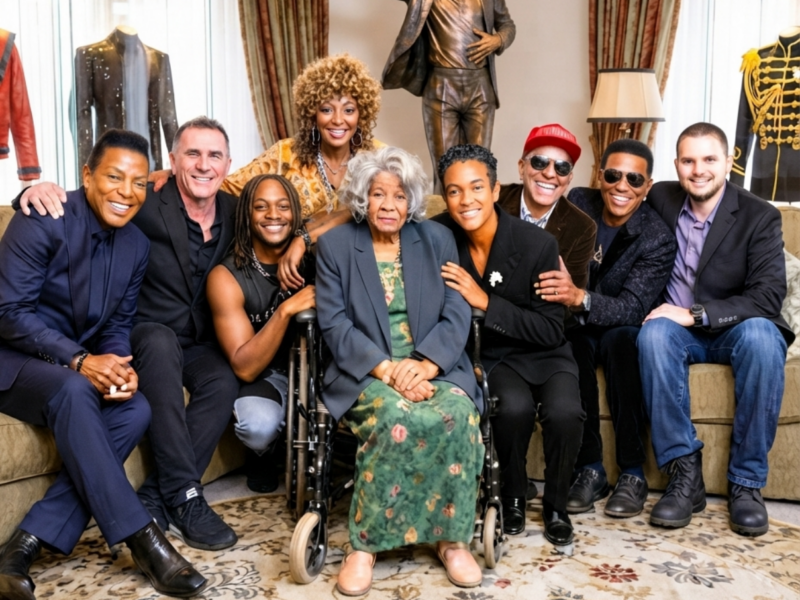
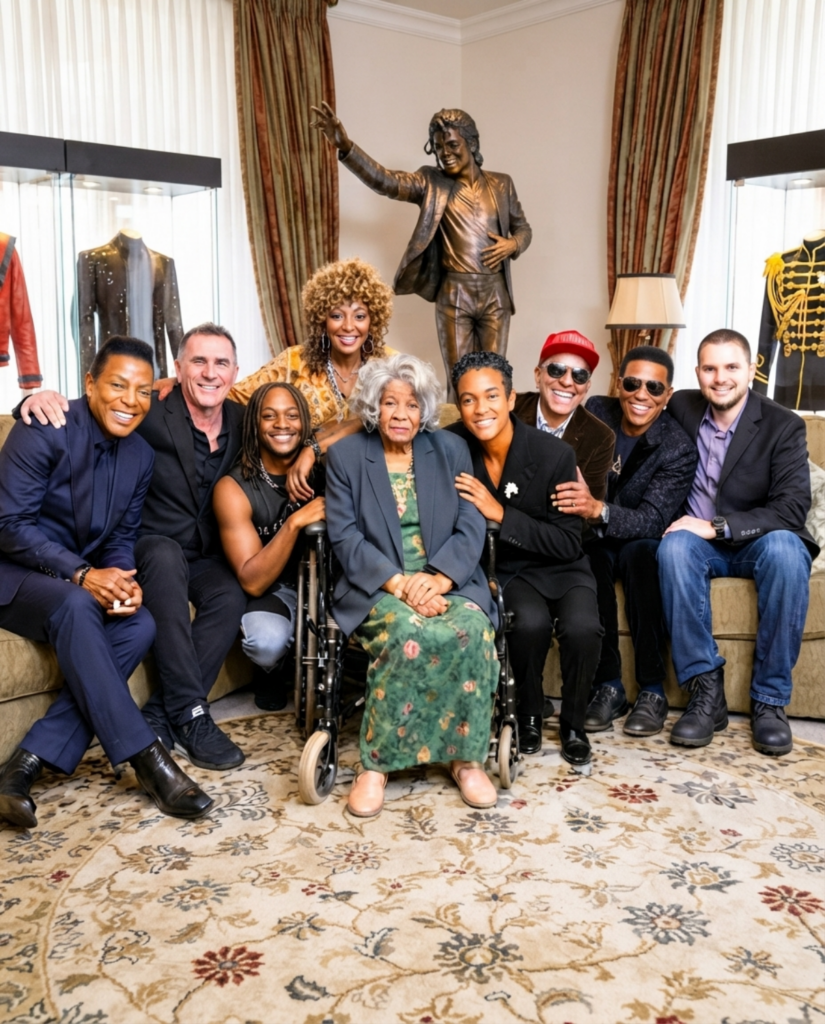
Before we move on, here is a heartwarming picture of a Jackson family gathering unlike any other.
Seated at the center, Katherine Jackson warmly holds the hand of her grandson, Jaafar Jackson, whose striking resemblance to Michael Jackson has amazed fans around the world.
Surrounded by family members and filmmakers, the moment feels like a heartfelt celebration of Michael’s life and legacy.
Adding to the emotion, the legendary red *Thriller* jacket hangs in the background, reminding everyone of the icon whose influence still fills the room.
What do you think of this emotional moment?
Let us know in the comments.
—
Katherine’s recognition.
Producer Graham King visited Katherine Jackson at her home in Encino and showed her Jaafar in full hair and makeup.
The 92-year-old matriarch fell silent for a long moment, studying her grandson’s transformed appearance.
Then she said simply, “That’s Michael.”
King later called that moment the highlight of his entire career.
Katherine had already endorsed Jaafar’s casting in 2023, telling *The Hollywood Reporter* that her grandson “embodies my son” and that it was “so wonderful to see him carry on the Jackson legacy of entertainers and performers.”
But seeing him transformed in person carried far more weight than any photograph.
Katherine had watched Michael grow from a child prodigy to a global icon.
She knew his face better than anyone alive.
When she saw Jaafar, she was not offering sentimental flattery.
She was stating a fact as she perceived it.
—
The first promotional images.
Photographer Kevin Mazur captured Jaafar in a crisp white suit with a slicked-back ponytail, evoking the *Dangerous* Tour era.
Another image showed him in a military jacket with aviator sunglasses, striking a pose that felt instantly recognizable.
Side-by-side comparisons with Michael from the 1990s spread rapidly across social media platforms.
The resemblance was startling, not just in bone structure, but in posture, expression, and the way he positioned his hands.
Clips of Jaafar rehearsing choreography from “Thriller” and “Billie Jean” surfaced online, displaying a fluidity that went far beyond simple mimicry.
Fans who had dismissed the project began to reconsider their initial skepticism.
The production had not chosen a random relative.
They had found someone who shared Michael’s physical vocabulary.
The visual evidence made the impossible seem plausible.
—
Jermaine’s familial pride.
Jermaine Jackson watched his son perform on set and struggled to process what he saw.
In an Instagram reel that quickly went viral, Jermaine admitted, “I thought I was looking at my brother, Michael.”
That confession carried decades of shared history between two brothers.
Jermaine had grown up alongside Michael in the Jackson 5, witnessing his brother’s evolution from a child singer to a cultural force.
To see his own son replicate those mannerisms, the subtle head tilts, the finger snaps, the distinctive vocal inflections, was both joyous and deeply disorienting.
Jermaine had spent years protecting Michael’s memory amid legal battles and tabloid scrutiny.
Now, his son was resurrecting that memory on a global stage.
The pride he expressed was not merely paternal.
It was a recognition that the Jackson legacy had found a capable steward.
—
Jackie’s emotional breakdown.
Michael’s older brother, Jackie Jackson, broke down during an *Entertainment Tonight* interview that aired during the film’s promotional tour.
He wept openly on camera, saying, “I got so emotional because he became Michael on that screen. It brought tears to my eyes. I couldn’t believe it. He’s incredible.”
Watching the film, I’m thinking I’m watching my brother Michael on the stage, but I realize it’s not Michael, it’s Jaafar.
Jackie had shared a childhood bedroom with Michael in Gary, Indiana, before the family moved to California.
He knew Michael’s habits, fears, and ambitions from before fame took over their lives.
Watching Jaafar embody those memories triggered a flood of emotions.
Grief for his lost brother.
Pride in his nephew.
And relief that Michael’s spirit could be conveyed with such fidelity.
Jackie’s tears were not staged for the cameras.
They came from a man who had carried the weight of his brother’s death for over 15 years.
—
Prince Jackson’s reaction.
Michael’s eldest son, Prince Jackson, served as an executive producer on the biopic.
He had grown up making home movies with his cousin Jaafar, so the professional collaboration felt organic and comfortable.
But seeing Jaafar transformed into his father was another matter entirely.
Prince confessed that it was “an emotional shock” to watch Jaafar on set for the first time, adding, “Because I had not seen my father in a long time, and to see him, Jaafar just embodied him and brought him back in that moment.”
Prince often struggled to maintain his composure during filming, instinctively wanting to embrace Jaafar as if reconnecting with a lost parent.
He publicly named Jaafar “the absolute only choice” for the role, praising his dedication and spirit.
The bond between cousins deepened through this shared creative endeavor.
—
Fuqua’s director’s lens.
Director Antoine Fuqua did not cast Jaafar solely on physical resemblance.
He auditioned multiple actors but found something intangible in Jaafar, a quality Fuqua later described as “Michael’s spirit that comes through in a magical way beyond the physical resemblance.”
Fuqua admitted that the project became a spiritual journey for everyone involved in its creation.
He saw Jaafar as a conduit for Michael’s energy, rather than a mere imitator of his moves.
The director pushed Jaafar to explore Michael’s vulnerabilities, not just his iconography and stage presence.
Fuqua’s previous work on *Training Day* and *The Equalizer* demonstrated his ability to extract complex performances from actors.
With Jaafar, he found a willing student who absorbed direction without ego.
Fuqua’s faith in the young actor never wavered throughout production.
—
Earning the role, not inheriting it.
Critics initially dismissed the casting as nepotism, pointing to Jaafar’s lack of film experience.
Jaafar acknowledged that he had to “really earn the role” and kept his casting a secret from his mother for an entire year.
When she finally saw him in full costume, “it blew her away. It was hard for her to connect it to me, so it was very emotional for her.”
Reviews highlighted that Jaafar did not coast on his famous surname.
One critic noted, “Jaafar may share his late uncle’s megawatt smile, lithe frame, and Bambi eyelashes, but his liquid dance moves and soft-spoken cadence are studied to perfection.”
He was not Michael reincarnated, but an actor who had invested thousands of hours into understanding the man behind the myth.
That work ethic earned respect from industry observers who had expected a vanity project.
—
Two years of rigorous training.
Jaafar’s preparation lasted roughly two years before cameras ever rolled on the production.
He worked daily with acting coach Angela Gibbs, master choreographers, and vocal coaches to refine Michael’s gestures, speech patterns, and legendary stage presence.
Gibbs later revealed that the first year focused on general acting exercises.
Only after eight months did they transition to biopic-specific scenes from the script.
The physical demands were extreme.
His feet frequently went numb from hours of dancing, and he often rehearsed until exhaustion forced him to stop.
Producer Graham King monitored his progress through video recordings sent regularly.
Jaafar did not complain about the grueling workload.
He understood that any misstep would be magnified by a global audience.
He was building muscle memory so that Michael’s movements became second nature.
—
The Hayvenhurst training camp.
Instead of renting a Los Angeles studio like most actors would, Jaafar returned to the Jackson family estate in Encino, Hayvenhurst, where Michael had grown up and where Jaafar himself had spent 15 years of his childhood.
He set up a makeshift training camp inside the historic house.
“I went back there and set up a training camp, a way to have a place to really work as long as I want, as hard as I want, as free as I want,” he explained.
The estate held decades of Jackson family history, from the 1970s through Michael’s peak years.
By training within those walls, Jaafar absorbed ambient memories that no archive could ever provide.
Living and working inside the historic estate gave him total artistic freedom to immerse himself in his uncle’s world without industry distractions.
Being physically present in the space helped him understand his uncle’s environment.
—
Sleeping on the floor.
Jaafar took his immersive approach to an unusual extreme.
He slept on the floor of Hayvenhurst because the house had no furniture.
Producer Graham King offered to buy him a comfortable bed, but Jaafar declined the offer.
Instead, he used a thin Japanese-style mattress that provided minimal comfort.
“I slept in many different rooms in the house just to feel the energy,” he said.
“Staying there allowed that to happen without forcing it. I was so fortunate to have that as my playground. Without that, I don’t think my performance would be what it is.”
Honestly, the minimalist living conditions stripped away modern comforts and forced him to exist in the space as Michael might have during his early years in the family home.
That physical discomfort became a tool for his preparation.
—
Access to personal writings.
Jaafar’s family connection granted him access to Michael’s private journals, poems, and personal affirmations, material that would never surface in public archives or biographies.
He described this access as a breaking point in his preparation process.
Reading Michael’s handwritten notes revealed anxieties, aspirations, and self-doubts that directly contradicted the confident public persona.
Jaafar began mirroring Michael’s habit of posting affirmations on walls and mirrors, adopting the same mantras to internalize his uncle’s mindset.
These writings provided unique insight into Michael’s internal conflicts and creative process.
Jaafar realized that Michael was not simply a confident performer.
He was a man who constantly sought validation through his work.
I had, uh, loud speakers in here and just dance, you know, nonstop.
Understanding that psychological tension changed how he played every scene in the film.
If you’ve made it this far, please hit the like button.
It really helps the channel.
—
The dance studio ritual.
Inside Hayvenhurst stood a small rehearsal room where Michael had practiced for countless hours.
Jaafar used that studio as his primary training ground throughout his preparation.
“There was a dance room where Michael used to train,” he said.
“I started training there.”
Rather than copying choreography mechanically, Jaafar used this sacred room to dissect the physical discipline behind Michael’s effortless execution.
Put all my heart and soul into it to really make them proud, but also to make, uh, my uncle Michael proud.
He spent countless hours repeating footwork in that same space, feeling the grooves left by decades of practice.
He focused on building the sheer stamina required for the routines, pushing through physical fatigue until every turn and glide moved from conscious effort into pure instinct.
The studio had transformed him.
—
Bridging a fractured family.
Michael’s death in 2009 left the Jackson family deeply divided.
Legal battles over his estate, custody of his children, and conflicting wills created lasting rifts among siblings.
Jermaine, Janet, Jackie, and the others each carried private grief compounded by constant media speculation.
The younger generation, Jaafar, Prince, Paris, and their cousins, grew up under the weight of their uncle’s fame, struggling to define their own identities.
Family gatherings often felt tense, with unresolved resentments simmering beneath the surface.
The biopic production forced conversations that had been avoided for years.
Jaafar’s preparation included interviewing relatives who had not spoken openly about Michael in ages.
Those interviews cracked open old wounds but also created opportunities for reconciliation rather than continued estrangement.
—
The younger generation’s burden.
Prince, Paris, and their cousins faced unique pressures as Michael’s heirs.
Prince took an active role as executive producer, carefully guarding his father’s legacy throughout production.
Paris, however, initially expressed skepticism toward Hollywood biopics in general, staying cautious about how her father’s story would be portrayed on screen.
One of the questions asked was they wanted me to list bands and artists that—
She chose not to participate in the project at all.
Her absence sparked widespread speculation about family dissent, though she never attacked Jaafar personally.
Meanwhile, Jaafar navigated the delicate balance of honoring his uncle while satisfying the expectations of relatives who remembered Michael differently.
The younger Jacksons had grown up with a version of Michael shaped by private family memories, not tabloid narratives.
Their perspectives on the film varied widely.
—
A unifying success.
The film’s performance reinforced its unifying effect on the Jackson family.
Upon its release, audiences responded with overwhelming enthusiasm, even as critics offered mixed reviews that debated the screenplay while praising Jaafar’s standout performance.
That critical-audience divide did not diminish the family’s collective pride in the project.
They watched screenings together at multiple premieres, sharing tissues and laughter.
Jaafar’s success became a shared victory, proof that the Jackson legacy could thrive without succumbing to internal rivalries.
His father Jermaine, uncle Jackie, and grandmother Katherine all appeared publicly to support him.
The red-carpet reunions at premieres displayed a united front that had been missing for years.
—
The Berlin premiere.
At the major Berlin premiere, multiple Jackson generations gathered on the same red carpet.
Katherine, Jermaine, Jackie, Marlon, La Toya, and Prince Jackson all posed together, embracing Jaafar with visible affection and pride.
The absence of Janet Jackson, who had declined to attend, sparked gossip among entertainment reporters.
But La Toya clarified that Janet was simply “not available,” not protesting the project.
The event became a visual testament to family cohesion after years of distance.
Photographs of three generations smiling together circulated widely online, replacing the tabloid images of legal disputes that had dominated coverage for over a decade.
For the Jackson family, the premiere served as a powerful public declaration of resilience.
—
La Toya’s reaction.
La Toya Jackson, walking the LA premiere red carpet, told *The Hollywood Reporter*, “We all forget and think that we’re watching Mike. It’s like, oh, I forgot this is Jaafar.”
She described being “flabbergasted” by his transformation and noted that even she occasionally believed she was watching her late brother.
La Toya also addressed Janet’s absence without judgment, emphasizing that her sister was asked to attend and “kindly declined.”
That measured response diffused rumors of a family feud.
La Toya, who had weathered her own share of family controversies over the years, understood the importance of maintaining public unity.
Her praise carried additional credibility because she had spent decades in the Jackson orbit.
She knew Michael’s mannerisms intimately.
—
From nephew to steward.
Before the biopic, Jaafar Jackson remained a peripheral figure within the Jackson dynasty, recognizable to dedicated fans but not a headline act.
He had released solo music without commercial breakthrough, staying largely out of the spotlight.
His family knew him as the quiet cousin who preferred rehearsing to partying.
The film transformed that perception completely and overnight.
Relatives began treating him with newfound respect, not as a beneficiary of his famous surname, but as an artist who had endured two years of punishing preparation.
His grandmother trusted him to carry the family torch.
His aunts and uncles deferred to his judgment on Michael-related matters.
Jaafar was no longer simply a grandson.
He was the custodian of their collective memory.
—
Trust across generations.
Older Jacksons — Jermaine, Jackie, Marlon, La Toya — found comfort in Jaafar’s portrayal because it aligned with their personal memories of Michael.
They had worried that a Hollywood director might sensationalize Michael’s struggles or reduce him to tabloid caricatures.
Jaafar’s involvement gave them veto power over creative decisions, but he rarely needed to exercise it.
He had absorbed enough family lore to anticipate their concerns.
We miss him. We miss him on stage, and we all have our moments that we think of him.
Meanwhile, the younger generation, including Prince, saw Jaafar as a peer who had accomplished something extraordinary.
They rallied around him, attending premieres and sharing social media tributes.
This cross-generational support bridged those who remembered Michael as a brother and those who knew him only as an uncle.
—
More than box office.
The film’s immense commercial box office success will eventually fade from entertainment headlines.
What matters more, according to Jaafar, is the lasting impact on family dynamics.
He admitted that the project deepened his love, pride, and appreciation for the Jackson name and reinforced the timeless value of an unshakable work ethic and family solidarity.
Those are not hollow platitudes.
Family members now share Michael anecdotes freely during gatherings, rather than avoiding painful subjects.
And what’s the excuse for you so ugly?
Can I take off my big brother Tito?
The production normalized conversations about grief, legacy, and artistic ambition.
Even Paris, despite her public criticism of the film, privately acknowledged that Jaafar’s commitment was genuine.
The project reoriented the entire family toward collaboration rather than litigation.
—
The healing legacy.
For over a decade, the Jackson family navigated Michael’s legacy through courtrooms and media statements.
Jaafar’s immersive journey fundamentally changed that approach.
Today, private family screenings and phone calls revolve around celebrating Michael’s artistry, not managing his estate.
The walls that separated siblings have partially crumbled.
Jaafar does not claim to have fixed everything.
Janet’s absence and Paris’s skepticism remind us that healing is gradual.
But he has demonstrated that performance can serve as therapy for a fractured family.
When Katherine Jackson says she cannot tell whether she is watching her son or her grandson, she articulates a profound truth.
For this very, very special occasion for my son.
Jaafar did not merely imitate Michael.
He channeled the man she raised.
That achievement constitutes his most enduring success.
For the Jackson family, the film’s billion-dollar box office and 97% audience approval mattered less than what Jaafar achieved off-screen.
He resurrected buried stories, reopened lines of communication, and reminded a fractured dynasty of their shared love for Michael.
When Katherine Jackson cannot tell her son from her grandson, she speaks a truth that transcends cinema.
A legacy carried forward, not imitated.









