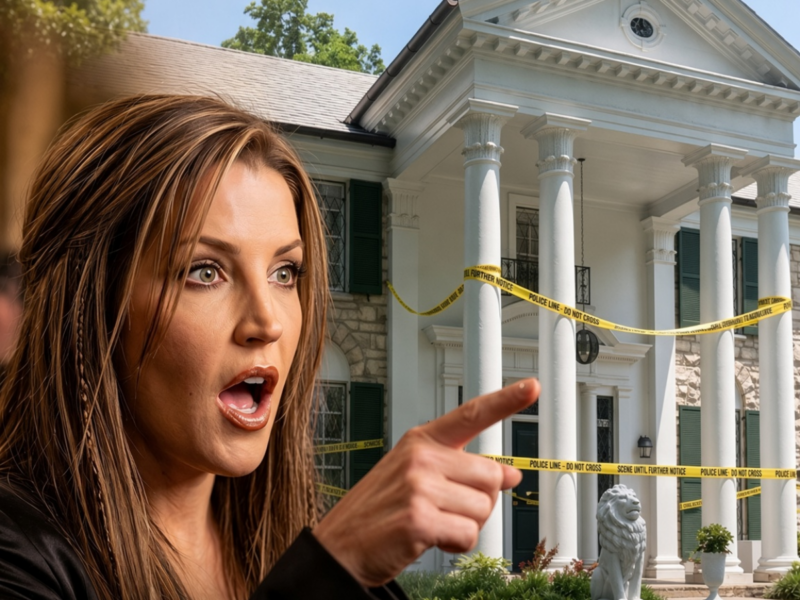
After 48 Long Years, What Had Been Kept Secret in Graceland’s Secret Room.
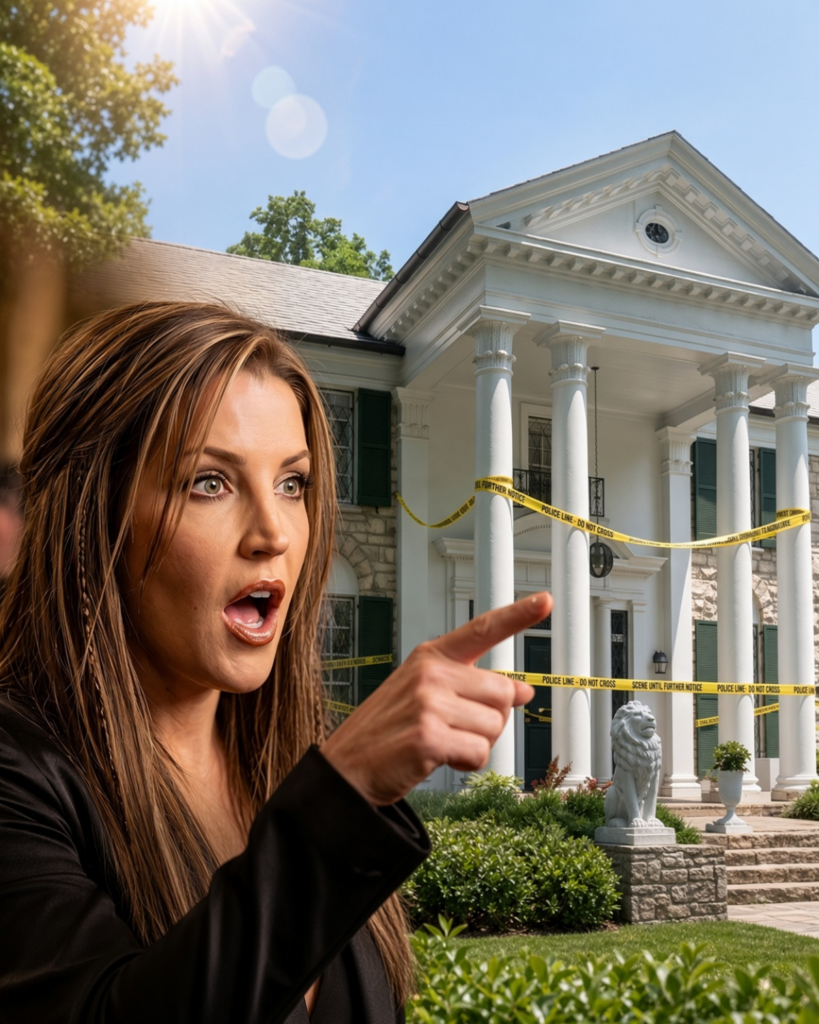
On August 17th, 1977, the day before Elvis Presley’s funeral, some seventy-five thousand fans visited Graceland, just the estate.
For forty-eight years, behind a heavy, handleless door deep within the Graceland basement, there lay a space that had never been open to anyone.
Not even Lisa Marie Presley dared to step foot inside throughout her entire life.
Inside that abandoned room from the fateful summer of 1977, there was more than just dust and frozen time.
When the lock was finally turned, what awaited defied all imagination.
A terrifying truth about that fateful night.
Conspiracies concealed for half a century.
And a shocking secret that completely overturns every preconceived notion about the death of the King of Rock and Roll.
All day long, people just walk through the house, and there is always a love there that seems to never stop.
At Graceland, people still speak of Elvis with such enduring affection.
Those who never met him travel thousands of miles just to stand inside the home where he once lived.
They search for a silhouette through a photograph, recognizing their own youth in a song.
Yet amidst a home known to millions, there stands a door said to have remained closed for nearly half a century.
A room no one has ever stepped into.
A lock no one has ever turned.
A silence that even his family avoids disturbing.
Nestled on an estate of roughly fourteen acres in Memphis, Tennessee, Graceland is reported to welcome nearly half a million visitors each year, frequently trailing only the White House in tourist appeal among private residences in the United States.
But those who come here are not merely looking to admire a fine house.
They want to walk the corridors Elvis once paced, stand where he once laughed and spoke, and shorten the distance between themselves and their idol.
Some carry the love passed down from their parents.
Others have grown old alongside his music.
To them, stepping through the gates is stepping into a chapter of life once thought accessible only in memory.
Inside, the 1970s appear frozen in time.
The Jungle Room with its thick carpeting, vivid hues, gold-plated bathrooms, walls lined with gold and platinum records, trophy rooms, and a prized automobile collection still speak to the unconventional tastes of the master of the house.
The carefully curated tours guide visitors through a dazzling world.
Yet the more one sees, the more one notices what is kept away.
Velvet ropes, staircases forbidden to the climb, and closed doors with no explanation offered.
Behind the neatly displayed memories, Graceland guards its blank spaces.
The upper floor remains a legendary boundary.
Guides do not lead visitors up, and cameras are strictly barred.
It is said that even former President Bill Clinton was once turned away.
Elvis’s private chambers thus became a temporal lockbox in the public imagination.
Secret journals, unreleased music archives, recordings detailing his final days.
Everyone projects their own questions there.
Yet the door at the center of this narrative lies elsewhere, at the end of a low-level hallway, heavy, reinforced, and completely lacking an exterior handle.
Longtime staff are said to speak of it only in hushed tones.
They call it the room that even Lisa Marie never opened.
Why would a daughter raised at Graceland avoid a part of her father’s house?
Some suggest it is merely a storage room magnified by imagination.
Others believe it holds relics too deeply personal, too agonizing to confront.
A more persistent theory holds that Elvis foresaw something and actively chose to conceal the room.
It is said to have been locked since the summer of 1977.
Its master passed away, yet the reason for the lock was never handed down to the world.
Another legend begins with a mundane task, inspecting and upgrading the electrical system.
Homes built before the 1980s inevitably require maintenance, and Graceland is no exception.
When maintenance workers dismantled a wall panel in the staff corridor, anticipating mere wires or pipes, they uncovered a hidden, narrow passageway.
Even staff of many years declared they had never seen or heard of it.
At the end of the corridor stood a thick, heavy wooden door, securely locked, yet not entirely unopenable.
A routine chore had brushed against architecture that defied their understanding.
The outer wall appeared to be part of the original design rather than a hastily erected partition.
This sparked suspicions that the concealment had been planned from the outset, perhaps ordained by Elvis himself.
The workers and a handful of family representatives reportedly stood before the space in silence.
No press release, no cameras permitted.
Management neither confirmed nor denied the reports.
Online, those claiming knowledge began to speak while skeptics continued to speculate.
An unseen door had become the focal point before anyone could prove what lay beyond.
In the narrative tied to Riley Keough, the decision to open the door arrived in 2025, nearly forty-eight years after her grandfather’s passing.
The person making the choice was the actress, filmmaker, and Elvis’s granddaughter.
Yet that return bore no resemblance to a celebrity event.
She had just walked through the sudden loss of Lisa Marie, carrying a daughter’s grief and the heavy legacy of her family.
No reporters waited.
No public announcement was made.
What brought her to Graceland was wrapped in a tiny object left behind by her mother, accompanied by words not yet fully understood.
The two differing accounts of how the door was discovered converge on a single truth.
Graceland still harbors a portion of life the public has never entered.
For Riley, it was no longer a mystery to debate and dismiss.
She sought to understand what her mother took with her and what the grandfather she never met had left behind.
Beyond the threshold, the story promised a message transcending ordinary memorabilia.
To comprehend why it weighed so heavily, one must return to the years Elvis was still alive, when the stage lights were bright and solitude followed him home.
By the early 1970s, Elvis had transcended the status of a mere singer.
Sparkling jumpsuits, sold-out arenas, and blinding flashbulbs made him an inseparable part of American culture.
Yet the stage eventually emptied.
Fans drifted away, carrying the sensation of having touched the extraordinary, while Elvis returned to Graceland to hours devoid of applause.
Downstairs accommodated guests, friends, parties, and the ceaseless motion surrounding a star.
Upstairs was the sanctuary to which he retreated.
Only family, his closest friends, and trusted aides were permitted to cross a boundary he guarded fiercely.
Elvis lived by night, frequently watching television, reading, or playing music long after others had fallen asleep.
His bedroom featured soft furnishings, luxurious details, a custom-built bed, and stacks of beloved records.
Beside the bed rested a direct intercom button connecting to the kitchen, allowing him to summon late-night meals or drinks without leaving his quarters.
Such comfort spoke of immense wealth, yet also reflected his desire to confine his private life within a strictly controlled perimeter.
Those close to him recounted that he would pace the house, wander back and forth, listen to gospel records, or immerse himself in books on philosophy and mystical thought.
Elvis appeared to be searching for an answer that fame could not provide.
He possessed wealth, devoted fans, and a status most only dreamed of.
Yet alone, with an open book, those blessings did not automatically banish his questions.
The voice that brought comfort to millions did not guarantee inner peace for its vessel.
Within a crowded mansion, he harbored tracks of solitude where few dared to follow.
According to lore, between 1974 and 1977, Elvis had a portion of the Graceland basement walled off.
Construction crews arrived under strict non-disclosure agreements, accepted cash, and vanished without a trace from the estate.
Architectural blueprints discovered years later recorded no such room.
A small circle of staff dubbed it the Contemplation Room, though whether Elvis coined the term or it arose through whispering remains unknown.
Some viewed it as another eccentric whim, akin to his custom television room or mirrored staircase.
Yet the absolute discretion surrounding this project felt entirely different.
Elvis was said to vanish for hours, occasionally descending into the basement alone in the dead of night without a word to Priscilla or his Memphis Mafia companions.
A former maid, speaking on condition of anonymity, recalled hearing faint music drifting through the floors.
Slow.
Haunting.
Heavy.
Unlike the rock, gospel, or country music associated with him.
At times the music gave way to speech, sometimes dropping to a murmur.
When asked about those hours below, Elvis reportedly replied, Just thinking.
That’s where I put on my real shows.
The remark left a lingering question.
What transpired down there that massive stages could not accommodate?
Some guessed it was a meditation chamber.
Others imagined a clandestine recording booth or a rehearsal space free from the pressure of formal sessions.
Rumors also circulated that Elvis feared surveillance, suspecting even those closest to him.
The room may have served as a bunker during a turbulent era where he could draft a version of himself that the stage forbade.
Whether meant for release, preservation, or simply for himself and someone who might one day understand, no one could say for certain.
But those solitary descents transformed the space from an unused room into something far more profound.
Then came August 16th, 1977.
Following a night spent rehearsing and conversing with girlfriend Ginger Alden, Elvis retired to his private suite.
He was discovered unresponsive in the bathroom adjacent to his bedroom.
Frantic efforts failed to revive him.
Elvis passed away at age forty-two.
Initial reports cited heart failure, followed by enduring debates over prescription medications.
His safest haven became inextricably linked to his greatest loss.
The family preserved the upper floor as a slice of frozen time, anxious lest public fixation on the bathroom overshadow his entire life.
They refused to let thousands file through only to dwell on his final minutes.
The private chambers were maintained precisely as he left them, intended for those who truly knew him.
Among the rare exceptions granted entry was Nicolas Cage, a lifelong admirer who once called Elvis his ultimate hero.
Through his brief marriage to Lisa Marie, Cage was shown the spaces where Elvis lived, worked, and slept.
He described the experience as both unbelievable and deeply profound, though he shared no photographs or film with the public.
Strict rules against recording and detail-sharing preserved the sanctuary’s privacy.
Another tale emerged from an influencer who claimed a staff member approached him during a tour and escorted him upstairs alongside security.
Doors were unlocked and drapes drawn before he was permitted a glimpse.
This spawned unverified rumors that he might be an unacknowledged descendant of Elvis.
Some visitors even reported hearing multiple voices upstairs during his visit, reminiscent of a private gathering.
Such stories fueled speculation.
Yet for Riley, what drew her toward the basement door was not internet gossip.
It was her mother’s handwriting upon an envelope.
Loss arrives without an orderly schedule.
On certain days, it manifests merely as the emptiness of an unplaceable phone call.
On others, a mere signature is enough to shatter whatever stability one struggled to maintain.
When Lisa Marie passed away in early 2023, Riley lost her mother and the living link connecting her most closely to the Presley universe.
She had long striven to respect the legacy while carving her own path untouched by its shadow.
Now the one person capable of answering countless questions was gone, leaving behind inquiries with nowhere to land.
Amidst the chaos of the funeral and legal estate matters following her passing, Riley retreated into silence.
In that fragile state, a small package arrived at her Los Angeles home.
There was no return address, only her name scrolled across the exterior.
Inside, wrapped in a faded handkerchief, lay an unopened envelope.
Riley recognized the handwriting instantly.
It belonged to Lisa Marie.
A single line was written within.
For when you are ready.
Yet she was not ready.
The words of the departed can weigh crushingly heavy even before they are read.
Weeks passed before Riley finally broke the seal.
What lay inside was no lengthy letter explaining loose ends.
It was an old brass key, heavy and cold to the touch.
Beside it rested a slip of paper covered in uneven, emotional handwriting.
There are truths harder to face than lies.
If one day you feel strong enough, you will know where this key belongs.
Forgive me if I could not do it myself.
No map, no instructions.
Yet the plea for forgiveness imbued the small object with the immense weight of years of silence.
Riley intuitively knew the key did not belong to a jewelry box or a desk drawer.
It belonged to the door at the end of the hallway in Graceland, the one Lisa Marie had never dared to open.
Her mother had issued no command, offering instead a choice coupled with the painful admission of her own weakness.
Riley had pursued acting without trading on her family name.
But Graceland had now summoned her through something far more intimate than fame, the past her mother carried in silence.
She returned quietly, alone, accompanied by neither press nor camera crews.
The corridors of her childhood greeted her under entirely altered circumstances.
Riley trailed her fingers along the banister her grandfather once leaned against, stood within the Jungle Room, gazed out at the grounds, and listened.
The house remained furnished, yet those who gave it meaning were gone.
She could neither ask her mother where to begin, nor question her grandfather about what he wished to preserve.
She held only a key and a message pointing straight to where her questions began.
At last, Riley stood before the door.
The brass key was worn at the edges but slid smoothly into the lock.
Her hand trembled.
Taking a deep breath, she turned it.
A faint click sounded, followed by the heavy mechanical shift of the bolt releasing.
The door groaned open.
In this telling, nearly half a century of silence cracked open through those simple mechanical sounds.
No grand announcement, no applauding witnesses, merely a granddaughter stepping past the boundary her mother refused to cross, descending into shadows that held no promise of what they might return.
The air was stagnant, dusty, and noticeably colder than the rest of the mansion.
A single overhead bulb hung from a pull cord.
Riley tugged it.
A dry snap echoed, and flickering light spilled over what lay below.
The room resembled neither a standard storage closet nor a professional recording studio.
It felt designed for an aspect of Elvis unknown to tourists, the observer, the man who lingered after every gathering had dissolved.
Nothing illuminated by that harsh light was arranged to impress outsiders.
Recounting the opening of the room, lore speaks of an unplugged lamp, a plastic-shrouded record player, and a small desk strewn with yellowed paper scraps.
Dust blanketed every surface, yet objects remained undisturbed.
The modern HVAC system seemed entirely absent, as though the room had drawn its last breath in 1977 and never exhaled again.
Silence clung to every surface, suggesting its master had merely stepped away mid-task, expecting a return that never materialized.
There were no guest chairs, no layout intended for dual occupancy.
The desk, the record player, the manuscripts, all centered entirely upon a single individual.
Elsewhere in Graceland, Elvis welcomed friends and family.
Yet this space offered no sign he ever expected company.
Perhaps it served as a laboratory for music, a reading nook, a writing desk, or a shelter for unspoken thoughts unfit for a crowded house.
The absence of visitors magnified its profound isolation.
A man called by millions had required a place where no one summoned him, if only for a few hours.
Riley’s gaze drifted to a wall lined with angled mirrors.
They were far from arbitrary decoration.
The seams between panels hinted at structural depth behind them.
At the base of the desk sat a small toggle switch.
Before touching it, she could still imagine it merely as a private retreat.
Yet the switch promised a hidden utility.
The room had preserved its secrets for decades.
Now, layer by layer, it was surrendering them to an heir, and what was about to open was far more than a concealed alcove behind a mirror.
The manuscripts upon the desk bore handwritten scrolls defying easy categorization.
Some resembled lyrics, others letters, while many captured disjointed reflections.
A few were whispered to be drafts of unreleased songs.
Phrases like dream machines, sleepless roads, and second kingdom surfaced without context, leaving readers feeling as though they had stumbled mid-conversation, permitted to hear only one side.
Familiar words, when cobbled together, formed bewildering puzzles.
Beside the desk rested a locked chest rumored to contain reel-to-reel tapes, raw, unpolished takes, and late-night recordings of fleeting thoughts.
Such recordings would preserve an Elvis distinct from commercial releases, complete with hesitations, aborted lines, and unbroken silences.
An old, dog-eared Bible also drew notice, its margins crowded with annotations regarding loss, guilt, and destiny.
Those ink-stained margins hinted at a private spiritual quest.
A man who sang gospel before throngs of believers evidently returned to those pages alone, seeking answers to his own trials.
Photographs of friends, family, and unfamiliar faces lay scattered about.
Most arresting was a framed picture of an older man standing before the Graceland gates, bearing neither date nor identification.
No one could definitively name him.
Yet the presence of a stranger among intimate belongings rendered the portrait impossible to ignore.
It sat in silence while those hearing the tale sought explanations.
Such items required no grand conspiracy to provoke curiosity.
The sheer absence of captions reminded visitors how little they truly knew.
Riley pressed the toggle switch.
The mirrors flickered and slid aside, revealing speaker mesh and analog audio components wired to a reel-to-reel deck.
Signal lines were labeled with the names of various Graceland rooms.
The Contemplation Room suddenly revealed itself as a listening post.
Within the space stood wooden chairs, a narrow, confessional-style booth lined with velvet soundproofing, and a cracked microphone wired directly to the desk.
Headsets rested beside a leather-bound journal.
The equipment inverted the central question.
Did Elvis wish to escape his home, or did he need to hear everything that transpired when he was absent?
Embossed across the journal’s cover in thick ink read, The Listener.
Riley opened it to dated entries, observations, and anxious notes.
They no longer listen to me, but I hear them.
Every single word.
Another page read, There are voices in this house that do not belong to the living.
And further on, If I cannot speak the truth, I will at least leave a record of it.
Riley’s heart quickened.
Placed beside equipment mapped to every room in the house, these private entries transformed a secluded retreat into an obsession driven by surveillance and fear.
The first tape rolled, crackling softly over a low hum before falling silent for several seconds.
Then came a voice attributed to Elvis, slow, raw, and weary, bearing little resemblance to his confident stage persona.
If you are hearing these words, it means I didn’t make it out.
Riley sat motionless as the reels turned.
The speaker dropped to a near whisper, pausing frequently to gather breath.
No audience awaited him.
No melody cushioned the void.
Those intimate confessions filled a room sealed away for too long.
They swapped my prescription again.
They call it routine, but I never asked for anything new.
Another segment revealed, Someone is screening my mail before it reaches me.
Then a name surfaced.
Joe acts differently when he thinks I’m not listening, as though he knows something.
In these recorded words, Elvis suspected surveillance by those closest to him.
The fragments offered no neat conclusion, yet exposed a pervasive paranoia within his own walls.
Those permitted closest to him had become objects of his deepest distrust.
Then a designation repeated itself.
Project Velvet.
The recorded voice pressed with urgency.
Project Velvet.
That’s what the doctor called it when he thought I was completely out of it.
Velvet isn’t a treatment.
It’s a trap.
Corresponding journal pages reportedly bore erratic notes, hastily scribbled names, and circled dates.
They pointed to what Elvis believed was a coordinated effort to manipulate his behavior, finances, and grasp of reality.
Riley heard the terror in his voice, yet recognized the vast chasm between subjective belief and verified fact.
They think I don’t know what they’re doing, but I do.
I know what’s happening, and I won’t let them rewrite who I was.
Following a lengthy pause came another declaration.
To those who know, I am sorry.
I never meant to drag anyone into this, but they will never let me walk away quietly.
Riley listened tape after tape.
Coherence gave way to consuming paranoia, anger, and utter despair.
One emotion permeated every recording.
Fear.
She was left to wonder what these secrets had ultimately cost him.
The musical drafts, the Bible, old photographs, listening gear, and spoken confessions formed an unassembled puzzle.
An artist experimenting.
A seeker of faith.
A homeowner terrified of his inner circle.
These facets belong to a single life, yet defied simple summation.
The room refused to offer quick answers, instead multiplying questions with every spinning reel.
Then a name arose with sufficient frequency to demand Riley’s attention.
John D. Shepard.
In the journal’s final pages, that name pointed her toward an object bearing a physical address and date.
Initially, Riley suspected John D. Shepard was a pseudonym, another veil thrown over uncomfortable truths within her grandfather’s notes.
Yet trailing the final leaves of The Listener lay a storage rental receipt from Nashville dated 1985, bearing a locker number and address scrolled in trembling handwriting.
Eight years after the world mourned Elvis, why did such paperwork exist?
Who rented the locker, preserved the receipt, and tucked it into his journal?
Previously, every thread remained within Graceland.
Now she possessed a lead outside those walls, offering a trail to follow rather than mere guesswork.
Riley flew to Nashville in secret.
The storage facility remained operational, and the locker number matched.
Yet access was not granted merely upon naming her family.
Riley was forced to navigate a maze of legal paperwork and verification via the Presley estate managers.
Ultimately, admission was granted.
Within the locker lay no grand archive, merely a duffel bag of men’s clothing, bills, and miscellaneous items awaiting sorting.
It was the dates stamped upon the bills that shifted everything.
They allegedly post-dated Elvis’s publicized death by many years.
Beneath the belongings rested a locked tin box, as though her search demanded yet another sealed threshold.
Inside lay a passport issued in 1981, bearing Elvis’s birth date alongside the name John D. Shepard.
Nearby rested a USB drive wrapped in yellowed paper inscribed, For her eyes only.
No explanation clarified the identity of the woman addressed.
A name from an audio tape now materialized on legal documentation.
Yet vast blanks remained.
The photograph of the older man outside Graceland still lacked a name or date to anchor it to the passport.
These items stunned through implication while demanding further answers.
Returning to Memphis, Riley loaded the file.
The screen flickered, revealing an older man seated before a camera, bearded, wearing dark sunglasses, looking far older than the iconic Elvis preserved in the public consciousness.
According to accounts, she recognized him immediately.
The man gazed directly into the lens and spoke.
If you are watching this, perhaps I was wrong to run away.
The single sentence drew all prior threads together.
Her mother’s handwriting.
The cold brass key.
The terrified recordings.
The Nashville address.
Riley sat alone in the room where her grandfather had supposedly watched, listened, and confessed, staring at the weary face on the screen.
She possessed footage, journals, tapes, and documents carrying the power to rewrite history.
Yet what does one do with truths the world may be unprepared to absorb?
From the moment leaks concerning the room emerged, online forums had erupted with theories.
Some believed management had known for years, suppressing the truth to protect the brand.
Others hoped for unreleased music, evidence of an aborted creative pivot.
Still others whispered of journals contradicting his public persona, secret spiritual beliefs, or rumored offspring.
Each faction sought its own Elvis within the void.
The burden of choice weighed heavily, because Riley bore more than a famous surname.
She was also the daughter who had just read her mother’s plea for forgiveness.
Lisa Marie had clutched the key without turning it.
Riley now understood why.
Knowing more does not necessarily lighten the soul.
A discovered artifact can spawn dozens of questions long after those capable of answering have vanished.
Airing them meant surrendering those blanks to countless strangers, each eager to fill them with whatever they wish to believe.
Public disclosure invited swift brands of fraudulence and betrayal from skeptics and loyalists alike.
The Presley name would become media fodder once more, while her family was forced to navigate outside interpretations.
Riley had returned seeking her mother.
Yet her quest had culminated in a decision extending far beyond herself.
The unearthed relics possessed global shockwaves, yet threatened to eclipse every other facet of her grandfather’s life.
Before the glowing screen, the ultimate question was no longer whether the door could be opened, but who would be permitted to cross the threshold after her.









