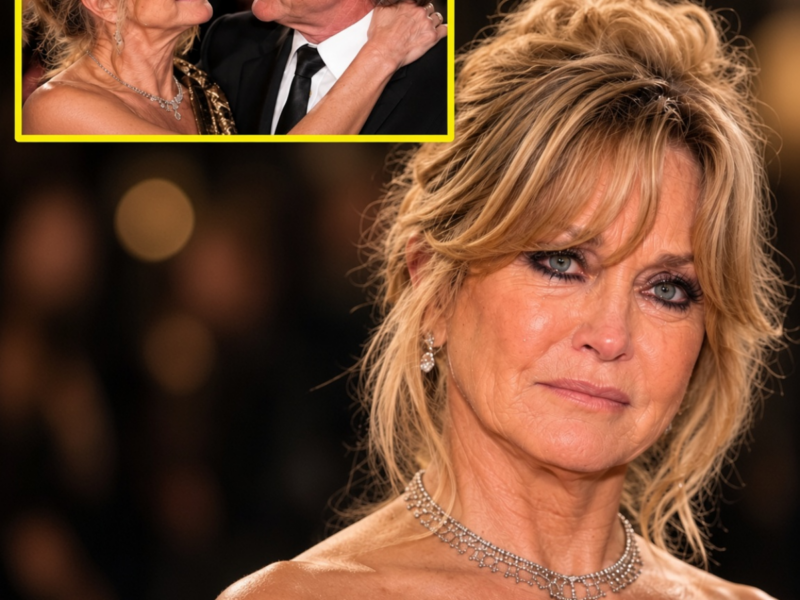
After 43 Years, Goldie Hawn Finally Reveals What She Refused to Give Kurt Russell.
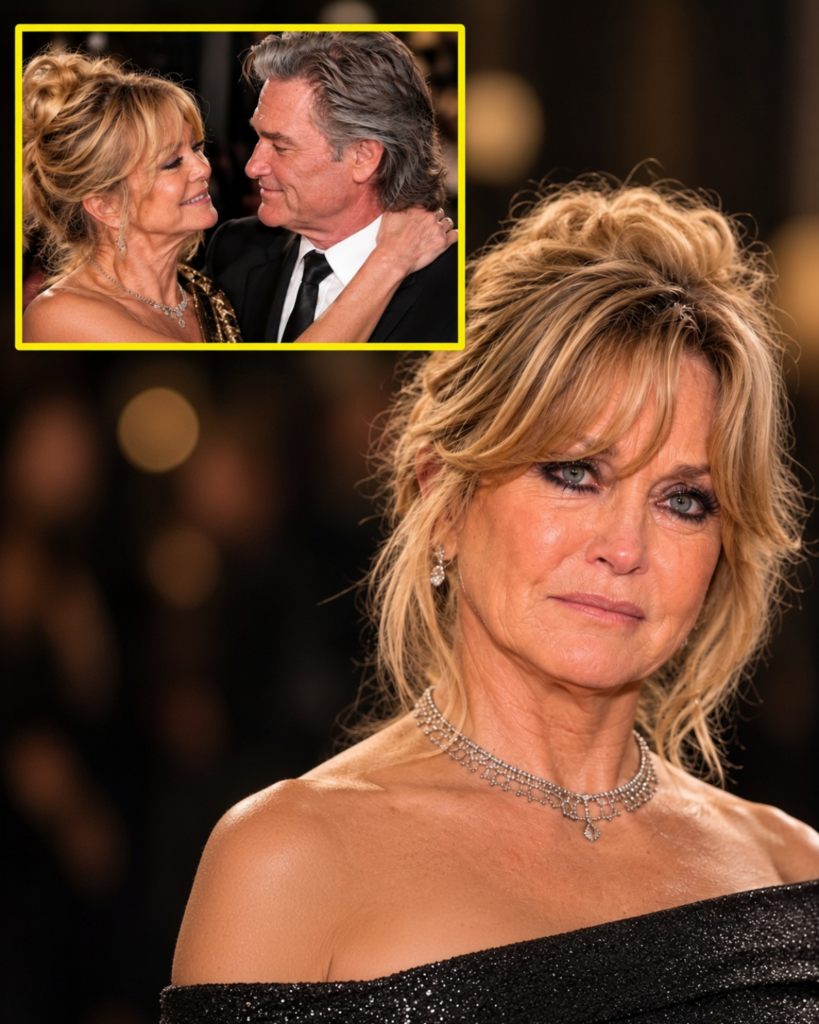
The question had followed Goldie Hawn for so long that it had become almost a piece of furniture in her life, something everyone else tripped over but she had learned to walk around without seeing.
Forty-three years with Kurt Russell.
Four children between them, a blended family that had grown into eight grandchildren, homes in Los Angeles and Palm Desert and Colorado and New York, a Hollywood romance that had outlasted almost every marriage the industry had ever celebrated or mourned.
And no wedding.
Not one.
No ring on the finger that the world could point to and say, there, that is what forever looks like.
The question came in interviews and on red carpets and in the comments beneath every photograph of the two of them together, and it always carried the same assumption, the same quiet accusation wrapped in curiosity: what was she waiting for, or what was she hiding, or what was she so afraid of that she would not give this man the one thing every other couple in America seemed to give each other without a second thought?
For years, Goldie had answered with a smile and a sentence about freedom, about choice, about waking up every morning and knowing that Kurt was there because he wanted to be there and not because a piece of paper told him he had to be.
The answers were elegant and they were true, but they never quite closed the door on the question.
People nodded and moved on and then asked again six months later, as though the answer might have changed, as though forty-three years of evidence might finally be outweighed by one more interview.
But in 2026, the question stopped being a question, because Kurt Russell himself sat down and described the beginning of their relationship in a way that made everything before it make sense, and Goldie, at eighty, finally explained what she had refused to give him in a way that could not be misheard or misunderstood or reduced to a soundbite about independence.
She had not refused him a wedding because she was afraid of commitment.
She had refused him a wedding because she had already given him something she considered far more valuable, and she had spent four decades protecting it.
The story began, as so many Hollywood stories do, with a timing that was both perfect and terrible.
Goldie Hawn and Kurt Russell had met once before, in 1966, on the set of a Disney musical called The One and Only, Genuine, Original Family Band.
She was twenty-one, a dancer with a laugh that filled rooms, and he was fifteen, a child actor with a jaw that had not yet caught up to his shoulders.
She thought he was adorable and she thought he was much too young, and that was that, or so it seemed.
Seventeen years passed.
Both of them married other people.
Both of them had children.
Both of them divorced.
Goldie had Oliver and Kate with Bill Hudson, and Kurt had Boston with Season Hubley, and by the time they found each other again in 1983 on the set of Swing Shift, they were not two innocent people who believed that love was a solution to loneliness.
They were two people who had already learned that a wedding could be beautiful and a marriage could still fall apart, that a promise made in front of witnesses could be broken in private, that the paperwork of commitment was no guarantee of anything at all.
Kurt was the one who put it into words that would follow them for the rest of their lives.
He told The Wall Street Journal in 2026 that they had looked at each other and said, simply, “Let’s have fun until we don’t.”
That was the entire agreement.
No vows.
No timeline.
No promise that they would be together forever, because both of them had already discovered that forever was not something two people could promise each other.
It was something they could only keep choosing.
The hook of that choice, the small and radical decision to wake up every day and decide again, would become the thing that defined them, and it would appear first as a question the world could not stop asking, then as a piece of evidence in Goldie’s own words, and finally as the symbol of everything their relationship had been from the very beginning.
What the world did not understand, and what Goldie and Kurt seemed to understand instinctively, was that the absence of a wedding was not the absence of a family.
By the time they got together, Goldie was already a mother, and Kurt was already a father, and the children were not an abstraction or a complication.
They were real people with real needs and real memories of the homes that had broken apart before this new one began to form.
Kate Hudson would later recall the moment she knew Kurt was different, the night her mother brought him home and he sat down beside each of the children while they slept, watching them, learning them, making a silent promise that had nothing to do with a ceremony.
Oliver Hudson would call him “Pa” and mean it, would say years later that he was the man who raised him, that he was the man he had become because of Kurt’s presence in his life.
Wyatt arrived in 1986, and the family was complete in the way that mattered, not in the way that could be registered with a county clerk.
Four children.
A house that was loud and messy and full of the ordinary chaos of a blended family learning to become something whole.
Goldie and Kurt did not need a marriage certificate to show up for parent-teacher conferences or to sit in the audience at school plays or to argue about bedtimes and homework and who was going to drive whom where.
They did those things because they had chosen to build a life together, and the life was already there, already real, already asking for everything they had.
The escalation came not in a single dramatic moment but in the accumulation of years and the slow realization that the question everyone kept asking was the wrong question entirely.
People wanted to know why Goldie would not marry Kurt, as though marriage were a gift she was withholding, a door she was refusing to open, a final proof of love that she was too stubborn or too damaged or too independent to provide.
But Goldie had been married twice before, and she had learned something in those marriages that she carried with her into the relationship with Kurt like a stone in her pocket.
She had learned that a wedding can make a promise but it cannot make a person stay.
She had learned that the legal machinery of marriage can turn a private love into a public negotiation, can make a separation into a business transaction, can turn two people who once cared for each other into adversaries in a courtroom.
In a 2023 interview, she explained it with a directness that cut through the usual Hollywood politeness.
“When it doesn’t work out, it ends up to be big business,” she said.
“It’s always ugly. Somebody actually has to take a look and say, ‘How many divorces actually are fun? How many divorces actually don’t cost money? How many divorces actually make you hate the person more than you did before? How many divorces have hurt children?'”
Those were not the words of a woman who was afraid of commitment.
Those were the words of a woman who had seen what commitment could become when it was held together by obligation instead of choice.
And she had decided, with her eyes open and her history fully known to her, that she would not risk turning what she and Kurt had into another one of those stories.
The concrete number that anchored everything was not a dollar amount or a statistic but a span of time that had become almost impossible to argue with.
Forty-three years.
When Kurt told the story of their beginning in 2026, he did not describe a grand romance that had been interrupted by circumstance or a love that had been forced to wait.
He described two people who had already been through the wringer, who had children who needed stability, who had learned that the future was not something you could control and that the only thing you could do was show up for the day in front of you.
“By then, both of us had been through divorces, and she had two small kids—Oliver and Kate—and I had one, Boston,” he said.
“We hit it off and agreed, ‘Let’s have fun until we don’t.’ It’s been 43 years.”
The number was the punchline and the proof at the same time.
Everyone who had predicted the relationship would collapse, everyone who had whispered that Goldie was wasting Kurt’s time, everyone who had assumed that a Hollywood couple without a ring was a couple on borrowed time, had been wrong for forty-three consecutive years.
And the reason they had been wrong was not that Goldie and Kurt had secretly gotten married and hidden it, or that they had some arrangement the public did not know about.
The reason they had been wrong was that they had built something the public did not have a name for.
A partnership that was not a marriage and was not a casual relationship and was not anything the culture had taught people to recognize.
It was two people who had decided, every single day for four decades, that they still wanted to be in the same room.
Goldie’s own explanation, when she finally gave it in a way that the world could not misunderstand, came in pieces over the years and then landed with full force in 2026.
She had said it before, in different words, in different interviews, but the version she gave on The View that year was the one that made people sit up and listen, because it was not about philosophy or independence or the abstract idea of freedom.
It was about coffee.
She was asked what made Kurt romantic after all these years, and she did not describe a grand gesture or a lavish gift or a second honeymoon that had never happened because there had never been a first.
She said he was kind.
She said he woke up happy.
She said he still made her coffee in the morning.
That was the answer.
Forty-three years with one of the most famous men in Hollywood, and the thing that kept her there was the small, daily, unphotographed reality of a man who got out of bed in a good mood and made her coffee.
The world had spent decades asking why Goldie would not give Kurt a wedding, and Goldie had spent decades knowing that the wedding was never the point.
The point was the morning.
The point was the choice.
The point was the fact that after all that time, she still woke up and looked at him and knew that she was there because she wanted to be there, not because a document in a drawer said she had to be.
“I like waking up every day and seeing that he is there and knowing that I have a choice,” she had said years earlier, and the sentence had not aged a day.
It was the same thing Kurt had said at the beginning, dressed up in different words.
Let’s have fun until we don’t.
The fun had never stopped.
The choice had never been taken away.
What the world had refused to see, and what the 2026 revelations finally made visible, was that Goldie had not refused to give Kurt a future.
She had refused to give him a contract.
She had not refused to give him her life.
She had refused to give him a piece of paper that said the life was legally binding.
And in doing so, she had given him something that most marriages never achieve, a relationship in which both people knew, with absolute certainty, that the other person was there by choice and not by obligation.
That was the hook that had been there from the beginning, the quiet radicalism of two people who had been hurt enough to know what they did not want and brave enough to build something else instead.
It appeared first as a question from the outside world, then as a daily practice inside their home, and finally as the thing that made their story worth telling at all.
They had not failed to get married.
They had succeeded at something else entirely.
They had built a family that included Oliver and Kate and Boston and Wyatt, and then grandchildren, and then great-grandchildren, and none of it had required a ceremony to become real.
Oliver had said no when Kurt offered to adopt him and Kate, not because he did not love Kurt, but because the love was already there and did not need a legal document to make it official.
That was the whole philosophy of the family in a single moment.
The love was already there.
The paperwork was optional.
At eighty, Goldie Hawn had not softened her position or apologized for it or suggested that she might have done things differently if she had known then what she knew now.
If anything, the passage of time had made her more certain.
She and Kurt still split their time between homes in Los Angeles, Palm Desert, Old Snowmass, and New York, and Kurt had said that his favorite was the log cabin in Colorado, the one they had moved into more than forty years ago, the one where he could wake up and look at the mountains through the bedroom window.
They were grandparents now, eight times over, and the house that had once been filled with the noise of four children was filled with the different noise of grandchildren, and the choice was still the same choice it had always been.
Wake up.
Look at the person beside you.
Decide again.
The world had spent forty-three years waiting for Goldie to give Kurt a wedding, and Goldie had spent forty-three years giving him something the world did not have a word for.
She had given him the freedom to leave and the knowledge that he never had.
She had given him a family that was built on choice rather than obligation.
She had given him mornings with coffee and evenings with grandchildren and the ordinary, unglamorous, unphotographable reality of a life that two people had built together because they wanted to.
And in return, he had given her the same thing, the same freedom, the same choice, the same daily decision to stay.
The question was never why Goldie would not marry Kurt.
The question was why the world had been so certain that marriage was the only way to prove what they already had.
After forty-three years, the answer was finally clear.
She had not refused to give him forever.
She had refused to give him a piece of paper and called it the same thing.









