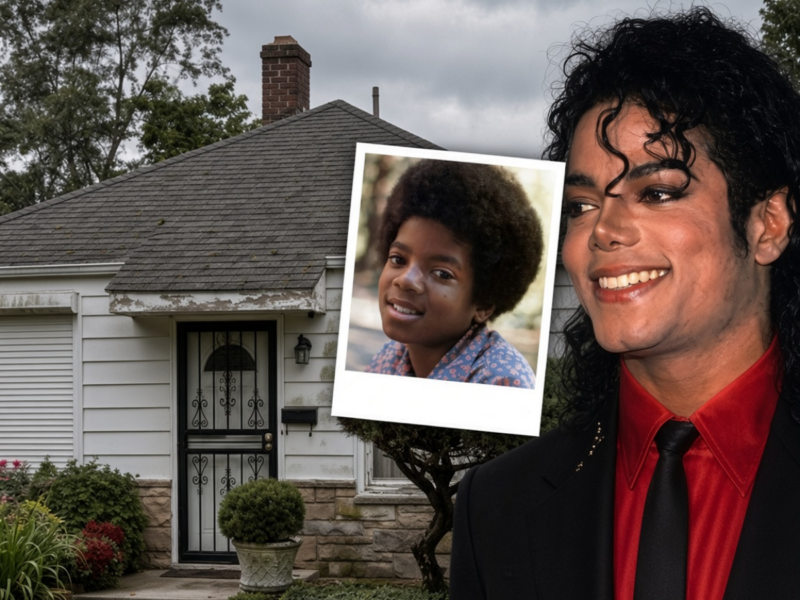
After 17 Years They Opened the Gary, Indiana House — What They Found Will Break Your Heart.
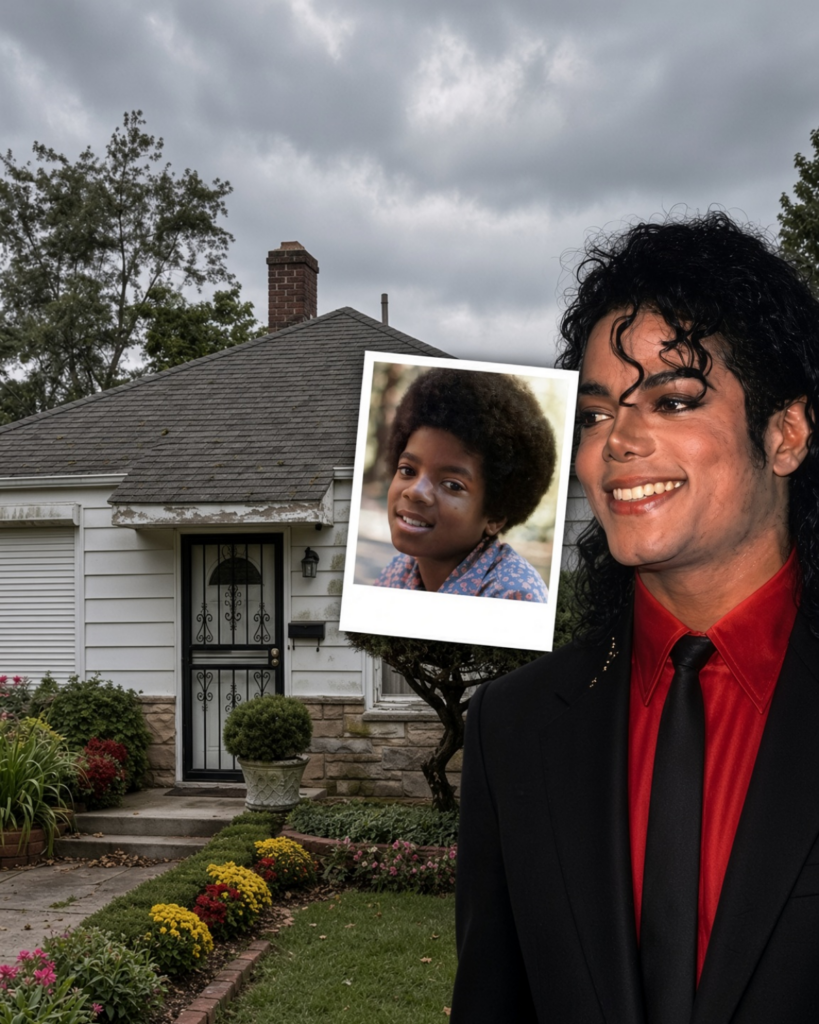
Some call it the crown jewel of Gary, Indiana.
A quaint two-bedroom home at 2300 Jackson Street.
People have come to visit that house since the Jacksons first emerged as youngsters.
The Jackson family keeps this house.
Seventeen years after the crown fell, darkness blanketed the front of 2300 Jackson Street in Gary, Indiana.
The pathetic little white bungalow stood dwarfed amidst towering legends.
No signs, no noise, only a cold iron fence and vacant windows where millions had once stood in silence, desperately wondering about Michael Jackson’s childhood.
The man stepped onto the porch, sliding the key into the lock.
After a choking heartbeat, a sharp click tore through the night.
The door cracked open, exhaling a freezing draft thick with the scent of memories.
He gave it a gentle push.
What emerged from behind that rotting timber stood in absolute defiance of every grandiose fantasy about the birthplace of the greatest musical empire on earth.
Stepping across the weathered threshold of 2300 Jackson Street, the first thing that struck the man was not a ghost or a strange noise, but the profound distortion of space.
The distance from the front door to the back wall was absurdly short.
The entire dwelling spanned a mere 672 square feet, anchored by just two modest bedrooms.
Yet inside that cramped matchbox, Joseph and Katherine Jackson had somehow managed to squeeze an entire sprawling family of eleven souls.
Decades later, Marlon Jackson would return to the old home and stand frozen in horror, looking back at the itty-bitty house where they once survived day by day, while Jackie vividly remembered how the living room served as a sweat-drenched battlefield for endless rehearsals.
The man walked slowly across the barren living room.
If one were to wind the clock back to the haunting days of the 1960s, this space offered not a single inch of breathing room.
Joseph and Katherine claimed one bedroom.
The five boys were wedged into the remaining dark room in a ruthless bunk bed hierarchy—Tito and Jermaine on top, Michael and Marlon in the middle, and Jackie stationed at the bottom.
The poor girls had no private corners whatsoever, forced instead to rest their bodies on the long living room sofas each night.
Thus, the grueling cycle repeated.
By night, the living room transformed into a suffocating dormitory.
By morning, the bedding had to be cleared away to make room for the daily life of the entire family.
A single room was forced to change its function multiple times within twenty-four hours, simply because there was not a single other square foot on earth belonging to them.
He tried taking steps, silently counting the distance from the front door to the bedroom.
Just a few footsteps.
Walking from the bedroom back to the living room took barely another short breath.
This was by no means the sort of tidy home where an adolescent could angrily slam an upstairs door, drown in a private world, and vanish for hours without anyone noticing.
The walls were so thin that the lives, breaths, tears, and even secrets of one person constantly spilled over and swallowed the space of another.
Here, people lived glued to one another like creatures trapped inside a glass cage.
And then, amidst that suffocation, his gaze halted on a strange detail.
The front window stood wide open, staring shamelessly across the street into the cold neighboring houses.
Tito Jackson, even after passing the halfway mark of his life, still carried a spine-chilling haunting memory of someone living right across the way.
Not because that person was a celebrated figure, but according to Tito, because it was a curious, morbid neighbor who constantly waited to snitch on every single move the Jackson kids made.
More than half a century passed, yet upon returning to 2300 Jackson Street, that name remained an indelible scar in Tito’s mind.
But it wasn’t the strangest memory connected to the windows of this house.
Another story would stay with Michael for years.
The Jackson children had been strictly warned by Joseph about a supreme rule.
They had to shut their bedroom windows tightly before falling asleep.
He wanted them to instill in their minds that a single loose gap meant any cold-blooded stranger out there could break into the house and rob them of their lives.
But instead of stopping at a dry, casual warning, Joseph, as Michael would later tremble in recounting, chose to deeply anchor that lesson through an extreme, almost pathological method.
He chose to wear a mask.
He waited until night completely swallowed the town of Gary, and then he quietly climbed back up through the bedroom window.
Michael carried the haunting trauma to the very end of his life concerning the moment that grotesque figure suddenly materialized in the pitch-black room.
The children bolted awake in sheer blinding panic, struck mute, their breathing frozen solid before the dark shape crawling clumsily through the glass pane—until the hideous mask was stripped away and they were left in shock to realize that the actor playing the monster was none other than their own biological father.
Joseph rationalized that it was a real-world lesson to teach his kids about vigilance.
But that harrowing memory clung so deeply to Michael’s mind that years later, even standing at the peak of the world, he could never forget the feeling of being pushed into a genuine nightmare by his own protector.
The traveling man stood frozen stiff right before the narrow window frame, his trembling fingers reaching up to touch the ice-cold lock latch.
If the room were plunged into the pitch-black darkness of those Indiana winter nights, a child half asleep would only have time to hear a spine-chilling creak before seeing a human silhouette crawl across the glass pane.
That bizarre psychological game lasted for only a few short minutes, but it permanently laid bare the lengths to which Joseph crossed every boundary of cruelty in order to shape his children.
And that monstrous mask was merely one dark chapter in a canvas overflowing with conflicting memories about him.
Michael had publicly torn away the halo to confess a paralyzing terror of his father, recounting blood-soaked training sessions.
“Well, you don’t get to do things that other children get to do. You know, the simple things that they so much take for granted.”
“Having friends and slumber parties and buddies and just hanging out. There was none of that for me. I didn’t have any friends when I was little. My brothers were my friends.”
La Toya had similarly painted a fractured, tear-drenched, and deeply wounded childhood.
“Michael was doing—um—I think it was Off the Wall, Thriller—and he was still getting beat. But what you guys see is him up on the awards accepting these awards and smiling, and my father’s chasing him around the house and he’s running from him terrified.”
It was precisely those opposing, tearing streams of memory that transformed Joseph Jackson into one of the most rugged and uncrackable enigmas in pop culture history.
But instead of trying to cleanly sort out right from wrong in the ashes of the past, a specific event—a cruel twist of destiny—erupted right within these cramped four walls, explaining why Joseph began pouring all his frantic fury and pressure onto the shoulders of his children.
Everything was triggered the moment Joseph discovered that someone had dared violate the ultimate forbidden zone: touching his prized guitar.
Worse still, a guitar string had been snapped clean.
And the wretched child guilty of that unforgivable crime was Tito.
Joseph’s guitar was an absolute taboo, a sacred zone that no one under the roof of 2300 Jackson Street was permitted to graze, even with a fingertip.
Tito understood better than anyone what terrifying punishment would descend if this secret were exposed.
Yet that suffocating prohibition transformed the forbidden item into an irresistible temptation.
On the afternoons when Joseph was away from home, as the cramped space settled into a rare, quiet lull, Tito would sneakily pull the guitar out to strum.
He fumbled and tortured his fingers to produce crude, clumsy chords that Joseph had never taught him for a single day.
For a brief period, that game of hide-and-seek with destiny seemed safe—until disaster struck in a moment of carelessness.
A taut string suddenly snapped with a dry, sharp pop out in midair.
Tito froze, dead cold sweat pouring down his body as he stared at the guitar in his hands.
He instantly understood what awaited him when Joseph walked back through the door.
The body of the instrument lay right there.
The truth could not be concealed, and no miracle could save a string broken in two.
When Joseph discovered the truth, his rage erupted like a volcano, ready to swallow the tiny room whole.
Yet, right at that darkest and most suffocating moment, a fateful turning point bent the history of mankind.
Instead of merely raining brutal beatings down upon his son’s small frame, Joseph reined in his anger, coldly hurled the broken guitar back into Tito’s hands, and barked a command.
“Play whatever you know. Let me hear it.”
Trembling violently, Tito clutched the instrument, his stiffened fingers striking strings in sheer panicky chaos.
Realizing the danger hovering over their heads, the remaining brothers hurriedly joined in, harmonizing background vocals to the jerky, disjointed notes.
And right there, within that suffocating space, the father who had once harbored his own failed musical fantasies suddenly awoke, realizing an invaluable treasure lay right inside his impoverished home.
These children—they possessed a monstrous talent far transcending any imagination.
It was a spine-chilling, miraculous paradox in music history.
One of the greatest families on the planet was ignited by an act of rule-breaking and a severed guitar string.
What if Tito hadn’t dared sneak the guitar away?
What if that fateful string had never snapped?
What if Joseph had only vented through violence instead of forcing his sons to perform?
Not a single soul held the answer.
All that was known was that from that second onward, life at 2300 Jackson Street was permanently fractured and reshaped.
The living room was instantly stripped of its original purpose, transformed into a sweat-drenched training dojo.
The young boys had to learn to synchronize every breath, every footstep, and were strictly forbidden from repeating any minor mistake.
Joseph didn’t want them to sing just for fun.
He wanted them sharp enough to sweep every talent contest out there.
Thumping footsteps repeated until their minds went numb.
Vocal harmonies matched down to the millimeter.
And choreography had to be as precise as clockwork.
Amidst that crowd of children, Michael—despite being far younger than his brothers by account—instantly shone like an anomaly.
He didn’t just hit the right notes.
He possessed a bizarre energy that knew how to hijack every single gaze toward himself.
Also, starting from this phase, stories concerning Joseph’s extreme harshness began weaving a gloomy shroud around the house.
Michael had publicly spoken about how a single misstep during practice could trigger ruthless punishments.
Over time, folklore and the fan community embroidered even more violent imagery—from Joseph constantly wielding a leather belt in every single rehearsal to brutal whipping without mercy.
Though the boundary between factual memory and mass myth had blurred, one truth remained undeniable.
The children were becoming increasingly flawless.
They began winning.
The name Jackson 5 began echoing across every nook and cranny of the steel town of Gary.
And then destiny pushed forward to a day when small promotional flyers for that child group caught the eye of a stranger named Gordon Keith.
Keith, at that time, could never have imagined that just a short while later he would stand frozen right in the cramped living room of 2300 Jackson Street, confronting Joseph, Katherine, and the flock of kids, only to be struck dumb when hearing the soaring voice of a boy named Michael echoing right in front of him.
He knew only one single thing at that moment.
At all costs, he had to find these children.
Gordon Keith had spotted the name “Jackson 5 plus Johnny” repeating across battered flyers all over the town of Gary, often enough to ignite an unquenchable curiosity.
Through a tangle of mutual connections, he managed to place a phone call to Joseph Jackson, and after a round of calculated bargaining, the fateful doors of 2300 Jackson Street finally creaked open to welcome him inside.
Then one afternoon, Keith stood tall right before that peeling wooden door—the very door the traveling man was now placing his trembling hand upon.
Joseph gave a cold, stiff nod, signaling the producer to step inside.
The living room was instantly thrown into chaos, rapidly cleared out to make space for a special audition.
The scarce furniture was shoved roughly against the sidewalls.
Bulky sound equipment crowded together to fill the suffocating gaps, and the five boys quickly locked into formation as a unified block.
In Gordon Keith’s later recollections, the presence of the kids alongside their crude instruments practically swallowed and consumed the entire cramped room.
Somewhere in a shadowy corner, Katherine quietly watched on alongside her daughters, while a tiny Janet remained just an infant, bewildered by the shifting times.
And then the music broke out.
Keith wasn’t merely listening to a group of teenagers singing casually to kill time.
From the very first notes, he caught a different scent.
The scent of wealth.
Of a flawless commercial product primed to conquer every music chart in existence.
The name Steeltown Records officially stepped into the Jackson saga from that exact moment.
And this was also the historical gray zone frequently eclipsed by the blinding halo of the Motown machine that followed.
The vast majority of the general public later grew familiar with the legendary narrative linking Diana Ross to the discovery of the Jackson 5, easily leading them to mistakenly assume Motown was the first to uncover the raw diamond.
But the truth was, before Barry Gordy ever laid a hand on them, before nationwide PR campaigns erupted, there had been grueling contest nights in the Midwest, Gordon Keith, and Steeltown sheltering them in the rawest of early recordings.
Even the question of who truly guided the Jackson 5 into the glorious doors of Motown remained a tangle of endless debates.
Diana Ross became the iconic figurehead presented to the world, but Bobby Taylor played an equally decisive role in throwing them into the crosshairs of the major label.
Behind the fairy tale of a major star accidentally plucking five poor boys lay a calculated gamble staked on countless human players, flickering stages, and desperate shots in the dark.
Yet before all those grand launching pads, the origin point of everything narrowed down to this exact living room.
The traveler stood frozen at the precise spot Gordon Keith had stood decades prior, squinting straight toward the opposite wall.
The distance was so short that if the five boys in their gear had crowded in, Keith would have had nowhere left to escape their field of vision.
And right within that suffocating, close-quarters space, an undeniable truth began shining brilliantly.
Michael was rising above them all.
Though history never recorded an official moment when Joseph stood in the middle of the room to declare the youngest son would become the brightest star in the cosmos, the bizarre energy radiating from Michael was something no wall or rule could cage.
The deeper they plunged into their musical journey, the more undeniable Michael’s central position became.
Then came 1969.
The doors of Gary were finally shattered wide open.
The Jackson 5 officially signed with Motown, packing up to abandon the steel town for the warm sun of California.
The tiny house that had once thundered with daily rehearsals abruptly plummeted into an eerie stillness.
The boys stepped out into the wider world, carrying dreams of striking it rich, never imagining that decades later, this exact address would transform into a pilgrimage shrine etched permanently into the minds of millions across the planet.
Number 2300 Jackson Street sank deep into the past—until June 25, 2009.
The fateful day that snatched away the life of Michael Jackson.
And almost immediately, unfamiliar faces came swarming back, sealing off the old house.
Yet this time, they carried no recording contracts or million-dollar checks to scout talented kids.
They came purely to desperately hunt down the final remnants of a legend who had permanently buried himself in death.
Just hours after news of Michael Jackson’s passing shook the planet, 2300 Jackson Street began morphing under a blanket of deep mourning.
Floods of people poured in from everywhere, transforming the cold iron fence into a sea of fresh flowers, portraits, tear-drenched letters, stuffed animals, and countless memorial tokens blanketing the entrance.
Thousands who had never once set foot in the steel town of Gary crossed thousands of miles to get here, just to stand in numb silence for a few minutes right outside the window where young Michael used to curl up to sleep through freezing nights.
Yet lurking deep beneath that wave of remembrance was another obsession tearing at the public mind.
Inside that house, what actual fragments of Michael still remained?
It proved fertile soil for morbid, mystical rumors to sprout.
Within hardcore fan communities, whispers circulated that inside those rotting walls, original traces from childhood still survived—that the family was hoarding old items, unreleased photos, or even that Michael’s bedroom remained sealed and preserved like a private museum.
Not a shred of credible evidence backed those sensational rumors.
Yet they refused to die down simply because the vast majority of the world would forever be forced to stare inward from outside the fence in sheer futility.
Even so, another painful truth genuinely unfolded.
Immediately following Michael’s death, a granite memorial plaque dedicated to him had been erected with solemn grace in front of the house, bearing an image tied to his timeless hit, “Never Can Say Goodbye.”
Yet as the years passed, that plaque quietly vanished.
The sudden disappearance of the most prominent memorial fixture sparked a fresh wave of skepticism within public opinion.
Who ordered its removal?
Who stood behind that cold decision?
And what ultimate fate awaited this house in the hands of heirs?
Then came 2017, when a black car slowly rolled to a halt before the familiar address.
Janet Jackson returned.
Accompanying her was her brother Randy.
Janet stepped slowly out of the vehicle.
Her eyes swept over the aged bungalow, and right then, the armor of a global superstar shattered.
She broke down into heavy, unconsoled sobs right on the front porch.
That moment carried a heart-wrenching weight, because Janet had no need to step into a hidden room or hunt for buried treasure to be brought to her knees.
After decades spent navigating dazzling stadium lights, luxury hotels, earth-shaking global tours, and a glittering world entirely divorced from Gary, the battered little house before her remained the only place harboring the purest version of her family—a sacred asset that not all the money on earth could ever buy back.
And then the ruthless wheel of time continued plucking away the final witnesses of the old family portrait.
Joseph Jackson drew his final breath in 2018.
Six years later, it was Tito Jackson’s turn to bid farewell to the mortal world.
Michael had been gone since 2009.
The three figures who had held the most violent, tragic chapters inside this house now existed solely as names locked in memory.
Yet, strangely enough, a gloomy premonition had enveloped the Jackson family long before those deaths came knocking one by one.
In 1989, they had taken the address of their old home—2300 Jackson Street—to name an album and a title track.
And if one listened closely to the voices ringing out in that song, it felt like a desperate attempt by the entire family, using music to drag each other backward into the past, struggling to rebuild the old roof through melody, when in actual reality, each had drifted off to completely distant horizons.
In 1989, the world witnessed the birth of an album titled 2300 Jackson Street.
It wasn’t some lavish landmark cooked up by PR strategists, nor was it some abstract concept.
It was simply the address of the battered bungalow in the steel town of Gary.
Yet the most wondrous and bittersweet element lay hidden right within the title track.
Michael joined in.
Janet joined in.
La Toya, Rebbie, Jackie, Jermaine, Randy, Tito, and even members belonging to the next generation of the Jackson family raised their voices together.
An expansive family that once had to squeeze themselves raw beneath a roof spanning a mere 672 square feet now had to borrow an expensive recording studio and a song named after their old address just to appear side by side.
There was a heartbreaking irony wrapped inside that.
Back when they were crammed together at number 2300 Jackson Street, they had zero choice other than living skin-to-skin every single second.
By 1989, when each of them held massive fortunes, private mansions, stellar careers, and completely divergent worlds, reviving the sensation of the whole family in one spot required turning it into a commercial commodity.
The traveling man stood quietly frozen inside the empty living room, his tired gaze sweeping across the space one last time.
This used to be the girls’ night spot.
This used to transform into the ruthless rehearsal dojo for the Jackson 5.
This used to witness Gordon Keith’s fateful audition.
And decades later, this became the desperate destination of fans praying for a single glimpse from behind the iron fence.
Yet he didn’t stop there.
He stepped slowly across the threshold, pushing deeper into the dark bedroom of the boys.
If the old bunk bed system were reassembled right this second, five names would have to be present.
Jackie, Tito, Jermaine, Marlon, and Michael.
Yet two of those souls had long since permanently turned to dust.
He turned, walking into the small room of Joseph and Katherine.
Joseph was also no longer of this world.
Three vital focal points inside the house had now been permanently vacated, with no force on earth capable of filling them back up.
And that was the exact moment this journey of exploration dealt its most ruthless answer.
Not about sensational rumors.
Not about the grotesque mask in the deep night.
Not about the snapped guitar string.
And not about whatever secret Michael once hid inside the corner cabinet.
The most agonizing, soul-crushing truth at 2300 Jackson Street was simply this.
The tiny house remained spacious enough to hold all of them curled up together.
Yet the family that once breathed life into it could never exist in that fashion ever again.
The traveler slowly drifted back to the small bedroom.
The evening sun cast pale yellowish streaks through the window glass, stretching long and weary across the cold floor.
In a suspended fragment of time, he deliberately closed his eyes, wiping clean from his mind everything that happened after leaving Gary.
No Thriller.
No Grammy statuettes.
No Neverland.
No sweeping investigations.
No flesh-ripping court trials.
No tabloid scandals.
And absolutely no June 25th, 2009.
The room in his imagination instantly reversed the clock.
Michael was nothing more than a skinny, timid boy right then.
Marlon stood right beside him.
Tito and Jermaine stirred on the upper tier while Jackie guarded the bottom.
Out in the cramped living room, Katherine’s silhouette bustled about managing everything.
And Joseph still lived, standing tall with a stony gaze.
Not a single soul inside that tiny house could fathom the terrifying future awaiting Michael—that this little boy would eventually rise into a god hunted by the entire world.
Nor could anyone imagine there would come a day when millions of people would disregard the arduous distance, traveling thousands of miles just to stand frozen right outside the very door they used to lazily shove open every morning.
He snapped his eyes open, quietly walking out of the room.
Passing the living room, he halted before the front door.
No secret safe had been uncovered.
No lost diary lay upon the floor.
No band audio tape or sealed-off room existed.
The most thrilling rumors ultimately drifted off into utter futility.
Yet at that moment, none of those things held the slightest shred of meaning anymore.
He stepped fully onto the wooden porch, placed his palm on the heavy door, and pulled it toward him.
Right before the gap swallowed the remaining light inside, he glanced back at the house one final time.
If imagination were allowed to linger for a few extra heartbeats, one could faintly hear clumsy guitar strumming, the patter of children’s feet racing across wooden floorboards, a stern shout urging them on from the next room, and five boys frantically harmonizing over an unfinished song.
Then the final streak of light vanished.
Click.
The door snapped shut, returning 2300 Jackson Street to the absolute silence of a graveyard.
Seventeen years after the death of Michael Jackson, the most heart-shattering thing to be found in this place was never a secret buried beneath rubble.
It was the permanent absence of the three souls who brought it to life.
Men who could now never step across that threshold alongside their family ever again.
Michael.
Joseph.
Tito.
The dust-choked house still stood tall.
Yet the family that made it a legend at 2300 Jackson Street could never be made whole again.









