9 Strange Things Found In Michael Jackson’s House.
November 2003.
This is the date the world has never been able to forget.
More than seventy officers from the Santa Barbara County Sheriff’s Department descended on a 2,700-acre property in Los Olivos, California.
They had a warrant.
They had a mission.
And what they found inside the gates of Neverland Ranch would fuel speculation, controversy, and obsession for decades.
But that raid wasn’t the only time strange things were discovered in Michael Jackson’s homes.
When he died on June 25th, 2009, investigators walked into his Los Angeles mansion and found a scene that shocked even seasoned detectives.
And years later, urban explorers who sneaked into the abandoned Neverland Ranch discovered things that made their skin crawl.
Michael Jackson was a genius.
He was a legend.
He was the King of Pop.
But he was also a man who collected things.
He collected toys, dolls, mannequins, arcade games, statues, costumes, and artifacts.
He collected so many things that his homes became museums of the bizarre.
Some of what he collected was whimsical and childlike.
Some of it was deeply unsettling.
Some of it raised questions that have never been fully answered.
Let’s begin with Neverland Ranch itself.
When Michael Jackson purchased the property in 1988 for an estimated $17 million, he didn’t just buy a home.
He bought a fantasy.
He named it after Peter Pan’s magical island—the place where children never grow up.
And then he spent up to $35 million transforming it into a full-scale amusement park and private zoo.
There was a Ferris wheel.
A full-sized carousel.
A small roller coaster called the Turtle Train.
A twenty-car bumper car ride.
A go-kart track.
A Zipper ride that stood eighty feet tall with twelve cars that rotated and flipped.
And a private zoo filled with exotic animals, including elephants, giraffes, orangutans, and his famous chimpanzee, Bubbles.
But it was the smaller things that truly raised eyebrows—the things found inside the house, the things that made visitors pause and wonder, and the things that investigators cataloged during that 2003 raid.
One of the most unsettling discoveries was a collection of life-size, childlike mannequins.
These weren’t ordinary mannequins.
They were realistic.
They were detailed.
And according to reports, they could be placed in whatever position Jackson wanted.
Photos taken during the 2003 search show these mannequins scattered throughout the property.
Some were in the arcade room.
Some were in the bedroom.
Some were standing in hallways.
They looked like children frozen in time.
Investigators described them as disturbing.
Jackson’s defenders said they were simply part of his artistic vision—a way of keeping childhood alive around him.
Then there was the secret room.
It was hidden behind Jackson’s walk-in wardrobe at Neverland Ranch, sealed shut with three deadbolt locks.
The room was dimly lit.
It contained extra couches and beds.
And according to a seventeen-year-old teenager named Ahmed El Attab, who spent six nights at the ranch, it was where Jackson would sleep with children.
“It is his secret room,” Ahmed told reporters.
“Anyone is welcome to stay the night or even a few days.”
Dozens of unmarked videotapes sat alongside toys, video games, and remote-control cars.
Police had searched the ranch in 1993 but failed to find the room hidden at the back of the wardrobe.
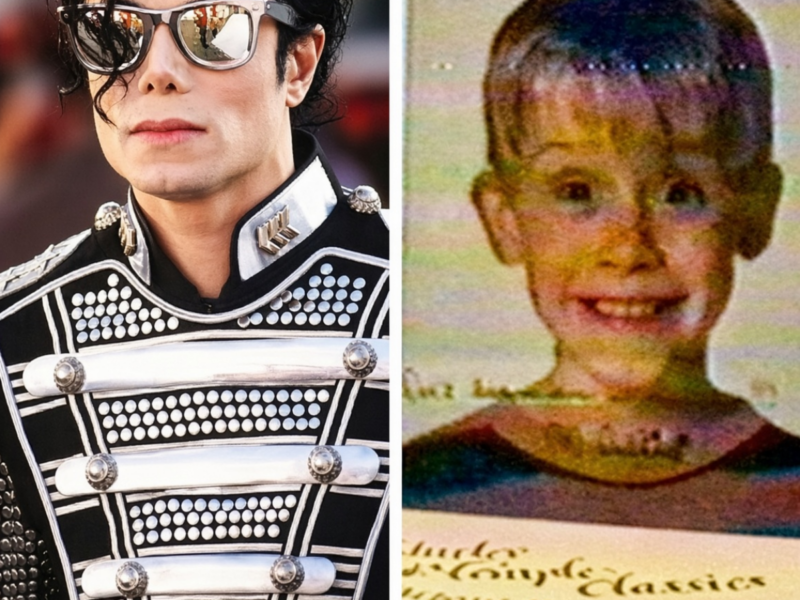
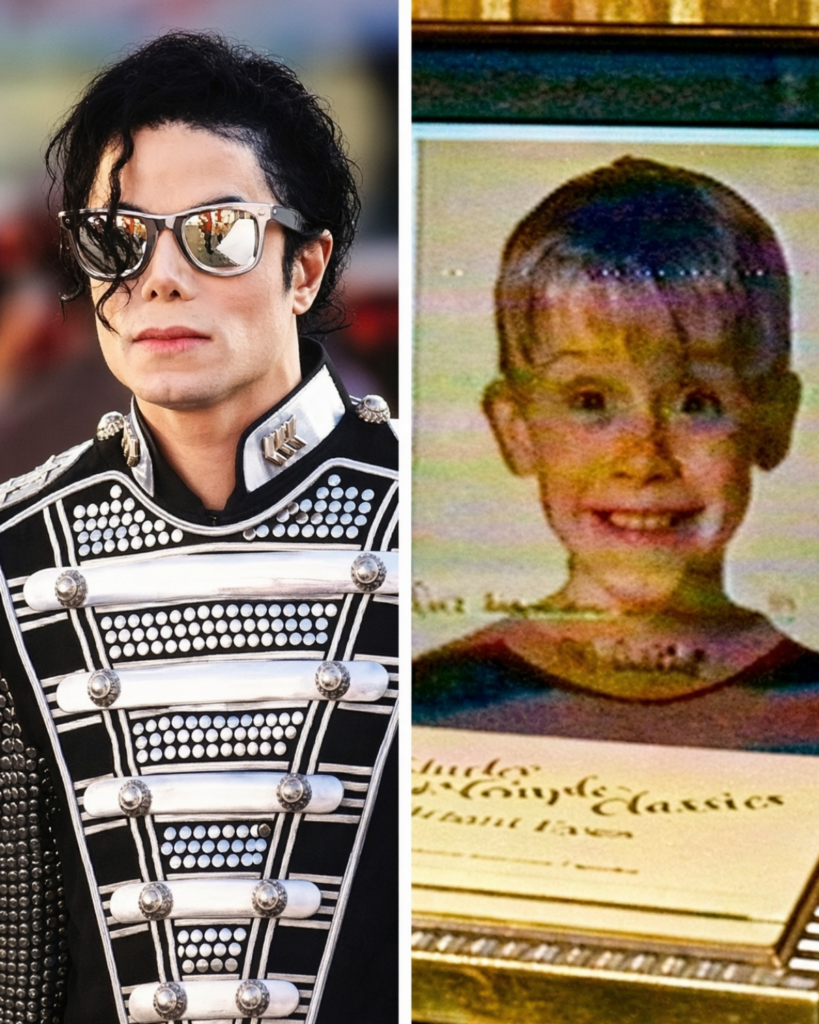
Inside that secret closet, investigators found something that has haunted people for years: a framed portrait of Macaulay Culkin, the child actor best known for Home Alone.
The photograph was signed by Culkin himself, and the inscription read, “Don’t leave me alone in the house.”
That message, written by a child, found in a hidden room behind three deadbolts, has been analyzed and debated for decades.
Some say it was a joke between friends.
Others say it was something far darker.
The secret closet also contained a shrine to Shirley Temple.
There were dolls, teddy bears, racing cars, Disney merchandise, remote-control cars, and a pair of Muhammad Ali’s boxing gloves.
It was a bizarre mixture of childhood innocence and celebrity memorabilia, all locked away where no one could see.
But the most disturbing discoveries were the books and images.
Police reports from the 2003 raid describe collections of photographs and books.
Investigators noted in their reports that this type of material can be used as part of the grooming process, by which people lower the inhibitions of their intended victims and facilitate the abuse of said victims.
Jackson’s defense team argued that the materials were art books, legally purchased, and that no child was ever found.
Jackson was acquitted of all charges in 2005, but the images remain a source of controversy and pain.
The bedroom itself had several locks, including a door that could only be opened from the outside using a combination keypad.
Prosecutors alleged that this was where the abuse occurred.
The defense argued that Jackson simply valued his privacy.
The truth, like so much about Michael Jackson, remains contested.
And then there was the painting.
Above the bed in the loft area, investigators found a large artwork that resembled Leonardo da Vinci’s The Last Supper, but instead of Jesus in the center, there was Michael Jackson.
He was surrounded by historical figures including Abraham Lincoln, John F. Kennedy, Albert Einstein, Walt Disney, and Elvis Presley.
It was a grandiose, almost messianic image.
Jackson had commissioned it.
He had hung it in his bedroom.
And it told the world exactly how he saw himself—not just as a pop star, but as a figure of historical significance, a man on par with the greatest minds and leaders in human history.
Now let’s talk about the things found inside Jackson’s Neverland Ranch that were simply strange.
Not disturbing, not evidence of anything.
Just strange.
There was a door knocker shaped like two men kissing each other.
It was an odd choice for a front door, and it raised questions about Jackson’s sense of humor and his aesthetic.
Why would a man who presented himself as a family-friendly entertainer have a door knocker depicting a same-sex kiss?
It was one of the many contradictions that made Michael Jackson so impossible to fully understand.
There were statues of boys scattered throughout the property.
There were bronze sculptures of two boys playing leapfrog.
There was a life-size sculpture of two boys on a bicycle.
There were fairy figures placed alongside statues of barely dressed children.
Jackson had a fascination with childhood, with innocence, with Peter Pan.
But the sculptures blurred the line between celebration and obsession.
There was his own golden throne.
Yes, Michael Jackson had a throne.
It was made of gold, jewels, and fine fabrics.
It was placed prominently in one of his homes, and it was yet another sign of how Jackson saw himself.
He wasn’t just a singer.
He was royalty.
He was the King of Pop, and he wanted everyone who visited his home to know it.
There was a fortune-teller machine—the kind you see at carnivals, the kind that dispenses a card with your future written on it.
Jackson kept one in his home.
Did he use it?
Did he believe in it?
We’ll never know.
But its presence adds to the sense that Neverland was not just a home.
It was a fantasy world, a place where reality was suspended, a place where a man could escape from the pressures of fame and live in a dream.
The carousel was another oddity.
It wasn’t just any carousel.
According to reports, some of the animals on it were holding things in their snouts, and they made whining noises.
It was a detail that seemed designed to unsettle, to make visitors feel like they had stepped into a world that was slightly off-kilter.
The hyperbaric chamber.
This is one of the most famous rumors about Michael Jackson, and it’s one of the few that he actually acknowledged.
He was photographed sleeping in a hyperbaric oxygen chamber.
The rumor was that he slept in it every night because he believed it would keep him young forever.
Jackson later said he had only used it once for a burn treatment and that the photo was leaked without his consent.
But the fact remains: there was a hyperbaric chamber in his house.
And for a man who was obsessed with Peter Pan, with never growing up, with staying young forever, the symbolism was impossible to ignore.
Then there was the painting of Michael Jackson with a group of children.
It wasn’t just any painting.
It was a drawing that showed Jackson surrounded by young kids, all of them looking at him with adoration.
The question that immediately came to mind for anyone who saw it was simple: Where was he taking them?
What was the context?
What was the meaning?
Jackson never explained, and the ambiguity became part of the mythology.
There were the stacks of fan mail.
This might not sound strange, but the sheer volume was staggering.
Boxes and boxes of letters from fans around the world.
Years’ worth of correspondence.
Jackson kept it all.
And among that fan mail, one item in particular stood out.
Urban explorers who entered the abandoned Neverland Ranch in 2007 and 2008 found a piece of mail that grabbed their attention.
It was a photograph of the prosecuting attorney from Jackson’s case, and someone had drawn devil’s horns on his head.
It was a small, petty, angry thing, but it was lying there on a tabletop as if Jackson had been looking at it recently.
It was evidence that even in his fantasy world, Jackson couldn’t escape his anger and his pain.
The explorers also found something else that they described as creepy.
It was a logo that appeared everywhere: a little boy in pajamas sitting on a crescent moon.
It looked almost exactly like the DreamWorks logo.
It was painted on the ground sixty feet wide.
It was on signs, on bumper cars, on the coach station.
It was everywhere, and to the explorers, it was deeply unsettling.
“The strangest thing to me was the little boy in pajamas sitting on the moon logo everywhere,” one explorer said.
“It was creepy.”
Now let’s move to Michael Jackson’s final home—the Los Angeles mansion where he died on June 25th, 2009.
When investigators walked into his bedroom, they found a scene that was both heartbreaking and horrifying.
The room was littered with medical paraphernalia.
Tables were covered with vials of drugs, syringes, and tubes.
Plastic bags containing latex gloves, creams, and saline bags were scattered on chairs and tabletops.
There were various tubes of pills and tablets.
An IV stand stood in the corner.
A loose needle was found nearby.
There was a computer on the bed.
There were Post-it notes with scrawled messages.
There were piles of books and dolls.
And there was a lifelike doll on the bed staring up at the ceiling.
But what truly stunned investigators was the shrine to babies.
A wooden dresser had a large white sign hanging from the drawers.
An image of a baby wearing a hat was visible in the corner.
The phrase “sweet baby” was written in red font on the left.
Above the sign, large circular images of babies crowded the top of the furniture piece beneath a grand mirror framed in gold filigree.
There were advertisements of pictures with babies on the walls.
Detective Martinez, who investigated the scene, said, “There was a computer on the bed. There was kind of like advertisements of pictures with babies. Everybody knew about the allegations that had been leveled against Mr. Jackson over the years. One of the things, when I saw the laptop on the bed, do I go into it? But you have to realize the type of case I was investigating.”
The room was also impossibly hot.
There was a fire going in the fireplace, even though it was the peak of summer in Los Angeles.
The room smelled terrible because Jackson had forbidden anyone from cleaning it.
And hanging in the closet was a collarless white shirt stained with dried blood.
Jackson’s bedroom was a contradiction.
It was the room of a man who was preparing for a comeback tour, a man who was excited about the future.
But it was also the room of a man who was in tremendous pain, who was relying on a dangerous cocktail of drugs to sleep, who was surrounded by images of babies and dolls and medical equipment.
It was the room where Michael Jackson died.
And it told the story of a life that had become impossible to sustain.
The 2003 raid of Neverland Ranch uncovered even more strange items.
Investigators seized notes, diaries, documents, photographs, audio tapes, and video tapes.
They took more than eighty video recordings and computer hard drives.
They found a briefcase of documents.
They found wine bottles that were forensically tested.
They found a bedroom suite with several locks.
They found a publication titled Hustler Barely Legal Hardcore.
They found a notepad with sketches of a face paired with different noses.
Among the most bizarre items seized were documents relating to something called The Rubber Head Club.
It was a club that Michael Jackson had apparently created.
The membership requirements were listed in a portfolio.
All members must be idiots and act crazy at all times.
All members must read and know the story of Peter Pan fluently.
All members must be vegetarians and fast on every Sunday for good health.
All members must have the brain power of a two-year-old child.
All members must watch at least two episodes of the Three Stooges every day.
And every member must take flying lessons at the Peter Pan School of Flying.
It was absurd.
It was childish.
It was also deeply revealing.
Michael Jackson wanted to live in a world where adults could be children, where responsibility and maturity didn’t exist, where everyone could be an idiot and act crazy and watch cartoons.
It was a fantasy, but it was a fantasy he tried to make real.
There was also a handwritten note found among the memorabilia.
It was addressed to Michael’s late sister-in-law, Dee Dee.
It said, “Please read this article about child molestation to Michael’s nephews, Taj, T.J., and Taryll. It brings out how even your own relatives can be molesters of children or even uncles or aunts molesting nephews and nieces. Please read. Love, M.J.”
That note is one of the most chilling things ever found in Michael Jackson’s possession.
Why would he send an article about child molestation to his nephews?
Why would he warn them about uncles who molest their nieces and nephews?
Was it a genuine attempt to protect them?
Was it a projection of his own guilt?
Was it a sign of his awareness of the accusations against him?
We will never know for certain, but it remains one of the most disturbing artifacts from a life that was filled with disturbing artifacts.
There were other things.
A black tuxedo worn not by Michael Jackson, but by his pet chimpanzee Bubbles.
An assortment of Janet Jackson’s bras.
Fifty-six master recordings of the Jackson 5 containing never-released songs.
Court documents from a 1987 restraining order that Michael Jackson sought against a woman claiming to be the Billie Jean from his hit song.
Michael’s Peter Pan collection.
A box of his childhood toys, including a troll doll with yellow hair.
Costumes and gloves and hats and socks from his performances.
A golf cart with an image of Jackson as Peter Pan on the hood.
A robot head from the film Moonwalker.
A Swarovski crystal-studded glove.
An Elizabethan portrait.
And there was the story of the mannequins again.
Because the mannequins weren’t just in one room.
They were everywhere.
Life-size, childlike mannequins in every room of the house.
They were part of Jackson’s collection.
They were part of his aesthetic.
But they were also deeply unsettling.
Why did Michael Jackson need so many mannequins?
What was he trying to recreate?
What was he trying to hold on to?
Some have suggested that the mannequins were a way for Jackson to surround himself with the childhood he never had.
He was a child star.
He never had a normal childhood.
He never had friends his own age.
He never had the freedom to play and explore and just be a kid.
So he created a world where childhood was frozen, where children never grew up, where he could be a child forever.
That’s the charitable interpretation.
The less charitable interpretation is that the mannequins were part of something darker, something that the investigators were trying to uncover, something that Jackson took to his grave.
In the end, the strange things found inside Michael Jackson’s homes may never provide one simple answer about who he really was.
They only show fragments.
Some beautiful.
Some disturbing.
Some confusing.
Some impossible to interpret.
But together, they form a portrait of one of the most complicated figures in entertainment history.
Michael Jackson wanted to remain forever young.
Instead, he left behind a frozen world of memories, objects, photographs, costumes, toys, and unanswered questions.
And long after the music stops playing, those questions may be the things that keep people looking back.









