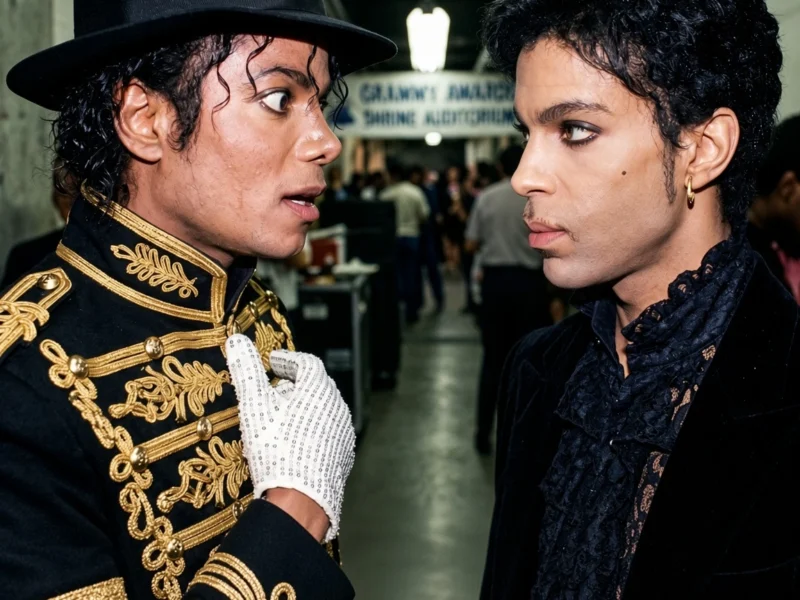
1985: Prince DARED Michael Jackson Backstage at the Grammys — Michael Never Saw It Coming.
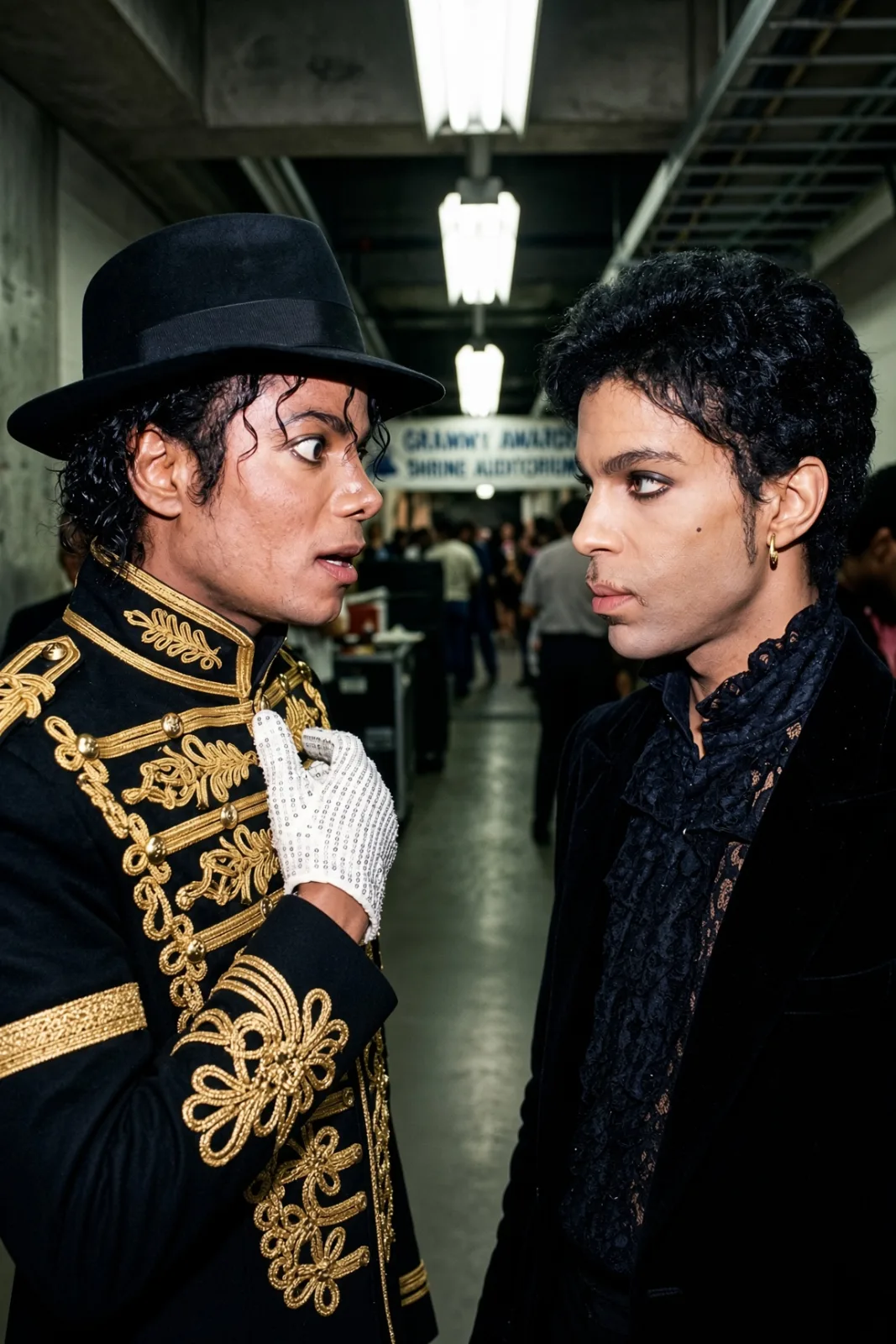
Prince was already in the corridor when Michael arrived.
That was the thing nobody planned for.
The thing the production schedule and the green room assignments and the careful logistics of a Grammy night with 37 million viewers hadn’t accounted for.
Two men in the same hallway at the same time.
12 months of unspoken competition between them and no handler fast enough to redirect either one before they were already looking at each other.
February 26th, 1985.
The 27th Grammy Awards.
Shrine Auditorium, Los Angeles.
In about 40 minutes, one of them was going to perform on that stage and do something that would be talked about for the next 40 years.
The other was going to watch it happen.
And what passed between them in that corridor in the minutes before any of that was the reason the performance became what it became.
If you’ve ever been in a room with someone who knew exactly what you were carrying and said nothing and let the silence do the work instead, you already understand this corridor.
Hit that subscribe button because what happened here has been told in pieces for 40 years and never quite like this.
Prince had spent the last 12 months doing the one thing Michael Jackson’s record-breaking Grammy night had convinced him he needed to do.
He had watched the broadcast on February 28th, 1984.
Sat in his living room while Michael collected eight awards while the telecast hit the highest ratings in Grammy history while the industry assembled to confirm what everyone already knew.
Thriller was the biggest album in the world, and Michael Jackson was the only person anyone was talking about.
When the broadcast ended, Prince turned to Bobby Z, his drummer, and one of his oldest collaborators, and said the thing that would define the next year of his life.
Next year, that’s going to be us.
Purple Rain wasn’t finished yet.
The movie wasn’t done.
The album was still being assembled.
But Prince knew what he had.
knew it the way he always knew things about his own work with the absolute interior certainty of someone who had been right about himself since he was 16 years old.
He went back to Minneapolis and he finished it.
He made a film.
He made a soundtrack.
He made something that by the summer of 1984 had become the number one album, the number one movie and the number one single in America simultaneously.
a trifecta that nobody had achieved before and that he had constructed deliberately and precisely in direct response to watching Michael Jackson collect eight Grammys 12 months earlier.
He had kept the promise.
Nobody said it out loud.
Nobody needed to.
Michael Jackson arrived at the Shrine Auditorium on February 26th, 1985.
Carrying something he hadn’t expected to still be carrying 12 months after the greatest night of his career.
Not the eight Grammys.
Those were in his house in whatever arrangement people put things they’ve stopped needing to look at.
What he was carrying was the particular weight of being last year’s story.
Thriller was still the bestselling album in the world.
It would be the bestselling album in the world for decades, but the industry had moved on the way the industry always moved on to the next thing, the next name, the next record that needed to be celebrated and absorbed and replaced.
And the name the industry was moving toward, the record it was now assembled to honor, was Prince.
Stay with me because this is where everything that happened that night begins to make sense.
Nobody backstage was ready for what happened next.
Nobody.
The corridor had that particular Grammy night quality.
Organized chaos held together by headsets and clipboards.
The compressed energy of a production managing a hundred things simultaneously.
People moved through it with purpose.
Nobody lingered.
You were on your way somewhere specific or you were in the way.
Prince was in the corridor outside the staging area in the ruffled shirt, the high-waisted trousers, the heeled boots that added 2 in to a frame that didn’t need them.
He was not pacing.
He was not warming up.
He was standing the way he always stood, completely still, completely present, the kind of stillness that looked like rest, but was actually a form of attention.
He was watching the corridor the way a person watches something they are about to own.
Michael came around the corner with two people from his team.
He saw Prince before Prince turned.
He stopped.
There was a beat 3 seconds maybe four where Michael Jackson was standing in a Grammy corridor looking at Prince and understanding in the specific way you understand things that you’ve been thinking about without saying that this was the conversation they had been not having for 12 months.
Prince turned and the corridor went quiet in the way corridors go quiet when something is happening that the people in them recognize without being told.
This next part is the one nobody in that building saw coming.
Nobody.
What people who were there always said, the ones who were close enough, the ones who had reason to be in that hallway and the sense to stay still and not interrupt, was that Prince didn’t speak first.
He didn’t need to.
He just looked at Michael with the expression of a man who has done the thing he said he was going to do and is now standing in front of the person he said it about and the expression itself was the dare.
Michael had been 26 on the night of eight Grammys.
He was 26 still but he had spent 12 months watching the world’s attention move.
Feeling it move the way you feel a temperature change before you can name it.
And he understood what he was looking at in that corridor with a clarity that required no explanation.
Prince had watched him collect eight Grammys.
And then Prince had gone away and made Purple Rain.
And Purple Rain had done what it did.
And now they were standing in the same corridor.
And Prince had five nominations.
And three of them were going to be wins.
And one of them, the performance, the thing that happened on that stage was going to be the thing everyone talked about when they talked about this night.
And Michael knew it.
This is the moment the whole story turns on.
Don’t go anywhere.
What Michael Jackson did in that moment was the thing that only a very specific kind of person knows how to do.
He didn’t retreat.
He didn’t defer.
He stood where he was and he let the silence hold for one more beat.
And then he said something close to you’ve had a good year.
Three words that were not three words that were 12 months of watching and understanding and not saying delivered with the particular grace of someone who knows how to take something that could be a concession and make it sound like an acknowledgement between equals.
Prince looked at him.
We’ve had a good year.
Prince said the Wii was the revolution.
It was also something else.
It was the industry.
It was the conversation.
It was the acknowledgment that what had happened between these two men over the last 12 months wasn’t a competition that one of them had won so much as a standard, but both of them had raised for each other, whether either one would have put it that way or not.
Michael was quiet for a moment.
Then he said, “I heard the album.”
Prince waited.
“The ballad,” Michael said.
Something in his voice changed.
Not softer exactly, but more specific, less public.
Purple Rain, the song, Prince said.
Nothing.
He had a way of receiving things by being completely still.
I didn’t expect it.
Michael said that song.
He paused.
I didn’t know you had that in you.
If you’re feeling this story, if you understand what it means to have someone you’ve been measured against for years see you clearly for the first time, hit that like button because what Prince said next is the thing that people who were in that corridor carried quietly for years.
Prince looked at him for a long moment.
When he spoke, it was with the patience of someone who has been waiting a very long time to say a specific thing to a specific person.
I’ve always had it in me, Prince said.
I just needed a reason to use it.
The corridor held that sentence.
Michael Jackson looked at him and something shifted in his face.
Not surrender, not concession, but the particular recognition of one musician for another when the other has said something true.
The look of a man who has just been shown something about his own field by someone he had been in competition with and is now for the first time considering the possibility that the competition was the point that the competition had made both of them better.
That without the eight Grammys there was no Purple Rain.
Without Purple Rain there was no reason for what was coming next.
The movie too.
Michael said you made a movie.
It had to be bigger than a record.
Prince said you showed me that.
This was the part the witnesses always found hardest to explain, not because it was simple.
Two men in a corridor acknowledging without ceremony that they had been making each other’s work necessary for years.
That the throne they had been competing for was large enough for both of them.
That the competition had never really been about who was better so much as about what the music could be when both of them were pushing it.
Stick with me because what happened on that stage 20 minutes later is the reason this corridor conversation matters.
One of Michael’s team members appeared at the edge of the conversation, not interrupting, just present.
The signal that the night was moving and people needed to be where they were scheduled to be.
Michael looked at Prince.
You’re performing tonight, Michael said.
I am, Prince said.
I’ll be watching, Michael said.
Prince held very still.
Then something that was almost a smile, brief, private, the kind that doesn’t translate to photographs, moved across his face.
I know, he said.
Michael turned and walked down the corridor with his team.
He didn’t look back.
Prince stood where he was for a moment.
Then he turned back towards the staging area unhurried in the specific way he moved when something had happened that he’d been expecting for a long time and it had happened the way he’d known it would.
Sheila E was in the staging area waiting.
She had been there long enough to understand from the way Prince came back into the room that something had occurred.
You run into someone?
She said Michael.
Prince said.
She waited.
He said he heard the album.
Prince said the ballad.
What did you say?
Prince picked up his guitar.
Checked the tuning the way he always checked the tuning.
Not because it needed checking, but because the ritual of it was part of how he gathered himself before a performance.
I said I needed a reason to use it, he said.
Sheila looked at him.
And and now I have a better one, Prince said.
The room went so quiet you could hear the air conditioning.
What happened on the Grammy stage at the 27th annual Grammy Awards on February 26th, 1985 has been described in a hundred different ways by a hundred different people who were in the Shrine Auditorium that night.
Electric, uncontained, the best performance in Grammy history.
The thing that couldn’t be repeated because it wasn’t really a performance so much as a demonstration.
Prince showing 37 million people what it looked like when someone had something to prove to a specific audience of one.
He came out in the ruffled shirt and healed boots.
And he worked no marks and followed no blocking and moved through the stage the way electricity moves through a building.
Not in straight lines, not predictably, not in any way that the production had planned.
He pulled Sheila E into the spotlight.
He ran into the aisle.
He peeled off his shirt.
He turned the Grammy performance into something that felt like a happening, a thing occurring in real time that could not be anticipated or contained.
Michael Jackson watched from the wings.
He watched the way you watch someone do something you understand completely and are witnessing for the first time.
Not passive active the specific attention of a person who is absorbing what they’re seeing because they already know it’s going to change something about how they think about their own work.
When it ended in the shrine auditorium came apart.
15,000 people on their feet rising before they decided to.
Michael was still in the wings, not clapping with the crowd, just standing looking at the stage.
One of his team said afterward that they’d never seen him look at another performer that way.
Not with envy, not with competition, with the particular focused attention of someone who has just been shown something they needed to see.
This is the part that people who were there never told like gossip.
They always told it like something they were lucky to be near.
Because what passed between those two men that night in the corridor before and in the wings after was not the rivalry that the press had been writing about for 2 years.
It was something more specific and more useful than rivalry.
It was two musicians who had been pushing each other toward the edges of what was possible, using each other as the standard, building work in response to work and arriving on February 26th, 1985.
At the specific moment when both of them understood what that process had been, Prince left the Shrine Auditorium that night with three Grammys.
One for Purple Rain as best rock performance by a duo or group with vocal.
One for Purple Rain soundtrack as best score soundtrack for Visual Media.
One as songwriter for I Feel for You.
The song Chocakhan had turned into something that stopped radio stations cold.
He had promised Bobby Z that next year would be theirs.
He had been right.
Michael Jackson left carrying something harder to categorize than a granny.
He had walked in as last year’s story.
He had watched someone he’d spent a year being compared to deliver something that nobody could argue with.
And he had stood in a corridor and heard three words that would stay with him for the next 2 years while he assembled bad.
I needed a reason to use it.
Michael went home that night and started thinking about what his reason was.
Prince had said I needed a reason to use it.
He had meant the ballad, Purple Rain, the song, the tenderness of it, the openness, the willingness to stand at a microphone and be completely exposed in a way that his earlier work had never quite allowed.
And Prince had said, “I always had it. I just needed a reason.”
What he hadn’t said, what the corridor didn’t have room for, was what the reason actually was.
That the reason was Michael. that watching someone collect eight Grammys for an album that had cracked something open in the culture had made Prince understand that if he was going to answer that, he had to answer with everything.
With the ballot in the movie and the vulnerability and the thing he’d always had but never had reason to reach for because nothing had required it yet.
Michael had given him the reason without knowing it.
Sheila E came out after the performance to find Michael still in the wings.
She would say later that she had been surprised to see him there.
She had expected him to be back in the green room or heading toward the exit.
Instead, he was standing looking at an empty stage, the crew already resetting for the next segment, the crowd still settling from what they had witnessed.
She stopped beside him.
He didn’t say anything for a moment.
Then he said, “He was talking to me, wasn’t he? It wasn’t a question.”
Sheila looked at him.
She didn’t say yes.
She didn’t need to.
The whole time, Michael said, “The whole performance, he was talking to me.”
She said afterward that she had never heard a man say something like that about another performer.
Not with resentment, not with the bruised quality of someone who has just watched themselves be surpassed.
With something closer to admiration, the specific tone of someone who has just understood that the best thing that ever happened to their work was someone else being better than them.
Yeah, she said.
I think so.
Michael nodded slowly.
Then he turned and walked back through the door he had come from.
Already somewhere else in his mind, Sheila went back to find Prince.
He was in the wings on the other side of the stage, completely still looking at the empty stage the way Michael had been looking at it from the other side.
Michael was watching, she told him.
Prince looked at her.
I know, he said.
He’s going to make something now, Prince said.
Not a prediction, an observation.
The tone of someone reading a situation they understand completely bad.
Sheila said Prince considered this.
Then he said something.
He’s going to make something because of tonight.
He reached over and picked up one of the Grammys, turned it over in his hand, the way people turn over objects they want to understand physically.
Then he set it back down.
And then I’m going to have to make something because of that.
He said there was no frustration in it.
No exhaustion.
Just the simple, almost cheerful acknowledgement of a man who has chosen to live inside a process that has no end, who has organized his entire creative life around the presence of a standard that keeps moving, who would not have it any other way.
Sheila laughed.
It never stops, she said.
No, Prince said.
That’s the whole point.
If you carry anything out of this story, if there is something here that stays with you the way the real stories always do, that is your cue to hit that like button and subscribe.
Because every week on this channel, we go into the corridors where the cameras weren’t rolling and find the moments that tell the real story.
The Grammy is always on the wall, but the story is always somewhere else.
He picked up his guitar.
He was 26 years old.
He had just delivered one of the most electric performances in Grammy history.
He had three Grammys and an album that was already history and a promise he had made to Bobby Z 12 months ago that was now fully and completely kept.
He was already thinking about what came next.
that guitar was going to be used for something.
He just hadn’t decided what yet.
But Michael Jackson was already on his way home from the Shrine Auditorium and somewhere in the back of a car moving through Los Angeles at the end of a Grammy night, he was thinking about an album called Bad and what it would need to be and how high the standard now was.
And that in the end is what that corridor gave both of them.
Not a winner, not a loser.
Just two musicians standing four feet apart handing each other the reason to keep going.
Sometimes that’s what the real Grammy moment looks like.
Not the one on stage, the one in the corridor where nobody was watching, where the cameras couldn’t reach.
Where two people said the true thing to each other without quite saying it at all.
Prince picked up his guitar and went to find what came next.
He always did.









