1984: Michael Jackson DARED Dolly Parton to Sing Beat It Live — Nobody Was Ready.
February 28th, 1984, 8:47 in the evening.
The Shrine Auditorium, Los Angeles, California.
The 26th Grammy Awards had been running for two hours and forty-seven minutes.
Michael Jackson had already won six of the eight awards he would take home that night.
Record of the Year for “Beat It.”
Album of the Year for Thriller.
Best Pop Vocal Performance.
Best Rock Vocal Performance—the first Black artist to ever win in that category.
The trophies were lined up backstage in a row, and people kept stopping to count them because the number kept being higher than they remembered.
He was twenty-five years old.
The number eight had a particular weight that night.
Eight trophies.
Eight times the Recording Academy had called his name.
Eight times the room had applauded, and the applause had gotten louder each time, not softer, because the room was catching up to something it had not fully processed at the beginning of the evening.
He was twenty-five years old, and he had just made one of the bestselling albums in the history of recorded music.
And the industry had gathered in the Shrine Auditorium to acknowledge it.
And the acknowledging kept coming in waves that nobody had quite prepared for.
The Shrine Auditorium held six thousand people, and every seat was taken.
And the air had the particular quality of a room that understands it is watching something historic in real time.
Not the comfortable kind of historic, where you know what you’re seeing and can settle into it.
The uncomfortable kind, where something is happening faster than anyone can process, and the only thing you can do is watch.
She was thirty-eight years old.
She had been in country music since she was a teenager.
She had won two Grammys of her own.
She had written songs that crossed every boundary Nashville had tried to draw around her—songs that became pop hits, songs that became film soundtracks, songs that other artists covered and turned into something new while the original remained entirely hers.
She had built a career by being exactly who she was in every room she walked into.
And she had been walking into rooms that weren’t sure what to do with her for twenty years.
She had a particular relationship with that kind of room—rooms where she wasn’t supposed to be, rooms where the music was not the kind of music she made, and the people were not the people who usually paid attention to her, and the expectation was that she would be polite and professional and slightly out of place.
She had been in those rooms her whole career, and she had never once let the room define her.
She was sitting in the fourth row when Michael Jackson walked past her in the aisle.
He was moving between the seats and the stage—the particular controlled movement of a man who had spent his whole life performing and knew how to move through a crowd without being consumed by it.
He was wearing the red leather jacket, the one from the “Beat It” video, the one that had become as recognizable in 1984 as anything else in popular culture.
He stopped when he saw her.
He leaned down.
She was seated.
He was standing.
And he said, quiet enough that only she could hear, loud enough that she could not pretend she hadn’t: “I want to hear you sing ‘Beat It.'”
She looked at him.
She said, “Tonight?”
He said, “Right now. Tonight. On this stage before the show ends.”
She said, “Michael, I’m a country singer.”
He said, “I know. That’s why I want to hear it.”
She looked at him for a long moment.
Michael Jackson at twenty-five was not the same person he would be at thirty-five or forty-five.
At twenty-five, he had a quality that people who knew him in that period described consistently and with a kind of wonder.
He was completely certain about music.
Not arrogant, not dismissive of other people’s work.
But when he heard something, or wanted something, or believed something about sound, there was no space between the belief and the expression of it.
He wanted to hear Dolly Parton sing “Beat It.”
And the wanting was immediate and total and entirely without irony.
She said, “You’re serious.”
He said, “Always.”
She said nothing for a moment.
She looked at the stage.
She looked at the trophies lined up at the side of the room.
She thought about “Beat It”—the guitar, the rhythm, the specific quality of the song that had nothing to do with anything she had ever done.
It was a rock song built on confrontation, built on the refusal to back down, built on Eddie Van Halen’s guitar climbing somewhere that nobody had expected a Michael Jackson song to go.
She thought, I have never in my life backed down from a room.
She said, “You get me the words, and you get me thirty minutes, and you find me a guitar player who knows that solo.”
Michael Jackson smiled.
Nobody in that building was ready for what happened next.
The backstage of the Shrine Auditorium on Grammy night was not the most peaceful environment in which to attempt something impossible.
It was noise and motion and the specific pressure of a live television production running behind schedule and correcting itself in real time.
Producers with headsets.
Camera operators repositioning.
Award presenters being briefed.
The machinery of one of the biggest nights in American music trying to absorb, in thirty minutes, a performance that had not been scheduled, rehearsed, or cleared with anyone above a certain level of the production hierarchy.
Someone called someone.
Someone called someone else.
By the time the decision reached the level where a decision could be made, there were four minutes left.
The answer was yes.
The words were not the problem.
Dolly had heard “Beat It” a hundred times.
She knew every word.
She knew the melody.
She knew the rhythm, the way it built, the specific energy of the thing.
The problem was the guitar.
“Beat It” without Eddie Van Halen’s solo was not “Beat It.”
It was a song with a hole in it.
And the question of who was going to fill that hole in thirty minutes at the Shrine Auditorium on Grammy night was not a small question.
Michael’s production team was working on it before Dolly had finished agreeing.
The guitar player they found was a session musician named Ray Fox who had been working the Grammy broadcast all evening.
He was twenty-nine years old.
He had never played “Beat It” in his life.
He had thirty minutes to learn the solo.
He said later that those thirty minutes were the most concentrated musical experience of his life.
That he didn’t think about whether he could do it.
He just played it over and over until his hands knew it the way his hands knew things he’d been playing for years.
And when the thirty minutes were up and they told him it was time, he walked out with an acoustic guitar borrowed from someone backstage, and he played the opening riff, and it sounded, against all probability, exactly right.
Dolly was in the wing.
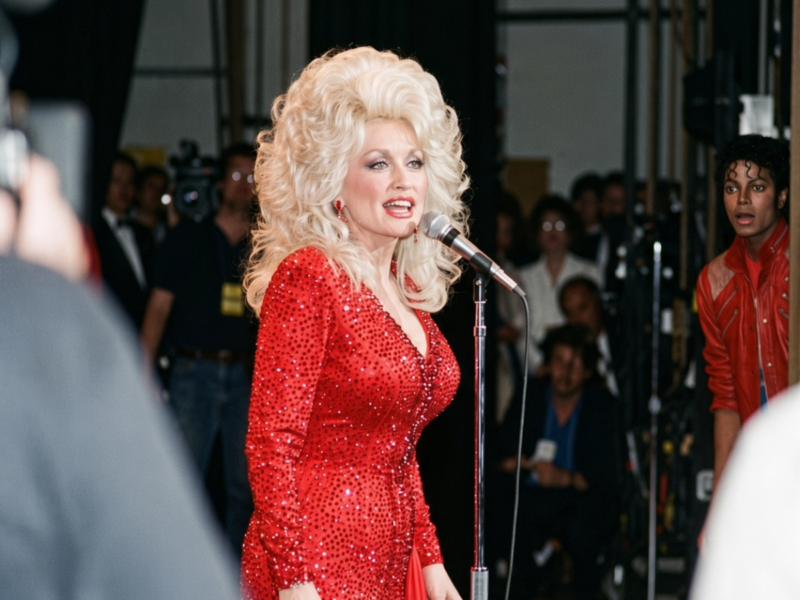
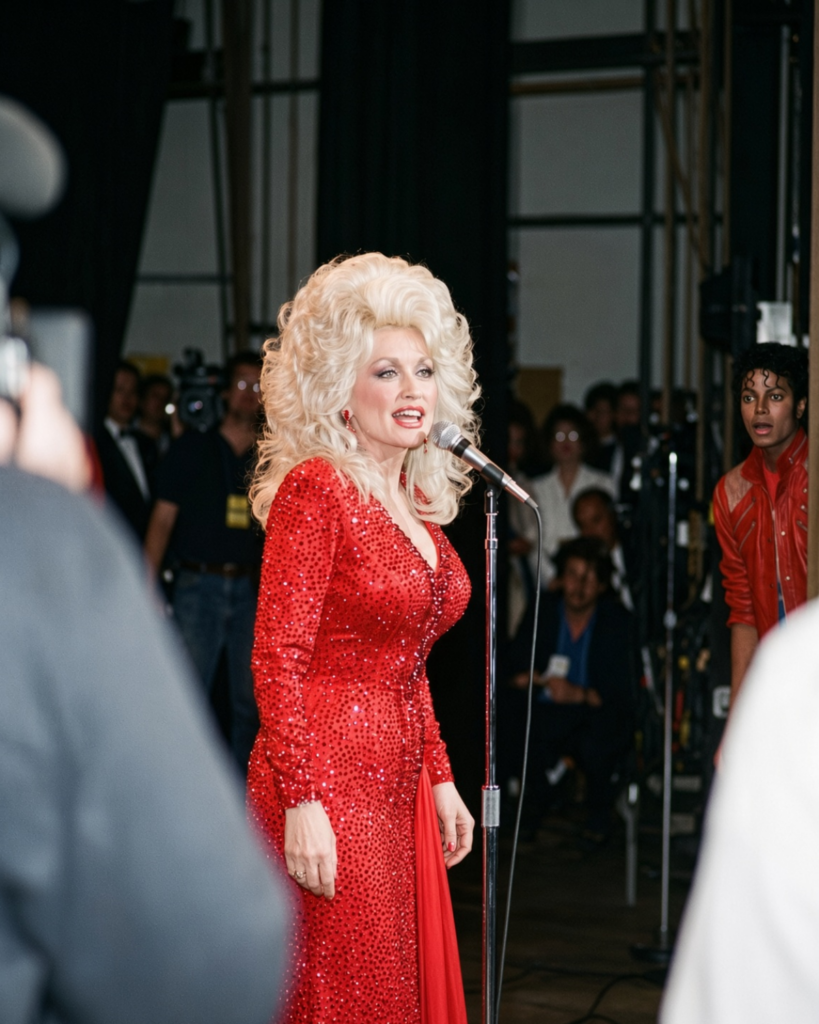
She was still wearing what she’d worn all evening—a red rhinestone gown that caught the stage lights the way only rhinestones catch stage lights, scattering them in every direction at once.
She had not changed.
She had not adjusted.
She was who she was, and she was about to go out there and sing a rock song in the most rhinestone outfit in the building.
She said to the production coordinator who came to get her, “Do I look like someone who’s about to sing ‘Beat It’?”
He said, “Honestly, no.”
She said, “Good.”
The introduction was minimal.
Michael Jackson walked to the microphone and said simply, “There’s someone here tonight who wants to try something.”
And then Dolly Parton walked out.
The response from six thousand people was the specific combination of confusion and delight that happens when something occurs that the audience had no framework to predict.
They knew Dolly.
They knew “Beat It.”
They could not imagine the combination, and they were about to hear it.
Ray Fox played the opening riff.
Dolly stood at the microphone.
She closed her eyes for exactly two seconds.
Then she opened them.
Then she sang.
What came out was not what anyone expected.
The six thousand people in the Shrine Auditorium had been prepared for a lot of things that evening.
They had been prepared for Michael Jackson winning eight Grammys.
They had been prepared for the big production numbers and the emotional acceptance speeches and the particular combination of spectacle and sincerity that the Grammy telecast tried to balance every year.
They had not been prepared for this.
For a woman in a rhinestone gown from Tennessee standing at a Grammy microphone and singing the hardest rock song of 1984.
Not because she sounded like Michael Jackson.
She didn’t.
She sounded like Dolly Parton—the specific voice, the specific instrument, the thing that came from the mountains of Tennessee and had spent twenty years traveling through every room in American music while remaining entirely itself.
She sounded exactly like herself.
But “Beat It” sounded exactly like “Beat It.”
The rhythm was right.
The defiance was right.
And this was the thing that nobody had expected.
The thing that made the six thousand people in the Shrine Auditorium go from confused to very still in the space of about eight bars.
The defiance that was built into “Beat It”—the specific energy of a song about refusing to be pushed around, about walking away from a fight without running from it.
That energy sounded completely natural coming out of Dolly Parton’s mouth.
Because Dolly Parton had been refusing to be pushed around for twenty years.
She just hadn’t been doing it with a rock guitar.
When Ray Fox hit the solo, something shifted.
He played it clean.
He played it the way he had learned it in thirty minutes backstage, the way Eddie Van Halen had played it in the studio in 1982 when he showed up and recorded it in twenty minutes as a favor and then went home.
He played it straight and true, and it rang through the Shrine Auditorium, and Dolly Parton was standing at the microphone while it played, and she did something that nobody in that room had seen coming.
She started to dance.
Not the full choreography, not the moves from the music video.
Just her.
The way Dolly Parton moved when the music was real, which was completely her own, completely specific, completely unlike anyone else.
She moved through the solo with the particular ease of someone who had been performing since she was seven years old and for whom the body’s response to music was as natural as breathing.
Six thousand people were on their feet.
Not politely.
Not the way audiences stand when they feel they should.
The way they stand when something has happened that they did not expect and their bodies have responded before their minds have caught up.
The way they stood was involuntary.
It came from the same place the defiance in “Beat It” came from, and the same place Dolly’s voice came from, and the same place every piece of music that has ever stopped a room dead and then brought it back to life has always come from.
The place where the truth lives.
She finished the song.
The room was on its feet, and it stayed on its feet, and the sound of six thousand people at full volume in the Shrine Auditorium is not a small sound.
It is the kind of sound that you feel in your chest from the stage.
It is the kind of sound that takes a moment to process as real.
Dolly stood at the microphone.
She said, “Well, I guess country music goes everywhere.”
The room got louder.
She walked off.
What happened backstage in the next ten minutes is the part that neither of them talked about publicly for a long time.
The production coordinator who was there described it in a 2009 interview after Michael Jackson’s death as one of the most private things he had ever accidentally witnessed.
Michael Jackson came off stage after the final award presentation.
He walked directly to where Dolly was standing in the wing.
He did not speak to anyone else.
He did not stop for photographers or for the production staff or for the people who wanted his attention on Grammy night, which was everyone.
He came to Dolly, and he said, “How did you know you could do that?”
She said, “I didn’t.”
He said, “You didn’t know?”
She said, “Michael, nobody knows until they do it. You know that better than anyone.”
He was quiet for a moment.
He said, “I’ve been performing since I was five years old. I’ve played in front of every kind of audience there is. Tonight was the biggest night of my career. And the thing I’m going to remember about it is not the trophies.”
She said, “What are you going to remember?”
He said, “The look on your face when you decided to do it. When you were standing in the wing and you made the decision, I was watching from the stage, and the look on your face was the reason I asked you.”
She said, “What was the look?”
He said, “The same look I have. The one right before. When you know what you’re about to do, and you know it’s going to work, and you also know there’s a chance it might not, and you decide to do it anyway.”
She was quiet for a moment.
She said, “You know what that look is?”
He shook his head.
She said, “That’s what they call courage, honey. And everybody’s got it somewhere. The trick is finding the song that lets it out.”
He looked at her for a long moment.
He was processing something.
She could see it—the way you can see it in a person when something has arrived and is reorganizing itself into a form they can use.
He was twenty-five years old, and he had just had the biggest night of his professional life, and he was standing in a backstage corridor with a woman in a rhinestone gown from Tennessee who had just sung his song better than he had expected anyone to ever sing it, and she was telling him something true about it.
He said, “I wrote that song because I wanted to write something that sounded like courage. Like the actual sound of not running away. I wanted you to hear it and feel like you could do anything.”
She said, “I know.”
He said, “Why not?”
She said, “Because it was yours tonight. Some things only happen once, and they’re right the one time they happen. Doing it again would be trying to be the first time again. And the first time is already gone. You keep the memory of it, or you keep doing it. And if you keep doing it, you lose the memory. I’d rather have the memory.”
He was quiet for a moment.
He said, “That’s how I feel about some of my songs.”
She said, “I know. You can hear it. The ones you meant once and kept performing, you can hear the distance in them. The ones you still mean, you can hear that, too. The audience hears it whether they know it or not.”
He said, “How do you keep meaning it?”
She said, “You remember why you wrote it. You go back to the moment before the song existed, when you were carrying it around inside you and it hadn’t come out yet. You go back to that, and you sing from there.”
He said, “What if you can’t find that place anymore?”
She said, “Then you write a new song.”
He nodded slowly.
She could see that landing in him—the specific quality of information that arrives not as a new idea, but as confirmation of something you already knew and needed someone to say out loud.
He said, “You understand music.”
She said, “I understand more than music.”
She picked up her rhinestone purse.
She looked at him one last time.
She said, “Michael, you are the most talented person I have ever shared a stage with. And I have shared a stage with some extraordinary people. Don’t let them take that from you. The world is going to try. The world always tries with people like us. Don’t let it.”
He said, “How do you stop them?”
She said, “You keep making the music. As long as you’re making it, they can’t take it. The minute you stop, that’s when they get in.”
She left.
The production coordinator who had witnessed the conversation said he had worked in the music industry for fourteen years and had seen a lot of backstage exchanges between famous people.
Most of them were about logistics.
This was not that.
He said he felt like he was inside something that was not meant for him, and he walked away and pretended he had somewhere to be, and he thought about what he had heard for years afterward—about what a twenty-five-year-old at the peak of everything was asking, and what a thirty-eight-year-old who had built everything herself was answering.
He stood in the wing for a while.
His manager came.
His brothers came.
The machinery of the evening resumed.
He went back into the world as Michael Jackson, which in 1984 meant going back into something that had no comparison and no map.
But people who were near him that night said something was different in the car back to the hotel.
He was quieter than usual.
Not sad, not deflated.
The quiet of someone who has heard something they needed to hear and are still feeling the shape of it.
Dolly Parton never sang “Beat It” again.
Not at a concert.
Not at a tribute.
Not as a joke or a callback or a crowd-pleaser when she was looking for something unexpected to do with an audience that already loved her.
It happened once.
That was the design.
She had said so in the wing, and she had meant it, and she had kept her word the way she kept all her words—completely, without drama, without the need for anyone to acknowledge that she was keeping it.
She mentioned the night in one interview in 2004 when a journalist asked her about unexpected moments in her career.
She said, “I sang a Michael Jackson song at the Grammys once, in 1984. Michael dared me to, and I said yes.”
She said it with a particular lightness she used when she was talking about something that had mattered more than she was going to admit in public.
The journalist said, “Why did you say yes?”
She said, “Because I’ve never said no to a dare in my life, and I wasn’t about to start with Michael Jackson.”
The journalist said, “Do you regret it?”
She said, “I regret nothing that happened in that building that night. Not one second of it.”
She smiled.
The interview moved on.
Michael Jackson died on June 25th, 2009.
He was fifty years old.
The tributes came from everywhere—from every genre and era and corner of the world that he had touched.
Dolly’s tribute was brief.
She said, “Michael Jackson was a genius. Not a word I use lightly. A genuine, specific, unrepeatable genius. I was lucky enough to share a stage with him once. I will carry that night with me for the rest of my life.”
She did not mention “Beat It.”
She did not mention the dare.
She did not mention the wing, or what he said about the look on her face, or the conversation about courage, or the things she told him about making the music.
She didn’t need to.
It was in the tribute.
If you knew what to listen for, it was all there.
Dolly Parton died on August 25th, 2026.
She was eighty years old.
People who had been in the Shrine Auditorium that night talked about it for years.
Not constantly, but when the subject came up—when someone mentioned Michael Jackson or Dolly Parton or the 1984 Grammys or the specific quality of a moment where something unexpected happened in a room full of people—they talked about it.
They described it the way you describe things that you were not prepared for and that have stayed with you, not because they were important in the way that history is important, but because they were true in the way that only things that surprised you can be true.
In the weeks that followed, people went looking for the 1984 Grammy footage.
They always do when someone important is gone.
They go back to the archive, to the footage, to the proof that the person existed and the moments were real.
The footage from that night was incomplete.
The full performance had not been captured by the broadcast cameras, which had not been expecting it.
What existed were fragments—a wide shot from one of the house cameras, a few seconds of audio from the broadcast feed, some photographs taken from the audience.
Not enough to see the whole thing, but enough to see her face.
And on her face, in every photograph, in every fragment of footage, was exactly what Michael Jackson had described.
The look.
The one right before.
When you know what you’re about to do, and you know it might work, and you know it might not, and you decide to do it anyway.
He had called it courage.
She had said it was the thing that music lets out.
Maybe they were both right.
Maybe they were saying the same thing.
She walked out in a red rhinestone gown and she sang a rock song that had nothing to do with anything she had ever done.
And the room went from confused to very still in eight bars.
And then it went from very still to six thousand people on their feet.
One time.
That one night.
The first time and the last time, the way she always said things should be.
Michael Jackson asked her to do it because he wanted to hear what would happen.
He had heard her voice somewhere, on the radio, at an event, in the particular way that a musician hears another musician—past the category and the presentation and the genre, straight to the thing that makes the voice what it is.
And he had heard something that he did not have a name for.
Something that his own voice had in common with hers, even though nothing else about them was the same.
The refusal to be reducible to a single thing.
The insistence on being exactly who you were no matter what room you walked into.
He was twenty-five years old.
She was thirty-eight.
They stood in that backstage corridor in their respective reds, and they talked about music and what it was for and what it cost to keep making it true.
And then she picked up her rhinestone purse and she left.
And he stood there for a while in the red leather jacket, with eight Grammys waiting for him and the knowledge—which was new and specific and not something he had expected to receive on this night—that a woman in a rhinestone gown from the mountains of Tennessee had just told him the most important thing he was going to hear for a long time.
“Keep making the music. As long as you’re making it, they can’t take it. The minute you stop, that’s when they get in.”
Dolly Parton kept making it until she couldn’t anymore.
And even then, the music she had already made kept going without her, the way real music always does.









