You Won’t Believe What Just Happened to Jaafar Jackson for Michael 2
Michael Jackson was the biggest entertainer on the planet, and putting his life on screen turned out to be nearly as complicated as the man himself.
The film that tried it was supposed to be a victory lap. Instead, it became a fight that played out in lawyers’ offices, on reshoot stages, and in the comment sections of the internet.
Lionsgate’s Michael biopic survived legal trouble, an expensive rebuild, and a critical pile-on. Then it did something no biographical film had ever done: it crossed $1 billion.
Here is the full story behind it, and the one scene that almost never made it out of the edit room.
It starts where Michael’s own story starts, with a child and a father who would not let him rest.
The first act follows the rise of the Jackson 5 in the late 1960s and 1970s. Young Michael is played by Juliano Krue Valdi in his film debut.
Colman Domingo plays Joe Jackson, the family’s driving force. His grip on the group created a tension that, the film argues, shaped Michael’s entire life.
Joe did not want his son’s solo future to come at the expense of the family act. That conflict became the dramatic engine of the whole movie.
The film shows a shy kid turning into a commanding performer. It also shows the punishing rehearsals, the emotional toll, and the endless chase for perfection.
That foundation matters. It sets up why the adult Michael’s life would be so complicated, from the pressure to the missing childhood.
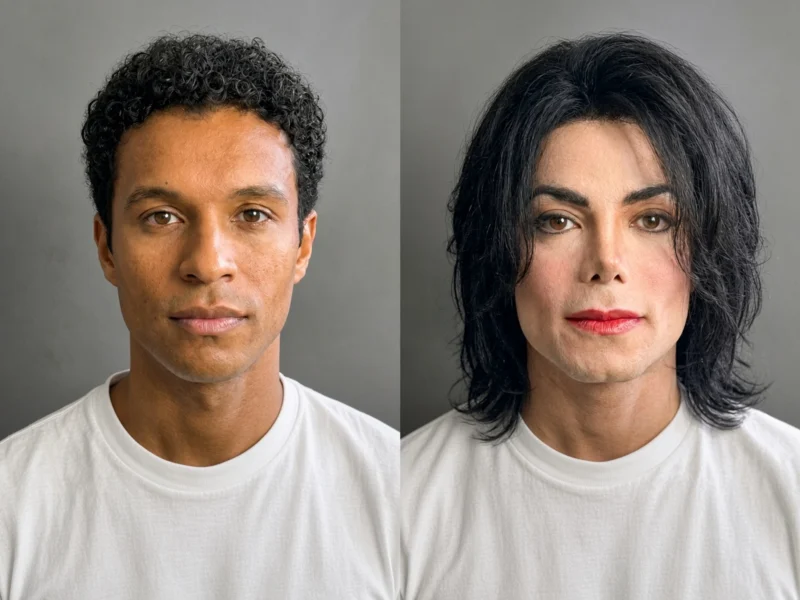
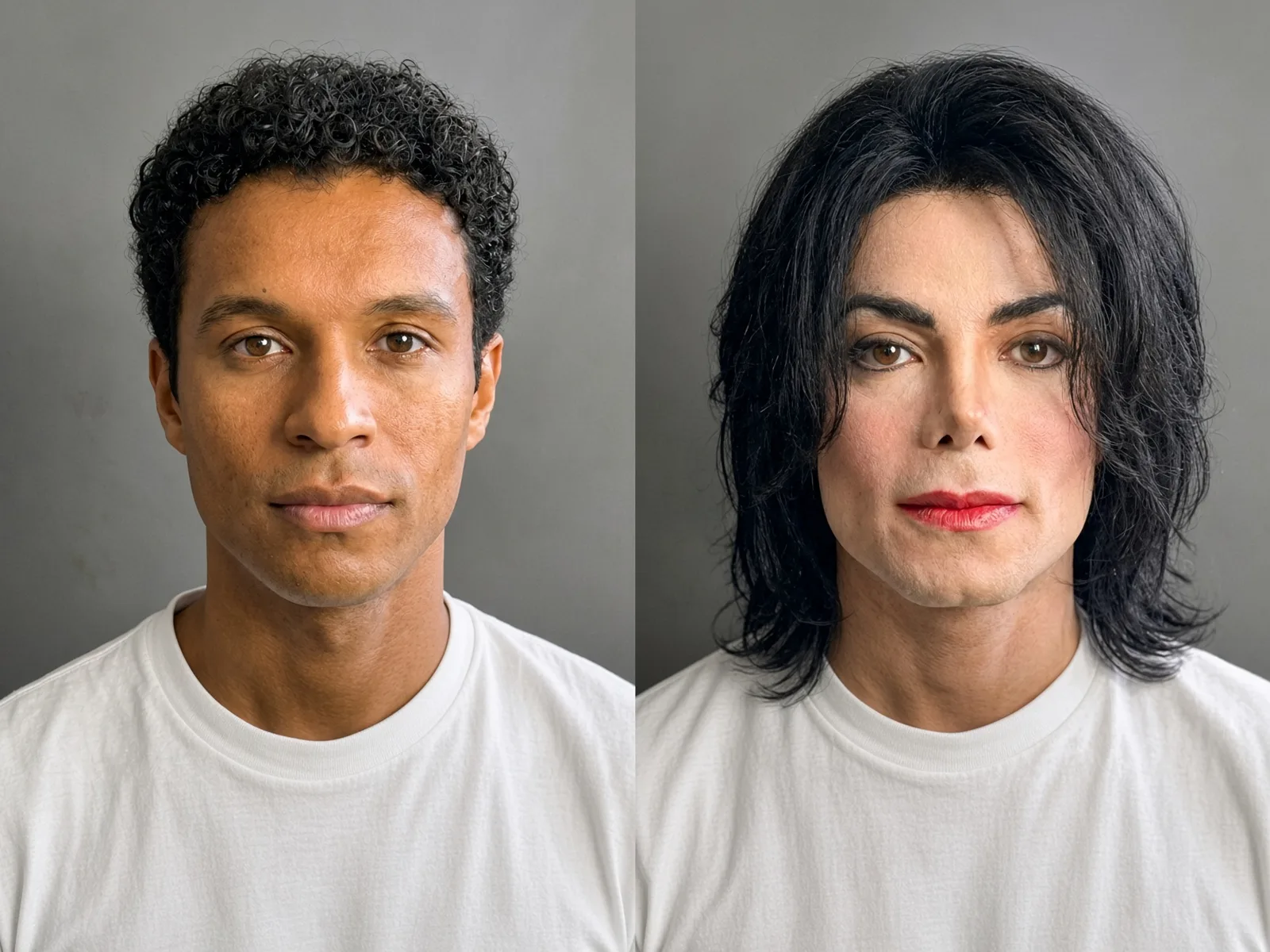
Before going further, there is a side-by-side image that has been making the rounds online. On the left, Jaafar Jackson appears with his natural look. On the right, his features are digitally altered to resemble Michael in the later years of his career.
Fans were stunned by how close the resemblance runs, and many said it shows just how convincing the biopic could be. It is a fair question to carry into the rest of this story: how much of the film’s success comes down to that face?
Then the film moves into the music. It covers Off the Wall in 1979 and Thriller in 1982, and it treats them as the creative peak.
Thriller became the best-selling album in the world. The film leans into that, delivering one showstopper after another.
The music videos from this era, especially the Thriller short film, are presented as cinematic achievements that changed how artists promote their work. The recreations are built with painstaking detail.
Director Antoine Fuqua focuses on the sheer spectacle of Michael’s talent. That makes this stretch the emotional high point of the movie.
It also sets the stage for what came next, as Michael stopped being a star and became a cultural phenomenon unlike anything the industry had seen.
One of the film’s few darker beats comes in 1984. While filming a Pepsi commercial, Michael suffered serious burns to his scalp in a pyrotechnics accident.
The recovery was long, with multiple surgeries and skin grafts. The film also connects this moment to the start of his struggle with painkillers.
Fuqua stages the accident with real intensity, and then softens the moment with a small act of kindness. Michael buys toys for children in the hospital.
It is a glimpse of the pain behind the polished public image, and it is one of the only times the film lets that pain show.
The story then reaches the 1984 Victory Tour. It was a huge commercial success, drawing millions of fans across North America.
It was also the moment the cracks in the family act widened. Michael wanted to express his own vision without interference.
The film ends there, with a brief jump ahead to the 1987 Bad Tour. The final image is Michael preparing to walk onto a stage at the height of his career.
That ending was designed to send audiences home on a high. But it was not the ending the film started with.
Originally, the movie was built around a much heavier chapter. In 1993, the story went to a Neverland Ranch search, with police lights flashing behind Michael as he stared at his own reflection.
The planned third act was devoted to the fallout from the allegations that surfaced that year, and to the toll they took on him. Jaafar Jackson had reportedly filmed those scenes.
Then the estate’s lawyers reportedly found a clause that made the footage unusable. The investigators-at-Neverland sequence ended up on the cutting room floor.
Fuqua had to abandon his original vision and rework the ending of the film at the last minute. The movie that came out was radically different from the one that was first imagined.
Remember that reflection in the window, because it is the image the film lost, and it is the one that critics would later say they missed.
Cameras had started rolling in January 2024 across Los Angeles and Santa Barbara. The production built period-accurate sets, including a full-scale recreation of the Jackson family home in Gary, Indiana, and the Neverland Ranch.
The crew spent weeks perfecting the Victory Tour stage, complete with period lighting rigs and pyrotechnics. More than 500 crew members worked on the production, including choreographers, costume designers, and makeup artists.
Cinematographer Robert Richardson, an Oscar winner for JFK and The Aviator, mixed 35-millimeter film with digital cameras. The goal was grandeur.
Fuqua worked with Jaafar for months before filming, mapping out every dance sequence and vocal performance.
The schedule was brutal. Jaafar sometimes performed complex dance routines for 14 hours straight, echoing the grueling rehearsals Michael himself endured on tour.
Then came the rebuild. In June 2025, the cast spent 22 days in Los Angeles shooting a new ending.
The reshoots added an estimated $10 million to $15 million to the budget, though some reports put the final adjustments between $40 million and $50 million. The Jackson estate covered the extra costs, since its own oversight had forced the changes.
The delay pushed the release from April 18, 2025, to April 24, 2026. The Palisades fire, which damaged screenwriter John Logan’s house, slowed things down further.
Fuqua had to reassemble the cast on short notice. He described the project as one of the most difficult of his career.
The numbers tell the same story. Lionsgate had greenlit the film at $155 million, and the reshoots came on top of that, bringing the total close to $200 million.
To soften the risk, Lionsgate sold international distribution rights to Universal. It made the film one of the most expensive biographical movies ever made.
The studio was betting that Michael Jackson’s global appeal would pay it all back. That was a $200 million bet on a name.
At the center of the bet was a first-time actor. Jaafar Jackson, Michael’s real-life nephew and the son of Jermaine Jackson, had never acted professionally.
Fuqua first noticed the resemblance. What convinced him, though, was emotional honesty in the audition room.
He recalled a screen test where Jaafar responded spontaneously in character, and it moved the crew. Jaafar remembers the director asking whether he had ever acted before. “Never,” he said. “I’ve never wanted to be an actor.”
That is a remarkable thing to say about the person who ends up carrying a billion-dollar movie. It was an extraordinary gamble for the studio.
Jaafar spent months studying his uncle’s mannerisms, vocal patterns, and dance moves. Even critics who disliked the film often found something to praise in his work.
Around him, the supporting cast gave the story its weight. Domingo’s Joe Jackson was menacing, and he drove much of the film’s tension.
Nia Long played Katherine Jackson, the gentle matriarch trying to shield her children. Miles Teller played attorney John Branca, who later managed Michael’s career and estate.
Kendrick Sampson played producer Quincy Jones. Kat Graham played Diana Ross, and Jessica Sula played La Toya Jackson.
Then the reviews arrived, and they were rough. Michael landed at 38% on Rotten Tomatoes from nearly 300 reviews, and 39 out of 100 on Metacritic.
Critics called it bland and barely competent. The BBC gave it one star.
The sharpest complaint was about what the film leaves out. The Wall Street Journal’s Kyle Smith wrote that the movie deals with Michael’s darker side “by ignoring it.”
Many reviewers felt the film sanitized his legacy and avoided the complexity of his life. The reaction from the press was overwhelmingly negative, with only a handful of outlets offering praise.
Audiences saw a different movie. They gave it a 97% score on Rotten Tomatoes and an A-minus CinemaScore, a strong sign of word of mouth.
On release day, critics sat at 40% while audiences sat at 96%. It carried the highest audience score of any musical biopic on the site.
Fans pointed to the musical sequences, the emotional depth, and Jaafar’s performance. The gap between the two groups became the story.
Spike Lee stepped into that gap. He had directed Michael’s 1996 video for “They Don’t Care About Us” and two documentaries about him, and he told CNN he watched the film twice and loved it.
His argument was about the timeline. The movie ends in 1988, years before the first controversy in 1993.
“If you’re a movie critic and you’re complaining about the stuff, all this other stuff, but the movie ends at 88,” he said. In his view, you cannot fault a film for leaving out something that happens after it stops.
It is a fair point, and it also explains something about that missing reflection in the window. The scene the film was meant to open with was the one that would have pushed it past 1988.
Then the money started rolling in. Michael opened to $97.2 million domestically and $217.4 million worldwide.
That crushed the previous opening record for a musical biopic, $60.2 million, held by Straight Outta Compton. IMAX alone brought in $24.4 million, the biggest large-format opening ever for a music biopic.
It opened in 82 international markets at once. The per-theater average was about $22,000 across 4,400 screens, ahead of Bohemian Rhapsody.
It was the biggest April opening in Lionsgate history, and it prompted immediate talk of a sequel.
Strong showings in Japan, the UK, and Brazil kept the pace up. Overseas markets would account for more than 60% of the total.
On June 14, 2026, the film passed $911.9 million worldwide, topping Bohemian Rhapsody’s $910.9 million to become the highest-grossing musical biopic ever. It took just over seven weeks.
The old record had stood for nearly eight years. For producer Graham King, who also made Bohemian Rhapsody, it meant breaking his own mark.
Two weeks later, on June 28, the film crossed $975.8 million, passing Christopher Nolan’s Oppenheimer to become the highest-grossing biographical film of any genre. It got there 65 days after release, faster than any biopic before it.
Oppenheimer had the Barbenheimer wave behind it. Michael had fan devotion and word of mouth, and weekly drops stayed modest.
Then came the number nobody in the business expected to see attached to a biopic. On July 12, 2026, Michael crossed $1.001 billion worldwide.
It was the first biopic ever to reach a billion dollars. North America contributed $371.8 million and international markets $629.8 million.
Japan, where Michael remains one of the most beloved international stars, pushed it over the line with $35.75 million. It was the second film of 2026 to hit the mark, after Super Mario Galaxy.
It got there in 79 days. For a movie that critics had written off, that is a staggering run.
For Lionsgate, it was a milestone with history behind it. Michael became the studio’s first billion-dollar title in 27 years, topping The Hunger Games: Catching Fire at $865.2 million.
The turnaround was dramatic. In 2024, the studio had generated $251 million in domestic ticket sales from 17 releases, down 85% from its 2012 peak of $1.72 billion.
That slide had fueled speculation about the company’s future. CEO Jon Feltheimer called Michael a turning point.
It also delivered career-best totals for Fuqua and King, and it launched Jaafar Jackson into stardom. A first-time actor, a $200 million bet, and a 38% critics score ended up at $1 billion.
And now the story is not over. A sequel is already in development, with about 30% of the footage reportedly shot.
That raises the question hanging over everything. If the first film ended in 1988, the next one has to deal with what comes after, including the chapter that was cut: the flashing lights, the long walk through Neverland, and the reflection in the glass.
Whatever the sequel decides to show, one thing is already settled. The film that almost lost its ending ended up with a record that may stand for a long time.