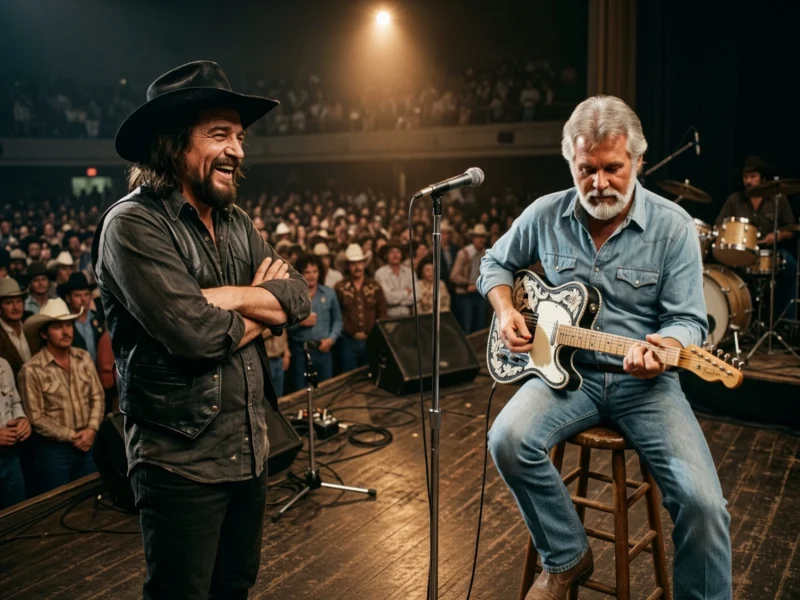
Waylon Jennings Invited Kenny Rogers On Stage to Mock Him – Nobody Was Ready For What Kenny Did
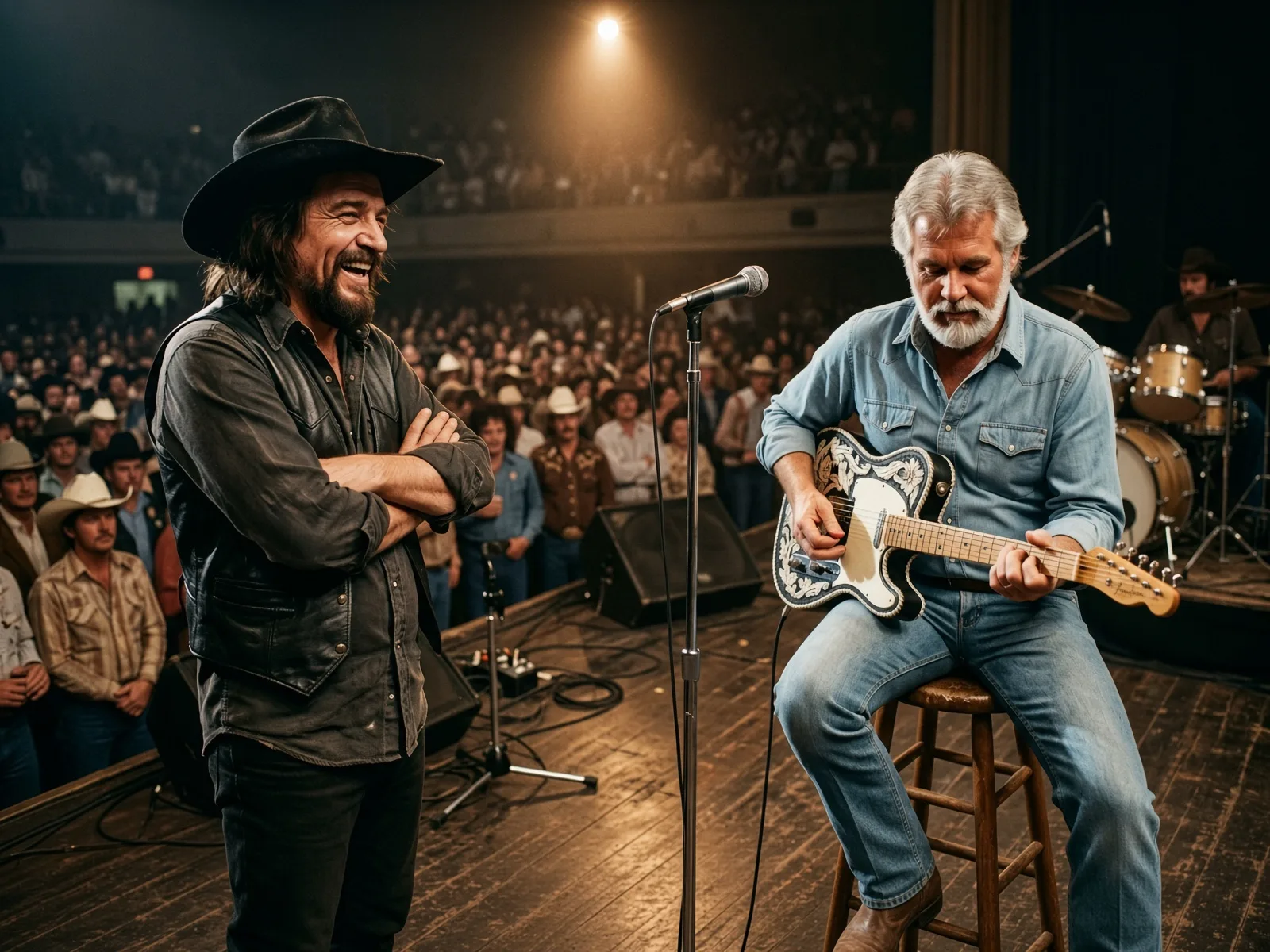
Lubbock, Texas. September 7, 1980.
Three thousand people packed into the old municipal auditorium on a hot, dry West Texas night. They were waiting to hear Waylon Jennings, the baddest outlaw in country music, play a hometown benefit on what would have been Buddy Holly’s 44th birthday.
But in the back corner, hidden under a plain brown cowboy hat pulled low over his eyes, sat a man nobody expected to see in Lubbock. He had flown into town that afternoon without telling a single reporter.
At that very moment, he was the biggest-selling recording artist in America. His name was Kenny Rogers.
What happened over the next hour became one of the most quietly whispered nights in the history of country music. Waylon refused to talk about it publicly for almost 20 years.
It ended with two of the most famous men in Texas standing on a stage with tears running down their faces. They were holding something so small that most of the audience couldn’t even see it.
Because Waylon Jennings invited Kenny Rogers up on that stage to make fun of him. And nobody was ready for what Kenny did next, not Waylon, not the band, not a single person in those 3,000 seats.
To understand that night, you have to understand what came before it.
In 1980, there was a war going on in country music. It wasn’t a real war. It was a war of words and style, a war over what country music was supposed to sound like and who it belonged to.
On one side stood Nashville, with its polished sound. There were strings and backup singers and smooth production, records that could cross over to the pop charts and sell millions to people who had never set foot in a honky-tonk.
On the other side stood the outlaws, Waylon Jennings and Willie Nelson. They had grown their hair long and their beards out, and they had walked away from the Nashville machine. They made raw, stripped-down records their own way.
They believed country music was supposed to sound like a dusty pickup truck, a long night, and a broken heart. It was not supposed to sound like a hotel lobby.
And if you wanted a single face for everything the outlaws disliked about smooth, polished crossover country, there was one obvious choice. Kenny Rogers.
He had the silver beard, the soft voice, and the big Hollywood producer. He had “The Gambler,” which had just been turned into a television movie.
He had “Coward of the County” and “She Believes in Me” sitting on the pop charts right beside disco records. He was selling more albums than anybody in country music, and maybe anybody in any kind of music.
Grandmothers loved him. Truck drivers loved him. But a lot of the hardcore country crowd thought he was something else entirely, a pop singer in a cowboy costume.
And nobody said it louder than Waylon.
Earlier that year, in a long, rambling magazine interview given in the back of his tour bus, Waylon was asked what he thought of Kenny Rogers. Tired and cranky after a long night, he said something he would later wish he could take back.
“Kenny’s a nice fella,” Waylon said. “But he ain’t country. He’s lounge music and a cowboy hat. Put him in a beer joint in Lubbock with nothing but a guitar and no strings section, and he’d last about two songs before they threw him out the back door.”
That line traveled fast. Within a couple of weeks, it was in every country music magazine in America.
People clipped it out and stuck it on the walls of bars. Disc jockeys read it on the air and laughed. Some of Kenny’s band members wanted him to answer it.
Kenny Rogers said nothing. Not to the press, not to his band, not even to his wife.
When reporters asked, he just smiled that easy smile. “Waylon’s entitled to his opinion,” he said. “I’ve always liked his records.” Then he changed the subject.
The people closest to him thought he had let it go. He hadn’t.
It wasn’t anger, because Kenny almost never got angry. It was one word in that quote that nobody else would have noticed, and it stuck in his chest like a splinter.
The reason was hidden in a small leather wallet Kenny had carried in his back pocket through four different wallets over 23 years.
Tucked behind his driver’s license, in a little slot nobody ever looked in, was a guitar pick. It was an ordinary tortoiseshell pick, worn smooth on one edge, with a tiny chip out of the tip.
Kenny had never shown it to a single person. Not his band, not his wives, not his children, and not one interviewer in 23 years of interviews.
And on the night of September 7, 1980, he had flown to Lubbock for one reason and one reason only. He was going to put that guitar pick back where it belonged.
What was that guitar pick? And why had Kenny Rogers kept it a secret for 23 years?
The answer goes back to a hot summer night in Houston, Texas, in 1957.
Kenny was 18 years old, still Kenneth to his mother. He was a skinny kid from the San Felipe Courts housing project with a cheap guitar, a high school band called the Scholars, and a head full of rock and roll.
In those days, before the beard and the gravel in his voice, he was a rockabilly kid. He wore his hair slicked back, he played fast, and he wanted to be Elvis.
Mostly, he wanted to be Buddy Holly. In 1957, Buddy Holly was a god to every teenage boy in Texas who had ever picked up a guitar.
Buddy was a skinny kid from Lubbock in thick black glasses who had proved you didn’t have to be handsome, rich, or from Memphis to make rock and roll. “That’ll Be the Day” was climbing the radio charts that summer.
That summer, Buddy Holly and the Crickets came through Houston to play a teen dance. The Scholars had talked their way onto the bottom of the bill.
They played three songs at 7:00, before most of the crowd had even shown up. Kenny was so nervous that he broke a string in the middle of the second song.
He dropped his only guitar pick somewhere in the dark at the edge of the stage. He finished the set strumming with his thumbnail, red in the face, sure he had just embarrassed himself in front of the whole city.
When he came off the stage, a skinny young man in black glasses was standing in the wings, leaning against a speaker cabinet. He was watching Kenny.
It was Buddy Holly.
Kenny froze. He couldn’t say a word.
Buddy grinned. He reached into his shirt pocket, pulled out a tortoiseshell guitar pick, and held it out.
“You dropped yours,” he said. “Here, take mine.”
Kenny took it with a shaking hand.
“You play too fast when you’re scared,” Buddy told him in that easy West Texas drawl. “Everybody does. Slow down, man. Let the song do the work. The song’s always smarter than you are.”
Then he clapped Kenny on the shoulder and walked out onto the stage. The place went crazy.
Kenny stood in the wings and watched Buddy play the whole set. Kenny held that pick so tight in his fist that it left a mark in his palm.
He never saw Buddy Holly again.
Eighteen months later, on February 3, 1959, a small plane went down in a frozen cornfield in Iowa in the middle of the night. Buddy was 22 years old. Ritchie Valens and J.P. Richardson, the Big Bopper, were lost with him.
The whole country mourned. They called it the day the music died.
Kenny was 20. He had just made his first record. He heard the news on a car radio in a Houston parking lot, and he sat in that car for a long time with the engine off and the guitar pick in his hand.
He kept it. He never played with it again, not once.
He carried it in his wallet through everything that came after. It went through the jazz clubs, the folk groups, the psychedelic band, the bad years, and the good years. That pick rode with him to every stage he ever stood on.
That afternoon in September of 1980, before the show, Kenny rented a car at the Lubbock airport and drove out to the City of Lubbock Cemetery on the east side of town. He didn’t tell anybody where he was going.
He found the grave on his own after 20 minutes of walking up and down the roads in the dry heat. It was a small, flat granite marker, flush with the grass.
Somebody had left a pair of drugstore sunglasses with thick black frames on top of it. There was a handful of guitar picks and a single yellow rose that had already wilted in the sun.
Kenny stood there a long time with his hat in his hands. A groundskeeper on a riding mower stopped about 50 yards away and watched him for a while.
He didn’t recognize him. He just saw a man with a silver beard standing very still in the heat in front of Buddy’s stone.
That evening, the groundskeeper would see Kenny’s face on the local news and say to his wife, “Well, I’ll be. That was him.”
Kenny reached into his back pocket and took out the old leather wallet. He slid the guitar pick out from behind his driver’s license.
He knelt down and almost set it on the stone with all the others. Almost.
Then he stopped. He looked at it for a long moment, and for a reason he couldn’t have explained to anybody, he put it back in his wallet and stood up.
It didn’t feel like it belonged there. Not yet.
And here is what nobody in that Lubbock auditorium knew in September of 1980. Here is the part of the story that makes everything that happened that night make sense.
On that frozen night in February of 1959, there was supposed to be another young man on that plane. He was Buddy Holly’s bass player, a 21-year-old kid from Littlefield, Texas, just up the road from Lubbock.
He had gotten the job because Buddy believed in him when nobody else did.
At the last minute, that young bass player gave up his seat on the plane to the Big Bopper, who had the flu and didn’t want to ride another freezing night on the tour bus.
When Buddy found out his bass player wasn’t flying, he laughed and teased him. “Well, I hope your old bus freezes up,” Buddy said.
The young bass player, joking back, said, “Well, I hope your old plane crashes.”
The next morning, it had.
That young bass player’s name was Waylon Jennings. He carried those words for the rest of his life.
He said later that for years he believed he had somehow caused it. His own careless joke had been the last thing he ever said to the best friend and best teacher he had ever had.
Twenty-one years later, on what would have been Buddy’s 44th birthday, Waylon stood on a stage in Buddy’s own hometown. He was about to look out into the crowd and see the one man in country music he had publicly sworn wouldn’t last two songs in Lubbock.
He had no idea what that man was carrying in his back pocket.
Backstage, an hour before the show, Waylon sat alone in his dressing room with the door shut. His road manager would remember that years later, because Waylon didn’t usually shut the door.
On most nights, his dressing room was full of musicians, friends, and hangers-on. There was a card game going in the corner and somebody always telling a story too loud.
But on that night, in that town, on that date, he had asked everybody to leave.
On the dressing table in front of him, propped against the mirror, was an old black-and-white photograph. It showed four young men in matching suits and skinny ties, squinting into the Texas sun.
One of them wore thick black glasses. One of them, the bass player, had a crew cut and a big, nervous grin.
Waylon looked at that photograph for a long time before he went on stage.
Back inside the auditorium, Waylon was 45 minutes into his set when he did something nobody expected. He stopped the band in the middle of a song.
He just raised one hand, and the music fell apart behind him.
The stage lights dropped to a single amber spotlight on Waylon, center stage. He wore a black hat and a black leather vest, his dark beard shining with sweat, and that famous black-and-white leather-covered Telecaster hung low on his hip.
He walked to the microphone slowly and grinned that crooked outlaw grin.
“Well,” he said, his voice low and dry, “somebody just told me we got a celebrity in the house tonight.”
The crowd hooted and whistled.
Here is how it happened. During the last song, one of Waylon’s road crew had come out to the side of the stage and whispered something to Waylon’s guitar player, who leaned over and whispered it to Waylon.
A fan in the back corner had recognized the man under the brown cowboy hat and told an usher. The usher told a security guard, and the security guard told the crew.
By the time it reached Waylon, the whole story fit into four words. Kenny Rogers is here.
Waylon shaded his eyes against the spotlight and squinted out into the dark.
“Where is he at?” he said into the microphone. “Somebody point him out.”
Three thousand heads started turning. Somewhere in the back corner, a few people stood and pointed at a man in a plain brown hat who was trying very hard to sink into his seat.
A spotlight operator in the balcony swung the light around, and it found him.
Kenny Rogers sat alone at the end of the second-to-last row. He raised one hand to shield his eyes and gave a small, embarrassed wave.
The crowd roared. Some cheered. And some, in a hometown Waylon crowd in West Texas in 1980, laughed, because every one of them had read that magazine quote.
Lounge music in a cowboy hat.
Waylon laughed too, a big, rough, delighted laugh.
“Well, I’ll be darned,” he said. “Ladies and gentlemen, the Gambler himself, all the way from Hollywood. Come to see how we do it out here in the sticks.”
The crowd laughed harder. Waylon leaned on the mic stand, enjoying himself now.
“Kenny, you know I said some things about you in a magazine a while back. Said you wouldn’t last two songs in a Lubbock beer joint with nothing but a guitar.”
He grinned wider. “Well, this ain’t a beer joint, but it’s Lubbock. Why don’t you come on up here and prove me wrong? Come on up, Gambler. Let’s see what you got when there ain’t no string section.”
The crowd erupted. Half of them were cheering for Kenny, and half were cheering for a showdown.
Waylon’s own drummer, Richie Albright, would say many years later that he leaned over to the bass player at that moment. “Oh Lord,” he whispered, “this is going to be ugly.”
Everybody on that stage knew what Waylon was doing. He was having fun, but it was the kind of fun that leaves a mark on the other fella.
In the back of the auditorium, Kenny sat very still. Every instinct told him to wave, laugh it off, and stay in his seat.
He was the biggest star in the room. He had nothing to prove to anybody.
Walking onto Waylon’s stage, in Waylon’s hometown, in front of Waylon’s crowd, with no band and no rehearsal, was the kind of thing a smart man doesn’t do.
But Kenny wasn’t thinking about any of that. He was thinking about the guitar pick in his back pocket, and about where he was and whose birthday it was.
He stood up. The noise in that auditorium doubled.
He took off the brown cowboy hat and set it on his seat. Then he started walking down the long center aisle toward the stage.
He walked not fast and not slow, the way a man walks up to a friend’s funeral. He was steady and quiet, like he knew exactly why he was there.
Three people near the aisle would later remember the look on his face. A young waitress from a Lubbock diner, sitting in row 20, said he looked like a man walking into church.
An old rancher in a pearl-snap shirt, sitting near the front with his grandson, said he looked like a man about to pay off a debt.
And a 17-year-old high school guitar player named Danny Ruiz, who had come with his older brother and sat in the third row, said Kenny didn’t look nervous at all. “He looked sad,” Danny said years later. “Like he knew something none of the rest of us knew, and it hurt him to know it.”
Kenny reached the stage and climbed the four wooden steps at the side.
Waylon stood at center stage, grinning, arms folded across his chest, the black-and-white Telecaster against his leather vest. The two men looked at each other.
Waylon was a little taller, darker, rougher around every edge. Kenny was silver and soft-spoken, dressed in a plain blue denim shirt and jeans. They looked like they had walked out of two different movies.
Waylon held out the microphone. “Well, Gambler,” he said. “Floor is all yours. Band can play whatever you want.”
Kenny shook his head. “I don’t need the band, Waylon,” he said, quietly enough that only the first few rows heard. “But I’d like to borrow your guitar.”
Waylon’s grin slipped.
Nobody borrowed that guitar. Everybody in country music knew that. That black-and-white, leather-covered Telecaster was as much a part of Waylon Jennings as his beard.
He had played it on every record for a decade. His road crew wasn’t allowed to tune it without asking.
For a few long seconds, Waylon didn’t move. Then he looked at Kenny’s face up close under the lights, and something in Kenny’s eyes made him stop grinning altogether.
Slowly, Waylon lifted the strap over his head and handed the guitar to Kenny Rogers.
Waylon’s guitar player said later that in eight years on the road, he had never once seen Waylon hand that guitar to another living soul.
Kenny slung it over his shoulder and walked to a stool at the front of the stage. He sat down and adjusted the strap.
Then he reached into his back pocket, pulled out the old leather wallet, and slid something small out of a slot behind his driver’s license.
Nobody in the audience could see what it was. It was too small.
But Waylon, standing six feet away, saw it. And Waylon’s arms slowly came unfolded.
It was a tortoiseshell guitar pick, old and worn smooth on one edge, with a tiny chip out of the tip.
Kenny held it up between his fingers in the spotlight and looked at it for a long moment. Then he leaned into the microphone.
“Waylon’s right,” he said. “I’ve had a lot of help these last few years. Strings, producers, fancy studios in Los Angeles. I’m not going to pretend I haven’t.”
He paused. “But I wasn’t always that fella. A long time ago, I was a skinny kid from Houston who wanted to play rock and roll. And I learned it from a boy from right here in this town.”
The auditorium went quiet.
“Today’s his birthday,” Kenny said softly. “So I thought I’d play him a couple.”
And then Kenny Rogers started to play “That’ll Be the Day.”
But he didn’t play it the way anybody in that room expected, or the way the record sounded. He certainly didn’t play it the way a lounge singer in a cowboy hat would have.
He played it the way a scared 18-year-old rockabilly kid would have played it in a Houston dance hall in 1957. It was raw, bright, and twangy, all downstrokes and rhythm, that old West Texas shuffle, with Waylon’s Telecaster ringing like a church bell.
His voice went up higher than anyone had heard it in 20 years. It had that young, hiccuping Buddy Holly sound that every Texas teenager had once tried to copy, and most had failed.
Kenny didn’t fail.
For the first verse, the crowd just stared. By the first chorus, people were on their feet.
By the second, 3,000 people in Buddy Holly’s hometown were clapping along and stomping on the wooden floor so hard that the old rancher said later, “You could feel it in your teeth.”
Waylon’s drummer, Richie, couldn’t stand it. Halfway through the second verse, without being asked, he picked up his sticks and started playing along.
It was that old Crickets beat, the one every drummer in Texas knew by heart. The bass player jumped in a bar later.
Waylon Jennings stood in the middle of his own stage with his arms hanging at his sides and his mouth slightly open. He was watching the man he had called lounge music play the most authentic Buddy Holly he had heard in 21 years.
When the song ended, the place exploded. Kenny raised one hand and waited for them to quiet down, which took a while.
“That’s one,” he said into the microphone, and grinned over at Waylon.
The crowd laughed and roared all over again. Even Waylon cracked a smile.
But Kenny wasn’t smiling anymore when he spoke again.
“This next one,” he said, “is one of the last songs Buddy ever recorded in a studio. They say he wrote it for his wife. He never got to hear it come out on the radio.”
He turned the guitar pick over in his fingers and looked at Waylon.
“This one’s for somebody standing on this stage,” he said quietly.
Kenny nodded to the band. Richie set his sticks down. The bass player stepped back from his amplifier.
Everybody on that stage understood without being told. This one was going to be just the guitar.
Kenny turned the volume knob on Waylon’s Telecaster down until it was barely more than a whisper. He took a breath, and then he began to play “True Love Ways.”
If “That’ll Be the Day” had been a fire, this was the embers.
He played it slow, slower than the record. The chords were soft and open, and they rang out into the dark of that old auditorium like a music box someone had wound up and set down on a bedside table.
When he started to sing, the high, young rockabilly voice from the first song was gone. In its place was the voice the whole world knew, warm and low and worn like an old leather chair.
It was the voice of a man who had lived 42 years and lost a few things along the way.
He sang it the way Buddy Holly had told him to play 23 years earlier. Slow down. Let the song do the work.
The auditorium went completely still.
Three thousand people who had been stomping on the floor a minute earlier stood motionless, many with their hands over their hearts.
A lot of the older folks in that room had known Buddy. They had gone to school with him at Lubbock High, danced to his band at the roller rink on Saturday nights, and stood in the wind at his funeral in February of 1959.
For a few minutes that night, it was like a voice from that time had come walking back through the door.
In the front row, the old rancher took off his hat and held it against his chest. His grandson looked up and saw that he was crying. He had never seen his grandfather cry.
And Waylon Jennings, standing six feet from Kenny at center stage with no guitar in his hands and nothing to do with them, slowly turned his back on the audience.
The people in the first few rows could see his shoulders. They saw them shaking.
He stood like that through the entire song, facing the drum riser, head down, one hand pressed flat against his black leather vest right over his heart.
He didn’t turn around until the very last chord.
When it came, Kenny let it ring until there was nothing left. Then he lifted his hand off the strings.
Nobody clapped, not right away. It didn’t feel like the kind of thing you clap for.
The auditorium was so quiet that Danny Ruiz, in the third row, said later he could hear the old ceiling fans turning overhead.
And then Waylon turned around.
His face was wet. He didn’t wipe it, and he didn’t try to hide it.
Waylon Jennings, the outlaw, the hardest man in country music, the man who had spent 20 years making sure nobody ever saw him soft, stood in a spotlight in front of 3,000 people with tears in his beard.
He walked over to the stool where Kenny sat and stopped in front of him. For a long moment, the two men just looked at each other.
Kenny stood up. He held out the guitar pick between two fingers.
“He gave me this in Houston,” Kenny said into the microphone, quietly. “Summer of ’57. I was 18. I was so scared I broke a string and dropped my pick off the edge of the stage.”
“He was standing in the wings, watching me. When I came off, he handed me his own. Said, ‘You play too fast when you’re scared. Slow down. Let the song do the work. The song’s always smarter than you are.'”
A murmur moved through the crowd. People turned to each other. Nobody had ever heard this story, nobody in the world.
“I never played with it again,” Kenny said. “Not once. I’ve carried it in my wallet for 23 years, to every show I ever played.”
He looked at Waylon. “I figure I’ve been carrying it for somebody else this whole time. I just didn’t know who until I read what you said about Lubbock.”
He pressed the pick into Waylon’s hand and closed Waylon’s fingers around it.
“You were his bass player,” Kenny said. “It belongs to you.”
Waylon looked down at the guitar pick in his palm. Then he did something nobody in that room would ever forget.
He pulled Kenny Rogers into a hug so hard it knocked Kenny’s reading glasses out of his shirt pocket and onto the stage. He held on in front of 3,000 people, in Buddy Holly’s hometown, on Buddy Holly’s birthday.
It was the outlaw and the lounge singer holding on to each other in the middle of a stage while the whole auditorium finally came apart.
The sound that came out of that crowd wasn’t applause, exactly. The old rancher would describe it later as the sound a whole town makes when it has been holding its breath for 21 years and finally lets it go.
When Waylon let go, he picked Kenny’s glasses up off the stage and handed them back with a rough laugh. Then he took the microphone off the stand.
“Folks,” he said, and his voice cracked in the middle of the word. He cleared his throat and started again. “Folks, I said in a magazine that this man wouldn’t last two songs in Lubbock.”
The crowd laughed through their tears.
“Well,” Waylon said, “he did two, and I don’t believe I could have done either one of them.”
The crowd roared.
“I owe Kenny Rogers an apology,” Waylon said. “And I’m going to give it to him right here in front of all of you, so there ain’t no question about it. I was wrong. I was dead wrong. Anybody that ever learned from Buddy Holly is country enough for me.”
He held up the guitar pick in the spotlight. Most of the crowd still couldn’t see it. It didn’t matter.
Then Waylon took his Telecaster back from Kenny and slung it over his own shoulder. He tucked that old tortoiseshell pick between his fingers and turned to his band.
“‘Peggy Sue,'” he said. “Key of A, and Kenny singing.”
For the next three minutes, Waylon Jennings and Kenny Rogers played “Peggy Sue” together on a stage in Lubbock, Texas.
Waylon played guitar with Buddy Holly’s pick for the first time. Kenny sang, with that young rockabilly voice back again. Richie Albright pounded out the old Crickets beat on the drums.
And 3,000 people sang along at the top of their lungs, the way they had once sung it at the roller rink on Saturday nights, when they were young and Buddy was alive and the whole world was still in front of them.
Backstage after the show, the hallways were crowded with crew members, promoters, and local reporters. Waylon pushed through all of them and found Kenny standing alone by the loading dock door, getting some air.
He stood beside him without saying anything for a long time. Then he pulled the guitar pick out of his vest pocket and turned it over in his fingers.
“You know the last thing I ever said to him?” Waylon asked quietly.
Kenny shook his head, although he did know. Most people in the business knew. They just never said it out loud in front of Waylon.
“He said, ‘I hope your old bus freezes up,'” Waylon said. “And I said, ‘Well, I hope your old plane crashes.'”
His voice broke. “That was the last thing. That’s what I said to the best friend I ever had. I’ve been hearing it every night for 21 years, Kenny. Every single night.”
Kenny didn’t answer right away. He let the words settle. Then he put his hand on Waylon’s shoulder.
“Waylon,” he said, “let me tell you something about the man who gave me that pick.”
“He was 20 years old, and he was famous, and he had a hundred better things to do that night than notice some scared kid from the projects who’d just made a fool of himself. But he noticed. He saw I’d dropped my pick, and he gave me his own, and he didn’t even have to think about it.”
Kenny shook his head slowly. “A man like that doesn’t spend 21 years blaming his bass player for a joke. A man like that would have laughed at it and forgotten it before the plane was off the ground.”
Waylon stared down at the pick. “You think so?” he said, very quietly.
“I know so,” Kenny said. “And I think he’d want you to quit carrying that joke around. Carry this instead.”
Waylon stood by the loading dock door for a long time after that, turning that little piece of tortoiseshell over and over in his hand.
Kenny didn’t say another word. He just stood beside him in the hot West Texas night until Waylon was ready to go back inside.
The night didn’t end at the auditorium.
Around 1:00 in the morning, after the crowd had gone and the trucks were loaded, Waylon walked up to Kenny by the stage door with his car keys in his hand.
“You got somewhere to be?” he asked.
“Not till tomorrow,” Kenny said.
“Then ride with me,” Waylon said. “There’s somebody I want to go see, and I ain’t been able to go see him by myself in a long time.”
Kenny didn’t have to ask who.
They drove out to the east side of town in Waylon’s car with the windows down and the radio off. The cemetery gates were closed, but the fence was low.
Two of the most famous men in country music climbed over it in the dark like a couple of teenagers. They walked across the grass by the light of a half moon until they found the little flat stone.
The wilted yellow rose was still there. So were the black sunglasses and the guitar picks other people had left.
Waylon knelt down on the grass. He took the old tortoiseshell pick out of his vest pocket and held it for a long time.
Then, very gently, he set it on top of the stone with the others, right in the middle.
“Happy birthday, Buddy,” he said. “I brought your pick back.”
Kenny stood a few feet behind him with his hands in his pockets and didn’t say a word.
They stayed until the sky started turning gray in the east. When they finally walked back to the car, Waylon stopped at the fence and looked back one more time.
Then he climbed over, and Kenny climbed over after him. They drove back into town as the sun came up over the cotton fields.
When the groundskeeper made his rounds that morning, he found a single tortoiseshell guitar pick, old and worn smooth on one edge, sitting in the center of Buddy Holly’s stone.
He didn’t know where it had come from. He left it right where it was.
Within a week, the story of that night was traveling through Nashville faster than any rumor anybody could remember. Reporters who had been in the audience wrote about it, and disc jockeys talked about it.
The country music magazines that had printed Waylon’s lounge-singer quote a few months earlier now printed something else. It was a short public apology from Waylon, given to a writer in the back of the same tour bus.
“Kenny Rogers is a better man than me,” Waylon said. “And he’s a better Texan than I gave him credit for. I hope he’ll forgive me. I know Buddy would.”
When a reporter asked Kenny about it, he did exactly what he had done the first time. He smiled that easy smile.
“Waylon’s my friend,” he said. “He always was. He just didn’t know it yet.” Then he changed the subject.
The two men were never close the way some stars are close. They ran in different circles and made different kinds of music for different kinds of crowds.
But for the rest of their lives, whenever they ran into each other at an awards show, a television taping, or a backstage hallway somewhere, Waylon would cross whatever room they were in. He would grab Kenny’s hand, lean in close, and say the same five words in that low, rough voice.
“Slow down, Gambler. Song’s smarter.”
And Kenny would laugh every time, because he always knew exactly where those words came from.
Danny Ruiz, the 17-year-old guitar player from the third row, grew up to become a music teacher at a high school in Lubbock. He taught guitar there for more than 30 years.
On the first day of every semester, before he let a single student play a single note, he would hold up a plain tortoiseshell guitar pick. He would tell them the story of the night he watched Kenny Rogers walk down that center aisle.
Then he would tell them the only rule in his classroom.
“You’re going to play too fast when you’re scared,” he would say. “Everybody does. Slow down. Let the song do the work. A boy from this town said that to Kenny Rogers once, and Kenny Rogers said it to Waylon Jennings, and now I’m saying it to you. Pass it on.”
Waylon Jennings was inducted into the Country Music Hall of Fame in 2001. He passed away in February of 2002 at the age of 64, 43 years almost to the week after the night he gave up his seat on that plane.
Kenny Rogers passed away peacefully at home on March 20, 2020, at the age of 81.
They were two men who started out as teenage boys in Texas in the 1950s. Both were touched for a moment by the same skinny kid in black glasses from Lubbock.
One of them played bass behind him. The other got a guitar pick from him and a piece of advice. Neither one ever forgot it.
Here’s the thing about the people who change our lives. Most of the time, they never know they did it.
Buddy Holly never knew that a scared 18-year-old in Houston would carry his guitar pick across the whole world for 23 years. He never knew that one sentence tossed off in the wings of a teen dance would become the way Kenny Rogers sang every song for the rest of his life.
Slow down. Let the song do the work.
And Waylon never knew, when he stood on that stage in Lubbock laughing at a man in a brown cowboy hat, that the man he was trying to embarrass had flown halfway across the country to give him back the one thing he had been missing for 21 years.
It wasn’t a guitar pick. It was permission to stop carrying the last thing he ever said to his best friend.
So the next time somebody laughs at you, calls you something you’re not, or invites you up on a stage hoping to watch you fall, remember a quiet man with a silver beard. He walked down a long center aisle in Lubbock, Texas, with a guitar pick in his pocket and no intention of winning anything at all.
He didn’t need the last word. He didn’t need to win the argument. He didn’t even need the crowd.
He didn’t go up there to prove Waylon wrong. He went up there to bring something home.









