The One Guest At Dolly Parton’s Funeral No One Expected
On the morning of Tuesday the 25th of August 2026, a video appeared on Dolly Parton’s Instagram account and within minutes it had stopped the world.
There was no music in it.
No rhinestones.
No wink at the camera.
There was just a man in a quiet room speaking carefully like someone who had practiced a sentence so many times in his head that he had almost convinced himself he could get through it.
His name is Brian Siver.
He is her nephew, the son of her sister Cassie.
And the first thing he did before he said a single word about loss was reveal something almost nobody knew.
This announcement, this exact video, was something Dolly herself had asked him to make years earlier, long before he allowed himself to believe the day would ever come.
Think about that.
One of the most famous women on earth sat down at some point in her life, looked at a family member, and quietly assigned him the hardest task of his life, then trusted him to carry it out.
And that is only the first thing she planned.
Over the next few minutes, I’m going to show you how deliberately Dolly Parton prepared for the end, why the details of her goodbye surprised even people who loved her, and one sentence she wanted sung at her funeral that tells you more about her than any of her number one hits.
I will also tell you about a final conversation between Dolly and a woman she called family.
A conversation the world was never meant to hear.
And what that woman said about it in public.
But first, I need you to understand how fast the news moved, because the speed of it says something.
Siver said he was representing the Parton and Owens family, announcing the passing of his aunt Dolly Rebecca Parton.
He called her sister, sis, and granny to one generation and Gigi to the next.
He said he had imagined the heaviness of this moment but had not truly felt it until now.
And then he said the line that people have been repeating ever since.
“Sadness lies with us, not with Dolly.”
She was eighty years old.
She had died that morning after what her publicist described as a brief battle with cancer.
And the part that left people reeling was the timing.
Only four days earlier, she had told People magazine that even though she was still healing, she was still working.
For days, she had been, as she always was, in the middle of a sentence about the future.
Tributes began arriving from every corner of the entertainment world.
The Grand Ole Opry, where she had been a member for more than half a century, went quiet in a way that Nashville almost never goes quiet.
And across every platform, in every language, strangers who had never met her began saying the same thing.
It felt personal.
It felt like losing someone from their own family.
Stay with me, because the reason it felt that way is the real story.
To understand why a woman could be mourned like a relative by hundreds of millions of strangers, you have to go back to the place she came from, because everything she became grew out of it.
Dolly Rebecca Parton was born on the 19th of January 1946 in a one-room cabin in the hills of Sevier County, Tennessee.
The fourth of twelve children.
Her father, Robert Lee Parton, was a sharecropper who sometimes paid the doctor who delivered her with a sack of cornmeal, which is not a legend dressed up for a movie, but a story she told herself for decades.
Her mother, Avie Lee, sang the old mountain ballads to a house full of children and gave her daughter the thing that would change everything: a sense that music was not a hobby but a language.
Dolly was writing songs before she could properly write.
She was on local radio and television as a child.
And the night after she graduated high school in 1964, she boarded a bus to Nashville with a cardboard box of ambition and a head full of melodies.
Here is the detail that I think reveals who she really was.
The first thing Nashville ever tried to do with her was fit her into a box.
Her voice was strange, high and trembling, and utterly unlike anything on the radio.
Her songwriting was already better than most of the people advising her.
And when she took a job as a singer on a television show hosted by country star Porter Wagoner, she found herself in a partnership that was both a gift and a cage.
He gave her a national audience.
He also, in her telling, assumed she would remain a supporting player forever.
Through all of it, she kept writing.
Songs arrived the way weather arrives, she liked to say, and her only job was to be home when they did.
That habit eventually produced more than 3,000 compositions, a body of work stretching from tender mountain ballads to stadium-sized anthems, and it began at a kitchen table with a pencil and a notebook.
Then came the moment that a lot of people consider the most extraordinary one in popular music history.
In 1973, after deciding it was time to leave and chart her own course, she wrote two songs in a single day.
One was called Jolene.
The other was called I Will Always Love You.
She has described that day many times, and each time she sounds a little amazed, as though the songs simply arrived.
One was a desperate plea to a beautiful stranger.
The other was a farewell to the man who had helped her rise, written as a gift and a goodbye in the same breath.
But the story of that second song is not the sweet one you think it is.
Because years later, one of the biggest names in the world wanted to record it.
And he came with a condition that would have cost her everything.
I will tell you exactly what she did and how that one decision, made by a young woman with almost no money, quietly shaped the rest of her life and eventually how she was able to give so much away.
The condition came from Elvis Presley’s camp.
He loved the song and wanted to record it, but his manager, Colonel Tom Parker, told Dolly that the arrangement could only go forward if she handed over half of the publishing rights.
Dolly says she cried about it because recording with Elvis was a dream she had carried since she was a child in the mountains, but she said no.
She has told the story many times, including the part where she was shaking and almost sick over the decision because it felt like turning down the sun.
She kept every share of her song.
Nearly two decades later, in 1992, Whitney Houston turned it into one of the bestselling singles in history.
And the money that poured in gave Dolly something rarer than wealth.
It gave her independence and the freedom to build, which is what she did for the rest of her life.
The lesson was simple and it never left her.
Protect the work and the work will let you protect other people.
That is the pattern I want you to remember because it explains almost everything.
She never let anyone own her and she never let money change what she was for.
She built Dollywood, which grew out of the old Silver Dollar City in the Smoky Mountains and became one of the most visited attractions in Tennessee, with thousands of jobs in a region that badly needed them.
She starred in 9 to 5, which she also wrote the unforgettable title song for, earning an Oscar nomination and a place in every workplace anthem for the next half century.
She wrote more than 3,000 songs.
She won multiple Grammys.
She sold an astonishing number of records.
And she poured millions of it back into people who had never done anything for her except exist.
In 2016, after wildfires tore through the Gatlinburg area and destroyed hundreds of homes, her My People Fund sent monthly payments to families who had lost everything.
In 2020, when the world was frightened and stuck inside, she gave a million dollars to Vanderbilt University Medical Center to support research on the coronavirus, a gift connected to the work that helped lead to one of the vaccines.
She did not call a press conference.
She wrote it down, mentioned it almost casually, and went back to work.
That was always her method.
She seemed to understand that generosity done loudly becomes a performance, while generosity done quietly becomes a habit.
She funded scholarships, education programs, and community causes for decades, often without a camera in sight.
And she has long suggested that her fame was something she held on behalf of the place that raised her.
Now, hold on to that detail about Vanderbilt, because it comes back in a way that is much harder to hear.
In the final days of her life, according to her own sister, something happened behind closed doors that has barely been discussed, and it reveals the last great gift she tried to give.
Her publicist said she died surrounded by loved ones.
The family has shared very little about her illness, and they have every right to keep it that way, but one detail that has been reported is the kind that makes you stop and sit still.
Her sister reportedly said that Dolly had offered to try experimental cancer treatments, not because she believed they would save her, but so that the research might help someone else.
Whatever the exact details of those final weeks, and the family has not shared them, it fits so perfectly with the way she lived that it almost feels like a closing line.
Even at the end, she was still thinking about the person who would come after.
And her own words in the days before she died carried the same stubborn light.
Earlier in August, she had missed the opening night of a new attraction at Dollywood after dizziness and dehydration, and her doctors advised her not to travel.
She had spoken openly about how heavily the loss of her husband, Carl Dean, in March of 2025 had weighed on her.
Carl is the part of this story that people always forget to ask about, and he may be the most important part.
They met in 1964 on her very first day in Nashville.
She was eighteen and he was a quiet asphalt contractor who said almost nothing and noticed everything.
They married in a tiny ceremony in Georgia in 1966, and they stayed married for nearly sixty years.
The story has been told so often that it has become part of Nashville folklore.
She was standing outside a laundromat, bright and wide-eyed, and he noticed her.
The courtship that followed was gentle and unhurried.
He supported her career without wanting a share of the spotlight, and she built a quiet life around him that she shielded from every camera.
He almost never appeared in public.
In all that time, he gave no real interviews.
He did not attend the premieres, the awards ceremonies, or the parties.
He simply lived in Nashville, a private man who loved a very public woman, and she protected that privacy fiercely.
He died at eighty-two.
And she spoke openly about how heavily the loss weighed on her.
Seventeen months.
That is how long she carried the quiet without him.
She kept smiling, kept working, and kept showing up for the people who needed her, even as the weight grew heavier.
Imagine losing someone you shared a life with for six decades and still choosing, morning after morning, to get up and do the work.
And here’s what makes the next part so remarkable.
She did not want her own farewell to be a spectacle, and she planned it with a care that matches everything else about her.
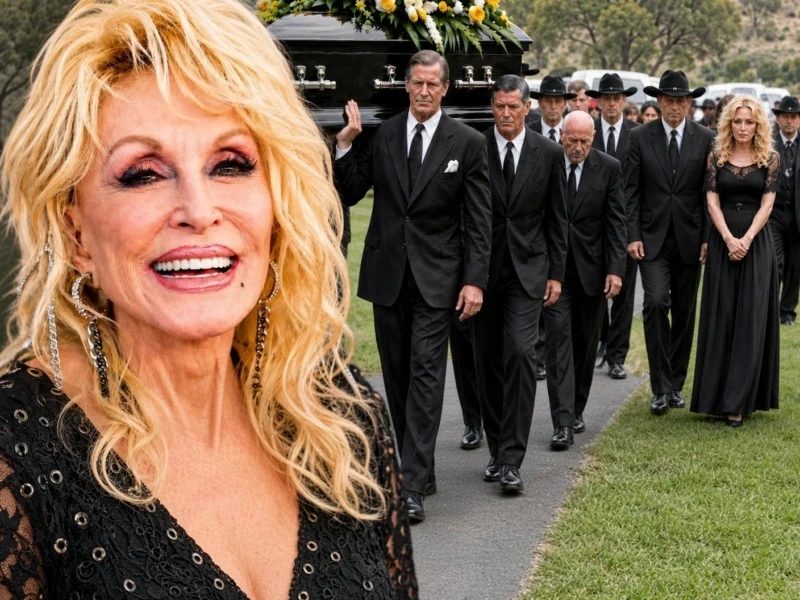
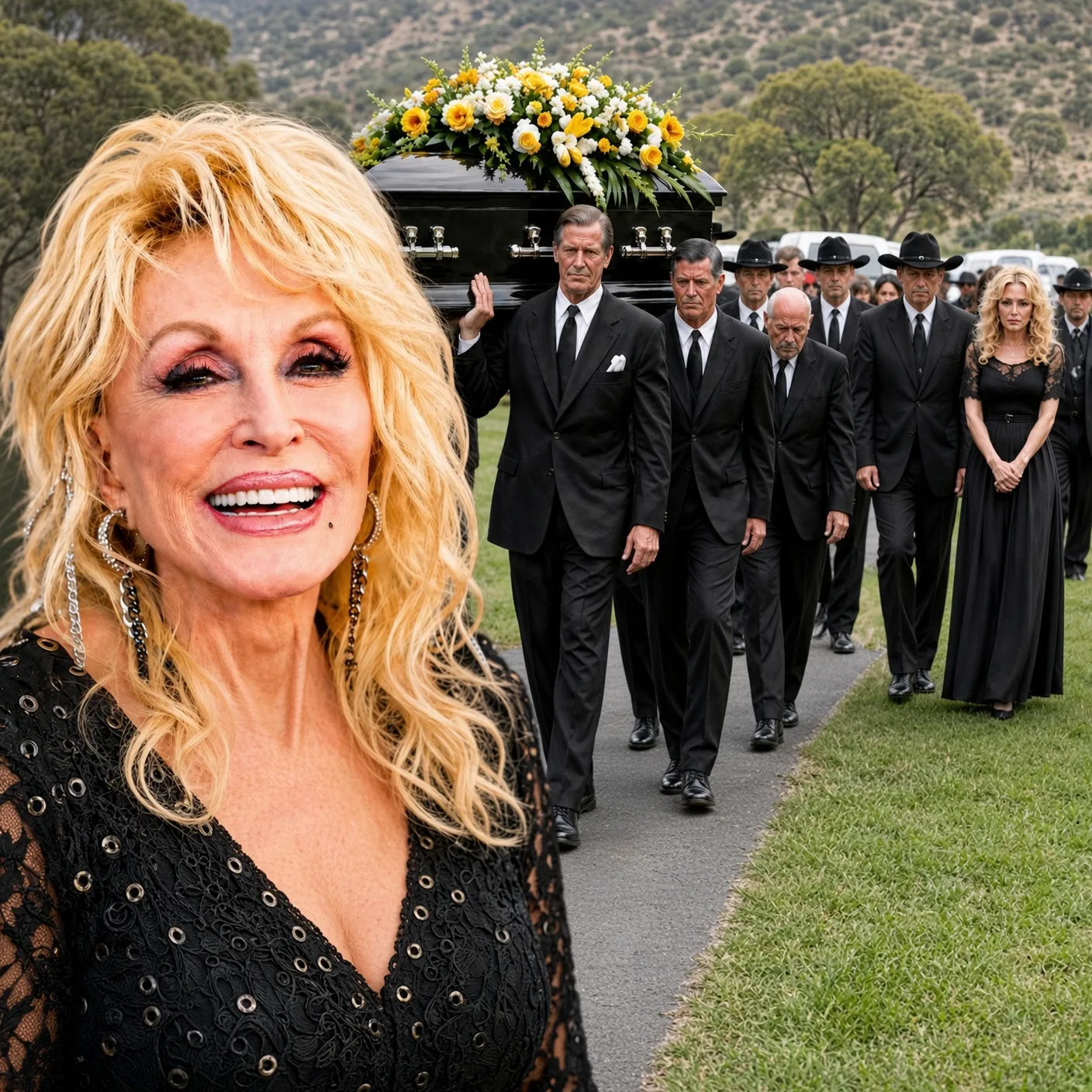
Her family announced that at Dolly’s request, there would be a small private service for immediate family only.
No stadium.
No televised memorial.
No red carpet of mourners climbing over each other to be seen.
The request was honored completely.
On Friday the 28th of August, she was laid to rest at Woodlawn Memorial Park and Mausoleum in Nashville beside Carl, in the place where he had been interred the year before.
A great-niece named Laney Parton confirmed it the following day in a post on Instagram, where she wrote that she had waited until after her granny was laid to rest before trying to put any of it into words.
She said her granny always made her feel like she was enough, and that she never made her dreams feel too big.
She wrote that it still did not feel real, and that is nearly everything the public knows.
It is worth pausing on how rare that restraint is.
In an age when private moments are routinely turned into public events, a family chose silence, and a global audience for once mostly accepted it.
There were no announcements about the program, the guest list, or the music.
And the people who loved her chose to leave it that way.
This is where I want to slow down, because there is a question many people have been asking.
Who was in that room?
The honest answer is that the family has not said, and I am not going to pretend to know.
Internet rumors will always fill silence, and we are not going to do that here.
What we do know is that she chose privacy on purpose, and that the people she loved respected it.
But there is one more voice I want you to hear, because it speaks to this directly.
Miley Cyrus, who Dolly called her goddaughter and who called Dolly her aunt, wrote publicly the day after the news broke.
She said that the feeling of losing her aunt Dolly was beyond what felt right to share.
And then came a sentence that explains the quiet more than any press release.
“Our most sacred moments were private,” she wrote.
“And they will stay there, behind the stage, beneath the glamour, and between our hearts.”
Read that again and notice what she is doing.
In a world where every grief becomes content within the hour, she drew a line and refused to cross it, exactly as Dolly would have wanted.
And in the middle of that post, she shared a single piece of advice she had received from the woman she called her aunt.
“Dolly would want me to feel it,” she wrote.
“Write a song about it and then continue and be strong.”
That is not the sentence of a celebrity mourning a celebrity.
That is a daughter repeating her mother’s rules.
To understand why those two women meant so much to each other, you have to understand how it began.
And it started on tour in 1992 with a single request.
Billy Ray Cyrus, a young singer from Kentucky whose song Achy Breaky Heart had made him famous almost overnight, was touring with Dolly Parton.
They bonded the way people from neighboring hills often do, quickly and without pretense.
And when he learned that his wife was expecting a baby, he turned to Dolly and said that if it was a girl, she had to be the godmother.
Dolly later recalled it on Good Morning America.
“When she was born, he said, ‘You just have to be her godmother.’ And I said, ‘I accept.'”
The baby was born in November of that year.
And she would grow up to be Miley Cyrus.
What is remarkable is that this was never a trivia fact for Dolly.
There was no ceremony, no formal title.
It was something deeper, and it lasted a lifetime.
When Miley became a child star, Dolly appeared on Hannah Montana three times between 2006 and 2010 as Aunt Dolly, a character who was really just Dolly being Dolly.
When Dolly released her rock album Rockstar in 2023, Miley was among the guests, and the two recorded a version of Miley’s own song, Wrecking Ball.
A gift handed back to the woman who had watched her grow up.
They stood together on television.
They wore matching outfits.
And they kept finding their way back to each other when the world was loud.
Miley has often described Dolly less as a legend than as a guide.
Someone who checked in, who offered advice, and who understood what it meant to grow up under a spotlight that never switches off.
For Miley, Dolly was proof that a person could survive fame without being swallowed by it.
That is why Miley’s post carried such weight.
She did not describe a famous friend.
She described the person who had been quietly in her corner for thirty-three years.
And now consider the song Dolly wanted at her own funeral, because it has a way of tying all of this together.
In a 2014 interview with Entertainment Weekly, she was asked about her wishes, and she answered with a song called If We Never Meet Again, an old gospel hymn that had been sung at Carl’s funeral.
“We did sing it at his funeral,” she said.
“And I would like it to be sung at mine.”
Reports have noted that it is unclear whether it was performed at her service, and the family has not confirmed it.
But the choice itself is the point.
Of all the songs she wrote, all the standards she gave the world, she wanted a simple hymn about a promise to see someone again.
Not a hit.
Not a showpiece.
A promise.
Which brings us to the last thing she asked of the world.
And it was not a monument.
When her family asked the public to honor her, they did not ask for statues.
They asked, in lieu of flowers, for donations to Dolly Parton’s Imagination Library.
That program began in 1995 in Sevier County, her home county, with a simple idea that came from a very personal place.
Her father, Robert Lee, the sharecropper who paid for a delivery with cornmeal, never learned to read or write.
She has spoken about him with enormous love and respect, and about how much it mattered to her that he could not read.
So she decided that every child in her county would receive a free book in the mail every month from birth until they started school, no matter what their parents earned.
It spread across Tennessee, then across the United States, then to Canada, the United Kingdom, Australia, and Ireland, and later beyond.
By the time of her death, reports said the program had delivered more than 300 million books.
Let that number settle for a second.
Three hundred million.
Each one a small envelope arriving at a front door, addressed to a child by name, from a woman those children often thought of as a friend.
And now think about who she was, because that tells you why she mattered more than a catalog of songs.
She was a woman who grew up in a cabin without running water.
Who became rich and famous beyond any reasonable dream.
And who never forgot that the real wealth was the thing her father could not do and wanted for his children.
She did not turn him into a symbol.
She turned him into a library.
And that is the answer to the question so many people have been asking since that Tuesday in August.
Why did it hurt so much?
Because Dolly Parton did the rarest thing a famous person can do.
She made enormous success feel like something that belonged to everyone.
She wore the wigs, the rhinestones, the impossible heels, and she made it clear with a laugh that she knew exactly what she was doing and that the joke was never on anyone but herself.
And when it was time to say goodbye, she did it the way she did everything else.
With careful planning, a quiet word to someone she trusted, and a refusal to let her ending become more important than anyone else’s beginning.
The day her nephew spoke, the sadness was real.
But he also said something that has stayed with me.
He said, “The sadness lies with us, not with Dolly.”
She had no fear of it.
She believed Carl would be waiting, that her parents would be there, that the long road would end in a familiar porch light.
So here is what I would ask of you tonight.
Before you close this video, think of someone in your life who needs to know where they stand with you.
Call them.
Or write them.
Or send a book to a child who might need one.
That is how you honor a woman like Dolly.
Not with grief alone, but with the kind of love that gets up and does something about it.
She spent eighty years proving that kindness costs nothing and changes everything.