The Marine Never Asked Anyone to Stay—Until His K9 Chose a Woman Who Was Leaving
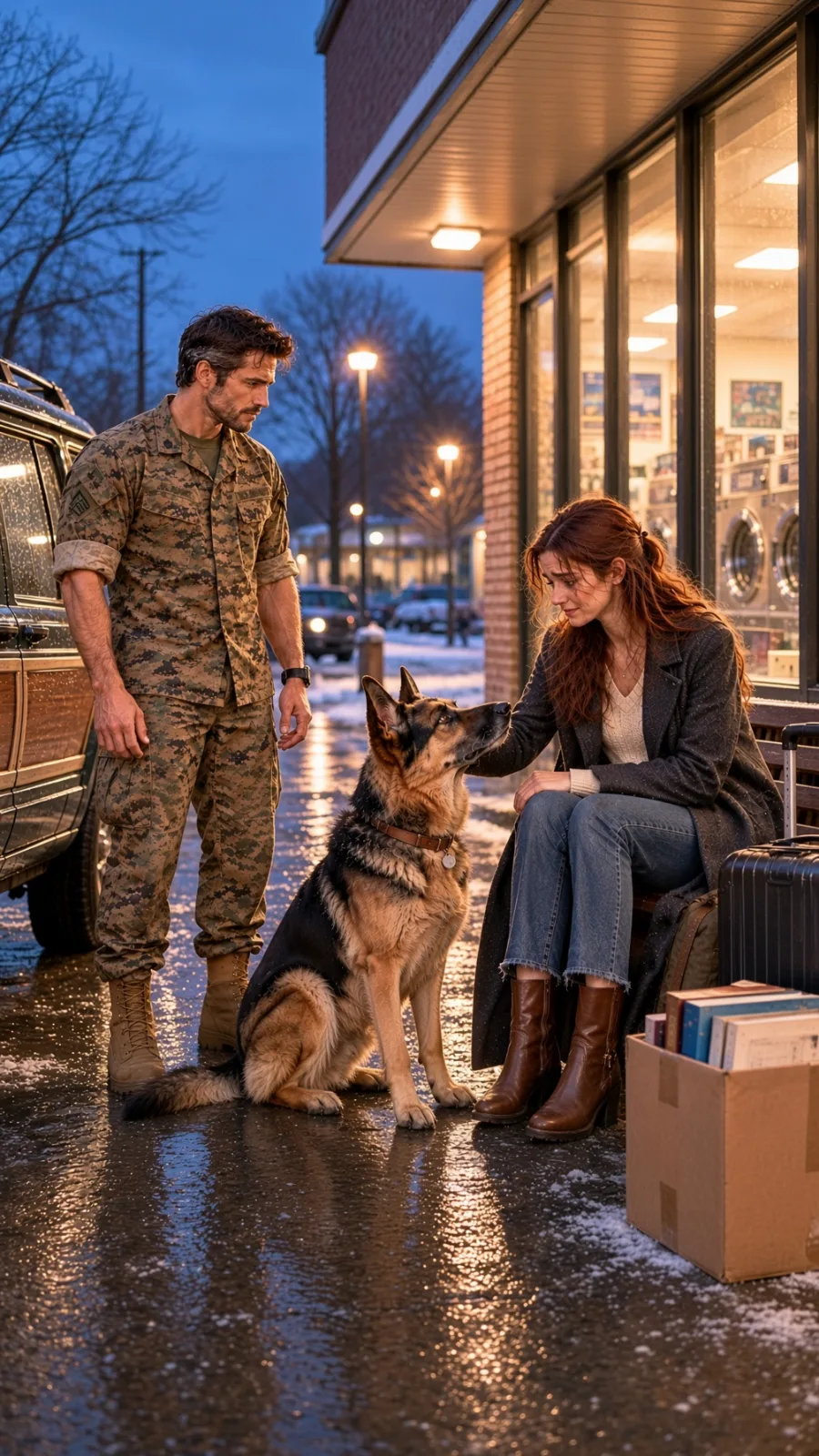
The Marine had spent nearly two years making sure no one got close enough for him to lose them.
Then on a freezing December night, his retired German Shepherd did something he had never done before.
Mako walked toward a young woman stranded outside a laundromat and refused to leave her.
Julian thought it was strange until she climbed into his Jeep and sat in the one seat he had kept almost empty since his best friend died.
And when that same woman prepared to leave weeks later, Mako would force Julian to face the one question he feared most.
Would he finally ask someone to stay?
Before we begin, tell us in the comments where you’re watching from.
And please subscribe and help us reach our first one thousand subscribers.
Freezing rain had begun to silver the roads outside Frederick, Maryland, by 6:30 that December evening, turning parking lots black and glossy beneath the streetlights while a cold wind pushed needles of rain across the empty highway.
Staff Sergeant Julian Cross eased his 1989 Jeep Grand Wagoneer off the road and into the yellow light of a convenience store beside a small laundromat.
At thirty-four, Julian carried the disciplined bearing of a career Marine without the hardened look people sometimes expected from one.
A little over six feet tall, he had an athletic, balanced build shaped by years of discipline rather than vanity.
His dark chestnut hair was clipped neatly at the sides but left just long enough on top to fall into a natural wave when damp, and faint stubble sharpened an already angular jaw.
Gray-blue eyes and a straight nose gave his face a striking, almost cinematic quality, though there was nothing performative about him.
Julian moved quietly and spoke politely, with the composed manner of a man who rarely needed to make himself the center of a room.
The Grand Wagoneer suited him better than anything new could have.
Dark forest green with faded wood-grain panels and worn tan leather inside.
It had scratches Julian had never bothered to hide and an engine he preferred repairing himself.
Behind him sat Mako.
The seven-year-old German Shepherd was black and tan with a deep charcoal saddle, amber-brown eyes, powerful shoulders, and the measured stillness of a dog who had spent most of his life being trained not to waste movement.
A retired military working dog, Mako had officially belonged to Julian for eighteen months.
Retirement had softened some routines but not his instincts.
He rarely barked without reason.
He noticed doors, hands, voices, and changes in a room before most people noticed him.
Julian stepped inside the convenience store for coffee and returned less than three minutes later.
Mako was staring across the parking lot.
Julian followed his gaze.
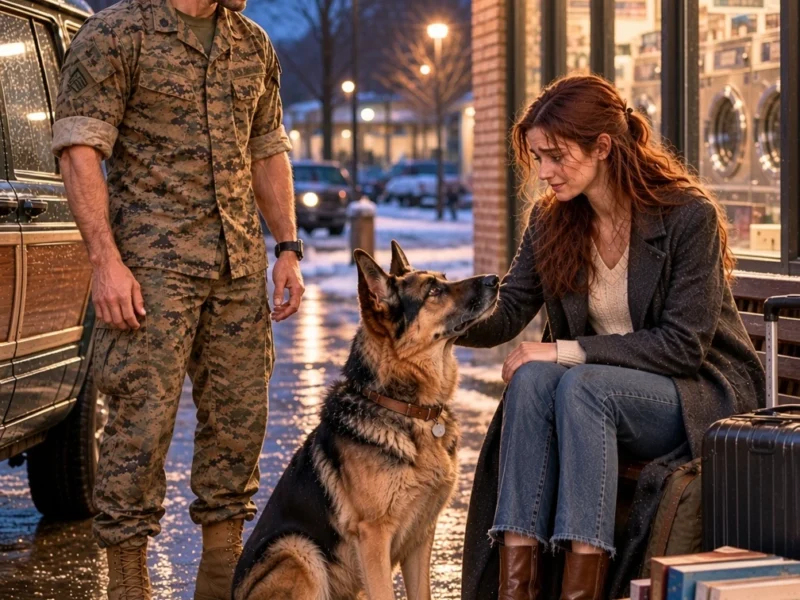
Under the narrow awning of the laundromat sat a woman beside two suitcases and a taped cardboard box filled with books.
She looked about thirty, slender but not fragile, with long dark auburn hair that had begun curling from the damp air and fair skin flushed pink by the cold.
Her hazel-green eyes were fixed on her phone with the concentration of someone refusing to let a bad day become a public breakdown.
She wore a charcoal wool coat over jeans and dark ankle boots.
Even from a distance, Julian could see exhaustion in the set of her shoulders, but not helplessness.
Come on, Mo.
The German Shepherd didn’t move.
Julian glanced down.
Mako.
One ear turned toward him.
The rest of the dog remained pointed toward the woman.
That wasn’t a suggestion.
Mako walked forward.
Julian exhaled and followed.
The woman noticed the dog first.
Her hand stopped above her phone as Mako approached, then halted several feet away and sat.
Does he usually ignore you like this? she asked.
There was tired amusement in her voice.
I’m going to say no for professional reasons.
She smiled.
It changed her face more than Julian expected.
Her name was Camille Rowan.
She had arrived from Pennsylvania that afternoon with everything she thought she needed to begin a new life in Maryland.
The man she had planned to marry had met her with a confession instead.
He had gone back to someone from his past.
Camille offered no dramatic version of it.
I’ve had better Tuesdays.
Julian almost smiled.
She had already booked a motel, already arranged a ride, and tomorrow she would decide what came next.
Julian respected that immediately.
She wasn’t waiting for someone to solve the evening for her.
She was simply sitting beneath a laundromat awning while the future reorganized itself without permission.
The freezing rain thickened, ticking against the metal roof.
Camille’s phone buzzed.
She looked at the screen for the first time.
Frustration cracked through her composure.
My ride canceled.
How far is the motel?
About two miles.
Julian looked toward the road.
A thin glaze had begun forming along its edges.
You’re not walking that with two suitcases.
Camille’s eyes returned to him.
I’m also not getting into a stranger’s car because he has a convincing dog.
Fair.
Julian reached slowly into his coat, removed his identification, and held it where she could read it without stepping closer.
Staff Sergeant Julian Cross.
You can photograph that.
The Jeep and the plate.
Call the motel and tell them you’re on your way.
Send everything to somebody you trust.
Camille studied him.
You’ve done this before.
Picked up stranded women outside laundromats.
Her mouth twitched.
No.
Then no.
He stepped back and gave her space.
That, more than the identification, seemed to make the decision for her.
Ten minutes later, Julian loaded one suitcase into the rear cargo area while Camille handled the other herself.
Mako climbed into the back seat without instruction.
Camille opened the front passenger door.
Julian froze only for a second, but she saw it.
His hand tightened almost imperceptibly around the driver’s door handle as Camille lowered herself onto the worn tan leather.
Something passed behind his eyes.
Not anger exactly.
Something quieter and older.
Camille glanced at the seat, then at him.
You okay?
Yeah.
The answer came too quickly.
Julian got behind the wheel.
For most of the drive, rain whispered against the windshield while the wipers kept a steady rhythm.
Camille didn’t ask about the moment at the door.
Julian was grateful for that, though he couldn’t explain why her silence felt more intimate than questions would have.
At the motel, he carried one suitcase beneath the awning and left the second for Camille when she reached for it.
No unnecessary rescue.
No reason to make her owe him anything.
Camille looked through the Jeep’s open rear door.
Mako was sitting upright, still watching her as though he expected her to come back.
I think your dog doesn’t want me to leave.
Julian looked at Mako.
Something tightened deep beneath his ribs.
Don’t get attached.
Camille smiled faintly.
Was that for him?
Julian didn’t answer.
She disappeared through the motel doors.
The Grand Wagoneer rolled back onto the wet road, its old engine humming beneath the rain.
Mako turned in the rear seat and continued watching through the back window until the motel lights disappeared.
Julian looked at him in the mirror.
Then his gaze drifted toward the empty passenger seat.
A faint impression remained in the worn leather where Camille had been sitting.
Julian looked away.
For nearly two years, whenever he could help it, that seat had remained empty.
Tonight, for the first time in a very long while, someone had sat there.
And Julian Cross had discovered that he wasn’t ready to explain why that mattered.
By morning, the freezing rain had passed, leaving Frederick beneath a pale December sky, its sidewalks wet and shining, and bare branches ticking softly against windows whenever the wind moved through town.
Camille Rowan did not go back to Pennsylvania.
She woke in the motel, expecting embarrassment to make the decision for her.
But what came instead was anger.
Not the wild kind, and not entirely at the man who had changed his mind.
Some of it was directed at herself.
For too long, she had arranged her future around someone else’s plans.
His city.
His timeline.
The apartment they would eventually find.
The life they would supposedly build.
If she packed her belongings and drove home simply because he had chosen someone else, then he would still be deciding where she lived.
By noon, Camille had found a furnished studio available month-to-month above a quiet brick building near downtown Frederick.
It was small enough that her boxes crowded the walls, but the key belonged to her.
Work came next.
Camille had spent years in regional community project management, administration, and fundraising.
The kind of work that required her to move between offices, donors, contractors, and project sites rather than remain behind one desk.
Within days, she accepted a temporary position at a local community restoration center, renovating an aging brick building into shared space for military families, veterans, and Frederick residents.
She liked that the place was unfinished.
Exposed plaster.
Stacked lumber.
Half-painted rooms that did not pretend transformation was tidy.
A week after the night at the laundromat, Camille stood in the courtyard holding a clipboard while volunteers unloaded supplies.
She heard boots on gravel and looked toward the gate.
Julian Cross was walking in with a small Marine volunteer detail.
She recognized him immediately.
Mako recognized her faster.
The German Shepherd lifted his head, stared for half a second, then crossed the courtyard with purposeful strides.
Julian called his name once, more surprised than commanding, but Mako continued until he reached Camille and sat beside her leg as if their previous meeting had ended minutes ago instead of a week earlier.
Camille looked down at him.
Well, apparently I’ve stolen your dog.
Julian stopped several feet away.
He has terrible judgment.
She looked up.
He smiled.
Not the restrained almost-smile she remembered from the laundromat.
This one reached his eyes and briefly stripped away the guardedness she had noticed in the Jeep.
I heard that, Camille said.
You were supposed to.
Mako leaned lightly against her leg.
The moment should have felt awkward.
Somehow it didn’t.
Mako was retired now, no longer accompanying Julian on military duties.
The restoration center allowed dogs, and Julian brought him only on volunteer project days when the setting was appropriate.
That distinction mattered to Julian.
Retirement meant Mako no longer had to earn his place by working.
Over the following days, familiarity grew without either of them deliberately encouraging it.
Camille coordinated schedules and donations while Julian helped organize repairs.
They disagreed over whether an old meeting room should become storage or remain open for community programs.
Camille won.
Julian claimed he had surrendered only because she possessed the clipboard.
They drank coffee on the back steps during breaks.
Sometimes after the other volunteers left, they walked Mako around two quiet blocks before going separate ways.
Camille learned that Julian could talk surprisingly easily when the subject required nothing from him emotionally.
He could explain why older engines were easier to trust because a man could understand what had failed by listening.
He could make dry observations about bad coffee and argue that anyone who painted over solid wood deserved prosecution.
But the future changed him.
One afternoon, Camille asked whether he would keep the Grand Wagoneer after leaving the Marine Corps.
Julian looked beneath the hood and tightened something with a wrench.
That’s a long way off.
You don’t know when you’re getting out.
I know.
What do you want to do afterward?
He lowered the hood.
Probably fix whatever starts making noise next.
It was smooth enough to sound like an answer.
Camille knew it wasn’t.
She began noticing a pattern.
Julian spoke about tomorrow, occasionally next week, almost never next year.
It wasn’t pessimism.
It was as though he had trained himself not to stand far enough into the future to see who might or might not be standing there with him.
Mako carried his own unanswered questions.
The old rubber ball first caught Camille’s attention during a break.
It was faded, scratched by years of teeth, and ugly enough that she wondered why Julian hadn’t replaced it.
Mako had left it beneath the bench.
Camille picked it up.
His head rose immediately.
She smiled.
This?
Mako walked over, gently took the ball from her fingers, and carried it several feet away.
Camille glanced at Julian.
Possessive.
Julian’s expression changed so slightly she might have imagined it.
Don’t take it personally.
He offered nothing more.
Two afternoons later, several volunteers were clearing an old storage room.
Among the donated equipment was a cardboard box containing obsolete training supplies.
Graham Wells, a broad, good-natured electrician in his late fifties with a shaved head, gray mustache, and the permanent squint of a man who had spent decades working beneath harsh lights, pulled out a small metal whistle.
Anybody know what this belongs to?
Before Julian could answer, Graham blew it once.
The sound cut sharply across the courtyard.
Mako exploded to his feet.
Not barking.
Not aggressive.
Running.
He crossed the yard toward the sound, past Graham, then stopped.
His ears stood high.
His body went perfectly still.
He looked toward the doorway, then toward the gate, then behind him, searching.
Mako.
Julian’s voice was calm.
The dog didn’t turn.
Mako.
Camille had never seen Julian’s composure change so quickly without his body moving at all.
His shoulders remained level, his hands relaxed at his sides, but something had emptied from his face.
Then Julian spoke a single command.
Zurück.
Mako turned instantly.
The courtyard fell silent.
Julian walked to him, clipped the leash to his collar, and briefly rested one hand against the Shepherd’s neck.
The gesture was controlled, but Camille saw his thumb move once through the fur, as though reassuring himself as much as the dog.
Everything okay? she asked.
Julian looked at her.
For a second, she thought he might answer honestly.
Yeah.
The same word he’d used in the Grand Wagoneer.
The same answer that had come too quickly.
Julian collected his coat and left before the workday ended.
Camille stood near the doorway as the old dark green Jeep crossed the parking lot.
Mako sat in the back, facing forward.
This time she thought about the battered ball.
He wouldn’t surrender it.
The command that had reached him when his own name hadn’t.
And the way Julian’s face had changed at the sound of an ordinary whistle.
A week earlier, Camille had wondered why one empty seat inside an old Jeep could make a man go silent.
Now she understood only one thing more.
Whatever Julian Cross and Mako had lost, they had lost it together.
And somehow both of them were still listening for it.
Three days later, winter settled harder over Frederick, the morning sky low and colorless above the restoration center while frost held to the shaded bricks long after sunlight reached the courtyard.
Camille had not asked Julian about the whistle.
When he returned to the project, she greeted him exactly as she had before, and he seemed both relieved and unsettled by her restraint.
Mako resumed his place near her desk during breaks, the battered rubber ball never far away.
And for several hours, the unanswered questions remained where Julian apparently preferred them.
Then Walter Baines arrived.
Walter was sixty-seven, a retired Army veterinary technician with a lean, slightly stooped frame, weathered brown skin, close-cropped silver hair, and rectangular glasses that continually slipped down his narrow nose.
Years of working around military dogs had given him the quiet habit of approaching animals sideways rather than directly.
He volunteered at the center twice a month and spoke to nearly everyone with dry affection, as though age had convinced him that very little deserved unnecessary drama.
He entered the courtyard carrying a toolbox, glanced toward Mako, and stopped.
His expression softened with recognition.
Well, I’ll be damned.
Mako lifted his head.
Walter smiled.
Silas.
The effect was immediate.
Mako turned so sharply his collar tags clicked.
Across the courtyard, Julian stopped moving.
Walter’s smile disappeared.
For several seconds, nobody spoke.
Then understanding crossed the older man’s face.
Sorry, he said quietly.
Saw the dog, and it’s fine.
Julian’s voice said otherwise.
He went back to work.
Camille did not ask who Silas was.
That evening, after most volunteers had left, she was stacking folders in the temporary office when Julian appeared in the doorway.
Mako stood beside him.
You want coffee?
Camille looked at him.
Is this the kind that tastes like burned roofing material?
That’s the only kind we have.
Then absolutely.
They sat on the unfinished back steps while Mako settled below them.
Julian held his paper cup between both hands for a long time before speaking.
Mako wasn’t mine.
Camille waited.
His handler was Staff Sergeant Silas Keane.
The name sounded different when Julian said it.
Silas had been thirty-five when he died, Julian explained.
A compact, broad-shouldered Marine with sandy brown hair kept brutally short, a crooked nose broken during training years earlier, and a grin that usually appeared seconds before he said something he shouldn’t.
He was outgoing where Julian was reserved, impatient with self-pity, fiercely loyal, and capable of turning almost any miserable situation into a story worth retelling later.
The two Marines had served together for years.
Silas had been Mako’s handler, but Julian had spent enough time training and traveling with them that the three became a familiar unit, even when paperwork said otherwise.
Nearly two years earlier, Silas had been killed during an overseas mission.
Julian survived.
Mako came home.
He did not describe the mission.
Camille didn’t ask him to.
Before the last deployment, Julian continued, he told me if anything happened, I wasn’t letting this old man get passed from house to house.
Mako raised one ear at the sound of Julian’s voice.
He called a seven-year-old dog an old man.
He started when Mako was four.
Camille smiled faintly.
So when Mako retired, I applied to take him.
How long has he been with you?
Eighteen months.
Camille looked at the Shepherd lying below them.
You kept your promise.
Julian stared into his coffee.
Yeah.
But there was no satisfaction in the answer.
Piece by piece, Camille understood the things she had noticed.
The battered rubber ball had been Silas’s training reward for Mako.
The command Julian had used after the whistle was one Silas had relied on so often that it could still cut through everything else.
Even the whistle itself had not mattered because of that particular piece of metal.
It was the sound.
Then Camille remembered the motel.
The passenger seat.
Julian’s jaw tightened.
She had guessed correctly.
Silas had usually occupied that seat whenever the three traveled in Julian’s Grand Wagoneer.
After his death, Julian never formally declared it forbidden.
That would have required admitting what it meant.
Instead, a tool bag appeared there.
Groceries.
A jacket.
Anything convenient enough to make the seat unavailable until Camille had opened the door that rainy night.
I didn’t know, she said.
I know.
You could have told me to sit in back.
I could have.
Why didn’t you?
Julian looked toward Mako.
I don’t know.
Camille let the silence remain.
Then she asked, when Silas asked you to take care of Mako, did he ask you to keep everything else exactly where he left it?
Julian looked at her.
There was no accusation in her expression.
That made the question harder.
His phone vibrated before he could answer.
Julian pulled it out, read the screen, and went still again.
Camille caught only the heading before he locked it.
Keane memorial gathering.
Anniversary? she asked.
Almost two years.
You going?
Julian folded the phone into his palm.
Didn’t last year.
That wasn’t my question.
A trace of irritation crossed his face, but Camille did not push further.
Finally, Julian said, I haven’t decided.
She nodded.
Then decide when you’re ready.
No lecture.
No insistence that grief had rules.
Julian seemed almost disappointed that she hadn’t made it easier by telling him what to do.
They returned inside and finished the day’s work.
Near dusk, Camille walked with Julian and Mako toward the parking lot.
The Grand Wagoneer waited beneath a bare maple tree, its faded wood grain darkened by the cold.
Julian opened the rear door.
Mako approached, then stopped.
Julian waited.
The Shepherd looked into the back seat, then toward the front.
Mako.
The dog stepped past him.
Julian’s hand remained on the rear door.
Mako reached the passenger side and stood looking through the glass.
Julian seemed to understand before Camille did.
He slowly closed the rear door, then opened the front.
Mako placed his paws on the running board, paused, climbed onto the passenger seat.
The old leather creaked beneath his weight.
He turned once, lowered himself, and rested his head between his paws.
Julian stood beside the open door.
Camille could see the struggle in his face.
Not because the dog had done something wrong, but because nothing terrible had happened when something changed.
Mako was simply sitting there.
The world had not ended.
Julian reached for the door.
For one second, Camille thought he might order Mako out.
Instead, he closed it gently.
Neither of them spoke.
Julian walked around the front of the Grand Wagoneer and stopped at the driver’s door.
His eyes remained on the windshield.
I thought I was teaching him how to live without Silas.
Camille waited.
Julian swallowed.
Maybe he’s been waiting for me to learn.
Then he climbed behind the wheel.
Camille remained beneath the parking lot light as the old Jeep pulled away.
This time, Mako wasn’t watching through the rear window.
He was riding in front.
By the final week of December, winter had sharpened over Frederick, leaving frost along porch rails each morning and thin sheets of ice in the shadows where afternoon sunlight never quite reached.
Something had changed between Camille and Julian, though neither of them had been brave enough to name it.
Mako seemed less interested in caution.
He slept beside Camille’s desk while she worked, surrendered his leash to her on evening walks without looking back for Julian, and one afternoon carried the battered rubber ball across the restoration center, placed it beside her boot, then lay down without immediately taking it away.
Camille noticed Julian watching.
Am I being promoted?
Don’t let it go to your head.
But he was smiling.
Julian had begun changing in smaller ways, too.
He talked about replacing the warped steps at his house when spring came.
He mentioned a woodworking course he might take someday.
Once, while tightening a loose hinge, he wondered aloud whether he would want work that involved his hands after the Marine Corps.
Camille said nothing about the significance of those words.
She simply noticed that Julian Cross had begun saying next spring and next year.
Then Baltimore called.
The offer came from a larger nonprofit coordinating community development projects across Maryland.
Camille would oversee multiple sites, working with donors, contractors, and local organizations.
The kind of regional work she had done before, but with better pay, greater responsibility, and room to build something permanent.
The first phase required her to be based primarily in Baltimore.
It was not an escape.
It was a promotion, and she wanted it.
That was what made the decision difficult.
She told Julian over coffee behind the center.
His face brightened immediately.
That’s great.
Camille waited.
You should take it.
She waited another second.
That all?
Julian looked confused.
What do you want me to say?
She didn’t know how to answer without asking for something she wanted him to offer freely, so she said nothing.
The deadline approached.
Julian never mentioned it again.
Camille signed the contract.
When she told him, he nodded once and asked when she started.
Then he helped her find moving boxes, checked the tires and fluids on her car, and wrote down a route into Baltimore that avoided a construction bottleneck.
Every practical kindness somehow hurt more than indifference would have, because Julian wasn’t behaving like a man who didn’t care.
That would have been easier.
He was behaving like a man who cared enough to make her departure painless while refusing to admit that her leaving might hurt him.
Each box he taped and every problem he solved seemed to remove one more reason she might need to turn back.
Two evenings before she was scheduled to leave, Camille stood beside her car while Julian checked the pressure in the final tire.
You’ve thought of everything, she said.
Trying to.
Except one thing.
Julian straightened.
Camille watched him for several seconds.
Do you ever ask anyone to stay?
His hands stopped on the pressure gauge.
The silence answered first.
Camille folded her arms against the cold.
You keep making it very easy for me to leave.
It’s your job, Camille.
I know.
It’s a good opportunity.
I know that, too.
Then what are we arguing about?
Her voice softened.
Maybe I’m trying to figure out whether you’d care if I stayed.
Julian looked away.
That hurt more than she expected.
You know what I think? Camille continued.
I think you tell yourself you’re respecting everyone’s choices.
Maybe sometimes you are.
But if you never ask anyone to stay, they never get the chance to tell you no.
Julian’s jaw tightened.
And you never have to find out what that feels like.
He handed her the pressure gauge.
Your tires are good.
Camille almost laughed at the absurdity of it.
Instead, she left.
That night, she returned to the restoration center for several folders she’d forgotten.
Most of the building was dark, but light spilled from the temporary office.
Julian was inside.
He stood beside her desk holding the small nameplate that had been fixed to the divider.
Camille Rowan.
He had already removed it.
She stopped in the doorway.
You’re already erasing me.
Julian turned.
You’re leaving in two days.
So you thought you’d save time.
That’s not what I’m doing.
What are you doing?
Preparing.
The word landed badly.
Camille stepped inside.
That’s what you always do, isn’t it?
Julian’s expression hardened.
Don’t.
You prepare for people to leave before they’ve even gone.
Camille.
You did it with that seat.
You did it with the memorial.
And now you’re doing it with me.
His voice dropped.
You don’t know what you’re talking about.
Then tell me.
I don’t owe you an explanation for how I remember him.
No, you don’t.
Her anger disappeared almost as quickly as it had risen.
But I’m not asking you to stop remembering Silas.
Julian looked at her.
I’m asking you to stop treating every goodbye like it’s the same one.
The words hung between them.
Camille saw pain move across his face and should have stopped.
Instead, hurt carried her one sentence further.
Silas died, Julian.
I didn’t.
Silence.
The instant she heard herself say it, Camille wished she could take it back.
Julian.
He looked at her for a long time.
Then the anger she expected never came.
That’s exactly why I’m afraid.
Camille went still.
Julian’s voice was quieter now.
Silas didn’t choose to leave.
He swallowed.
You can.
There it was.
Not fear of death.
Not even grief by itself.
Julian was afraid of giving someone enough importance that they could look at him one day and decide somewhere else was better.
Death had taught him that people could disappear without permission.
Loving Camille required something even harder.
Accepting that she had permission.
That she could know him completely, remain entirely free, and still decide not to stay.
He had spent nearly two years protecting himself from loss.
Now he understood that control had never been what frightened him most.
Choice was.
Camille’s eyes burned, but she refused to turn the moment into a promise she wasn’t ready to make.
I can’t make that choice for you, Julian said.
I never asked you to.
Neither knew what else to say.
Later, Julian helped carry the last boxes from Camille’s studio to her car.
Afterward, he drove home with Mako while Camille followed in her own car to return a project folder and the stainless steel thermos Julian had left at her studio earlier that week.
At his house, Julian moved the Grand Wagoneer through the gate so she would have enough room to turn her car around in the narrow drive.
Mako watched from the porch while Camille handed Julian the folder and thermos.
For a moment, neither of them seemed willing to make the next movement.
Then Camille got into her car.
She drove away with both of them still carrying too many things they had not said.
Julian stood beside the open gate until her taillights disappeared.
Then he went inside.
On the table near the door sat a wooden box he’d taken from the closet earlier that evening.
The memorial gathering was approaching, and for the first time he’d considered bringing something of Silas’s.
Inside lay old photographs, a worn set of tags, a folded cloth patch, and Silas’s own old training whistle.
Mako had watched Julian open the box.
He had smelled every object.
Julian closed the lid.
The house felt unusually quiet.
He poured water into a glass, stopped.
Mako.
Nothing.
Julian looked toward the living room.
Mako.
No tags against the floor.
No nails clicking on hardwood.
He crossed the room quickly.
The back door stood partly open.
Beyond it, cold air moved through the yard.
Then Julian saw the gate still open.
His stomach dropped.
Mo.
He ran outside.
Empty sidewalk.
Empty street.
Julian turned back toward the house, already reaching for his phone, when another thought stopped him.
He went to the place beside Mako’s bed where the old rubber ball usually rested.
Nothing.
Julian stared at the empty floor.
The gate was open.
Mako was gone.
And Silas’s ball had gone with him.
The temperature kept falling over Frederick as sleet began whispering against the pavement.
Light enough to leave the roads open, but cold enough to make every passing minute matter.
Julian called Camille before he reached the sidewalk.
She answered on the second ring.
Mako’s gone.
No explanation.
No pride.
No attempt to handle it alone.
I’m turning around.
Camille was back within minutes.
They searched the surrounding streets first, calling Mako’s name through alleys, yards, and the narrow wooded strip behind Julian’s neighborhood.
Julian moved quickly but without panic, checking places a trained dog might choose rather than wandering blindly.
Camille followed his directions, her coat dampening beneath the sleet.
Nothing.
Back at the house, Julian stood beside Mako’s empty bed.
His eyes moved to the wooden box.
Silas’s things.
The whistle.
Then the missing ball.
Something connected.
I know where he might be.
The old K-9 training property sat less than four miles away, beyond a stretch of secondary road and neglected fields.
Years earlier, before Silas’s final deployment, he had brought Mako there repeatedly for private training sessions.
Mako knew the route, the turns, the smells, the land around it.
Julian knew it, too.
He simply hadn’t driven there in almost two years.
The Grand Wagoneer stopped beside a weathered fence.
Camille was out before Julian had fully killed the engine.
Mako.
They followed the fence line.
Then Julian stopped.
The German Shepherd lay beneath the bare branches of an old sycamore, unharmed and alert, his coat speckled with melting sleet.
Between his front paws rested the battered rubber ball.
Julian’s shoulders dropped.
Not from exhaustion.
Relief.
Mo.
The dog’s ears shifted toward him, but he didn’t rise.
Julian approached slowly and lowered himself to the cold ground several feet away.
Camille stayed back.
For a while, Julian said nothing.
Then he looked beyond the fence.
Silas asked me something here once.
Camille waited.
It was before the last deployment.
He asked what I planned to do when the Marine Corps was finished with me.
A faint smile touched Julian’s face.
I told him I didn’t know.
He could almost hear Silas laughing at the answer.
He said, figure it out before life decides for you.
Julian looked down at his hands.
I thought we had time.
The words were barely audible.
Mako watched him.
For two years, I kept thinking the promise was about making sure he was safe.
Feeding him.
Giving him a home.
Keeping everything he knew close enough that nothing else disappeared.
Julian’s gaze settled on the old ball.
I thought keeping him was the promise.
Silence.
Then Julian breathed out.
Maybe living was.
He stood.
Camille felt something shift in the stillness.
Not disappear.
Not heal all at once.
But loosen.
Julian looked at the Shepherd.
Mako.
Mako raised his head.
His eyes went to Julian, then to the ball.
For several seconds, he remained between them.
Finally, the German Shepherd stood.
The ball stayed on the ground.
Mako walked to Julian.
Julian rested a hand against his neck, closed his eyes for one brief moment, then turned toward the Grand Wagoneer.
He did not retrieve the ball.
Neither did Camille.
The three of them left it beneath the tree.
The next morning, Camille’s car was packed for Baltimore.
Julian stood beside it while Mako waited near the porch.
This time, there were no route notes in Julian’s hand.
No tire gauge.
No practical task he could hide behind.
I want you to stay.
Camille looked at him.
Julian didn’t look away.
I should have said it before.
Her eyes softened, but he continued.
I’m not asking you to give up Baltimore.
I’m not asking you to give up anything you’ve earned.
I just don’t want you driving away thinking you didn’t matter here.
Camille’s throat tightened.
If you chose to stay, Julian said, I’d choose you, too.
There were a hundred easier answers.
Camille gave him none of them.
Instead, she stepped forward and wrapped her arms around him.
Julian held her, then let her go.
Camille drove to Baltimore, and Julian watched her leave without pretending it meant she was gone forever.
The weeks afterward did not return him to the man she’d met outside the laundromat.
Julian attended Silas’s memorial gathering, standing among Marines and veterans who remembered his friend through stories Julian had almost forgotten how to hear without pain.
He laughed once.
It surprised him.
He finished the restoration project.
He began seriously considering what kind of work he wanted after his current assignment.
On some mornings, Mako climbed into the Grand Wagoneer’s passenger seat.
Julian let him.
Six weeks later, late winter sunlight stretched across Julian’s yard while he replaced the warped front steps he had once spoken about as something he’d do in spring.
Mako was lying nearby when his head suddenly rose.
His ears lifted.
Then he ran toward the gate.
A car pulled to the curb.
Julian lowered the drill.
Camille stepped out.
Her auburn hair was longer than he remembered, stirred loose by the cold breeze.
And there was something different in the way she stood.
Not transformed.
Simply certain.
Julian looked past her.
Cardboard boxes filled the back seat.
Among them sat the small potted plant that had lived on the windowsill of her Frederick studio.
He looked back at her.
That’s a lot of luggage for a visit.
Camille smiled.
Good thing I’m not visiting.
For six weeks, she had worked primarily from Baltimore and proven she could manage the nonprofit’s projects without being tied permanently to one office.
The position had always been regional, spanning multiple Maryland sites.
Camille had negotiated what made sense for both her work and her life.
Frederick would become her primary base while she continued traveling to Baltimore and other projects as needed.
She had not abandoned her career.
She had made room for a life alongside it.
Julian stepped toward her.
Mako beat him there.
The German Shepherd disappeared briefly around the side of the porch and returned carrying something in his mouth.
A ball.
Bright.
New.
Mako stopped in front of Camille and dropped it at her feet.
She laughed and bent to pick it up.
Julian stared at the ball.
For an instant, he remembered another one lying beneath a winter tree.
He remembered Silas.
The memory still hurt.
Maybe it always would.
But it no longer felt like a door he was required to keep closed.
Camille tossed the new ball across the yard.
Mako ran after it.
Julian watched him go, then looked at Camille.
This time, when she reached for his hand, he didn’t hesitate.
Some people could remain part of the past without being asked to occupy the future.
And sometimes moving forward wasn’t leaving someone behind.
It was finally carrying their love in a way that left your hands free to hold something new.
Sometimes God’s miracles do not arrive by giving us back what we have lost.
Sometimes they come quietly through a loyal dog who refuses to forget, through a stranger who enters our life at the right moment, or through the courage to finally release what we have been holding for too long.
Julian learned that moving forward did not mean leaving Silas behind.
It meant carrying his memory with love while making room for tomorrow.
And maybe that is something all of us need to remember.
We cannot change every goodbye, heal every wound, or bring back everyone we miss.
But with faith, love, and time, we can learn to open our hearts again.
Perhaps God does not always close the door to our pain.
Sometimes he simply opens another door beside it and waits for us to find the courage to walk through.
If this story touched your heart, share it with someone who may need this message today.
Tell us in the comments what is something or someone you are learning to carry differently.
Subscribe and join us for more stories of loyalty, courage, healing, and second chances.
May God bless you, protect your family, comfort those you miss, and guide you toward the beautiful chapters of your life that have yet to be written.