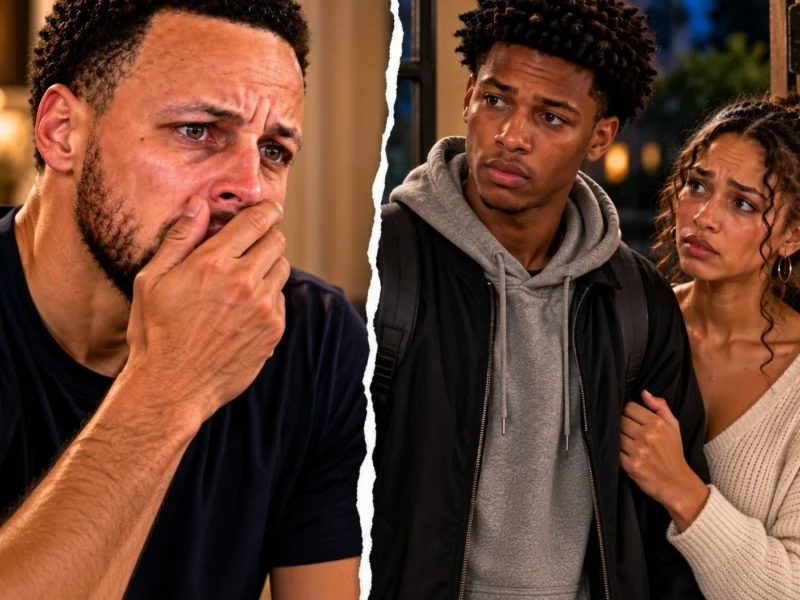
Steph Curry’s Daughter Brings Home a Boy Nobody Expected—Steph Reaction Leaves the Family Speechless
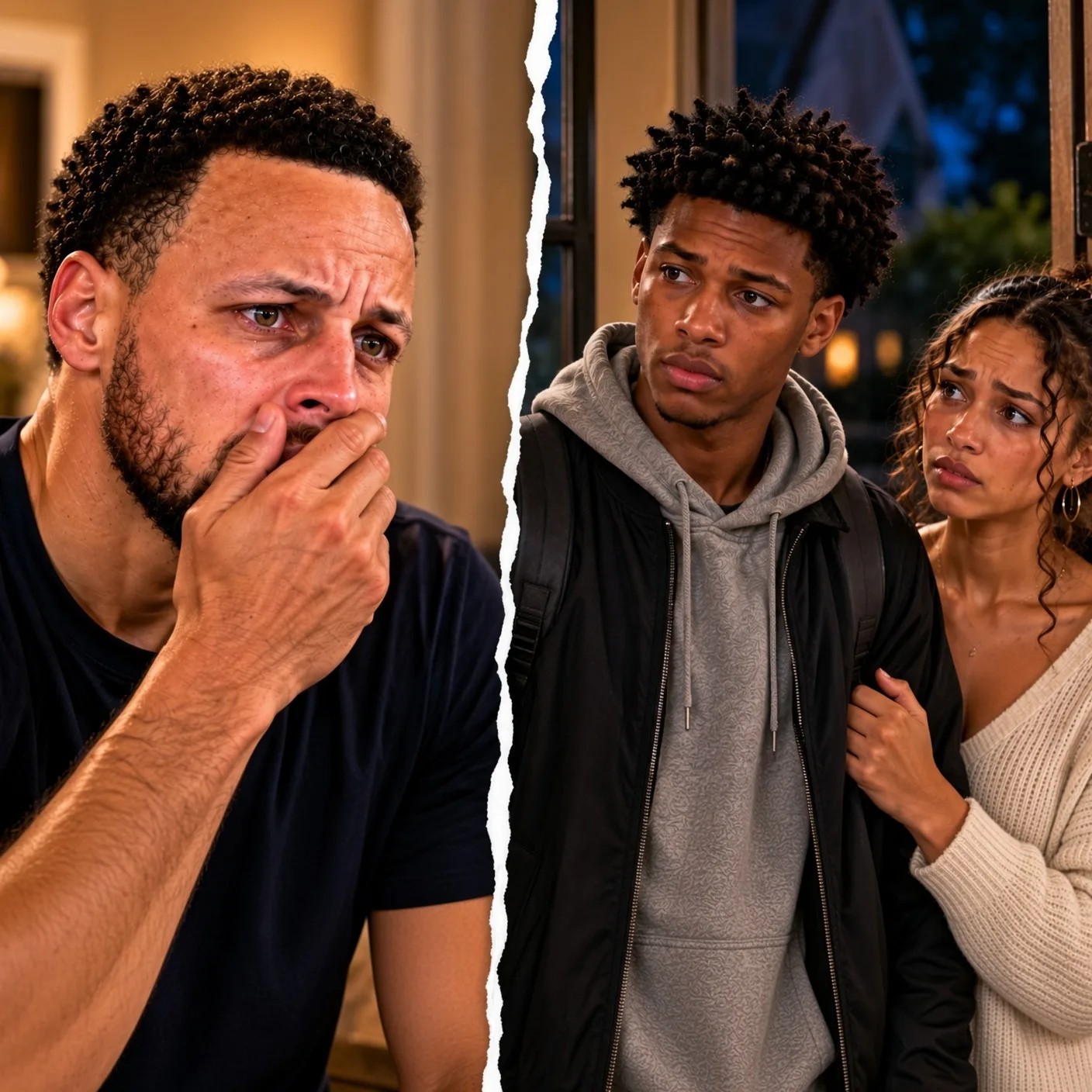
When Steph Curry walked through his own front door on a Tuesday evening in October 2026, he was not expecting anything unusual.
He was tired. Practice had run long, and his legs felt like wet sand.
All he wanted was to sit down, breathe in whatever Aisha was cooking, and listen to his kids argue about their day.
But the second he stepped into the living room, everything stopped.
His 14-year-old daughter, Riley, was sitting on the couch. Next to her sat a boy nobody in that family had ever seen before.
Now, here is the thing. In 14 years of being Riley’s dad, he had never once come home to find a boy in his house.
Not for a school project. Not for a study group. Not for any reason at all.
This was the very first time.
And this boy, quiet and calm and serious in a faded gray hoodie, did something that almost nobody who walks into Steph Curry’s home ever does.
He did not stare at the championship trophies. He did not pull out his phone for a photo. He did not flash that big, nervous smile everyone always flashes.
He just looked at Steph, steady and easy, like two regular people meeting on a regular street in a regular town.
And something about that, something Steph could not name, felt deeply and powerfully familiar.
By the time dinner was over, Steph would hear two words that made him set down his fork and forget how to breathe.
A name. A name he had not heard out loud in years.
It was tied to a promise he had made, and then buried so deep under the speed of his own life that he had almost forgotten it existed.
Almost.
What happened in that house over the next 48 hours is one of the most emotional things you will ever hear.
There is a small wooden box. There is a silver key. There is a letter written years before this night, by someone who was already gone, carrying a message so perfectly timed it will make you wonder how the universe keeps its calendar.
And Steph Curry, a man who has hit some of the biggest shots in the biggest moments the game has ever seen, is going to stand in his own living room completely, utterly speechless.
Stay with us for the whole story, because the moment that letter gets opened is something you cannot miss.
It happened on a Tuesday.
Stephen Curry had walked through that front door about 10,000 times. He knew every sound the hinges made.
He knew which floorboard near the hallway complained when you stepped on the left side. He knew the exact smell of the place: garlic, warm bread, and something clean, like laundry dried in the sun.
And in all those thousands of times, he had never once stopped cold in the doorway.
Until tonight.
It was October 6th, 2026, and the sky over Atherton, California, had turned that deep fall orange, the kind that comes when the light slides through the hills slow and soft.
Steph had finished morning practice at Chase Center in San Francisco, crossed the Bay Bridge, and rolled up the long driveway with his mind on nothing but dinner.
He pushed the door open.
The house smelled right. Aisha was in the kitchen, and he could hear a pan hissing.
Canon, his youngest, eight years old, was upstairs bouncing a ball off a wall. Ryan, eleven, was yelling at Canon to knock it off from somewhere nearby.
Normal. All of it, perfectly normal.
And then he looked into the living room.
Riley was on the couch, and that part was fine. She was 14 now, tall and quiet and serious, and she sat on that couch after school almost every afternoon.
What was not fine was the boy sitting beside her.
He looked about 15, with a thin face and calm eyes. His gray hoodie had been washed so many times it had lost nearly all its color, and his sneakers were old but spotless.
He sat with both hands on his knees and his back straight, perfectly still.
Here is what the boy was not doing.
He was not staring at the four championship trophies in the glass case by the hallway. He was not studying the framed jerseys on the wall.
He was not reaching for his phone to prove to someone later that he had been inside this house.
He was simply sitting there, waiting.
When Steph walked in, the boy met his eyes, direct and unhurried, and said nothing at all.
He just let Steph speak first.
Steph stood in the doorway of his own living room and could not remember the last time someone had made him feel like he was the one who needed to catch up.
“Hey, Dad.”
Riley jumped to her feet. Her voice had a tiny shake in it, which she covered fast. Riley almost never sounded shaken.
“This is Marcus. He goes to Menlo School. We’ve been working on a project together.”
Aisha appeared in the kitchen doorway behind him, drying her hands on a dish towel.
She gave him a look that said, I know. Stay calm. I’ll explain later.
Marcus stood. He was tall, almost Steph’s own 6-foot-3, which stopped Steph for half a second, and he held out his hand.
Steph shook it. The grip was firm and the eye contact never wavered.
No giant smile. No trembling. No “Oh wow, you’re Steph Curry.”
“Nice to meet you, sir.”
“You too,” Steph said, and he meant it, even though he could not have told you why.
Ryan thundered down the stairs and skidded to a stop in her socks.
“Who are you?” she asked, with zero apology.
“Marcus,” the boy said, and he smiled at her easily, like he had known her for years.
Canon peeked around the bottom of the staircase, thought it over, then marched across the room and pressed himself against his father’s leg.
Steph stood in his own hallway while his family moved and talked and filled the air the way they always did.
But his eyes stayed on the boy.
Something about him was familiar, and that something was going to matter. Steph just didn’t know yet how much.
And on the boy’s chest, just under the collar of that old hoodie, a thin cord rose and fell with each breath. Steph did not notice it. Not yet.
Aisha Curry had a rule: if you were in her house, you were going to eat.
It did not matter who you were, where you came from, or how long you planned to stay. You sat down, you got a plate, and you ate.
So Marcus Webb stayed for dinner.
Aisha made lemon chicken with pasta, a green salad with the sharp, tangy dressing Steph had been begging her to sell in stores for 12 years, and fresh bread, still warm.
There was a tall pitcher of ice water with lemon slices floating near the top.
It was a Tuesday dinner that smelled like a Sunday dinner, because Aisha had never learned how to cook halfway.
They all sat down together the way they always did, elbows bumping, everyone talking at once.
Canon kicked someone’s foot by accident within the first 30 seconds.
Marcus sat across from Steph. He was quiet, but not the nervous kind of quiet.
It was the other kind, the kind that belongs to people who have learned to watch the world carefully before speaking in it.
He looked at the food without rushing toward it. He waited until Aisha nodded before he filled his plate.
Then he ate well, not fast and not greedy, but with the focus of someone who does not waste a good meal.
It was the kind of eating that tells you something without a single word.
Ryan watched him the whole time. She always watched everyone, and it was just her nature.
“Do you play basketball?” she asked, head tilted, no apology.
Riley made a small sound next to her.
“No.”
One word, quiet and clean.
The table went just slightly still. Even Canon froze mid-bite.
Because in this particular house, saying you did not play basketball was a little like walking into a bakery and announcing you don’t eat bread.
“That’s fine,” Steph said, keeping his voice easy and warm. “Basketball isn’t for everyone.”
It was the right thing to say, and he meant it.
It just came out a little stiff, and he hoped nobody noticed.
Marcus didn’t seem to. He passed the bread basket to Ryan like it was the most ordinary dinner he had ever sat through.
Ryan took a piece and forgot to keep staring, which was rare.
Aisha moved the conversation forward the way she always did, smooth as someone steering a boat without making a wave.
She asked Marcus about school.
“I like writing,” he said. “And history. I’m reading a book about the civil rights movement right now. Just for fun, not for any class.”
“That’s weird,” Ryan announced.
“Maybe,” Marcus said, and then he smiled.
Then Aisha asked where he was from.
“Charlotte, North Carolina. We moved out here about two years ago.”
Steph reached for his water glass.
“What part of Charlotte?”
“Near Plaza Midwood. Before we moved.”
Steph knew that neighborhood. He had grown up less than 20 minutes from there.
He nodded slowly and said nothing more.
“Why’d you move all the way out here?” Ryan asked.
Nobody could stop Ryan. It was better to just let her finish.
Marcus paused. It was not a hiding pause. It was the pause of someone choosing the right words, and there is a difference, and you can always feel it.
“My grandma needed medical care. She wanted to be close to Stanford Medical Center, down in Palo Alto. So we packed up and came.”
“Just you and your grandma?” Aisha asked. Her voice had gone softer.
“Yes, ma’am.”
He said it simply, no drama and no heavy sigh, just a plain fact settling above the dinner table.
The whole family went quiet. Even Ryan.
Marcus looked around at all of them and gave a small, easy shrug.
“She’s enough, though. She’s actually more than enough.”
Steph looked at this boy across his dinner table.
He looked at the worn-out hoodie, the careful way he spoke, the way he held his shoulders, not sad and not angry, just steady.
He looked like someone who had been told very early that life was going to be hard, and had decided to be just as hard right back, only quietly.
Something moved in Steph’s chest. He couldn’t name it.
He put his fork down.
“What’s your grandma’s name?”
Marcus reached for more bread.
“Gloria. Gloria Webb.”
The name landed in the room.
And Steph Curry, who had hit the biggest shots in the biggest moments anyone had ever seen, felt his heart do something it had never once done on a basketball court.
It stopped.
He picked up his water glass and took a long, slow drink. He set it back down.
He made sure his hand was steady before he let go.
Across the table, Aisha was watching his face. She had been married to him for 11 years, and she could read him the way most people read a large-print sign.
She saw something move behind his eyes, something she had never quite seen before, and she filed it away without a word.
Dinner ended. The kids cleared plates, and Marcus helped without being asked, which made Aisha glance at Steph with one raised eyebrow.
Marcus left around 8:00, and Riley walked him to the front door.
When she came back, she went straight to the kitchen and started helping with the cleanup, also without being asked.
This almost never happened. Steph watched her and understood that she was trying very hard to seem normal, which meant she was feeling anything but.
He stood at the kitchen sink and turned on the water.
He did not wash a single dish.
“Steph.”
Aisha came up behind him, quiet as a held breath.
“You have been standing at that sink for 12 minutes. The water’s running cold.”
He reached over and shut off the tap, then turned to face her.
“His last name is Webb.”
“I know. He told us at dinner.”
“Devon Webb was my best friend at Davidson College.”
Aisha set down the dish she was holding, slowly and carefully, the way you set something down when your hands have suddenly stopped working right.
“Say that again.”
“Devon Webb. My freshman year at Davidson, fall of 2006.”
Steph leaned back against the counter. His voice was level, but his eyes were somewhere very far away.
“I was 17 years old. I had just moved into the dorms. Virginia Tech hadn’t recruited me. Duke didn’t want me. Every big program in the country looked at me and decided I was too small, too slow, not enough.”
He paused.
“Devon was one of the first people at Davidson who looked at me like I belonged there. Like it wasn’t even a question.”
Aisha said nothing. She waited, the way she did when she knew more was coming.
“He was a backup guard from Charlotte, same as me. He used to say we were the two Charlotte underdogs against the whole world.”
A small, tired smile crossed Steph’s face and left quickly.
“He made up nicknames for everybody on the team. Terrible ones. Mine was Saucepan. I burned my hand on a ramen pot in the dorm our very first week, and he never once let me forget it.”
He stopped. He breathed.
“Then in November of our sophomore year, 2008, Devon collapsed at practice. A heart condition called hypertrophic cardiomyopathy. The walls of the heart grow too thick, and it can’t move blood the right way. For an athlete, it’s serious.”
He kept his eyes on the floor.
“The doctors told him he could never play again. His career was over at 20 years old.”
The kitchen was very quiet.
“He went back to Charlotte. We stayed in touch for a while. Phone calls, texts. Then I got drafted in 2009, and everything started moving at a speed I couldn’t control.”
“There were calls I meant to make. Visits I kept planning and never took.”
He shook his head once, slowly.
“Devon passed away in June 2015. I flew to Charlotte for the funeral. I sat in the back of the church and held myself together the whole service.”
He stopped.
“And then I cried alone in the parking lot for a long, long time.”
Aisha reached out and put her hand on his arm.
“After that, I lost touch with his family. His mother. I told myself I’d reach back out. I told myself I’d check in. And I didn’t.”
“You don’t know for certain this is Devon’s son,” Aisha said carefully.
He looked at her directly.
“Marcus said his grandmother’s name is Gloria Webb. Devon’s mother’s name was Gloria Webb. She and my mom went to the same church in Charlotte for almost 20 years.”
He let that sit.
“That’s not a coincidence, Aisha. That’s not even close to a coincidence.”
The silence that followed was the heaviest kind, the kind with actual weight in it.
Outside, October had gone fully dark over Atherton. Crickets. Wind in the big oak trees. A neighborhood asleep and peaceful and completely unaware.
“Call your mother,” Aisha said simply.
He nodded and reached for his phone.
And then Riley appeared in the kitchen doorway in her pajamas, holding her own phone out toward them.
“Marcus just texted me,” she said.
She had no idea what her parents had been talking about. She just looked like a normal 14-year-old sharing a normal moment from her day.
“He sent this photo. Him and his grandma, from this past summer.”
She turned the screen around.
It was a simple picture, a boy and an older woman, both laughing at something outside the frame.
The woman wore a soft head wrap, the kind people wear during treatment. She was thin, but her smile was enormous.
Around her neck, on a thin cord, hung a small silver key.
And on the shelf behind them, half in shadow, almost out of the frame, sat a plain wooden box.
Steph stared at that box.
He could not have explained why his eyes stopped there. He could not have said what it was about a small wooden box on a stranger’s shelf that made his breath come shorter.
He just knew, the way you know something true before your brain has had time to catch up with the part of you that already understood.
He handed the phone back.
“Go to bed, sweetheart.”
“Dad, are you…”
“I’m fine. Go to bed.”
She went.
He stood in the kitchen with his wife while the house settled quiet around them.
And the little silver key around Gloria Webb’s neck turned slowly in his mind, like something that had been waiting a very long time to be used.
It was 2:00 in the morning, and Steph could not sleep.
He went downstairs in the dark and sat at the kitchen table with only the glow of his phone.
He opened his photo gallery and went deep into the old archive, years and years back, scrolling past the championship parades and the trophy presentations and the babies being born.
Past the 2022 Finals. Past the 2018 and 2017 rings. Past the first one in 2015, when the parade through the streets of Oakland was so packed you could not see the pavement.
Past draft night in New York, June 2009, when the commissioner called his name seventh overall and Steph let out the longest breath of his life.
He kept scrolling, all the way back to Davidson.
The old photos had soft, square edges, the kind phones made before cameras got too sharp and too perfect.
The campus in fall, red and orange leaves against old stone buildings. The small gym that smelled like floor wax and sneaker rubber and hard work.
Coach Bob McKillop running drills on a Tuesday morning with his arms wide, his voice carrying across the whole court.
And then, Devon.
Wide smile, long arms, head thrown back, laughing at something that probably wasn’t even that funny, because Devon laughed at everything.
In one photo, they had their arms around each other after a long practice, both of them sweaty and grinning and squinting into the lens.
Devon was pointing at the camera like he had already decided, before the shutter even clicked, that it had been a great day.
You always decided it was going to be a great day, Steph thought. Before you even got out of bed. You just decided.
He scrolled to the 2008 NCAA tournament.
Davidson College was a small school in a small town about 20 miles north of Charlotte, with fewer than 2,000 students. Nobody gave them a chance when March Madness began that year.
They beat Gonzaga in the first round. Then Georgetown. Then Wisconsin.
The whole country started to pay attention.
Then came Kansas, in the Elite Eight in Detroit, on March 30th, 2008, the greatest college basketball game Steph had ever been part of.
He scored all night. He could not miss.
Davidson was one made shot away from the Final Four, one basket from the kind of impossible thing people talk about forever.
Kansas 59, Davidson 57.
Steph remembered the locker room afterward, the silence of it, heads down, the ceiling too low, the cold fluorescent lights draining the color from everyone’s faces.
The end of a dream, sitting in a cold arena in a city none of them were from.
And then Devon had crossed the room.
Devon, who wasn’t playing anymore because of his heart. Devon, who had watched every minute of that tournament from the bench with both fists clenched against his knees.
He had put both hands on Steph’s shoulders and looked at him with clear, steady eyes.
“That’s the first one. You hear me? That is just the first one.”
“You are going to keep shooting. You are going to shoot until the whole world runs out of basketballs.”
Steph had laughed through his tears.
He had not known then that Devon had less than eight months left on that bench.
He had not known the heart condition was getting worse. He had not known that the guy with the big laugh and the terrible nicknames was quietly running out of time.
He set the phone face down on the table.
The kitchen was dark and very still.
Devon would be 38 right now, he thought. Same age as me. We’d be comparing gray hairs, complaining about our knees, swapping stories about our kids.
He thought about a boy growing up without him in a small house in Charlotte, raised by an aging grandmother who was sick and still somehow holding everything together.
A boy reading history books for fun. A boy staying quiet in rooms full of strangers, keeping steady the only way he knew how, because nobody had ever shown him another way.
He has Devon’s smile. I saw it at the dinner table tonight. The quick, wide, fully meant one. The one that decided things were going to be fine before anyone else had agreed.
He bent forward and put his head in both hands.
Outside, Atherton was completely silent. No cars, no voices, just the faint press of wind through the oaks along the dark street.
He sat like that until the clock on the microwave read 3:07.
Then he went back upstairs, lay down beside his wife, and stared at the ceiling until the sun came up.
He did not sleep one minute.
But somewhere near dawn, floating in that thin space between awake and exhausted, he felt the edge of something.
A promise.
There was a promise. He could feel the shape of it in his memory, the way you feel a word that will not come, right there, just out of reach, and absolutely real.
He would remember it fully in two more days.
He found Riley alone in the kitchen the next morning.
She was sitting at the table eating cereal, a tablet propped in front of her, her hair still twisted up from sleep. The rest of the house was quiet.
Morning light came through the window over the sink in long pale strips and made everything look soft and unhurried.
She looked up when he walked in, and something in her face shifted, the way a door shifts when someone on the other side puts a hand on the knob.
She had been waiting for him.
He sat down across from her. He did not get coffee first. He did not check his phone.
He just sat and looked at his daughter.
“Tell me about Marcus.”
She set her spoon down carefully.
“What do you want to know?”
“Everything.”
She was quiet for a moment, choosing. Then she started.
She had met Marcus three weeks ago, the first week of October. He had just started at Menlo School, and he did not know a single person.
At a school like theirs, private and expensive and full of kids from some of the wealthiest families in the Bay Area, the social rules were written before the first bell ever rang.
You knew which table was yours before you sat down. You knew which names mattered. New kids were expected to figure it out fast and fall in line.
Marcus had eaten lunch alone on his very first day.
“Most kids didn’t talk to him because he doesn’t follow sports,” Riley said, turning her spoon over in her fingers. “At our school, that’s basically not allowed.”
“Everybody knows every team and every stat and every player. If you don’t, they think something’s wrong with you. So they just left him alone.”
Steph watched her face.
“But you didn’t.”
“He seemed real,” she said simply. Then she looked up. “Dad, you know what it’s like at that school.”
“Every single person there knows exactly who you are. They know your stats. They know your rings. They know your shoe deal and how much our house cost. It changes how people talk to me. They’re nice, but it’s the wrong kind of nice.”
She paused.
“Marcus barely knew anything about you at first. He just talked to me like a regular person. Like I was some girl in his English class.”
Steph sat with that for a moment. It landed somewhere tender, somewhere he had not known was still bruised.
“Did he ever talk to you about his father?”
Riley looked at him carefully. Her eyes went slow and steady, the way they did when she was deciding how much to say.
“Once. He told me his dad played basketball at a small college somewhere in North Carolina. But his dad got sick and had to stop.”
“He said he never knew which college. His grandma told him the name once when he was little, but he forgot it.”
Steph kept his voice very level.
“Was it Davidson?”
The room went completely still.
Riley put both hands flat on the table and stared at him. Then her eyes filled, and she blinked the tears back hard and fast, the exact same stubborn blink her father used.
The Curry kids had watched their dad hold himself together in hard moments their whole lives, and they had learned it without anyone teaching them.
“How do you know that, Dad?” she whispered.
“Because Marcus’s father went to Davidson with me. He was my best friend.”
Riley did not move for a long moment.
Then she said something that sat Steph back in his chair so hard it scraped the floor.
“I thought so.”
“What?”
“I thought so,” she said, quietly but clearly. “Not for sure. But Marcus has an old photo on his phone. His dad, when he was young, standing in front of some college campus. Stone buildings. Trees turning orange behind him.”
She stopped.
“There was something about the face. I kept feeling like I’d seen it somewhere before, and I couldn’t figure out where. I thought I was imagining things.”
Steph could not speak.
“I wasn’t imagining it,” she said. It was not a question.
“No,” he said. “You weren’t.”
She stood. School would start soon, and she had to grab her bag and get moving. She was already thinking forward, the way she always did, practical even with wet eyes.
At the kitchen doorway she stopped and turned around.
“Dad.”
Her voice was quieter now, almost careful.
“Marcus has a box. His father left it for him before he passed away. His grandma has kept it all these years.”
“She put a key on a necklace and gave it to him on his tenth birthday. She told him he’d know when the time was right to open it.”
Steph went very still.
“I know,” he said softly. “I saw the key in the photo last night.”
Riley nodded once.
“He hasn’t opened it. I asked him about it one time, and he thought about it for a really long time before he answered.”
She looked at the floor.
“He said he’s scared of what’s inside. He said it might make his dad feel more real, and he doesn’t know yet if he can handle that.”
She left. Her footsteps climbed the stairs, and the house was quiet again.
Steph sat at the table with a slice of untouched toast going cold in front of him.
He thought about a boy who carried a key around his neck every single day and still could not bring himself to use it.
He understood that feeling. He understood it better than he wanted to admit.
He drove across the Bay Bridge alone that morning, the city rising ahead of him in the October blue, the water below flat and silver and cold.
Traffic was light, and the bridge hummed under his tires the way it always did. The skyline stood exactly where it always stood.
Everything looked the same as it did every other morning.
Nothing felt the same at all.
He pulled into the parking garage beneath Chase Center and turned off the engine. He sat in the dark with both hands still on the wheel.
He made the calls before he went inside.
The first was to his mother.
Sonia Curry lived in Cornelius, North Carolina, a quiet town just north of Charlotte, close to Lake Norman. She had grown up in that world and never fully left it.
She remembered every name from every decade, every church friend, every neighbor, every face from every wedding and funeral and Sunday morning she had ever attended.
If anyone knew the Webb family, it was her.
She answered on the second ring.
“Baby, you’re up early.”
“Mom.” He kept his voice steady. “Do you remember a woman named Gloria Webb?”
A pause. Longer than a normal pause.
The kind that tells you the person on the other end isn’t searching their memory. She’s deciding something.
“Devon’s mother,” she said at last. “Yes, of course I remember Gloria Webb.”
Her voice warmed right away.
“We sat in the same church for almost 20 years. She used to bring a sweet potato pie to every potluck that would make you want to sit right down and cry. Best pie I’ve ever eaten in my life.”
Another pause, shorter this time.
“Why are you asking about Gloria, Steven?”
He told her everything, starting at the beginning.
Marcus on the couch. The handshake. The calm eyes and the worn gray hoodie.
Dinner, the name, Gloria Webb and her head wrap and the small silver key, and the wooden box half hidden in the background of a photograph.
What Riley had said that morning about the campus photo and the feeling she could not explain.
He went through all of it without stopping and without rushing, laying it out in order, the way you lay something out when you need another person to see it clearly.
When he finished, his mother was silent. He checked the screen to make sure the call hadn’t dropped.
“Mom?”
“Steven.”
She used his full name. She only did that when the weight of something required it.
“Devon’s girlfriend was pregnant when he got sick. I knew about it. I’ve known this whole time.”
The parking garage was absolutely silent around him.
“You knew,” he said.
“I knew.” Her voice broke slightly on the second word, and she steadied it. “You were in the middle of that first championship season. Everything was moving so fast for you.”
“Every time I picked up the phone to tell you, I thought, let him get through the playoffs first. Let things slow down. I’ll tell him when things slow down.”
She stopped.
“But things never slowed down, baby. They just never did.”
“Her name was Deja, Devon’s girlfriend. She left when Marcus was three years old. Gloria has raised that boy alone from that day forward, all by herself.”
Her voice had gone very quiet.
“I’m sorry, Steven. I should have told you years ago. I’m so sorry.”
He closed his eyes.
“The college,” he said. “Devon’s college. Was it Davidson?”
“Davidson College. Same as you.”
“Then Marcus is Devon’s son.” He opened his eyes. “There’s no question.”
His mother made a sound on the other end of the line. Not crying exactly, but the sound of something long held finally being set down.
It was the particular exhale of a person who has carried something heavy, quietly, for years, and has just been allowed to put it on the floor.
“Did Devon ever mention leaving anything for Marcus?” Steph asked. “A letter? Anything written down?”
A short silence.
“He told me once,” Sonia said slowly, “about two months before he passed. He said he’d put everything important into a box. He said Marcus would have it when he was old enough and ready.”
Her voice dropped lower.
“He said he wrote down every important thing, every person in his life who mattered. Every person he trusted.”
Steph stared at the concrete wall in front of his windshield.
“Every important name,” Sonia said.
He ended the call and sat for a moment. Then he made the second one.
Jordan Price had been a Davidson teammate, a big, easygoing forward from Winston-Salem who had moved back to Charlotte after college and stayed connected to everyone they had ever known.
If Devon had talked to anyone in those final months, it was Jordan.
Jordan answered on the third ring, surprised and genuinely glad.
They talked about Davidson for a minute. The old gym. Coach McKillop’s voice carrying across the practice floor. The 2008 tournament run that still came up every March like clockwork.
Then Steph asked about Devon.
Jordan went quiet in a different way, a warm, remembering kind of quiet.
“Devon was something else, man. Right up until the end, he was the most, I don’t know how to say it right. The most grateful person I’ve ever been around.”
“He understood his time was limited, so he refused to waste a second of it complaining.”
“Did he talk about his son?”
“All the time.” Jordan’s voice softened. “Marcus this, Marcus that, every conversation. He’d pull out his phone and show you pictures before you even asked.”
A pause.
“He told me he wrote the boy a letter and put it in a box with some other things. He said it had every single person in it that Marcus was ever going to need. Anyone who could step in and take care of him when Devon was gone.”
Steph gripped the phone tighter.
“Did he say any names? Anyone specific?”
Jordan was quiet for a long moment.
“Steph,” he said finally. “He said yours first. Your name was the very first one he wrote down.”
The garage was silent.
Somewhere far above him, tires squealed on a ramp, the ordinary sound of the world continuing without pausing for anyone.
“He made me promise something,” Steph said quietly. “I can feel it in my memory, but I can’t fully reach it yet.”
“You’ll remember it when it matters most,” Jordan said. “That’s how those things work.”
They said goodbye.
Steph got out of the car and walked into Chase Center and went through practice.
He ran plays. He moved through drills. His teammates called out to each other, and the coaches talked, and the speakers played the same playlist they always played on a Wednesday morning.
But underneath it all, something in him was shifting, quietly and steadily, the way a river changes course, slow at first and then all at once.
In warm-ups, he hit 47 three-pointers in a row without a miss.
His teammates figured he was locking in early for the season opener.
Not one of them knew he was shooting because his hands needed something to do while the rest of him was somewhere else entirely, sitting in a parked car outside a Charlotte hospital in October 2014, listening to a tired voice ask him for one last thing.
By lunchtime, the ripple had already started, and not in the place Steph expected.
At Menlo School, the news that Riley Curry had brought a boy home spread through the hallways faster than any text thread could carry it.
It did not matter that nobody knew his last name. A rumor at a school like that moves with a life of its own.
Riley found out in the cafeteria, when a girl she barely spoke to slid into the seat beside her with a smile that had a hook in it.
“So is it true? You brought the new guy to your house? The one who doesn’t even know who your dad is?”
“He knows who my dad is,” Riley said evenly. “He just doesn’t act weird about it.”
The girl laughed, a little too bright.
“Right. Well, everybody’s saying it’s kind of a sad story. His grandma’s sick, he’s on some kind of scholarship. People are saying you’re, like, doing a charity thing.”
The word hit Riley like a thrown book.
She set down her fork. She was 14 years old and had spent her whole life learning how to stay calm under a hundred cameras.
She used all of it now.
“He’s not a charity thing,” she said. “He’s the only person in this building who has ever asked me a question I didn’t already know someone would ask.”
“He reads books about history for fun. He eats lunch alone because he’d rather be alone than fake. If you think that’s sad, then I don’t think you know what brave looks like.”
The table went silent.
Across the cafeteria, at a corner table by the window, Marcus looked up from his book.
He had heard none of it. But he saw Riley standing, and he saw the faces turned toward her, and in that instant he understood more than anyone had told him.
He gave her the smallest nod. I’m okay. Don’t worry about it.
She nodded back. I’m not.
That afternoon, Riley texted her father three words: Please hurry home.
He was already on the bridge.
That night, Aisha found her husband in the backyard, standing on the grass beneath the oaks with a basketball he was not shooting.
He was turning it slowly in his hands, over and over, as if it might tell him something.
“Riley told me about lunch,” she said.
“I know. She told me too.”
“She was magnificent.”
“She was,” Steph said. His voice caught. “She was also standing in a cafeteria defending a boy who has no idea how many people are already trying to decide who he is. Aisha, I know what that feels like. I was 17 and everyone had decided I wasn’t enough.”
Aisha slipped her arm through his.
“Then you know what he needs.”
“Someone who shows up.”
“Someone who shows up and doesn’t leave,” she said. “Not for a season. Not for a good month. For good.”
He set the ball down in the grass, and it rolled to a stop against the roots of the oak.
“I’ve been avoiding a call all day,” he admitted. “Gloria’s number. Mom got it for me. I’ve looked at it about 20 times.”
“What are you afraid of?”
He was quiet.
“That she’ll say what I would say if I were her. That 11 years is a long time to wait for a friend who never came.”
Aisha squeezed his arm.
“Then let her say it. And then answer her. Honestly.”
He nodded slowly.
He dialed the number standing under the oak tree, with the October stars coming out over the hills.
It rang four times.
“Hello?”
The voice was thinner than he remembered, but the warmth underneath it had not changed at all. It was the voice that had once handed him a plate at a church potluck and told him to eat more, because a boy your size needs a second helping.
“Mrs. Webb,” he said. His own voice cracked on the second word. “It’s Stephen Curry. Stephen. From Davidson. From…”
“Baby,” Gloria said.
That one word held 11 years.
“I have been waiting for this phone call,” she said, “since the day my son left this world.”
“I’m so sorry,” he said. “I should have called a long time ago. I should have come.”
“Yes,” she said, and she was not cruel about it, only honest. “You should have. And I’d be lying if I said I wasn’t angry once or twice.”
“But that was a long time ago, and I’ve had a lot of time in this house to think. And what I think now is this. You are calling tonight. Out of all the nights there are, you are calling tonight, and you are calling on your own.”
She took a slow breath.
“That tells me everything I need to know about the kind of man you are.”
He pressed his hand against his eyes.
“Marcus came to my house yesterday,” he said. “I didn’t know who he was. I didn’t know until he said your name at the dinner table.”
“I know,” Gloria said gently. “I sent him.”
Steph went still.
“What?”
“Not in so many words,” she said, and he could hear the small smile in her voice. “He came home three weeks ago and told me he’d met a girl at school who was kind to him. I asked her name. When he said Riley Curry, I put down my dishrag and sat in my chair for a very long time.”
“I didn’t tell him why. I just told him to be a good friend to that girl, and to let the day come however it was meant to come.”
Her voice trembled.
“The key’s been around his neck for five years. I think the box has been waiting for you the whole time.”
Steph could not answer.
“Bring your family tomorrow evening,” she said. “Or I’ll bring Marcus to you. Either way. It’s time.”
“I’ll be there,” he said. “Whatever time you say.”
“Seven o’clock.”
She hung up.
He stood under the oak tree with the phone against his chest, and he looked up at the sky, and for a single moment he could have sworn he heard a laugh he had not heard in 17 years.
The next evening, they did not wait for Marcus to come to them.
But Marcus came anyway. Riley had texted him that afternoon, standing in the school hallway with her heart in her throat, and he had walked the two miles from his grandmother’s apartment rather than wait for a ride.
He arrived after dinner. Same couch, same quiet posture, same worn gray hoodie that Steph was beginning to think might be the only one he owned.
Canon had already been put to bed. Ryan had been sent upstairs with the firm promise that someone would explain everything to her later, which she accepted only because she could tell from the temperature of the room that this was not the moment to argue.
Aisha sat in the chair near the window. Riley sat at the far end of the couch, close enough to show she was with him, far enough to give the conversation room.
Steph sat directly across from Marcus.
No warm-up. No small talk.
He looked at the boy and began.
“Marcus. You told Riley your father played basketball at a small college in North Carolina. Do you know which one?”
The boy went very still. The easy quietness he always carried shifted into something more careful.
“My grandma thought maybe Davidson, but she wasn’t completely sure.”
He paused.
“Why are you asking me that?”
“Because it was Davidson,” Steph said. “I know that for certain. I was there.”
He kept his eyes steady on the boy’s face.
“Your father’s name was Devon Webb. He and I played together at Davidson College from 2006 to 2008. He was my best friend, and he was one of the best, most decent, most real people I have ever known in my entire life.”
Marcus did not move.
He looked like someone who had been walking toward something for a very long time in the dark and had just seen a light come on ahead of him.
Not sure yet whether it was real. Not sure yet whether he was allowed to walk toward it.
“You knew my dad,” he said.
His voice came out carefully, like he was handling each word before setting it down.
“He was my best friend,” Steph said again, because it was worth saying twice.
A long silence opened between them.
Riley, on the couch, did not breathe. Aisha, by the window, folded her hands in her lap.
Then Marcus said something no one in the room expected.
“Tell me something about him. Something my grandma doesn’t already know.”
Steph did not have to think for long.
“He made up nicknames for everyone on the team. Awful ones. Mine was Saucepan.”
He watched Marcus’s face.
“I burned my hand on a ramen pot in the dorm our first week of freshman year. He thought it was the funniest thing that had ever happened to any human being in history. He called me Saucepan every single day for three years and never once got tired of it.”
Marcus sat completely still.
Then, just once, a short, quiet breath of a laugh escaped him.
He stopped it quickly, like he wasn’t sure he was allowed to laugh yet. Like joy, in that moment, needed permission.
“My grandma calls me Sauce,” he said, barely above a whisper. “She’s called me that since I was little. She never told me where it came from.”
The room tilted, the way rooms do when something true lands in the middle of them and rearranges everything.
Steph could not speak for a moment.
He looked at the fireplace. He breathed carefully through his nose. He gave himself three seconds, and then he came back.
“Marcus,” he said, “do you have a box? Something your father left behind for you?”
The boy’s hand moved before he could stop it, straight to his chest, his fingers pressing against the fabric of the gray hoodie right over the spot where the cord hung beneath his shirt.
“How do you know about the box?”
“A teammate from Davidson told me. Devon left something for you. A letter, with every important thing your father needed you to know.”
Marcus looked down at his own hand. He wrapped his fingers slowly around the shape of the little silver key beneath the cloth.
“My grandma gave me this on my tenth birthday,” he said quietly. “She said I’d know when the time was right.”
“I think the time might be right,” Steph said, as gently as he knew how.
A long silence, the longest of the whole night.
Then Marcus said two words, plain and honest and completely unguarded, the way only someone very young or very brave can say something true.
“I’m scared.”
“I know,” Steph said. “So am I.”
Marcus looked up sharply.
“Why are you scared? He wasn’t your dad.”
“No,” Steph said.
He leaned forward, elbows on his knees, closing the distance between them.
“But Devon was my brother. Not by blood, but by everything that actually counts.”
He held the boy’s gaze.
“And because I didn’t look for you, Marcus, all these years, I should have found you. I should have made sure you were okay. I knew Devon had a son, and I let life get in the way.”
“I’m standing here in front of you right now telling you that I am deeply sorry I didn’t come sooner.”
One single tear moved down Marcus’s face.
He wiped it away fast, almost angry about it.
“Can I go get the box?” he asked.
“Only if you want to.”
He called his grandmother.









