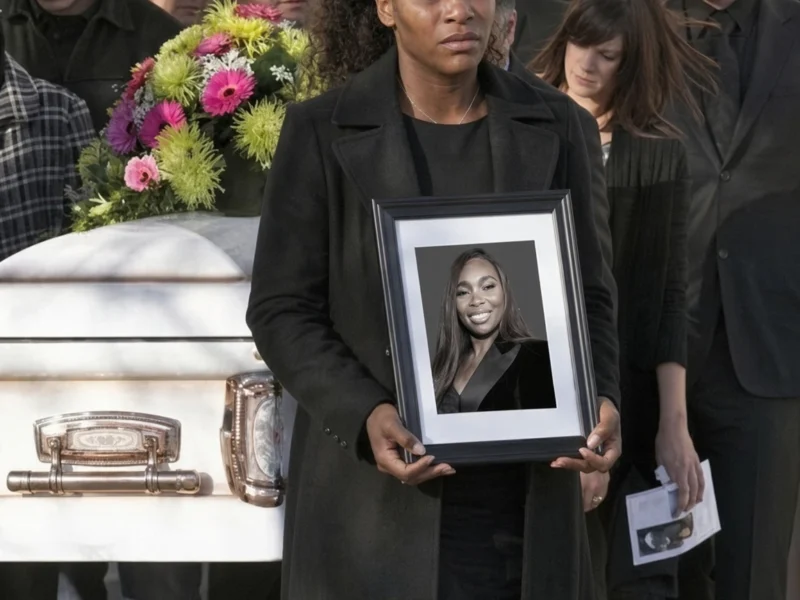
Serena Williams SAYS GOODBYE After Her Sister Venus’s Tragic Diagnosis
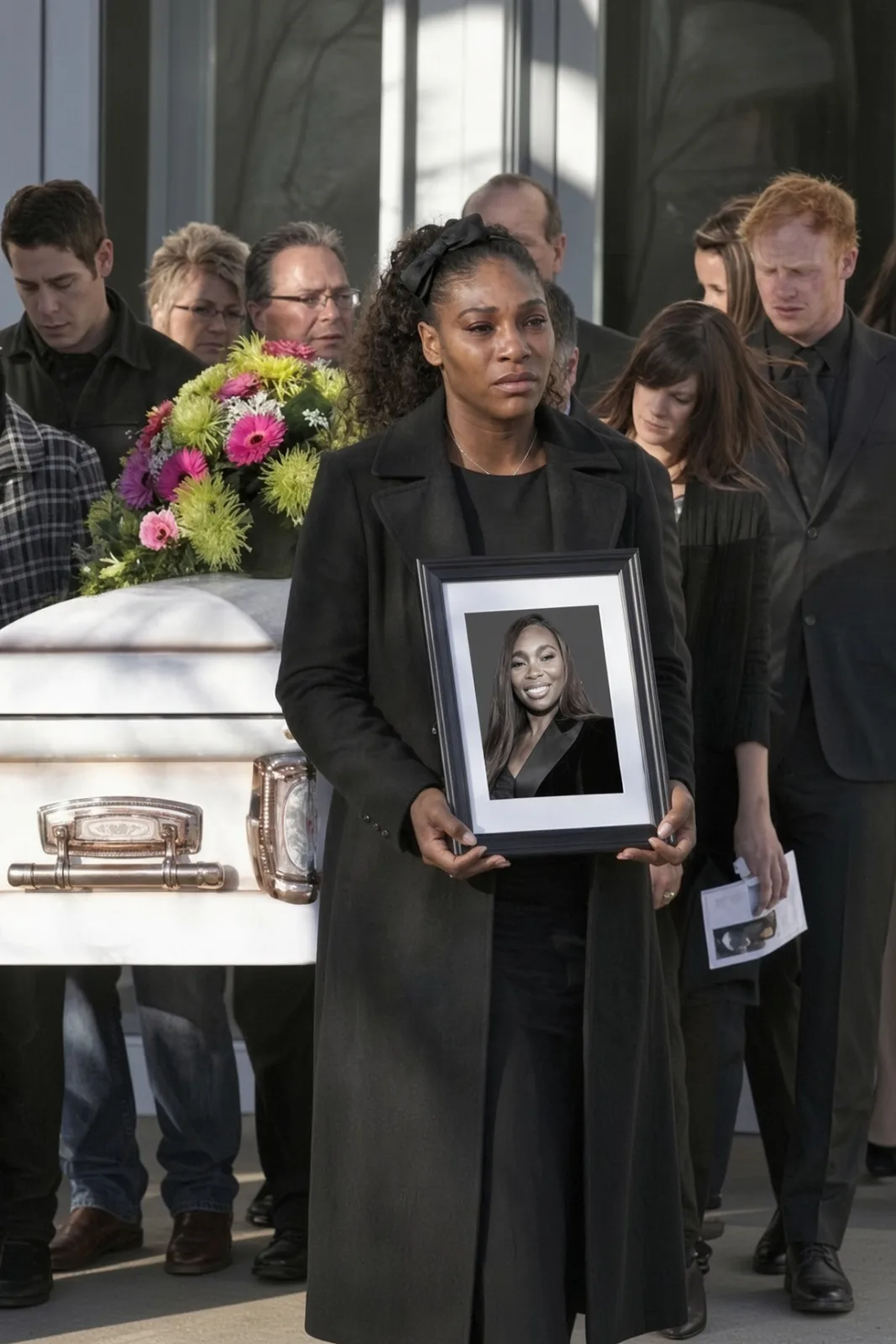
In late September, what Venus Williams expected to be a routine gynecological appointment turned into a life-altering moment.
During the exam, her physician noted an area of abnormal enlargement in one breast and ordered further imaging and a biopsy.
Days of waiting followed.
The forty-six-year-old former world number one later described the period to a magazine as one of near-constant anxiety.
“Until I got the final diagnosis, I barely slept. I was in a state of panic.”
The results confirmed advanced breast cancer, staged at four.
“It felt like everything collapsed,” Venus said. “The fear I’d been carrying became real.”
She has stressed that the findings came only because she kept the appointment.
Had she postponed it, she believes the disease would have progressed further without her knowledge.
Venus has long managed other health conditions, including Sjögren’s syndrome, which forced her to adjust her training and competitive schedule over the years.
The new diagnosis has shifted her immediate focus entirely to treatment.
Doctors are pursuing a combination of systemic therapies aimed at controlling the metastatic disease while preserving quality of life.
She has begun the process and is working with a care team that includes specialists familiar with the demands of elite athletes.
Public discussion of reproductive and sexual health was not something Venus grew up hearing at home.
Raised in a conservative household, she has said those topics were rarely addressed.
Most of what she learned about her body came from friends, school, and magazines.
Only when a physician prescribed birth control did she receive a fuller explanation of related risks.
The cancer diagnosis has reinforced her view that open conversation about illness, screening, and bodily changes should not remain taboo.
In the same interview, she recalled being direct with a partner about sexual health before their relationship deepened, including suggesting joint testing for sexually transmitted infections.
“A man who takes care of his own health shows intelligence and responsibility,” she said.
Those conversations now feel secondary.
Her priority is treatment and recovery.
She has also spoken about still wanting children, an aspiration that now sits alongside the medical realities of advanced cancer and its therapies.
News of the diagnosis reached her younger sister quickly.
Serena Williams, who has remained one of the most visible figures in the sport even after stepping back from full-time competition, released a brief statement through a representative.
“I am heartbroken for my sister,” Serena said. “Venus has carried so much with strength and grace for so long. Right now, she needs space to focus on getting well, and our family is surrounding her with love. We are grateful for the doctors and for everyone sending support.”
The two have long been close, both on and off the court, and Serena’s public words underscored the personal weight of the news within the family.
Venus has indicated she intends to share updates selectively, rather than document every step of treatment.
She has encouraged other women, particularly those who delay screenings, to keep regular appointments.
“If I had skipped that checkup, I might not have known until things were even further along,” she said.
Medical experts note that while routine gynecological visits primarily address pelvic and reproductive health, clinical breast exams or patient-reported changes can still lead to earlier detection of breast abnormalities, even when dedicated mammography is scheduled separately.
For now, Venus is concentrating on the treatment plan in front of her.
Friends and former colleagues in tennis have offered private messages of support.
The former champion, who once dominated the sport alongside her sister and helped redefine what was possible for women in the game, is facing a different kind of contest.
One measured in scans, side effects, and the hope of more time.
Of course, this is far from the first time Venus has stared down long odds.
Years before the diagnosis, Sjögren’s syndrome left her battling fatigue and pain that nearly ended her career.
She fought back through it all and kept competing into her forties, proof of the willpower her family now sees as she begins treatment.
Compton, California, in the early 1980s was known to outsiders mostly through crime statistics.
Street gangs controlled many neighborhoods, drug sales financed much of the violence, and the city’s public services were stretched thin.
It was here that a man named Richard Williams, who owned a small security business and had come west from Shreveport, Louisiana, decided to produce two professional tennis players from nothing.
He had never played the sport seriously.
He had no connections in it and no money to buy any.
Williams had grown up poor in the segregated South, raised largely by his mother.
He later told interviewers that he saw a television broadcast of a tennis tournament in which the winner was handed a check for forty thousand dollars, and that he concluded the sport might offer a way out for his children.
He was married to Oracene Price, a nurse, who already had three daughters from an earlier marriage, Yetunde, Isha, and Lyndrea.
Together the couple had two more girls.
Venus Ebony Starr Williams was born on June 17th, 1980, in Lynwood, California.
Her sister Serena followed about fifteen months later.
Richard Williams wrote a plan, reportedly seventy-eight pages long, for raising two champions.
He taught himself the game from books and instructional videos, then taught his daughters.
Venus was around four years old when she began hitting balls on the public courts near the family’s home.
The courts were cracked and poorly maintained, and the nets sagged.
Richard hauled used balls in a shopping cart.
By his own later account, he was beaten by local gang members while working with the girls on those courts.
He said he lost teeth and had his nose broken.
The family’s ordinary routine, in other words, included the possibility of violence on the walk to practice.
Venus developed quickly.
She competed in United States Tennis Association junior events in Southern California and, by the standard account, built a record of sixty-three wins without a loss.
Her height, her reach, and her power drew attention from coaches who had no connection to the family.
Magazine writers began arriving in Compton.
Richard, who was comfortable with microphones, told them his daughters would become the best players in the world.
Many in the tennis establishment treated the claim as bluster from an outsider.
Some of them said so in print.
In 1991, when Venus was eleven, Richard withdrew her from junior tournament play.
He said he wanted to protect her from burnout, from the pressures of the junior circuit, and from what he described as the racial dynamics of a sport dominated by white institutions.
The decision drew sharp criticism.
Commentators accused him of controlling his daughter’s development and of using her to draw attention to himself.
The family moved across the country to Florida, where Venus and Serena trained at an academy run by the coach Rick Macci.
Richard eventually took over the coaching himself, and the family kept its distance from much of the established system.
Venus turned professional on October 31st, 1994, at the age of fourteen.
The event was a tournament in Oakland, California, and her tournament ended with a loss to Arantxa Sánchez Vicario, one of the best players in the world.
The performance was strong enough to confirm what observers had suspected.
Richard then restricted her schedule sharply.
For the next two years, she played very little, and the family did not apologize for the choice.
The tour’s governing body later introduced age eligibility rules, limiting how many matches young players could play, in part because of concerns about burnout among teenagers who turned professional early.
Venus’s case was one of several that prompted the discussion.
She returned to full-time play in 1997 and arrived at the United States Open that September unseeded, with a ranking in the sixties.
She reached the final.
Her opponent was Martina Hingis, then the dominant player in the women’s game, and Venus lost in two sets.
The result still carried historical weight.
Venus was the first unseeded woman to reach the final of the tournament in the open era.
She was also the first Black woman to reach a United States Open final since Althea Gibson, who had won the title in 1957 and 1958.
The following year brought her first tour title in Oklahoma City.
At the 1998 Australian Open, she played Serena for the first time as a professional, and she won.
The two would meet dozens of times, and the circumstances of that first match, two sisters from Compton facing each other across a net in Melbourne, set the terms for a rivalry that critics, fans, and the sisters themselves would struggle to interpret for years.
Also in 1998, Venus won her first Grand Slam titles, though in mixed doubles rather than singles, partnering Justin Gimelstob at the Australian Open and the French Open.
The year 2000 was her breakthrough.
In July, she won Wimbledon, defeating Lindsay Davenport in the final in straight sets.
In September, she won the United States Open, beating Davenport again.
In between, she won the singles gold medal at the Sydney Olympics, and she took the doubles gold there with Serena.
During that period, she won thirty-five consecutive matches.
In the span of a few months, the daughter of a man whom the tennis world had dismissed had become the most successful woman in the sport.
The triumph was followed almost immediately by controversy.
In March 2001, at the tournament in Indian Wells, California, Venus was scheduled to play Serena in the semifinal.
She withdrew shortly before the match, citing a knee injury.
The crowd, which had paid to see the sisters play, reacted with anger.
Rumors circulated, none ever substantiated, that the sisters or their father arranged the results of their matches.
Serena advanced to the final, and when she and Richard appeared at the stadium, they were booed.
Richard later said that members of the crowd directed racial slurs at him.
Serena described the experience as deeply painful.
The sisters stayed away from the tournament for well over a decade.
Later in 2001, Venus won Wimbledon again, beating Justine Henin in three sets after losing the first set badly.
She then reached the United States Open final, where her opponent was Serena.
It was the first Grand Slam final between sisters since 1884, when Maud and Lillian Watson met at Wimbledon.
Venus won in two sets.
The match was played in the evening and broadcast in prime time.
It marked the peak of her career as a singles player, and it also marked the point at which the balance within the Williams family began to shift.
On February 25th, 2002, Venus became the number one player in the world.
She was the first Black woman to hold the top ranking since computerized rankings began in 1975.
She held it for eleven weeks.
Serena then took over the position, and the two sisters met in a series of major finals that Venus lost.
Between June 2002 and July 2003, she lost five Grand Slam finals to Serena at the French Open, Wimbledon, the United States Open, the Australian Open, and again at Wimbledon.
The results were reported as a transfer of power inside a single household.
Venus said repeatedly that she did not resent her sister’s success.
She also said, in the clipped way she handled most questions, that losing hurt.
In the summer of 2003, an abdominal injury sidelined her for months.
Then on September 14th, 2003, her half-sister Yetunde Price was shot and killed in Compton.
Price was thirty-one, a registered nurse who had worked for the sisters.
She was sitting in a vehicle outside a house that police said was known for drug activity when a gunman opened fire.
The violence that Richard Williams had worked to keep his daughters away from had reached into the family.
The sisters returned to the sport in due course, but the loss did not leave.
In 2006, a man named Robert Edward Maxfield was convicted of voluntary manslaughter in the case and sentenced to fifteen years in prison.
The verdict did not satisfy everyone who followed the case, and the family said little publicly about it.
The years that followed were difficult on the court as well.
Venus’s results declined.
In 2004 and 2006, injuries limited her schedule, among them a problem with her wrist.
By 2007, her ranking had fallen to the thirties, and people who had once treated her as unbeatable began to talk about her career in the past tense.
Richard and Oracene Price had divorced, and the family structure that had supported the sisters since childhood was changing.
Venus took on projects away from the court.
She founded an interior design business, V Starr Interiors, and later a clothing company, EleVen.
In 2007, she completed a degree at the Art Institute of Fort Lauderdale.
She also began a public campaign that would define a large part of her legacy.
At the time, Wimbledon paid its women’s champion less than its men’s champion.
Venus, who had won the women’s title there in 2005 after one of the longest finals on record in which she saved a match point against Davenport, argued that the difference was indefensible.
She raised the issue with officials, and in 2006, she wrote a newspaper column making the case.
In February 2007, Wimbledon announced it would pay men and women equal prize money beginning with that year’s event.
The French Open had already made the change.
Wimbledon was the last of the four majors to do so.
In 2007, Venus won Wimbledon again, seeded twenty-third and ranked thirty-first, beating Marion Bartoli in the final.
She received the same check as the men’s champion, the first woman to do so at that tournament.
The result was a vindication of the argument she had made and of her own place in the sport.
She won Wimbledon once more in 2008, defeating Serena in the final, and that summer, she won another Olympic doubles gold medal in Beijing.
In 2009, she reached the Wimbledon final again, and Serena beat her in straight sets.
By then, she had won seven Grand Slam singles titles, five at Wimbledon and two at the United States Open, and a third of those fell within a stretch when many assumed her best years had passed.
In 2011, the problems returned in a form that could not be treated like an injury.
A hip injury at the Australian Open that January began a long layoff.
In late August, she withdrew from the United States Open before her second-round match and announced that she had been diagnosed with Sjögren’s syndrome.
The condition is an autoimmune disease that attacks the glands that produce tears and saliva and commonly causes fatigue and joint pain.
Venus said she had experienced symptoms for years and had not known their cause.
The diagnosis explained the exhaustion that had undercut her matches and her training.
It did not offer a cure.
Her ranking dropped out of the top one hundred, and a number of commentators suggested her career was over.
She chose to keep playing.
She changed her diet, adopting a plant-based approach, and altered her training to manage her energy.
She said she planned her schedule around how her body responded.
In 2012, she and Serena won the doubles gold medal at the London Olympics, her fourth Olympic gold.
Slowly, her results improved.
In 2015, she was back in the top twenty, and in 2016, she reached the Wimbledon semifinals.
At the Rio Olympics that summer, she lost in the first round of singles, then won a silver medal in mixed doubles with Rajeev Ram, extending a run of five Olympic Games.
In 2017, her career had its most improbable revival.
She reached the final of the Australian Open, her first Grand Slam final in eight years, and lost to Serena, who was playing while pregnant.
Months later, she reached the Wimbledon final at the age of thirty-seven, the oldest woman to do so since Martina Navratilova in 1994.
She lost to Garbiñe Muguruza in two sets.
She ended the year ranked fifth in the world.
By any measure, it was a remarkable return for a player who, six years earlier, had been told by a diagnosis that her body might no longer allow her to compete.
Between those two finals, a different event interrupted the season.
On June 9th, 2017, in Palm Beach Gardens, Florida, Venus was driving through an intersection when her vehicle collided with another car.
The passenger in the other car, Jerome Barson, who was seventy-eight, was seriously injured.
He died about two weeks later.
The police report initially said Venus had violated the right of way.
After the department reviewed surveillance video, it concluded that she had entered the intersection lawfully on a green signal and was not at fault.
Barson’s widow filed a civil lawsuit, which was settled in 2018.
Venus said she was devastated by the death and that her thoughts were with the family.
The episode lingered in coverage of her for months, and it changed the tone of what had been one of the most celebrated seasons of her later career.
After 2017, the decline resumed, and it was gradual and public.
She won no further tour titles.
At Wimbledon in 2019, at the age of thirty-nine, she lost in the first round to Coco Gauff, who was fifteen and who had grown up watching Venus and Serena play.
Gauff won in two sets.
Venus handled the loss with composure, but the match marked a handoff that older fans found difficult to watch.
In the years that followed, she entered smaller fields, accepted wild cards into tournaments that her ranking no longer earned, and lost often in early rounds.
A series of injuries and illnesses interrupted her schedule.
Richard Williams, whose plan had started it all, had receded from public life.
In 2021, the film King Richard dramatized the family’s early years with Will Smith in the title role.
Venus and Serena served as executive producers.
Smith won the Academy Award for Best Actor.
The film presented Richard as a flawed but determined figure, and it renewed debate about the line between a father’s ambition and a parent’s control.
Venus did not enter that debate in detail.
She said the story was true to her experience, and she left it at that.
In September 2022, Serena retired.
The sisters played their last match together at the United States Open that year, a first-round doubles loss, ending a partnership that had produced fourteen Grand Slam doubles titles along with Olympic golds.
Venus kept playing.
She had no stated retirement date and said she wanted to continue as long as she was able.
She was forty-two.
She turned forty-five in 2025, still competing and still occasionally winning.
In July 2025, at the Washington tournament, she won a singles match, a victory that turned out to be her last for more than a year.
Her record in the months after that was uniformly poor.
In January 2026, she lost her first singles match of the season to Magda Linette in Auckland, New Zealand, a match that was the 1,101st of her singles career on the WTA Tour.
Reports said she moved freely and hit hard, and she lost in two sets.
She lost again at Indian Wells, at Miami, and at Madrid, each time in the first round.
She returned to the French Open, and she did not win there either.
In July 2026, she was scheduled to play Wimbledon doubles with Serena, who was recovering from a knee injury.
She withdrew from the tournament because of her sister’s injury, and the planned reunion did not take place.
The sisters did play together in August at Cincinnati, their first match together since the 2022 United States Open.
A few days later, the organizers of the United States Open granted Venus a wild card into the singles draw.
On the night of August 30th, 2026, Venus played Sofia Kenin on Arthur Ashe Stadium in the first round.
The match followed a five-set loss by Novak Djokovic, and it did not begin until after midnight.
Kenin won the first set in thirty-two minutes.
Venus trailed by four to two in the second, and fought back to force a tiebreak, then lost it, and the match ended at 2:01 a.m.
The final score was 6-2, 7-6.
It was her twenty-sixth appearance in the tournament, and it was her fourteenth consecutive singles defeat dating to the Washington win a year earlier.
The crowd that remained stayed until the end.
Afterward, she spoke briefly to reporters.
Asked whether she would think about her future in the sport, she said she did not think she should have to.
She added, “I had a lot of great moments.”
She did not say whether the match had been her last in a Grand Slam singles draw.
She was scheduled to play doubles in the same tournament with Serena later that week, and she did not announce any retirement.
Venus Williams was forty-six years old.
She had entered a professional tournament for the first time thirty-two years earlier at fourteen, as the product of a plan written by a man in Compton with a shopping cart full of used tennis balls.
The appointment was the thing, and the thing was the appointment, and the appointment was a routine gynecological exam in late September that a forty-six-year-old former world number one almost skipped and did not, and that decision may have saved her life.
The appointment was the thing.
The appointment is always the thing.









