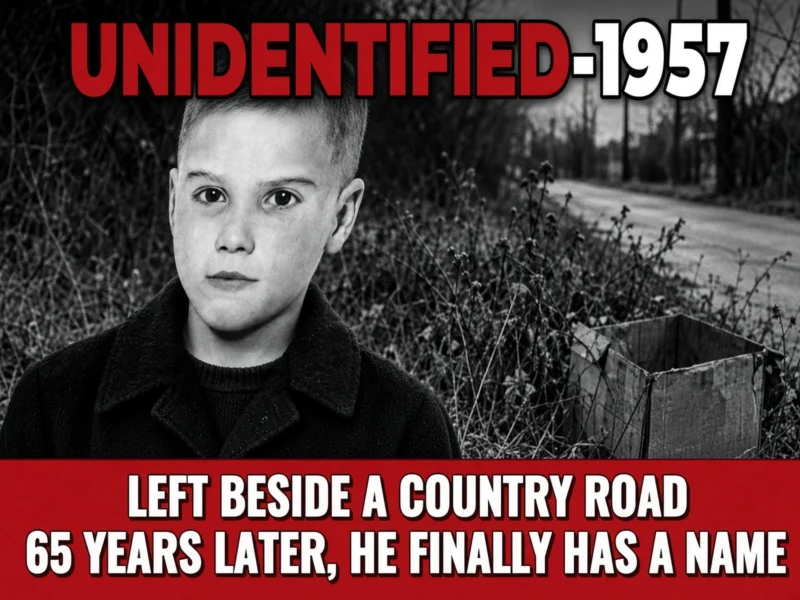
PENNSYLVANIA 1957 Cold Case Identified After 65 Years — America’s Unknown Child
It is late February 1957 in the Fox Chase section of Philadelphia, and a young man is out checking his rabbit traps.
It is an ordinary errand on an ordinary day.
But a few steps off the roadside, in the brush, he sees a large cardboard box.
It once held a baby’s bassinet. Inside, wrapped in a plaid blanket, is a small boy about four years old.
And here is the detail that has haunted investigators for more than six decades.
Someone had taken care of him.
His hair was freshly cut. His nails were neatly trimmed. He had been washed and made presentable.
And then he had been left beside a road where no one was meant to find him.
The young man walked away. He did not tell the police.
When officers finally came, they found a child nobody had reported missing.
No mother came forward. No father. No neighbor. No teacher. No relative.
In the words of the police commissioner many years later, “No one ever came forward to claim the child.”
Police recruits combed the ground.
Four hundred thousand flyers were slipped into the gas bills of Philadelphia so that nearly every household would see his face.
And in a city full of families, not one person said, “I know that boy.”
He was buried in a grave without a name.
For sixty-five years he was known only as the Boy in the Box, and as America’s Unknown Child.
Then came a few small samples, a laboratory, and a family tree built branch by branch by strangers who had never met him.
Together, they would do what an entire generation of detectives could not.
This is the story of the Boy in the Box, of the people who refused to let a city forget him, and of the day his name finally came back.
In 1957, the Fox Chase section sat in the northeast part of Philadelphia.
Susquehanna Road ran through it, bordered by brush and trees.
Drivers passed along that road every day, and a cardboard carton lying in the undergrowth was easy to overlook.
That is why the box sat unnoticed.
Records place the first sighting on February 24th or 25th.
A young man checking rabbit traps saw the large carton and walked away without reporting it. He was afraid the authorities might confiscate his traps.
It took another passerby for word to reach investigators.
A college student saw the carton later. The next day, after hearing about a missing girl in New Jersey, he reported what he had seen to the police.
On February 26th, 1957, the Philadelphia Police Department opened the investigation.
Officers pushed into the brush just off Susquehanna Road.
There was the carton. It had held a bassinet sold by J.C. Penney.
Inside, wrapped in a plaid blanket, was a small boy.
Records place the first officer on the scene as Patrolman Elmer Palmer of the 7th Police District.
According to one account of the case, Palmer never forgot what he saw there. He is said to have visited the boy’s grave for decades afterward, long after the file had left his hands.
It is a small detail, but it says something about the kind of case this was.
The people who touched it did not walk away from it.
He was about four years old. He was small and frail, but as investigators looked closer, they saw details that seemed out of place.
The boy had been washed, his hair had been recently cut, and his fingernails were trimmed.
Think about that for a second.
Someone had taken the time to care for him before he was left there.
Someone had washed him, trimmed his hair, and wrapped him in a blanket.
It made no sense to the officers at the scene, or to anyone who would study the case in the years that followed.
Philadelphia fingerprint expert Bill Kelly was called to the scene.
Kelly took the boy’s fingerprints right there.
A set of prints is the kind of thing that can name a person in a single afternoon, if that person has ever been recorded anywhere.
Nothing came of it.
A small boy who had never been fingerprinted, never been arrested, never been enrolled in anything that kept prints on file, could not be found that way.
His death was ruled a homicide, and detectives had almost nothing to go on.
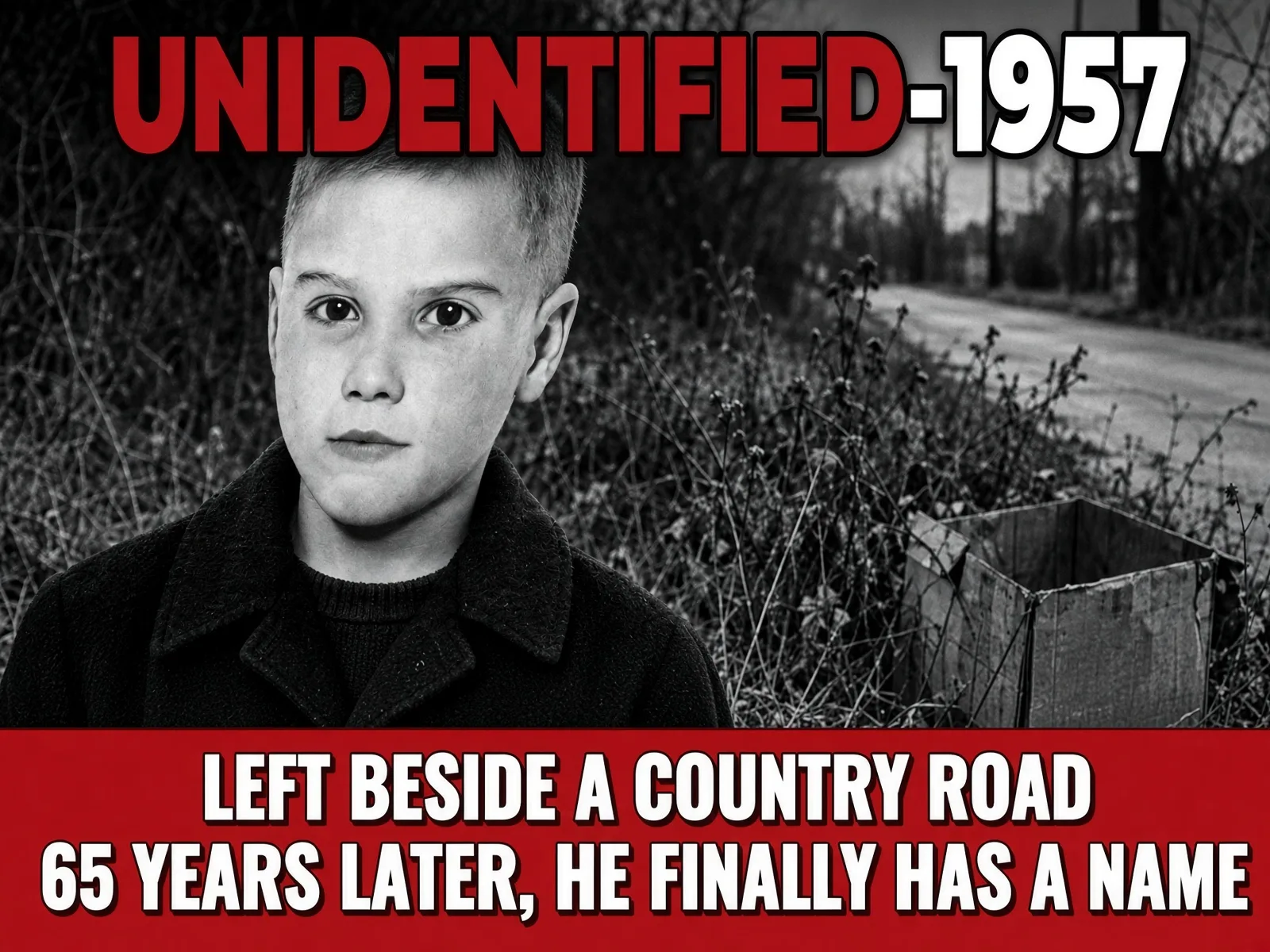
They had a box, a blanket, and a child no one had asked about.
A missing four-year-old cannot simply disappear without someone raising the alarm.
Surely a mother would call, a father, a neighbor, a doctor. But no one did.
Nobody came forward with his name, and the police were about to find out how hard that would make everything.
The search began on the ground.
Two hundred seventy police recruits were brought out to the brush along Susquehanna Road.
They lined up and worked their way across it, checking every ditch and every hollow.
Before long, searchers turned up three items.
A man’s blue corduroy cap, a child’s scarf, and a man’s white handkerchief marked with the letter G.
It seemed like a promising lead. It wasn’t.
None of the three led anywhere. They were objects found near a roadside, and nothing tied them to the boy.
The cap drew the most attention.
It was a blue corduroy cap with a custom buckle, not the kind of thing a man picks up off a shelf by accident.
One account says detectives traced it to a hat shop in South Philadelphia.
A cap like that should have pointed to a buyer. It pointed to no one the police could name.
The handkerchief carried a single letter. G.
In a city that size, a single letter is both a clue and an impasse at the same time.
It fit hundreds of people, and it fit no one in particular.
With the ground searched, the investigation moved into the city itself.
The Philadelphia Inquirer printed four hundred thousand flyers, and they were included with the gas bills sent to homes across Philadelphia.
Accounts of the case say the picture on the flyer was a retouched photograph made to show the boy as he might have looked in life.
Someone had to decide how a four-year-old should be shown to a million strangers.
They chose to show him gently, and to ask the city to look.
Four hundred thousand flyers arriving in mailboxes all over the city.
In 1957, before the internet and before round-the-clock television news, that was how a city sounded an alarm.
Families opened their bills and found themselves looking at a lost child.
Almost everyone in Philadelphia saw him.
Meanwhile, investigators worked backward from the physical evidence.
The carton that had held him was traced to a J.C. Penney bassinet.
It was a common baby bed, and it had not been sold in secret.
One account of the case says the carton came from a shipment of twelve bassinets delivered to a J.C. Penney store in Upper Darby in late November of 1956, and that all twelve were sold for cash over the following weeks.
That sounds like a lead. It is the kind of lead detectives dream about, a short list of buyers, a short list of addresses.
According to that same account, investigators traced all twelve purchasers, spoke to them, and cleared everyone.
The trail ended exactly where it began.
Tracing the carton did not lead them to the boy.
If retail records could not help, detectives hoped medical files might.
Records place investigators checking hospital birth records across the city, comparing the infant footprints that hospitals kept.
One account puts the number at more than one hundred thousand footprints gathered from dozens of hospitals across the Delaware Valley.
That figure rests on a single source, so treat it as an estimate, but the effort itself is not in doubt.
Investigators were willing to compare a four-year-old boy against every newborn they could find.
They ruled out child after child. Not one produced a match.
If he had been born in a Philadelphia hospital, no one could find the record that proved it.
Then they turned to missing children.
If a child was gone, someone had to have noticed.
Detectives searched the missing person reports on file, and they compared every four-year-old boy reported missing anywhere.
No missing person report ever matched him. Not in Philadelphia, and not anywhere else.
It was as though he had lived without ever touching the outside world.
No one had called to report a child missing from down the street. No one had called at all.
Recruits had walked the brush. Four hundred thousand flyers had reached the city’s homes. Hospital records had been turned over page by page.
Weeks turned into months, and no one had said a word.
It helps to understand how few tools existed in 1957.
There was no DNA testing. There was no national database of missing children, and no internet to carry a face across the country in a second.
A child who was not reported missing had no file anywhere.
The only way to find out who he was, was for a person who knew him to speak up.
For reasons the records do not explain, no one did.
What investigators faced was almost impossible to comprehend.
A little boy, roughly four years old, without a name.
Records do not show where he had lived or who had cared for him in his last years. There was no paper trail. Not a single record.
Philadelphia Police Commissioner Danielle Outlaw would capture the heartbreak of that silence.
“No one ever came forward to claim the child.”
His photograph had been printed four hundred thousand times and slipped into gas bills across the city.
Yet not a single person walked into a station house to say his name.
Not a parent. Not a neighbor. Not a relative.
He remained entirely alone. An innocent child who seemed to belong to no one.
By the summer, with no family to arrange a burial, he was laid to rest in a potter’s field.
That was the ground set aside for the unidentified and the forgotten.
The exact date is not certain, though one account places it in July.
Reports say the detectives who had worked the case paid for his casket themselves, though that detail rests on a single source.
The same account says his marker carried a short prayer. “Heavenly Father, bless this unknown boy.”
Think about what that marker was.
It was not a name, and it was not a date. It was strangers asking for a blessing on a child none of them had known.
Nearly everything the city could do for him, it had done by then.
The one thing it could not do was say who he was.
There was no family name to carve into a stone.
He was no longer just an open file in a precinct drawer. He had become the city’s child.
The file was never closed. It was passed from older detectives to younger ones, each new investigator inheriting the same unanswered question.
To those officers, he was never just a case number.
Years passed, and the detectives who had stood on that road grew old, but the story did not end in that grave.
In the Philadelphia Medical Examiner’s Office, an employee named Remington Bristow could not let the case rest.
For decades, Bristow made finding the boy’s identity his personal mission.
Accounts of the case say he gave about thirty-six years of his life to it, and chased more than a thousand leads.
Those numbers are not certain, but the pattern is. He kept coming back.
While most of the city moved on, he did not.
In 1960, a psychic’s tip pointed him toward a foster home.
According to accounts of the case, the psychic described a stone house with a wooden railing, and Bristow found a place near Fox Chase that seemed to fit.
It stood roughly a mile and a half from where the boy was found.
A psychic’s description is not evidence, and the police never treated it as proof.
But to a man who had been looking for years, it was something to hold on to.
Bristow believed he had finally found where the child once lived.
It seemed like the breakthrough he had spent years waiting for. It wasn’t.
When police looked into the foster home, they found that every child who had lived there was accounted for.
There was no missing child and no connection to the box in Fox Chase.
Investigators set the theory aside.
That foster home was only one of many leads that led nowhere.
Tips came in over the decades from people who had read about the case or seen the flyers.
Detectives followed what they could. Every lead unraveled. Not a confession, not a record, not a single confirmed match.
Then came 2002. Forty-five years had passed since the boy was found.
A woman contacted detectives with an account about a relative of hers and what she said had happened to the child.
It was a serious claim, and detectives treated it that way. Nothing held up.
Police could not verify it, and without proof, that account too was set aside.
That is how a careful investigation has to work.
A claim is not a fact until something outside the claim supports it.
Detectives can listen and they can take every word seriously, but they cannot charge anyone or name anyone on a story alone.
By then, the man who had carried the case longer than anyone else was gone.
Remington Bristow had devoted decades of his life to that little boy.
Records place his death in 1993.
He had spent his final years still looking, still wondering who the child was, and he died without ever learning the boy’s name.
The detectives who had stood on that road in 1957 retired.
An entire generation of Philadelphia investigators left the job carrying the memory of a child they could never name.
1960 became 1970. 1970 became 1980. 80 became 1990.
The file stayed open, and each new investigator took up the same search.
For decades, that dedication was all the child had.
In 1990, a new organization came together in Philadelphia.
It was called the Vidocq Society, co-founded by William Fleisher, to review cold cases that had run out of leads.
Its members were veteran investigators and specialists who refused to let forgotten files sit in a drawer.
The case of the unknown boy had haunted Philadelphia for thirty-three years. The Vidocq Society took it on.
The group took its name from a famous French detective of the early 1800s.
Its founders included William Fleisher, a former FBI agent, and the sculptor Frank Bender.
They gathered people from different fields, because a case that has beaten one kind of expert for decades sometimes gives way to another kind.
Their approach was simple.
Take the oldest, coldest files in the city and look at them again without the assumptions that had grown up around them.
Among the people who worked on it was Frank Bender, a forensic sculptor.
Bender made a reconstruction of the boy’s face so that the public could see a living child rather than an old photograph from 1957.
Investigators hoped someone might finally recognize him. It did not give them his name.
In 1998, forty-one years after the child had been laid to rest in a potter’s field, investigators made the difficult decision to reopen his grave.
They needed DNA, and specialists were able to obtain it from a tooth.
That tooth would matter more than anyone could have guessed.
He was not returned to the potter’s field.
Ivy Hill Cemetery in Cedarbrook donated a plot so the child could rest with dignity.
He was reburied under a stone reading “America’s Unknown Child.”
A city had claimed him.
Reports say the monument took the form of a carved granite lamb.
Over the years, visitors left flowers, teddy bears, and notes at the grave. Some of them from far outside Philadelphia.
Reports also say the Vidocq Society and some of the original detectives gathered there each year.
People who never met him had made a habit of coming to see him.
The one thing no visitor could do was call him by name.
Investigators now held the boy’s genetic profile, but a profile is not a name.
In 1998, DNA was only part of the puzzle, and it did not tell them who he was.
The reason comes down to what kind of DNA they had.
The material from a tooth of that age was mitochondrial DNA, a kind that passes down only through the mother.
It can show that two people share a maternal line. It cannot build a family tree, and it cannot reach the relatives on his father’s side.
To use it, police needed a relative who was already looking for him. No relative was.
The science had given them a voice, but it was not yet enough.
For the moment, it had simply arrived too early.
1998 became 2000. 2000 became 2010. The case file waited for another opening.
Then, on March 21st, 2016, the National Center for Missing and Exploited Children released a new facial reconstruction of the child.
Again, the answer did not come. Decades of silence remained unbroken.
Conventional police work had run out of road.
The flyers, the clay likeness, and the digital reconstruction had all reached the same wall.
To find his name, detectives would need more than a single tooth could give them.
Then, in 2019, investigators opened that grave a second time, and what they took from it would change everything.
In 2019, investigators returned to Ivy Hill Cemetery in Cedarbrook.
More than six decades had passed since February of 1957, and the profile taken from a tooth was never going to be enough.
This time, detectives obtained a bone sample so that modern science could build a more complete profile.
The difference between the two attempts was enormous.
The first in 1998 produced a single thread of maternal DNA. The second aimed at something far larger.
Reports say a specialized laboratory in California worked from that sample and managed to read hundreds of thousands of genetic markers from it.
Degraded DNA is hard to read, and the lab’s name rests on a single source, so we will leave it out.
What matters is the result.
For the first time, there was enough information to compare the boy with living people far beyond his mother’s side of the family.
What followed was not traditional police work. It was investigative genetic genealogy.
In standard criminal investigations, detectives compare evidence against government databases looking for a direct match.
But if a person has never been entered, the search returns nothing.
Those systems were not designed to find a nameless child who was never reported missing.
Think of it as a map drawn backward.
Everyone alive carries pieces of DNA that came from their parents, their grandparents, and the generations before them.
Two people who share a great-grandparent will share a measurable amount of that DNA, even if they have never met and never heard of each other.
The closer the relationship, the more they share.
If you can find enough of those matches, you can work out where an unknown person fits in a family, and eventually who his parents must have been.
Genetic genealogy approaches the mystery from the opposite direction.
Instead of searching for the child himself, investigators search for his relatives.
When everyday citizens submit DNA to testing companies to explore their family heritage, they create vast networks of shared biological code.
By measuring those shared segments, researchers can trace family lines back to common ancestors and reconstruct entire branches of descendants.
Strangers looking into their own family history were unknowingly holding the pieces to a sixty-two-year-old mystery.
To lead the search, the Philadelphia Police Department and the Vidocq Society brought in Identifinders International, led by genetic genealogist Colleen Fitzpatrick.
Fitzpatrick was a pioneer in forensic genealogy.
Older samples present hurdles because time breaks down DNA, but a usable genetic profile was developed, and that gave the genealogists the foundation they needed.
The first breakthrough came when a cousin uploaded DNA to a public database.
It seemed like a small detail at the time. It was not.
That match gave investigators their first real direction in decades.
They encouraged that person’s mother, who was a first cousin to the unknown boy, to upload her own DNA to a public database called GEDmatch.
That single decision changed the course of the investigation.
With a first cousin in the database, Fitzpatrick and her team had a direct biological anchor.
Branch by branch, they built out the family tree, and the match led them to the boy’s parents.
Accounts of the work say the team followed family lines back through seven to nine generations of old records.
The sort of documents that exist only on paper, in parish files, in city directories.
A tree like that is built slowly.
Every person on it has to be found, confirmed, and checked against the DNA before the next branch can be trusted.
It is painstaking work, and most of it is invisible.
There is no moment when a name simply appears.
There is a long stretch of small decisions, each one narrowing the field until the field is a single family.
By October of 2021, the genealogist had a name.
After sixty-four years of silence, there was a name.
Still, a name on a genealogical chart was not proof.
Science had pointed detectives toward an answer, but an open homicide investigation demanded certainty.
A genealogical hypothesis was a road map, not a verdict.
They needed official documentation and living relatives to verify the biology. No one was going to rush it.
They had a name. Now they needed the paper trail to prove it.
Detectives obtained a court order to get the birth certificate.
When the record was located, it confirmed what the genetic tree suggested.
There, on paper from 1953, was the child’s legal name, along with the names of his parents.
It is worth pausing on what that paper meant.
For four years, a boy had existed in the world and in the records of a Pennsylvania hospital, and then, as far as anyone could tell, he had stopped appearing in any record at all.
The certificate had been sitting in the files all along.
No one had known to ask for it, because no one had known his name.
Reports say the city’s medical examiner’s office later amended its record of his death to carry the name Joseph Augustus Zarelli.
Whatever else was missing, the paperwork was finally right.
But a birth record alone could not settle it.
To be certain, police needed direct confirmation.
They turned to living relatives, and DNA from those relatives verified the parentage.
Not a rumor, not a theory, not a guess.
For the first time since 1957, police knew who the child had been.
Imagine being one of the detectives who had worked the case for years and holding that confirmation in your hands.
Reports say one of the veteran detectives who had spent years on the case died only weeks before the public announcement and never saw it.
Others had retired long before.
For the people who gave years to this boy, the ending came late, and for some, it did not come at all.
Between that confirmation and the day the public heard it, there was a stretch of waiting.
Records place the genealogist’s name in October of 2021 and the formal announcement more than a year later.
During that time, the court order, the birth record, and the testing of relatives all had to be completed, each step checked against the last.
It is the kind of patience that cold cases demand.
Getting it wrong would have meant giving the wrong name to a child who had waited sixty-five years for the right one.
Then, in late November of 2022, the silence broke.
CBS 3 reported that investigators had established the child’s identity.
On November 30th, the Philadelphia Police Department announced the identification.
The formal press conference came on Thursday, December 8th, 2022.
Police Commissioner Danielle Outlaw stood at the microphones alongside Captain Jason Smith.
Reporters and cameras filled the room. The moment had arrived.
For sixty-five years, Philadelphia had called him only the Boy in the Box.
His face had been printed on four hundred thousand flyers, and his likeness had been rebuilt in clay and again on a screen.
He had been buried in two graves under a stone that could not name him.
An entire city had wondered who he was.
At that press conference, police gave the boy his name.
His name was Joseph Augustus Zarelli.
He was born on January 13th, 1953.
Joseph Augustus Zarelli.
Hearing it aloud changed everything.
He was no longer an anonymous case number in a file cabinet.
He was not just an unknown child left in the brush beside a road.
He was a four-year-old boy who had lived, who had a family, and whose life ended before he had the chance to grow up.
Commissioner Outlaw spoke of the dedication of the investigators who had refused to let the case go.
She spoke of what had been done to him, saying that his entire identity and his rightful claim to own his existence was taken away.
Listen to how she put that.
It was not only a life that was taken. It was everything that comes with a life.
A name, a birthday, a place in a family, a headstone with the right words on it.
For sixty-five years, all of that had been missing. The press conference was the first step in giving it back.
A name does something that nothing else can do.
It turns a case into a person.
It tells strangers who to grieve for, and it tells a family who they lost.
It also means that for the first time, detectives could ask the questions that only a name makes possible.
Who was he living with? Who knew him? Who stopped seeing him, and when?
Those questions were not possible on the day before. They are possible now.
Sixty-five years of silence had been broken by forensic science, genetic genealogy, and the refusal of investigators to surrender.
The question of who was responsible for his death remained open, but his identity was no longer lost.
For the first time in sixty-five years, the city had a name to say.
As far as anyone knows, very little of Joseph’s life was ever written down.
Police believe he came from West Philadelphia, in the neighborhood near 61st and Market Streets.
And when Joseph disappeared from the world, nobody raised an alarm.
He was never reported missing.
Records do not show where he lived during his final years, or who was caring for him. His daily world remains a blank.
That is a hard thing to sit with.
Most of us can say where we were at four years old. We can name a street, a kitchen, a person who tucked us in.
For Joseph, nobody can.
The records say he was born. The records say he was found. For the four years in between, they say almost nothing.
Both of Joseph’s parents have died.
Police chose not to release their names, out of respect for his many living brothers and sisters on both sides of the family.
They are people with their own lives, and they have not been named here.
Captain Jason Smith explained that the case would benefit from the application of modern forensic techniques.
Advanced genetic genealogy and laboratory testing did what traditional detective work had not been able to accomplish on its own.
Yet technology only mattered because people refused to give up.
William Fleisher of the Vidocq Society spoke of the long road that brought them there.
As Fleisher reminded the room, many of these men and women are not with us anymore.
He was speaking of the investigators who had carried Joseph’s story through the decades and did not live to hear his name spoken aloud.
Fleisher had been part of this from the start of the Vidocq Society’s work on the case in 1990.
That is more than thirty years of lunches, files, and false starts.
When he stood in that room, he was speaking about people he knew.
Many of them had spent real stretches of their lives on one small boy, and they were not there to see it end.
Commissioner Outlaw credited the hard work, dedication, passion, and doggedness of the many.
That meant generations of Philadelphia detectives who passed the file down, the Vidocq Society, which was founded in 1990, and the genealogists who finally found the family.
When one detective retired, the file went to the next.
Fingerprint expert Bill Kelly had taken the child’s fingerprints at the scene in 1957.
Those prints were the first thing anyone ever did to try to name him.
It took sixty-five years and a different science to finish what they started.
America’s Unknown Child was finally known. Joseph Augustus Zarelli had his name back.
But a name is not the same as justice.
Even with a name on the birth certificate, the case remains open. It is still an active homicide investigation.
No one has been arrested. No one has been charged.
More than sixty-five years after a four-year-old boy was left in the brush off Susquehanna Road, no one has faced a courtroom.
Captain Smith was direct about where the investigation stands.
Police have suspicions, but they will not share them.
They do not publicly name or identify who they believe is responsible.
Modern forensic techniques gave the city his identity, but science alone has not answered the question of who was responsible.
With so much time gone, every lead, every interview, and every old record carries the weight of six decades.
Reports also say detectives are continuing to work with prosecutors and are speaking with surviving relatives as they try to establish who had custody of Joseph in the years between his birth and his death.
That is the center of the whole case.
Somebody knew where he was during those four years. Somebody knew him.
The city is offering a twenty-thousand-dollar reward for information leading to an arrest and a conviction.
Twenty thousand dollars for clues about a day in late February 1957.
Whatever the odds, finding the truth has no expiration date.
Commissioner Outlaw put it into words on the day his name was spoken.
In her words, this announcement only closes one chapter in this little boy’s story while opening up a new one.
The first chapter took sixty-five years to write. The second is still being written.
That is why investigators are still asking the public for information.
Police believe he came from West Philadelphia near 61st and Market Streets, and anyone with information is urged to come forward.
Someone might remember a face.
Someone might remember a quiet little boy who suddenly stopped being seen.
Not an arrest, not a trial, not a final answer.
After all these years, the pursuit of justice has narrowed to whatever truth can still be recovered from the past.
Finding his name did not answer who left him in that cardboard box. It only made the remaining questions harder to carry.
But one more promise could still be kept, and it was a promise about his name.
From late February 1957 to December 8th, 2022, sixty-five years and nearly ten months slipped away.
Joseph was born in 1953, and he would have turned seventy before his name was set beside his image on a memorial.
That was the cost of the delay.
With every passing year, the silence grew heavier. Witnesses grew old. The original detectives retired, carrying the file with them.
Many of them did not live to see this day. Yet the case never truly closed.
That persistence belonged to the Philadelphia police detectives who refused to let the file gather dust.
It belonged to the Vidocq Society, who kept his memory alive.
And it belonged to the genetic genealogists.
Working alongside police, Colleen Fitzpatrick and the team at Identifinders International built the bridge back to his past.
Not a confession, not a tip. A family tree built one branch at a time.
Reports say the same methods are now being turned on other unidentified cases in Philadelphia.
If that is true, then the Boy in the Box has left something behind beyond his own name.
He has changed how the city looks for the people it has lost.
On January 13th, 2023, a new memorial was unveiled at Ivy Hill Cemetery in Cedarbrook.
It was what would have been his seventieth birthday.
For decades he had rested beneath a stone reading “America’s Unknown Child.”
Now the memorial bore his full name and his image, and his name was added to the existing headstone.
He was unknown no longer.
It is worth saying who else made this possible.
Ordinary people took DNA tests to learn about their own families, and in doing so, they handed investigators the pieces of a stranger’s family tree.
A cousin uploaded a profile. A cousin’s mother agreed to do the same.
Neither of them had any idea what they were part of.
Genetic genealogy only works because of choices like that, made by people who simply said yes.
The same is true of the relatives who came forward once the identification was in reach.
They were asked for something private, a sample of their own DNA, and they gave it.
Police have been careful to protect them.
Joseph’s parents have not been named, and his brothers and sisters are not named either.
Their privacy is part of the respect this case is owed.
Think back to where this journey began.
A road in Fox Chase, in late February 1957. The brush along Susquehanna Road. The cardboard bassinet box.
Inside, wrapped in a plaid blanket, was a four-year-old child who had been washed, groomed, and left alone.
For more than six decades, he was remembered only by the sorrow of how he was found.
“No one ever came forward to claim the child,” Commissioner Outlaw reminded the city.
But grief alone could not give him back his name.
What happens next is up to the people who may still remember.
Somewhere there may be a person who knew a little boy in West Philadelphia in the early 1950s.
A person who knew who was looking after him, and who stopped seeing him one winter.
That person may be elderly now.
They may have carried the question for decades without knowing whether it mattered.
It matters. It is the one piece of this story that science cannot supply.
Genetic genealogy found his name. Only someone who remembers him can explain the rest.
Today, that long silence has ended.
He was never just the Boy in the Box.
He was never just an evidence file, a case number, or an entry in a police archive.
His full name was Joseph Augustus Zarelli.
He was a little boy who deserved to be known, to be remembered, and to have his real name spoken aloud.
If you take one thing from this story, let it be this.
A child can go unclaimed for a lifetime and still be found, if enough people refuse to stop looking.
Detectives did it with a file and a promise.
Scientists did it with a single bone and a family tree.
Strangers did it by sending in a sample of their own DNA.
None of them had to. They did it anyway.
The box had held a bassinet, the box had been found in the brush off Susquehanna Road, and the box had held a boy for sixty-five years before the world finally learned his name.
Joseph Augustus Zarelli. Born January 13th, 1953.
Known at last.









