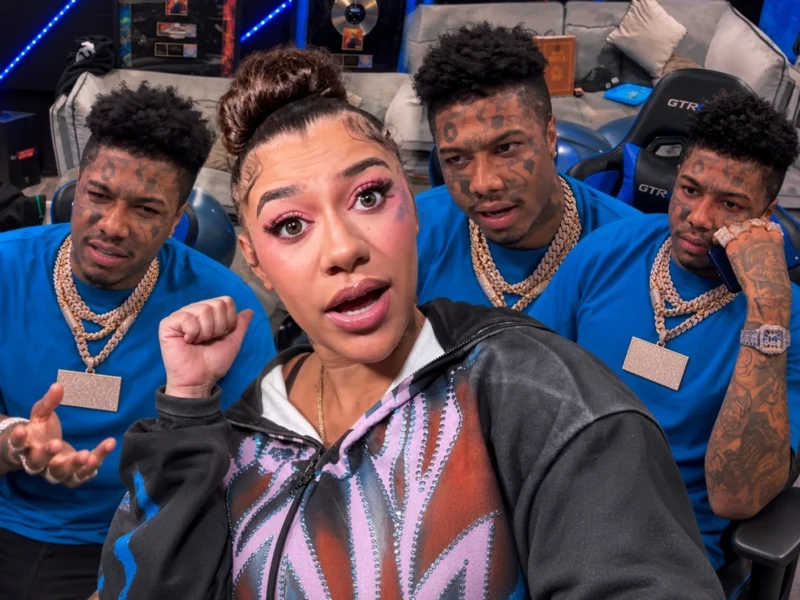
Nevaeh GOES OFF & wants FULL CUSTODY of Blueface Jr & Speaks about Chrisean & her Alleged DUI
The camera light clicked on in a quiet corner of a Nashville living room, and suddenly the internet had a front-row seat to a year nobody saw coming.
Somewhere between the soft hum of a ring light and the nervous tap of a fingernail against a phone case, a young mother cleared her throat and looked directly into the lens.
“I’m back again with another video,” she said, “and this is part fifteen thousand seven hundred and eleven of the Blueface saga.”
That line alone told you everything about the world she had stepped into.
Because once you’re counting parts in the thousands, you’re not telling a story anymore.
You’re living inside one, and the algorithm is the landlord.
What follows here is not a takedown piece and it’s not a gossip recap.
It’s a reconstruction of a very public unravelling, pulled straight from her own words, from his own words, and from the receipts both sides kept waving at a camera.
And by the end of this, you’re going to understand one thing clearly.
This was never really about a car.
It was about a car seat, a birth certificate, a passport application, and a woman trying to prove she could stand up on her own two feet while somebody kept reminding her whose floor she was standing on.
So let’s start where she started.
A mother, a microphone, and a threat she says she got on record.
“I got everything on record,” she said, “of a mother threatening me with my child, and much more, and then bringing that person to their house.”
She paused, letting it land.
“Then looking forward to more. Blah blah. Yeah, it gets depressing.”
That was the cold open of her new chapter, and it wasn’t subtle.
She wasn’t hiding behind a PR statement or a carefully worded Notes app apology.
She was doing what thousands of young mothers in America do when they feel cornered by a legal system that costs money they don’t have and a public that already made up its mind.
She was talking into her phone.
And the promise she made in that first minute is the promise we’re going to collect on by the end.
She said she was done crying, done explaining, and done letting anyone else write her story.
So the real question isn’t whether she was angry.
The question is whether the anger was earned.
To answer that, you have to go back to the beginning of the custody war, and the beginning wasn’t in a courtroom.
It was in a garage.
The car.
It always comes back to the car.
“All I want is my car,” Blueface said in a video that played on repeat across every gossip page in America.
“I paid ten thousand dollars up front to get that car fixed.”
Ten thousand dollars.
Sit with that number, because it’s going to show up again.
That’s not a repair bill.
That’s a mortgage payment in most of the country.
And according to him, that money had already been spent, the shop had the car, and the pink slip was already in her name.
“So what don’t you get?” he asked the camera. “Your car is getting fixed. You have to go without a car for a couple of days.”
Then he said the line that made the whole timeline click into place.
“She’s using my truck. Give me back the truck.”
There it is.
The truck.
A single vehicle sitting at the center of a custody fight like a chess piece on a board where both players think they’re the king.
She saw it as leverage.
He saw it as a lesson.
“Don’t bite the hand that feeds you,” he said, “because I could just cut your water off.”
That sentence is the hinge the entire saga swings on.
Because everything that followed — the videos, the tears, the prayers, the passport drama, the move across the country — all of it came down to one young mother deciding she would rather go without the water than keep drinking from a tap she didn’t control.
And here’s what she said about the night it all broke open.
“I was done the biggest favor in life,” she told her chat.
“He kicked me out, and guess what? He kicked me to receive all my blessings.”
That’s not the language of a woman who lost a fight.
That’s the language of a woman who decided the fight wasn’t worth winning.
But before she got to that peace, she had to walk through the paperwork.
And the paperwork is where this story stops being about feelings and starts being about the law.
Because in America, when two parents disagree, the fight doesn’t happen in a living room.
It happens on a form.
And the form she kept bringing up had a very specific name.
The passport application.
“Somebody doesn’t want to sign the baby’s passport,” she said, “because they fear the baby is going to go see a… shouldn’t be nobody’s concern.”
Then she said something that sounded almost like a legal argument, delivered with the confidence of someone who had spent her nights reading state department guidelines on her phone.
“You guys do know my last name goes first on Superior’s birth certificate, right?”
She was right about that part.
In most U.S. states, the mother’s information is listed first on a birth certificate, and for an unmarried mother, that document is often the first piece of evidence in a custody case.
But a birth certificate is not a custody order.
And that’s the part she was learning in real time, in front of an audience, with a baby on her hip.
“I’ve been had his passport,” she said. “That’s why I ain’t pressed to have no signature for that.”
Whether that’s accurate or not, one thing is certain.
She believed it, and she was building her entire legal strategy on it.
Which brings us to the piece of evidence that turned a family dispute into a national headline.
The hot mic.
During a phone call that was somehow, accidentally, or perhaps deliberately broadcast to the internet, a voice could be heard saying the words that would follow her for months.
“Threaten my kids’ life.”
She repeated that phrase in her video like a woman holding up a torn piece of a shirt in court.
“You got one time as a man to sit up and threaten my kids’ life,” she said. “Babe, y’all probably thought I was dumb, but babe, very smart. Very much got a brain on my shoulders.”
That recording became the fulcrum of everything.
Because once a mother hears a threat against her child, the entire relationship changes.
There is no negotiation after that.
There is no “let’s talk about the car.”
There is only survival, and survival has a price tag.
In her case, that price tag had a number, and she said it out loud.
“$39,000.”
That’s what she said he spent replacing things after she left.
“You see what a rich man is going to do? He’s just going to go replace the stuff. I’m not going to cry and argue with you about it. I’m just going to get $39,000 out the bank and replace it.”
She wasn’t impressed.
She was making a point about the difference between money and memory.
“No amount of money can make you lose your memory,” she said. “It can’t erase. Money can’t fix you. It can only fix your surroundings.”
That’s the line.
That’s the hinge sentence of her entire testimony.
Because everything Blueface said about money — the ten thousand for the car, the thirty-nine thousand for the furniture, the million-dollar chains and the restaurants and the houses — all of it landed on her like water on a stone.
It rolled off.
What stuck was the threat.
What stuck was the passport.
What stuck was the night she sat in a house with her two babies and realized the man who paid for everything also believed he owned everything.
And that’s where the story pivots from him to her.
Because in his version, he was the trainer who built her up, and she flexed on him.
“That’s what these women do,” he said. “I train them. I let them work out with me. They get big and strong, and then they want to flex on the trainer.”
Then he delivered the line that probably got him the most headlines of the week.
“Don’t bite the hand that feeds you.”
It’s a simple sentence.
It’s also the oldest sentence in the playbook of anyone who has ever confused generosity with ownership.
And she answered it without ever saying his name.
“I never said I keep my son away from his father,” she said. “But for a person that’s not caring about where their child’s at, or caring for them in general, just shows that there’s no care for the kid. So let’s just not talk about it.”
Then she said the thing that made every mother watching her stop scrolling.
“Well, I don’t care for you to be around him.”
That’s not a custody argument.
That’s a maternal instinct firing on all cylinders.
And here’s where the receipts get specific.
She didn’t just say she was worried.
She named the thing she was worried about.
“I got everything on record of a mother threatening me with my child.”
That’s not vague.
That’s a mother-in-law problem, a grandmother problem, a family problem that spilled into the public square.
And in her telling, the threat didn’t stay in a text message.
It came into the house.
“And then bringing that person to their house and looking forward to more.”
She was describing a pattern, not an incident.
Which is why she said the next part the way she did.
“I get to make my little mother that little all mine, because he is all mine.”
That sentence came out of her mouth with the grammar of somebody talking faster than she could organize her thoughts.
But the meaning was crystal clear.
She was done sharing custody of her own peace of mind.
Now, here’s where we have to be careful, because the internet is not a courtroom, and a video is not a verdict.
What we can say with certainty is that both parents told their side, both parents had receipts, and both parents were fighting over a little boy who had no idea any of it was happening.
What we can also say with certainty is that the timeline matches up.
In September of 2025, a video appeared online in which she announced she was postponing a major professional commitment.
She said her doctors told her she had to rest.
Then, in a later video, she said she had been feeling dizzy, dehydrated, and had been told by her own doctor that she could not travel that week.
The same month, a gossip account posted clips of her explaining that she had been dealing with “some health challenges,” and that she had put her own care on the back burner while she was watching someone else’s health decline.
That someone was a family member, and the decline was real.
And the detail that ties it all together is this.
The same week those travel restrictions came down, she was seen on camera, smiling, in full glam, telling her followers not to worry.
That’s not denial.
That’s the oldest instinct in the American mother’s playbook.
Smile through it.
Get through it.
Then cry about it later in your car.
And later came.
She admitted it herself.
“Honestly, I’m not mad that I was crying in the interview,” she said, “and I don’t want nobody to ever feel no type of sympathy for me, because at the end of the day, I’m a grown woman. I put myself through that.”
That’s a confession, not a victory lap.
And it leads to the second escalation, the one where the story turns from a custody fight into a national conversation about who gets to tell a woman’s story.
Because once she said the word “threat,” the internet did what the internet does.
It picked a side.
And the side it picked was not hers.
“I know you guys heard that I wasn’t valuable,” she said. “I know you guys heard that I was worthless. I know you guys heard a lot of things about me. It was all false.”
Then she did something that most people in her position never do.
She started listing her credentials.
“I got my GED in L.A. when I was 23,” she said. “I have pictures of me playing soccer. I got my lifeguard license at George Washington. If you know me and we went to school at George Washington, you know how much I love swimming.”
That’s the moment the tone shifts.
Because a woman who feels safe does not recite her high school transcript.
A woman who feels safe does not name-drop a community college lifeguard certification.
A woman who feels safe does not say “I have a record of selling drugs, that’s life, that’s normal, we be from the Midwest” like she’s explaining a parking ticket.
But a woman who has been called worthless by a million strangers will list every single thing she ever accomplished just to prove she is a person.
And that’s the hinge sentence of the second act.
Because the truth is, she didn’t need to prove she was valuable.
She needed to prove she was present.
And she did.
She stayed.
She pumped milk in a hot car.
She changed diapers on camera.
She took the baby for a walk by the pool.
She prayed.
She said, “I prayed for Superior, and I prayed for my baby, and when I got done praying, I had got a picture of Superior sleep.”
Then she said something that no PR team would ever script.
“And the baby started smiling. I’m like, oh, she must have heard me praying.”
That’s not a soundbite.
That’s a mother alone in a house with a breast pump and a phone, doing the only thing she knows how to do when the world is on fire.
She’s singing to the baby.
Now, here’s where the story gets its numbers.
And the numbers don’t lie.
Forty-five thousand dollars, according to her, is what a legal fight would cost before it ever reached a judge.
One passport application, one birth certificate, one signed consent form.
Three missed calls from the father in a single week, according to her account.
And one phrase that keeps coming back like a drumbeat.
“You done dug something up that you can’t get out of.”
She said it twice.
Once as a warning.
Once as a verdict.
And by the third time she said it, the meaning had flipped.
Because the thing that had been dug up wasn’t her past.
It was her power.
She had been told she was a squatter in a house she never owned.
She had been told she would get nothing and leave with nothing.
She had been told she was “brain dead,” “slow,” “a goofy.”
And yet, at the end of the video, there she was.
Sitting on a couch, in a clean shirt, with a baby on her lap, telling two hundred thousand strangers that she was abundantly blessed.
“I’m blessed,” she said. “She’s blessing me. Oh, when I say all the are blessing me, they’re blessing me. I told you guys, I don’t do black magic. If I did, I don’t think I would have received no blessing. Let that sit in.”
That’s not a threat.
That’s a testimony.
And testimonies, in the American tradition, are how people turn pain into a platform.
But there’s a darker side to this, and it’s the side the gossip blogs never show you.
Because while she was blessing her chat, the father was telling his.
And his version of the story had its own numbers.
Ten thousand dollars for the car repair.
Thirty-nine thousand dollars for the replacement furniture.
One truck.
One Range Rover.
One pink slip.
And a sentence that sounded less like a father and more like a CEO closing a factory.
“I’m going to go to the lowest extent,” he said. “There’s no squatter’s rights.”
Those two sentences are the whole case in miniature.
He believed the law was on his side because he paid for the things.
She believed the law was on her side because she birthed the child.
And in between those two beliefs, a little boy named Superior was growing up in a country where neither of those beliefs is actually true.
Because in America, the law is not about who paid for the couch.
It’s about who shows up.
And that’s the thing she kept proving, over and over, in a way no courtroom could capture.
She showed up for the passport.
She showed up for the prayers.
She showed up for the milk.
She showed up for the diaper change on camera, in real time, with a microphone pinned to her shirt and a baby who needed to be burped.
That’s the evidence that no lawyer can subpoena.
And it’s the evidence she was building, one video at a time, for a judge she hasn’t met yet.
Now, the third escalation.
The one where the story stops being about two people and becomes about a culture.
Because the phrase “nine to five” is going to come up here, and it’s going to get twisted.
She said she wouldn’t date a man with a nine-to-five job.
The internet heard that and lost its mind.
“People are going in on her for that,” the commentary accounts said.
“Reached that peak and went through what I went through before,” she replied. “I know my worth now.”
That’s not a knock on working people.
That’s a knock on a very specific kind of man.
The kind who looks at a woman who has been through a public fire and says, “I can fix her, and by the way, can I get a shoutout in your next video?”
She said it herself.
“I’ve messed with the broke ones before. Trust me. All they’re going to do is try to gain clout. I witnessed that. I had a past literally posting me as if I was Beyoncé.”
That’s not a money issue.
That’s a dignity issue.
She was tired of being somebody’s content strategy.
And the man who was calling her a squatter had, in his own words, spent ten thousand dollars to fix a car that was in her name, and then told the internet he was cutting off her water.
That’s not a nine-to-five problem.
That’s a power problem.
And the numbers back her up.
Thirty-nine thousand dollars on replacement furniture.
Ten thousand dollars on a car.
One truck.
One Range Rover.
One pink slip.
One passport application.
And zero signed consent forms.
Every single one of those numbers points to the same thing.
Money can replace a couch.
It cannot replace a father’s signature.
And that’s the part that no amount of cash could buy, and no amount of anger could fake.
The fourth escalation is the one that lands hardest, because it’s the one where she stops talking about him and starts talking about herself.
“I just want you guys to know we’re good,” she said. “We’re abundantly blessed over here. Me and my two babies. And anybody that’s surrounded by me, I say hello.”
Then she picked up the baby and looked into the camera.
“You guys are crazy. Please stop thinking otherwise. Let’s not talk about that.”
She was talking about the reconciliation rumors.
The ones that always come.
The ones that always say, “She’s going back.”
And she answered them with the clearest sentence she has ever spoken on the internet.
“One thing my big brothers always taught me, don’t you ever set nobody up, because that will come back on you ten times unfold. Especially if you got sons.”
Then she said the line that closes the whole chapter.
“I ain’t never played them type of games. You could never get me in a room with you. The only room is court.”
That’s the payoff.
That’s the promise she made in the first minute, collected in full.
She wasn’t going back to the house.
She was going to court.
And she was going to do it with a GED, a lifeguard license, a soccer photo, a prayer journal, a breast pump, and two babies who were not hearing their mother be called worthless.
She was going to do it the way every American mother has ever done it.
One video at a time.
One diaper at a time.
One prayer at a time.
And here’s the residue.
The thing that lingers after you watch all fifteen thousand seven hundred and eleven parts of the Blueface saga.
It’s not the car.
It’s not the truck.
It’s not the ten thousand dollars or the thirty-nine thousand dollars or the passport.
It’s the phrase she said near the end, almost as an afterthought, while she was changing a diaper.
“People lie. Numbers don’t.”
That’s the whole story in four words.
Because the numbers are these.
One car in her name.
One baby in her arms.
One passport she says she already has.
One grandmother she says she’s still willing to let in.
One father whose signature she still needs.
And one court date she hasn’t missed yet.
That’s the math of a single mother in America.
And that’s the math no amount of money can rewrite.
Because money can replace a couch.
It can buy a Range Rover.
It can pay ten thousand dollars for a car repair and thirty-nine thousand dollars for a new living room.
But it cannot make a mother stop praying.
It cannot make a baby stop smiling.
And it cannot make the truth go away.
The last time she said it, she said it with a baby on her lap and a camera in her face and a chat full of people who had spent the whole year calling her crazy.
“You done dug something up that you can’t get out of.”
She was talking to the internet.
She was talking to her ex.
She was talking to every man who ever thought a woman couldn’t build a life without him.
And by the time she signed off, smiling, in full glam, with the baby talking to the chat in the background, the meaning had flipped one final time.
She wasn’t warning them.
She was telling them she had already climbed out.
And the hole she left behind was theirs.