‘My Life Changed…’Mani Niall on TOURING with Michael Jackson
I can’t even believe I said this.
I’m hanging out with them.
I’m listening to it.
And I look at Michael and I go, “You think it’ll be top ten?”
And he looks at me and he goes, “It’ll be number one.”
That’s the moment Mani Niall still can’t quite believe happened.
He was a cook at a vegetarian restaurant in Los Angeles.
Michael Jackson was the biggest star on the planet.
And somehow, on a random afternoon in 1982, Mani found himself standing in a recording studio, listening to the playback of The Girl Is Mine, standing next to Paul McCartney and Linda McCartney, and asking the King of Pop if he thought the song would chart.
It did.
It went to number one on the adult contemporary chart.
And that was just the beginning.
Today’s guest had one of the most unique and interesting jobs anyone has had in Michael Jackson’s inner circle.
During the height of the Thriller era, as Michael prepared for and traveled on the legendary Victory Tour, he entrusted his daily meals to his very first private chef.
Chef Mani wasn’t just cooking for one of the biggest entertainers in history.
He was traveling alongside Michael during one of the most exciting, demanding, and transformative chapters of his career.
From rehearsals to backstage moments, from photo shoots to late-night meals, from life on the road to quiet afternoons at Disneyland, Chef Mani witnessed a side of Michael that very few people ever got to see.
He’s been sharing online, and he’s here today to talk about so many of those amazing memories and moments from his career.
Chef Mani, welcome to the show.
“Aisha, thank you. My skin tingles just hearing that. I still am blown away at how fortunate I was and how this just kind of rolled into my life. So, thank you for that wonderful intro, and it’s a pleasure to be here.”
“I’m so excited to hear so many of your memories and stories today. I know that you share some online. You have TikTok and Substack, which we’re going to direct people to. But I hope that you’ll share with us some of those really cool stories and memories today. First of all, though, I want to know who is Chef Mani before Michael Jackson. Tell us.”
“Wow. Before Michael Jackson. Well, I will say this. I was born in Idaho. We moved to Michigan. I grew up in a family that cooked. We were just people who— nobody was a chef or anything, but my mom cooked, my dad cooked. My dad didn’t just grill the steak in the backyard, but he made fudge every Christmas for the family. So I just grew up with a real familiarity and level to being in the kitchen. My first job was in a restaurant. When I went to college, I worked part-time in a vegetarian restaurant. And when I met Michael, I was working at a vegetarian restaurant. I’m not a vegetarian anymore, or I’m an omnivore as they say, but Michael was a vegetarian then, I was a vegetarian, and it just kind of came second nature because cooking and being in the kitchen was just always part of my life.”
“So you did work at the Golden Temple restaurant, right? Which was one of the popular restaurants in Los Angeles. Tell us about that.”
“Sure. Sure. It was such a different era than it is now. You could go to just about any good restaurant, you could get vegetarian food, you could get vegan food, you could get gluten-free. Back then, there was pretty much the odd vegetarian restaurant here and there. And back then, maybe macrobiotic, which— you don’t even hear people talk about macrobiotics anymore. But the two really cool vegetarian restaurants in LA were The Source up on Sunset Strip— it was a scene and it was kind of cool and it had been around since the mid-’60s— and the Golden Temple. The Golden Temple was kind of the more day-to-day. We were right down the street from CBS. We had this really great salad bar, served with cornbread and soup of the day. And I made the soup for five years. All the actors and actresses, the people, the staff teams from CBS and all the studios around, the workout teachers from Jane Fonda’s workout, Demi Moore when she was on General Hospital, Sidney Poitier, Captain Kirk, William Shatner, Mariel Hemingway, Lily Tomlin— I don’t even know if these names resonate anymore— Bob Dylan. I mean, all these celebrities came in, but it was not the scene. The Sunset Strip, The Source, that was kind of the hip place. We were the more working-class, day-to-day, get the salad bar, order one of their entrées. But vegetarian food was hard to come by back then. So you had to seek it out. You wanted to have something tasty, really vivid flavors, and healthy as well.”
“That’s so interesting. I do remember hearing stories about Michael being a vegetarian at that time. Did he come into the restaurant? Was he ordering takeout? Tell us about what kind of customer he was.”
“Sure. Sure. I actually got a— the manager of the restaurant, who was very good, her name was Germuk. She was a people person. She just had that magnetism about her. And I ran the kitchen, and my good friend Akasha was the chef. Gerbbo comes in the kitchen one day, and she just goes, ‘Oh, Michael Jackson’s been eating here.’ Now, this is post-Off the Wall but pre-Thriller, right? He’s still in the studio with Quincy. And she just said, ‘Oh, Michael Jackson’s been eating here and he likes our food and he wants someone to deliver next time he orders.’ We didn’t deliver back then. There was no GrubHub or anything. And she said, ‘You know, since you’re starting a catering department, I think you should do it.’ I was like, ‘Okay, cool.’ And I thought it was cool, but it wasn’t— my life was working at the restaurant. I was part of this sort of alternative spiritual community. It was fun that all these celebrities came in, but it wasn’t like our thing, right? We weren’t Hollywood types. But after that first delivery to the studio, he got my name. And Aisha, I’m so embarrassed. I don’t even remember meeting him that first time.”
“Wow.”
“I think I might have even left the food with the secretary, whose name was Sherry Dub, but after that, he called and asked for me. And then pretty soon he had my home phone, and it just rolled from there. And then he would come in. He would always come in between lunch and dinner. The salad bar would still be open, but he’d come in after 2:00, between 2:00 and 5:00, when technically the kitchen was closed. But when Michael Jackson comes in and he wants a hot grilled enchilada, or our wonderful Asian ginger miso salad, you made it for him.”
“Yeah.”
“He would come in either with Bill Bray or often this guy Nelson Hayes, who was a longtime family— he worked for Michael, he worked for the family, he was a production assistant. They would come in, and you’d hear him walking— the kitchen had these windows onto the walkway— you’d hear him laughing, you’d hear him snapping his fingers. It was like a buzz flying down into the patio. Like, ‘Oh, Michael’s here.’ And I’d go out front, and of course I’d make him hot food even though the kitchen was technically closed. Rarely did they eat there. They’d usually take the food with them, but that way the restaurant wasn’t super crowded. And that’s how Akasha and I got to know him very casually. So, yeah. Sorry if that was long-winded.”
“No, no, that’s great. I love the way you painted that picture for us. It kind of takes me into the moment of just him standing around waiting for food like a normal customer.”
“Yeah. He’d chitchat. He’d chitchat with customers. That’s how he got to know me and Akasha. We might even be sitting up front having our lunch, and of course we jump up and go make something for him. The manager was super personable. I remember there’s some pictures of him chitchatting with customers, pictures with them. But it wasn’t the era like we have now with camera phones, so you weren’t running around. Plus, it’s LA. You were cool. You didn’t go running after celebrities for a photo or an autograph. A lot of people in the industry.”
“So, he has your name, your phone number, he calls you. Is he calling just to be like, ‘Hey, are you cooking today?'”
“Oh my god, that’s so funny that you would ask that question. So, there’s several things. Number one is he would call to ask me to come cook for him out at the condo because Havenhurst was under renovation. And it’s so funny that thanks to the massive fan group, I now have seen the address on Lindley where he had the condo where he was living while Havenhurst was under renovations. I remember going there and making him dinner. That wouldn’t be lunch. It would be dinner. I’ll tell you the story about Paul McCartney in a minute. But one time he called in an order and he asked for me, and he placed an order, and he always ordered the same thing. He always ordered that ginger miso salad. He always ordered the enchilada. And he always wanted something sweet but no chocolate. We only cooked with honey and maple syrup back then. So he goes, ‘Were you cooking yesterday?’ And I said, ‘No, it was my day off.’ And he goes, ‘I could tell.'”
“Oh, wow.”
“It didn’t have the same feel to it. And I’m like, ‘What do I even say to that?’ The thing I realized is some of the line cooks, they’re line cooks. They’re just cranking out food. And I always thought it’s all about the attention to detail. Because the enchilada that he loved— if you didn’t spread the chili sauce to the edge and cover it with cheese and put it under the broiler, it could get leathery.”
“They probably just didn’t pay attention to detail. And I paid attention to detail.”
“Yeah.”
“So that was just one of those moments you kind of never forget once Michael kicks in in your life. Like, I have this crazy vivid memory.”
“Oh my gosh, that’s— yeah, I can’t imagine hearing him say that. I would not know what to say either. Very cool. So you started off cooking at the condo, and how did you end up— because you ended up going on the Victory Tour with him, which is huge. But what happened in between?”
“Yeah. Well, I think when the Thriller album— of course, I met him, who I want to say, fall of ’81 or very early 1982. Thriller came out late ’82, and The Girl Is Mine was recorded in April of ’82. So, about a week before The Girl Is Mine recordings, I knew him well enough to go to his condo. And this is again one of those things, like, pinch me, like I might lose it here. I’m out at the condo, and he starts singing. I’m making dinner and stuff, and he starts singing the song ‘Here, There, and Everywhere.’ I think it’s from Revolver. It’s not as well known, but if you look at the top ten songs that Michael loved about the Beatles, that’s one of them. And he’s— I’m sitting there going, ‘Michael Jackson is singing to me.’ Right? So he sings not the entire song, but he sings quite a bit, and he just turns to me and he goes, ‘Do you like the Beatles?’ And I go, ‘Yeah.’ And he goes, ‘Paul’s going to be here next week in the studio, and they’re vegetarians like me. Can you make dinner for me and him and Linda?’ And I just, like, put the broiler pan in the sudsy water and stared at him and was like, ‘Yeah, I think I can make lunch for you.’ And Paul and Linda McCartney, who was just a delight. So I think after that day— so that day comes, I bring them lunch. Michael’s very involved with the studio and the technicians, Bruce Swedien and all the people. Paul’s— and they’re eating the food. They’re clearly hungry. Linda just really tuned into me. She was really friendly. Asked me to come back at the end of the day with veggie burgers for her and Paul and the band for their Learjet— for their Band on the Run Learjet. I made that up. Sorry, bad joke. If you know Paul, if you know the Wings music. So I bring the veggie burgers back, and now it’s the end of the day. They’re listening to the playback of The Girl Is Mine, and all the musicians are there, the technicians are there. Michael and Paul and Linda are there. And I just— Aisha, I can’t even believe I said this. I’m hanging out with them. I’m listening to it, and I look at Michael and I go, ‘You think it’ll be top ten?'”
“And he looks at me and he goes, ‘It’ll be number one.'”
“Wow.”
“And it was— on the adult contemporary chart, but still number one. And so after that day, I think Michael realized, ‘I’m not a jerk. I’m not going to ask for autographs.’ Paul and Linda are completely at ease with me and I’m bantering. I’m not treating him like this standoffish— I think a lot of people would just get so nervous. And still, I’m slightly embarrassed that I was that— chutzpah would be the word. But that’s me. And I think he got a sense, like, ‘Oh, this guy Mani, he’s going to be himself.’ So I think after that, there was just a certain trust level. So I was at the Thriller album photo shoots. There were two of them. One of them never was used. I would go to his condo. He would have very famous people over. Havenhurst wasn’t done yet, so there wasn’t like dinner-party throwing until after the Victory Tour. And then the studio and this and that. He got really busy as after the Thriller video came out. He got so busy. You mentioned the Disneyland weekend, which was just a few months before the Victory Tour launched, when he asked me to go cook for him at Disneyland. That’s when things kind of gelled again, because his schedule had gotten so busy that I was not cooking for him. I was cooking for him once a week, two, at least three times a month for about a year, and then it just really slowed down as his schedule got busier. They were just placing to-go orders with the restaurant. I would find out later that the restaurant was working very hard to undermine me and steal that relationship away. Anyway, I know I’ve just introduced like five new plot points.”
“No, no, that’s all great to hear. But I did— I have to stop you. You mentioned the Thriller photo shoot for the album cover. I’ve listened to a lot of interviews, and I’ve never really heard anybody talk about the Thriller album cover photo shoot. Can you tell us a story from that?”
“Sure. Sure. And I’ve looked for this, and there’s no record of it that I can find. So, okay. And of course, Bill Bray, who everybody knows now because of the biopic, and Bill’s getting his due. I love it. I love, love, love it. Bill would often call when there was something going on. Michael would be like, ‘Can you come make me dinner?’ Bill would be like, ‘There’s an event. There’s the address. I need— Michael wants to eat.’ So Bill calls and wants me to meet him at a trailer. I don’t know if you can picture LA, but CBS Studios goes up Fairfax and then Beverly Boulevard, and there’s a trailer at the corner. It’s set in from the road, but there’s a trailer at the corner of Beverly and Fairfax, and Michael’s going to be in there with a photographer and Bill and a few other people and makeup. And he has this suit, and I realized in retrospect it was one of the early iterations of the ‘Thriller’ jacket, and it glowed. So the piping of the suit and the collar and the pocket, jacket pocket, all glowed with a little stick, a little button Michael had in the jacket. And they took photos. And this is one of those things I love. While the photographer’s getting set up, Michael’s walking over toward Beverly Boulevard. It’s sunset. It’s dusk. People can’t really see him because it’s getting darker. So he’s turning on the light of this jacket. It’s all outlined with like pink and green and orange and blue and yellow. And nobody can tell it’s him. I can tell he was totally getting off on that. So they go back and I feed him, and then it’s getting dark enough that they’re going to take the photo. So the light works, and then— it’s not my place to ask them stuff, right? Like, what happened? But then about a month later, I get a call to meet them at the Helms Bakery building for a photo shoot. And I go in there, and I saw Karen Faye, who was a customer of ours, and she’s got matching Bengal tiger underwear to the little baby Bengal tiger. And I asked Michael why— why didn’t— what happened to that old photo shoot? And he said when the wire was lit up, it was so dark that you couldn’t see my face. And when they shined light on my face, the wire effect was limited. So they ditched that photo shoot. So I’ve tried hard to find any record of that and I can’t, but I didn’t make it up. So I have the distinction of having fed him for the two photo shoots. The first one and then the real ones.”
“Wow. Thank you for sharing that. So cool to actually hear the real behind-the-scenes of what happened with that. Okay, so I want to start showing some of the really amazing photos that you have, because you’ve got a lot of photos with Michael from that time. This first one— I believe, well, you’ll have to tell me— but I think this is of you and Michael at Disneyland.”
“Yeah. So this is in ’84, March or April, maybe even February. And Michael called me after not hearing from him since— maybe I was only cooking for him very occasionally. And he said, ‘Can you come cook for me and some friends at Disneyland this weekend?’ I was like, ‘Absolutely.’ And so it was great. It was the first time I was cooking for him like all three meals in a day and for multiple days in a row. And then the reason I’m here in this photo is that his friends— his friends were vegetarian too. It was this woman who was a member of his Jehovah’s Witness church, but she was also a customer of ours and she was a vegetarian and she loved our food. So I immediately knew her, and she took the pictures of me and sent them to me later. She actually said, ‘Michael, Mani is so much fun. Can we bring him? Can he come to the park with us today?’ And he goes, ‘Sure.'”
“Wow.”
“Like, stop me in my tracks. I’m here to cook for Michael and now I get to go to Disneyland for the day.”
“Amazing.”
“So, yeah. So I discovered two things. Every day at Disneyland, Michael— first thing he does is goes to Space Mountain, goes through it two times in a row. Absolutely. And then he always gets snuck onto rides at the last minute through these kind of back corridors. But there was a moment where we’re going up a down escalator and these cheerleaders start doing somersaults to like chase us, and they’re literally running off and all the parents and kids nearby are getting pulled into their little orbit. They’re chasing us, and we run through this thing, and I’m the last person through the door with the Disney guides protecting us, and she just looks at me and she goes, ‘You’re so lucky.’ And I just went, ‘I know.'”
“Yeah, feeling my eyes.”
“You were caught up in that hysteria for that moment.”
“It was fun. It was fun. But the Disney people, they pulled us back. And then on the ride back to the hotel was when Michael said, you know, ‘Hey, the Victory Tour got delayed for a full year. We leave in a couple months. Can you go?’ I’m like, ‘Yes.’ And there’s a whole other story there that’s just too long and involved. But because I almost didn’t want to go when he asked me a year earlier, just for misplaced devotion to my job, let’s just say. So he asked me to go, and then literally I don’t hear from them for months.”
“And then in early— maybe the second week of June, I get the call from Bill Bray. ‘Plane’s leaving from the Burbank Hangar, June blah blah blah, Hangar 49, whatever. Tuesday at 1:00. Are you there?’ My guess—”
“Like, quick, quick answer. Yes.”
“Yeah. My— let me tell you, my spiritual path went from chanting mystical mantras from another culture to ‘I will go on the Victory Tour. I will work for Michael Jackson.’ Like, I’m sorry, but I had earned it, Aisha. I had cooked for him dozens and dozens of times and situations and places. And I was like, if anybody else gets this job, I will be a mess. I will be— I know I’ll live, but I’ll be a mess. And when he came through for me, I mean, my life changed.”
“Yeah. I have a lot of gratitude for the opportunities that came my way because of Michael.”
“Yeah.”
“That is just— that’s so amazing to hear, just how it all happened like that and just that quick yes. So much more, right?”
“The first time I hesitated. This time it’s like, ‘Yes. Are you kidding?'”
“Okay. Well, before we get to the Victory Tour, because I can’t wait to hear more about that— you mentioned at the first time at Disneyland that you cooked breakfast, lunch, and dinner. Can you tell us what a sample menu would be like for Michael Jackson and his friends?”
“Oh, thank you. Yeah, that’s great. Because when he ordered from the restaurant, he’d look at our menu, he would choose something, you’d make what he liked. But when you’re going to cook for someone now, suddenly breakfast, lunch, and dinner. I’d never made him breakfast. They weren’t open for breakfast. We were a restaurant that used dairy products. Michael wasn’t vegan. Trust me on that. He loved his dairy products. So we didn’t cook with eggs. So we never made like omelets and stuff. And Michael really didn’t eat eggs. So the first thing the first day I made— I took giant pineapples and scooped them out and filled them with pineapples and strawberries and grapes. I put yogurt on the side. I make big piles of whole wheat toast with peanut butter and honey and butter and jam. And then, of course, and like I just posted today on my TikTok and my Substack, blueberry muffins, whole wheat blueberry muffins. I made all sorts of muffins. Put blueberries in them. Put raspberries, banana muffins, banana walnut. So I quickly discovered big bowls of fresh fruit, granola, made my own granola, yogurt, then smoothies. As soon as I noticed how much he loved tropical fruits, by the time the Victory Tour started, I would make a tropical smoothie almost every day. And then on special days, pancakes or waffles. Those aren’t easy to make without eggs. Pancakes without eggs are okay, but waffles— man, they can stick to the waffle iron, but pancakes are a lot easier. So kind of the sweet stuff. Yogurt for protein in the morning, whole grains, but very, very carb-centric, fun, healthy breakfast food.”
“Oh, that sounds good. And then, okay, lunch and enchiladas maybe.”
“Oh, yeah. So lunch would often be like— oh, boy. When I was at the Disney hotel, I’d make pizza dough in the morning so it could sort of rest for the evening, so they could have pizza in the evening, or for one night, and for another night I’d put on a— I’d soak pinto beans so I could simmer some beans. So one night I would do the pizza. I would make sort of an Italian salad to go with it. But I quickly discovered Michael wasn’t crazy about salad. He loved that ginger miso salad that we did. So I would just make that even if it didn’t match with Italian pizza. So I’d have dough resting for the evening for pizza and I’d make a big salad, or I’d make my enchilada sauce, and then I would just not just make the enchiladas. I’d stuff potato skins. I’d make nachos. Michael loved nachos. I’d make tacos. Basically, I’d make anything Mexican with that red chili enchilada sauce that he always ordered at the restaurant. And lunch might be like veggie burgers or maybe pizza for lunch and then Mexican food for dinner. I know, maybe it doesn’t sound like the healthiest thing, but you’re at Disneyland for three days. Come on.”
“Yes. Exactly.”
“And lots of snacks, lots of cookies, lots of popcorn, lots of pretzels and grapes, and just food to keep— I always wanted to keep food around him so if I wasn’t around and he was hungry, there was something to eat, either sweet or savory.”
“Oh, that’s great. Yes. I remember in some of the photos, I think we have some more photos, and I’m not sure if they’re from Disneyland. I’m going to bring one up. This is so interesting because Michael’s clearly in his bathrobe there. Okay, that is the ginger miso salad. And you can see it fills the plate, right? You know, the Chinese chicken salad— often one of the defining tastes is toasted sesame oil. So we would make that miso dressing, but then you’d cook tofu and mushrooms in the toasted sesame oil. You put something crunchy like nuts or almonds or cashews or something. So it had all the elements of the famous LA Chinese chicken salad, but it was vegetarian. And the other thing you could see in that picture were potato skins.”
“Oh.”
“Like baked potatoes, scoop out the center, put veggies and cheese and probably a nice drizzle of that New Mexican red chili sauce. And then there’s probably another plate with that giant cookie. You know, you go to a bakery now, cookies are all that big, but back then that was kind of a giant oatmeal cookie. Cookies have gotten really big in bakeries these days over the decades.”
“Yes. Okay, we got the picture. Yes. This one, right?”
“Yeah. Yeah. And that was all like honey and whole wheat and oats and walnuts. And I love currants, the teeny tiny raisins, but I don’t like the little dry raisins. I would always get either golden raisins or these big juicy— I think they’re called flame raisins— some kind of dried fruit that’s really chewy. These days, I would use probably dried cranberries or my favorite are sour cherries. But yeah, some kind of dried fruit, nuts, and then like this big thick oatmeal cookie with nuts in it. Michael loved those.”
“That sounds so good. And I think I saw in your Substack you mentioned that he didn’t eat— he didn’t want to eat sugar, right? So you had to use the alternative ingredient.”
“Well, and the funny thing is also back then, these days we have agave, we have coconut, palm sugar, monk fruit. So most health food restaurants only used honey and or maple syrup. No white sugar. And then of course once we discovered this thing called maple sugar, which is 100% maple syrup, there’s no processing. It’s just boiled to a certain point that it crystallizes. So you could get a crunchy texture with the maple, which you couldn’t get a real crunchy texture with honey very well. So those were the three sweeteners we used. Honey, maple syrup, and maple sugar. Everything. Ice cream, sweet potato pie, cookies, apple tarts, carrot cake, cream cheese frosting, you name it. All no sugar, just honey or maple.”
“Well, this is— that’s so cool. I have to stop you here because I— last year sometime I heard about Michael Jackson sweet potato pie recipe. I think you commented on that because I made a reel and I was like, ‘Does anybody know— did Michael Jackson really make this? Did he really like this? Is this even a legit recipe?’ I found it online. Can you tell us? Did he like sweet potato pie?”
“Yes. And I will tell you the truth. They were probably yams because yams tend to be more bright orange than sweet potatoes do. But we always called it sweet potato pie. Anyway, give me a pass, please. But it’s good. Yeah. So I’d make sometimes I’d make like a graham cracker crust, sometimes more of a nut crust, some kind of just a typical pie crust. And then I’d roast the sweet potatoes or the yam so they get that— when you roast them instead of just boiling them, they just get this wonderful— the sugars in them caramelize. And then you puree that with cream, good old cream, and a little bit of honey and a little bit of maple syrup and sort of the pumpkin pie spices, you know, cinnamon, ginger, not too much cloves, nutmeg, and then you’d serve it with a big dollop of whipped cream. So yeah, I made that a lot.”
“That’s so— I’m telling you, I’m already starting to get hungry. I’m going to be starving at the end of this because everything you’re talking about sounds so delicious.”
“I have to work up that recipe from my files and post it. But you know, it’s one of those recipes. You got to make the crust, you got to make the filling, then you got to bake it, then you got to make the whip. It’s like one of those five-mile-long recipes.”
“Oh, that’s cool. Yeah. This is— and just a fun story from my past. For a high school project, I had to make a menu, like a themed restaurant menu. And I chose— because I was a huge Michael Jackson fan— I was like, ‘I’m going to make a Michael Jackson themed menu.’ And at that time, there was so little about what he used to eat online besides like that he was a vegetarian. So, I’m enjoying this conversation a lot.”
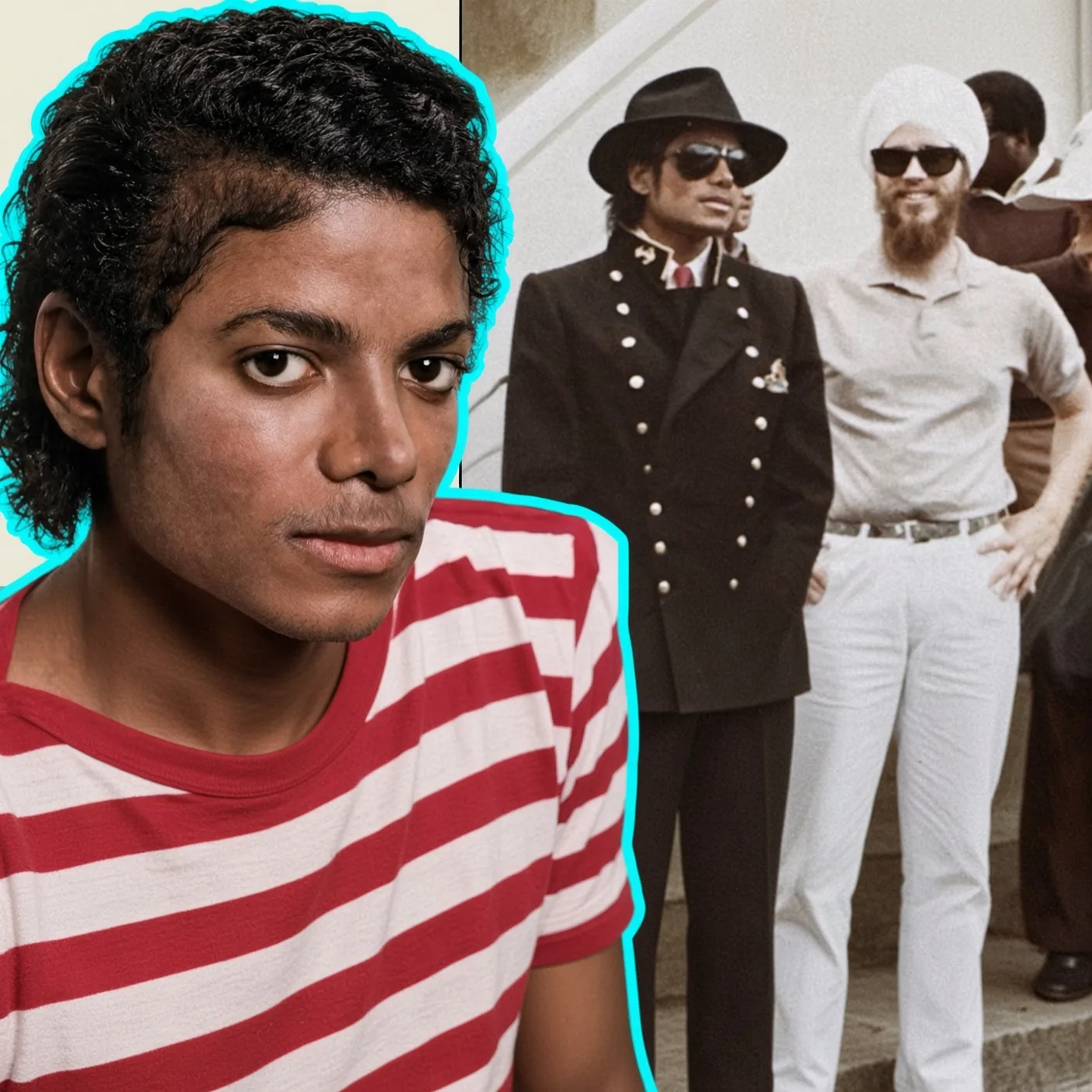
“If you can get a hold of an old Rolling Stone interview from I think 1983, Thriller had just come out, the album, not the video, and he’s on the cover wearing a red and white striped shirt. And they interviewed him. It was one of the last big interviews he ever did in a major publication. And they talked at length about his diet and his vegetarianism. And they never named us by name like they did in the biopic, but they said he knows how to drive to three places: his church, the studio, and his favorite health food restaurant.”
“Wow.”
“Even though he didn’t drive much, but he did know how to get to that other place.”
“That’s amazing. Okay, so let’s go back to the photos because I love hearing the stories behind these. This photo is so fun.”
“Thank you. Yeah, this is— and you know, like I said, I didn’t go around taking these pictures. This is a Polaroid. This is a Polaroid and it was taken at a funny angle. So when you put it straight up like that, it’s crooked. This is on the private jet. We typically had the same pilot and stewardesses most of the tour, or a rotating group of people that we knew. And Michael had his own room toward the front, his own room and bathroom. And he would— and I would feed him there. The stewardesses fed us. I always looked forward to what they got us for in every town because they knew Bill and the guards, the bodyguards, wanted barbecue and meat. They knew I wanted vegetarian, and they took such good care of us. Michael was up in the front in his own room and he’d hang out in the cockpit with the pilots. He loved that. He loved learning what they did and checking the controls. So everybody had their spot. And Bill and the— the back of the— I’m going to do a post soon because I found all these pictures of that plane that was called the Casino. There was a four-chair dining table at the back of the plane. Bill and the bodyguards and Chuck and Jack and whoever else was there played poker the entire flight, and we called that the Casino. In the middle there were couches and like VCR tapes for us, but Bill and the gang were at the Casino. Michael was up in front, and then we all just hung out in the middle, and the stewardesses just took such good care of us. I just love them. I loved when the stewardesses and the pilots got to come to the concert. That was so fun.”
“So cool. I got to ask— well, let me not get off. I want to look at one more photo and then I want to get into the Victory Tour. Okay. So, history lesson. Do you have any idea who Dick Clark is?”
“Yes.”
“And Dick Clark was a force in Hollywood. I think he started a production company. He owned a bunch of the game shows. So Dick wanted to revisit Michael’s success. They had stayed friends over the years. And anyone in the music business, you were friends with Dick Clark, right? So Dick Clark wanted to have Michael over when Thriller came out and he did his research and he asked around and said, ‘What does Michael like to eat?’ And he found out about the Golden Temple restaurant. So me and Akasha drove out to his insanely gorgeous house in Malibu. He had a big beautiful kitchen and we just fed he and his wife Kari. Kari and Dick Clark. And Dick posed for that. He had us— he went in the kitchen. He said, ‘Pick up a kitchen utensil.’ I picked up the whisk and Michael picked up that cleaver.”
“Oh yeah.”
“That is— that’s him. It’s like— and not only did Dick take the picture, he sent 8×10 copies of it to our restaurant.”
“I mean, what an— and again, this is one of the wealthiest, most successful people in Hollywood. And there were no like servants around— it was him and his wife. And they took those pictures and sent us copies. I mean, what a nice gesture, right? Very, very fun. And I love— and that again, that’s why the few pictures I have, I treasure because they were always taken by someone else and then gifted to me. I never went around going, ‘Hey, Michael, can we get a picture together?’ You just didn’t do that back then.”
“Yeah. Well, I do have another interesting photo. I’m not sure if this is from the tour. I think it is. Let’s take a look at this clipping. It looks like it’s from the newspaper.”
“Yeah. No, that’s from People magazine. There was an episode all about— there was a special issue of People all about Michael and the tour. And even though the tour, it was about Michael— all due respect— there were some pictures and images of his brothers and his story on all of them. But there was a great— and Michael approved this, you know, ‘People magazine are going to interview you.’ I’m in the kitchen at the Helmsley Palace in New York and, you know, I’m making— I made a pizza and you can see my little bag of Arrowhead Mills whole wheat pastry flour. And then they interviewed me and they did that little blurb. Sometimes I look back on it, Aisha, and I’m like, ‘Okay, I definitely stood out like a sore thumb with my beard and my turban. Was I another one of Michael’s menagerie?’ The good thing is I knew how to cook. And you can see I would have to chop up those vegetables like mushrooms and asparagus. I would have to chop them up and fold them into a taco or put them under the cheese on a pizza because he was a vegetarian, but he liked the carbs and the cheese and the yummy stuff. And I was like, ‘I want to make sure you stay healthy, young man. And so I’m going to make sure there’s some vegetables in there, too.'”
“Yeah. Okay. So once you— okay, so let me go back because I know that we stopped around the time when you cooked for him at Disneyland. You cooked for him and Dick Clark. Tell us about the Victory Tour. Like, tell us all about that.”
“Sure. Yes. And I also want to mention— because we talked about this earlier, but today is July 6 when we’re recording this, right? And that’s also the first day of the Victory Tour.”
“The big day. I’ve got a ticket. It’s not going to show up if I show you, but I’ve got an original ticket from that first day. July 6th, 1984, Arrowhead Stadium, Kansas City, Missouri, section 120, row 6, seat 22. $28.”
“Wow.”
“Imagine.”
“And that was controversial at its time. I’m sure you’ve read the whole story about you had to buy four tickets at once and Michael was not happy about that. Okay. Yes. Let’s go back to that. So I’ve left the restaurant. There was a lot of drama there. I’m kind of floating around. Michael pinpoints everything after that Disneyland trip. The Victory Tour starts and I very quickly meld into Michael’s entourage. Bill Bray I knew fairly well. Frank DiLeo had just been brought on board as Michael’s manager. His assistant was along with us, Sherry. His photographer, Sam Emerson. I got to know Chucky Devine, the big bodyguard with the top hat, and Jack Cohn. And there was kind of a core group of people that traveled on Michael’s jet. And when we got to a city, Michael didn’t go in a flashy car. He got in a van. He got in a brown van. He didn’t ride Rolls-Royces. But we very quickly all fit in and got along and had fun. And we went from hotel to hotel. The first place we went was Birmingham, Alabama, where they were still rehearsing. And I learned quickly, like, go to the kitchen, get to know the chef, see who’s going to be your point person. And there was this— how could I put it— there were mild annoyance that they weren’t going to be cooking and making food for Michael Jackson. It’s— I’m sorry, it’s human, right? Michael’s coming to your hotel. The chefs want to cook for him, but his chef is in your kitchen and he’s kind of a nice guy. He’s not a know-it-all, attitudey kind of a person. So they would always take care of me. They’d always assign me one person or a sous chef to make sure I had what I needed. I usually had to go to a local health food store to find everything. And then I would bring the food up in like the bus carts from room service. Occasionally Michael would have a suite, a kitchen in his suite like he did at the Helmsley Palace. And then— the biggest difference— breakfast for Michael was around 11:00 a.m., maybe noon. Lunch around 4:00, and dinner could be anywhere from 11:00 to like 2:00 a.m.”
“Oh, now why is it so late? Oh, okay. Well, why so late?”
“Performance nights. Think of the performance, right? He doesn’t want to eat for four or five hours before he goes on that stage. So the first day— and I wrote a story about this for Substack. I’ve got to direct people to it because it was one of my most favorite days— where Michael was just in such a mood. His suite was just pulsing with energy. And there was no music. He never listened to music. He never had music playing in his room. He had music playing, you know, like background music at Havenhurst. But his suite was just pulsing with energy. But he wanted lunch around 4:00 in the afternoon. So on that first day, July 6th, I made pizza. I brought other snacks and fruit and pretzels and cookies. But they didn’t usually come on stage till 9:00, 9:15 at night.”
“Hey.”
“So he doesn’t want to eat since 4:00 tonight. He doesn’t want to eat. He’s got to be limber. I want to make sure he was like carbed up and proteined up and everything during the day. But then he didn’t want to eat before the show. So he gets done with that show. He’s famished. He’s ready to eat, you know, massive quantities. So after the show, if they get back in the show 11:00, 11:30, he showers. So dinner quite routinely becomes midnight.”
“That makes— I see, that makes sense now. And so at that time you’re having to— I guess you would, because hotel kitchens would usually be closed, but then you’re going down and making stuff.”
“Thank God for 24-hour room service.”
“Most of the hotels, even if room service was closed, they knew they had to keep the kitchen open for me. But there would usually be somebody doing— hotels have to feed a lot of people. A lot of people. Even at Disneyland that first time, like, ‘Oh my god, there’s massive rows and rows of perfectly diced vegetables and mashed potatoes and roasts and breads and pastries.’ And like, you’re humbled by the skill level, right? And I’m like, ‘I work in a little health food restaurant.’ But the hotels would quickly discover, like, ‘Okay, they’re not going to be cooking for Michael. Too bad.’ But they would be people— people would rotate over and stand by me for a while and pick their grain while they’re prepping something. And I’d roll with it. And I wasn’t like saying, ‘Hey, Michael’s leaving at 2 this afternoon.’ But you’re friendly. You got to like, ‘Yeah, yeah, I met him in LA. Oh my god, he’s so cool. Like, oh, we’re doing this and we’re going to that.’ And people wanted to get a sense of who he was. The funniest thing, Aisha— he also never came and went through the lobby. He went through the back service elevator. So the kitchen’s always on the ground floor. Always. I mean, maybe some places the basement, but these are always on the ground floor. So you’d be standing there and all of a sudden the kitchen would just empty out and you’d quickly realize, ‘Oh yeah, housekeeping told them Michael’s leaving.’ So they all race to where the elevator opens to get a glimpse.”
“Oh.”
“Wow. Yeah. That must have been so surreal. Did you go on every single tour stop then?”
“Yeah. Yeah. I was— once I left LA, I mean, I subleased my apartment. I put my car in storage somewhere. I don’t even remember. And I was on every stop on the tour. And I had that all-access pass like you can see behind you. I could bring friends to the show. It was pretty darn cool.”
“What was it like seeing the concert?”
“It was electric. It really was. I’ll just say briefly, it was very well reported in the LA Times back then and in the movie that Michael had really wanted to tour with his family. He wanted a solo tour. He was ready for a solo tour after Off the Wall and Thriller, but that didn’t happen. And over 50% of the song catalog was Michael or Michael solo hits. And half of the fun was the energy of the crowd. Seriously, just riding that wave of energy of people that were so excited to see Michael and his brothers, but mostly to see Michael. And the fact that he could moonwalk and the people in the farthest seats up somewhere in the back could feel that wave of energy. And my favorite song honestly in many ways was ‘Human Nature.’ There was just something about how heartfelt that song was and the lighting that they did. And when they did the biopic, I was just losing it because it was like, ‘This is exactly how it was.’ I mean, I saw this dozens of times and they really recreated that lighting effect. But yeah, and then they go into this Jackson 5 medley and they come out with ‘I’ll Be There’ at the end. And then Michael did this like jazzy scat thing— his mom called it scat, you know, it’s this jazz riffing. And then they went into I think they went into ‘She’s Out of My Life.’ I mean, there were just parts of the concert that just flowed from point to point in his life and the Jacksons and the Jackson 5. And then of course ‘Billie Jean’ and ‘Beat It,’ and then everyone’s going wild.”
“Yeah. Okay. Tell me your thoughts about the biopic. The biopic really was centered around a lot of the time that you worked with Michael. So what did you think about it and what was your reaction when you first saw it? The restaurant you worked in was featured, right?”
“Yeah. Well, thank you. I don’t think that much of the biopic was centered around the time I worked with him, but thank you for that. That’s awesome. I mean, I wasn’t— I’m going to be blunt with you. I went in with really low expectations. I thought, you know, the estate has had its share of critique over the years. Jaafar is an unknown actor. This might be a movie by committee where everybody has to agree to everything. I just thought, I don’t know what’s going to happen. But I had a little hint because when we heard that they wanted to buy like 1,800 of the cookies that are featured in— we didn’t know they were featured in the movie, by the way. We didn’t know, Akasha and I. But yeah, so the cookies that are on that tray that Bill Bray brings out, that was our key, our ticket to the movie, because Akasha had coordinated having those for the afterparty and they gave us two passes. So we went and I’m just thinking, I’m just here to celebrate Michael. I’m here for the love of Michael. And then Jaafar just had me in the palm of his hands. You know, obviously I know a lot of the details of what happened and the time frames that were off and this thing that didn’t line up. But then Jaafar would start singing or dancing and I’d be like— I would forget that I wasn’t watching a live concert.”
“Yeah.”
“Especially the Victory Tour stuff, especially the Motown 25, because I vividly remember Motown 25. And then ending it with ‘Bad,’ which I saw the Bad Tour, but not in Prague or Japan or wherever that was— Yugoslavia or whatever that was. But he just— I was blown away. I was mesmerized. He had me in the palm of his hands. He didn’t do a tribute. He didn’t do an homage. He embodied Michael.”
“You know, and then the fact that Keenan Derell Jones— Bill Bray gets his due, because Bill, oh my god, is Bill a character. Bill was such a big part of my life during that era. Did I forget? No, I mentioned him at the casino and talking about Michael’s entourage, because Bill was almost like— he was just there. He just handled things. And fiercely devoted to Michael. Also a crackup. Also a funny person. He could tell a joke. He would tease me about the noise my food processor made, and it did. It was bad. It was loud. Oh, and the story of the cookies— like, there’s no sugar, there’s no white flour, there’s no chocolate chips. ‘Those aren’t cookies, those are ookies.’ And then they became known as ookies. Like Bill could just— he was just funny. One time we were in Amelia Island. It was one of the few times we weren’t staying at a hotel. We were touring. It was Northern Florida for Jacksonville concerts and we were staying in like little bungalows, and so there’s no room service for Bill to get food from, right? So he had to go shop and cook. And I was— it was great because it was just Bill, me, Michael, and Chucky. And it was super chill and super relaxed. But Bill had to cook dinner. And I swear to God, Aisha, he must have left the ground beef on the counter at the grocery store, because he gets back and he’s looking around for the rest of the tour. He tells everyone, ‘Mani’s a vegetarian, but he’s so deprived he ate a pound of beef raw at that.’ Because I put that down. I turn around and it’s gone. He ate it. He ate a pound of raw beef. And he would just get going and he would have a room in stitches. You know, and I love that about him, because otherwise I was always doing something wrong or I was disappearing for hours or something. I was always on his bad list. But the fact that I could make him laugh and he did like my sweet potato pie— even though he recorded his cookies with sugar and chocolate chips, he did like my sweet potato pie. So there was just a lot of fun on that tour.”
“You mentioned that from the beginning you kind of were able to treat Michael like a normal person because you were just being yourself. Did you ever have a moment where you’re like, ‘Okay, this is no longer Michael Jackson the superstar. This is just now just Michael.'”
“That’s a complex question, I think, because I met him the way I did when Thriller hadn’t hit yet. And I had kind of dropped out of pop culture. I was not that aware of Off the Wall, even though I was only 19 when it came out. I was not that aware of it. I just was not a part of pop culture. So he was just another LA celebrity to me. But he was huge in my childhood. Huge. I mean, the Jackson 5 brought together the Black kids and the white kids on my playground. Truly. Truly. And we used to listen to their records during the recess in Michigan when it was snowy, and the friendships that that forged there that didn’t normally exist— I always credit them. But you know, by the time I met him, it was more like I watched him become the icon in front of my eyes, and that was sort of like, ‘Oh shoot, wow, what a— wow, how did I stumble into this?’ Because I would occasionally— like I told you, he’d come into our restaurant in between lunch and dinner, but every once in a while someone would be there and I’d see their reaction. And then I saw their reaction after ‘Billie Jean’ and then ‘Beat It’ and then ‘Thriller,’ and you just watched the public’s reaction to him ramp up. And then I became very protective and very respectful of the trust he placed in me.”
“Yeah.”
“You know, that was very special. And I honored that. And it made me feel like I’ve got his back and he knows I’ve got his back and I’m not going to do anything to threaten that.”
“I love that.”
“I might have— I might spend a little too much time wandering around Manhattan shopping for the vegetables you need. Oops, I went to the Guggenheim. Oops, I took a walk in Central Park. But he knew I had his back. And that was sacred to me.”
“Yeah.”
“I mean, that’s really my calling. All those years studying, trying to be a yogi person— I found my calling with food. That was the discipline, the daily practice and repetition of that really brought meaning to my life.”
“Yeah. Did— I know you mentioned that Michael noticed when you weren’t the cooking that day when you were at the Golden Temple restaurant. But did he ever express appreciation for the cooking that you did on the Victory Tour or anything? Did he ever say anything like that that stuck with you for all these years?”
“Yeah. So this gets into like the phraseology of the ’80s. And I made something one time and, you know, he loved a lot of dairy products and I didn’t eat a lot of cheese back then. So like I’d make a pizza with less cheese. I can’t remember what I ate, but one day he was like, ‘That was really good.’ I said, ‘Yeah, thank you. I know. I had some for dinner, too.’ And he goes, ‘Did you hurt yourself?'”
“Because, you know, it’s so good it hurts.”
“He goes, ‘That’s so good it hurts.’ He’d say, ‘Did you hurt yourself?’ I was like, ‘Yeah.’ And then he’d laugh because I’m picking up on his lingo. He’s like, ‘That’s so good it hurts.’ So yeah. And then, you know, he would introduce me to his friends. I mean, he introduced me to Marlon Brando. He would never just ignore me or treat me like the guy that set the food down. He would stop and introduce me to Sir Richard Attenborough and Jacqueline Onassis and Brooke Shields and Diana Ross. And he would be like, ‘Yeah, that’s Mani. He’s my cook,’ or ‘He’s my chef,’ or whatever. There was that level of respect and I noticed it.”
“Wow. Amazing. Amazing. I want to— okay, I want to get back to some of the photos because there’s still so many cool pictures that we have here. Just amazing. Okay, first one here. Love this picture. Tell us about this.”
“Sure. So on the Victory Tour after the Denver shows, we went up to Caribou Ranch, and Caribou is a very famous recording studio. Elton John’s album Caribou is named after it. All the ’70s and ’80s rock stars recorded up there, from Fleetwood Mac to the Beach Boys to like kind of more pop like folk country singers. Michael knew about it. Jimmy Guercio, who had been the producer for Chicago, the rock band Chicago, bought that property, built the state-of-the-art recording studio. And we went there after the Denver show. So here’s the thing about the Victory Tour, if I didn’t mention— shows were only Friday, Saturday, Sunday.”
“Oh.”
“And his brothers would often fly back to LA. Michael had his own jet and we’d either hang out where we were or we’d go to Disney World yet again. Or like after Denver, we went up to Caribou. So it just depended week to week. If the shows were all on the East Coast up in New England, we stayed in Manhattan. So after the Denver shows, we go up to Caribou. We’re riding horses. We’re— Michael’s riding ATVs. We each have our own little log cabin, man, beautiful decked out hut. They had a chef on site. So their chef is cooking for me. I’m cooking for Michael, and their chef’s cooking for Michael’s chef. Like it was so fun. And we went for like— that was like a three-hour horse ride. Those were not performative pictures. You’ve seen other pictures. This is from— I want to say Life magazine. There’s a whole bunch of pictures of like Michael with his arms out. Michael with these rocks and this really blue fresh air behind him. Michael riding an ATV. Those were not performative. Michael rode the horse for three hours. Michael’s very coordinated. He could roller skate. He could go down on one knee and do that thing where he skates between two people. So he just let loose. There were nobody around. He could just have fun and go into the recording studio during the day. So the fact that that picture and I had my hair down for a change, because most of my pictures back then I had the turban on. The fact that there’s that picture and that that picture ended up in Life magazine— he must have approved it. I look back on it like, ‘He must have approved the picture with his cook on the horse in the background.’ Like, thank you. And be— why? Like, to me, that’s the honor. That’s the thank you. That I got to show up in a handful of the photos capturing his life. And that was just such a delight up at Caribou Ranch. Love that place.”
“Talk to us a little bit about Disney World, because you mentioned it a couple times and I know you have some stories from him being at the Michael Jackson suite at Disneyland, right? Or Disney World.”
“Yeah. It’s sort of like unpacking those little moments in the biopic. You know, the picture of Space Mountain on the wall in his room. Well, hello. He went there twice every day when he was in Disneyland or Disney World. So that hat that he’s wearing in the biopic says Royal Plaza. And the Royal Plaza, probably everyone knows by now, is the site of the Michael Jackson suite. And there was a room that had his signature with the little twinkles at the very end, the way he did with Michael Jackson. And there were some Grammys or some awards. They had to have been bolted to the wall so they couldn’t be stolen. So the hotel could lease out the Michael Jackson suite when he wasn’t there. When he came to Disney World, which was frequent, he would stay there. And I’m telling you, it wasn’t like the top, nicest, fanciest hotel in Orlando, but it was a hotel that he stayed at, and he developed a connection to a woman named TP Henderson. And Toppy was a guest relations and hospitality coordinator. And Toppy became his friend for life. She became my friend for life. Her daughters are my friends for life. I haven’t met her grandkids. I wish. And it was Toppy. I mean, the Royal Plaza was great and I cooked in that kitchen and Akasha cooked in that kitchen and the staff there were wonderful. But I’m telling you, I’ve never heard Bill Bray and Michael speak so highly of one person as I have of Toppy Henderson.”
“Wow.”
“And Toppy was head of hospitality, guest relations at the Royal Plaza. Disney would send their people to manage Michael and to plan all his— because Epcot and Discovery Island and these Wild West shows— and they wanted to organize everything for him. And he and Bill would be like, ‘Yeah, Toppy’s got it covered.’ And that would annoy the crap out of the Disney team. And they’d come too, but it was like Toppy had us covered. And then he wants to go to Walt Disney World or he wants to go to Knott’s Berry Farm or he wants to go to a miniature golf or the Haunted House. She would manage it all. And it would be fun because Toppy could manage it, get it taken care of, and also join us and have fun. I’ve got a picture right over here with Toppy and muscles around Toppy’s neck. And then Toppy York would organize hot air balloon flights, you know. So that cap represents the Royal Plaza Hotel physically, energetically. It’s all about TP Henderson and she’s sadly passed. But wow, what a force she was in bringing fun to life for Michael Jackson and all his friends and all his entourage.”
“Thank you so much for sharing that story. It brings so much meaning to now knowing what that hat represents, what it represented for Michael.”
“Well, and it’s funny because Toppy is like my name, Mani. It’s unusual. The first time I kept hearing this word, Toppy. Toppy. I kept hearing Bill say it and I was like, ‘What are they talking about?’ And I think we were— I think it was our second or third stop in the Victory Tour and we were about to go to Florida and I kept hearing this word. I didn’t know what it meant. And again, I wasn’t like in your face like, ‘What are you guys talking about? Where are we going next? What’s happening?’ I was there to feed Michael and I wasn’t there to get in his face. And that’s probably why I lasted. But I kept hearing this word, Toppy, and I finally realized, ‘Oh, it’s a person.’ And then we got to Orlando and I met her and just got to become dear friends with her. And I realized, okay, that’s why Michael and Bill are so animated about this person with this unusual name like mine. And four letters, ends with an I.”
“Well, I just— these stories today, all your memories you’ve shared, you’ve been so generous with your memories and stories. And I know that you also share them online as well on your socials and your Substack. Can you tell people where to find you? Because I don’t— there’s so much more I know that we could cover. I hope one day to talk to you again soon. I’m sure there’s so many more things we could talk about.”
“Yeah. Yeah. So I’ve got MJChefMani on Instagram. MJ, obviously, ChefMani, M-a-n-i, on Instagram. That’s also my Substack and my TikTok. Part of me is like, why didn’t I just create it Mani Niall, my last name, because I am definitely working on a memoir cookbook about my life. Like you said, like how did I end up in the kitchen? What did the kitchen represent to me? It won’t be written by MJChefMani. It’ll be written by Mani Niall. But in the meantime, I’ve got TikTok, I’ve got Substack, and I’ve got Instagram, MJChefMani, M-a-n-i. And I literally just did a story today about the blueberry muffins and the smoothie and some videos and things for that very first day of the Victory Tour. That very first performance day, I should say. July 6, 1984. Yikes. It’s— you’re young. It’s scary when you can think back in terms of 42-year chunks of time.”
“Oh my gosh. But yeah, you do have like an incredible memory, like just so many cool details you shared today. I can’t wait to go home and check out the recipes. Maybe I’ll try to make some of the things you share recipes on your Substack as well.”
“I do, and like I said, I try to share the simpler ones. And sometimes like making a smoothie, I’m not going to measure out the amount of pineapple, but I’m going to show you the kind of fruit Michael used and how much juice you use and blah blah blah. Simple things like cookies and muffins. I’ve done the red chili sauce. I don’t think I’ve yet done that ginger miso salad, but I’m going to build it over time. That’s number one. Number two, the thing is after he died, I realized I need to start capturing these stories. I needed to just sit down and write. And then after like two years of doing that every maybe couple times a week, but I was like, ‘Well, what was happening in my life then?’ Because these are fun stories, but if there’s not a bigger point to it, it’s just— I don’t know— gossip or something. So I started weaving in what was happening in my life. So again, so I could remember it. And memory feeds memory. You know what I’m saying?”
“Yeah.”
“My mom saved every clipping. Every clipping. Like if you could see my head in the back of Michael’s on a roller coaster, she saved it. And so it was a letter to her that I wrote that he sang ‘Here, There, and Everywhere.’ I always remembered he sang a Beatles song when the— you know, the day, couple days before I met Paul McCartney. But in a letter to her I wrote what the name of the song was. So it’s good to have a good memory, but sometimes I think, ‘Wow, it would have been great if I’d kept a diary.’ But yeah, like I said, I started writing 2009 just to capture the stories for posterity. And hopefully now that the biopic’s mentioned our restaurant, I think there’s really an interested audience that really wants to learn from the people that were lucky enough to collaborate closely with Michael and help him live the life that he lived.”
“Yes. Yes. Well, I am— it’s been an honor. It’s been really cool to talk to you today and I hope I get to talk to you again soon. I hope you’ll come back for another episode someday.”
“I would love to, and I love listening to your podcast and thank you for doing what you do.”
“Thank you. Well, everybody, make sure you guys go and follow Chef Mani. I hope you guys enjoyed this episode. Definitely go check out his Substack and comment down below. Did you try any of the recipes? Were you surprised about any of the stories today? Give us some feedback. Let us know how you enjoyed it. And follow the show and I’ll see you on the next episode.”
The cookies were called ookies.
The plane had a poker table called the Casino.
The first photo shoot for Thriller didn’t work because the wire was too bright and the face was too dark.
And the man who made the food for all of it was just a guy from a vegetarian restaurant who happened to be standing in the right kitchen when the phone rang.
I can’t even believe I said this.
I’m hanging out with them.
I’m listening to it.
And I look at Michael and I go, “You think it’ll be top ten?”
And he looks at me and he goes, “It’ll be number one.”
He was right.
He usually was.
And the man who fed him for all those years is still telling the story.
One recipe at a time.
One memory at a time.
One ookie at a time.