Michael Movie Behind The Scenes Funniest Moments!
It’s a level of authenticity that you can’t create.
You really feel the spirit of Michael, and it resonates throughout the entire crew.
The Michael movie is now a global sensation.
Jaafar’s outstanding performance, along with the incredible work of the rest of the cast, has made everything feel so real that it is hard to believe this legend is no longer with us.
Now, we are going to explore some funny and crazy behind-the-scenes moments and bloopers that will show you how this epic film was made.
The global search for the King of Pop.
Before a single camera rolled on Michael, the production team faced a daunting task.
Casting someone who could convincingly portray the most famous entertainer on Earth.
The global talent search spanned over two intense years, evaluating more than two thousand hopeful candidates across continents.
Director Antoine Fuqua and producer Graham King were not merely searching for an actor with a passing physical resemblance.
They required a rare performer who could duplicate Michael’s specific vocal range, extraordinary stage presence, and deep emotional complexity.
Ultimately, the trail led straight back to the Jackson family tree, landing on Jaafar Jackson, Michael’s nephew and Jermaine Jackson’s son.
Making his feature film debut, Jaafar stepped into one of the most high-pressure roles in modern cinematic history.
The casting decision carried immense financial and artistic risks for the studio.
If global audiences failed to buy into Jaafar’s performance, the entire multi-million-dollar endeavor would collapse before ever hitting theaters, leaving the film’s investors facing catastrophic financial losses.
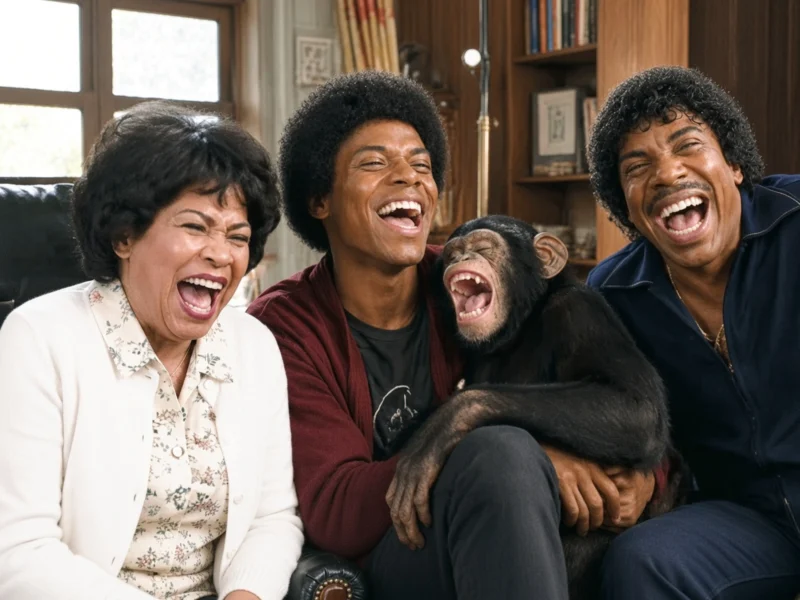
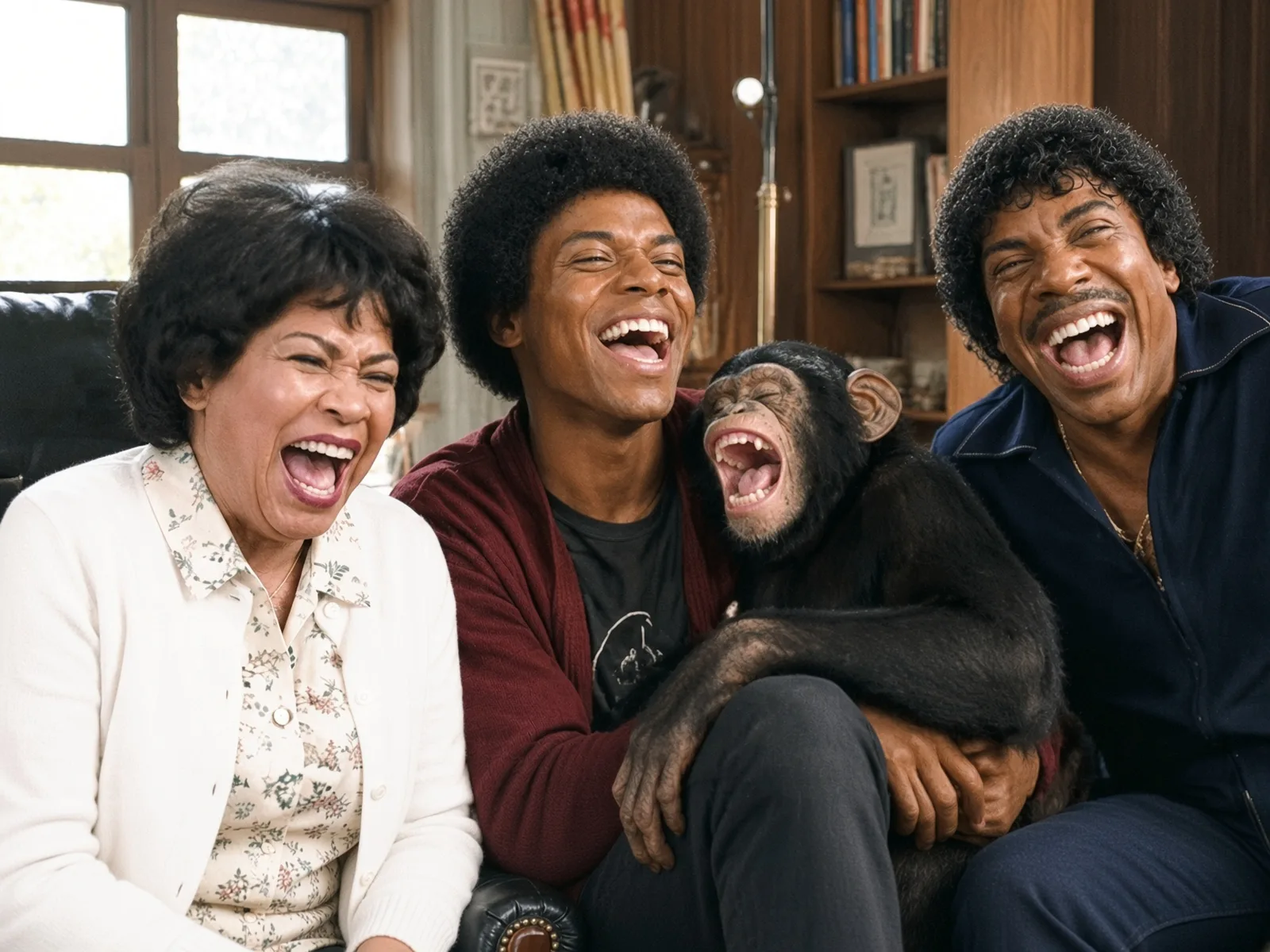
Now, let us take a look at this heartwarming behind-the-scenes moment.
This image shows Jaafar Jackson portraying young Michael, laughing with the actors playing Katherine Jackson and Joe Jackson, while a chimpanzee portraying Bubbles sits happily in the middle.
During the filming of the Michael movie, the cast could not stop laughing after the chimp unexpectedly copied one of Jaafar’s facial expressions, turning a serious rehearsal into an unforgettable moment.
The entire crew reportedly burst into laughter, forcing filming to stop for a few minutes.
While the exact story behind this moment has not been confirmed, it perfectly captures the fun atmosphere often shared behind the scenes.
Securing matriarchal approval.
Casting Jaafar Jackson was far more than a creative gamble.
It required direct emotional buy-in from the Jackson family matriarch, Katherine Jackson.
Before filming could officially move forward, the production team sought the blessing of Michael’s mother, whose approval was essential for establishing the project’s legitimacy.
Katherine publicly gave Jaafar her full backing, stating that her grandson genuinely embodied her late son’s spirit, fluid movement, and total devotion to performance art.
For a family that had spent decades fiercely guarding Michael’s public image, her public endorsement represented a massive turning point.
It granted the filmmakers crucial cultural authenticity, while giving Jaafar the psychological confidence necessary to tackle such a daunting role.
Behind closed doors, this vital moment helped soothe lingering friction between studio executives, legal representatives of the Jackson estate, and surviving family members who closely monitored every phase of development to ensure the pop star was honored appropriately without exploiting his complicated global legacy.
Method acting at Hayvenhurst Estate.
To prepare for the performance of a lifetime, Jaafar Jackson immersed himself completely in his uncle’s former daily environment rather than relying strictly on archival footage.
He temporarily relocated to the legendary Jackson family estate at Hayvenhurst in Encino, California.
Jaafar spent months living inside the residence, surrounding himself with childhood memories, quiet private spaces, and personal family heirlooms.
Preparing within Hayvenhurst rapidly blurred the boundaries between traditional acting exercises and profound emotional reenactment.
For the Jackson family, watching a young relative walk those familiar hallways while taking on Michael’s soft voice and body language brought back intense waves of nostalgia and grief.
Living inside that environment infused his performance with a rare, quiet gravity seldom seen in Hollywood biopics.
This intensive level of method preparation became one of the most talked-about aspects of the entire production, illustrating Jaafar’s total dedication to capturing his uncle’s true essence far beyond the public superstar persona.
Cracking the mind of an icon.
Inside his private workspace at Hayvenhurst, Jaafar constructed a massive research wall that looked more like a detective’s investigation room than a standard actor’s prep space.
He painstakingly arranged personal letters written by Michael, private journals, handwritten song lyrics, philosophical notes, and detailed timelines matching global historical events to major career milestones.
Rather than settling for a polished surface imitation, Jaafar worked tirelessly to uncover Michael’s underlying mindset during key artistic peaks and severe personal trials.
Having access to these private family archives allowed him to understand the personal motivations driving iconic studio albums like Thriller and Bad.
This exhaustive research routine gave the creative team a solid psychological foundation that deeply impressed both crew members and protective estate handlers.
It signaled from day one that the biopic aimed to examine the man behind the music with genuine detail, diligence, and respect during an era of intense public scrutiny.
The grueling physical toll of rehearsals.
Recreating Michael Jackson’s legendary stage choreography turned into a grueling physical ordeal for Jaafar Jackson.
Having no prior professional acting or stunt experience before signing on to the film, Jaafar was subjected to relentless daily rehearsal schedules designed to teach him complex footwork, rapid spins, and the iconic moonwalk.
He spent ten to twelve hours every day in the dance studio, executing difficult routines over and over until his feet were blistered, swollen, and bloody.
The physical demand was overwhelming, presenting a constant risk of serious injury that could easily hold up principal photography.
However, Jaafar consistently refused shortcuts, fully aware that millions of dedicated fans across the globe knew every single move by heart.
Replicating Michael’s explosive physical energy demanded extraordinary conditioning.
This painful rehearsal process became a legendary part of his preparation, reflecting the sheer determination required to meet the high standard established by his late uncle.
Winning over the original choreographers.
Mastering Michael Jackson’s intricate dance vocabulary required direct instruction from veterans who had shared the stage with the pop icon.
The production brought on expert choreographers Rich and Tone Talauega, who had spent years touring and filming music videos alongside Michael himself.
Early on, the Talauega brothers expressed serious doubts about whether anyone, even a talented family member, could truly duplicate Michael’s precise rhythmic timing and natural kinetic instinct.
Overcoming their initial skepticism became a major emotional hurdle for Jaafar.
Rather than backing away from the challenge, he requested additional evening practice sessions, pushing through intense physical exhaustion to bridge the performance gap.
His relentless drive slowly turned their early doubts into complete artistic confidence.
Earning the genuine respect of choreographers who knew Michael’s movements intimately validated Jaafar’s performance, ensuring the high-energy dance sequences captured on camera would withstand rigorous global critique.
Shock departure in the camera department.
Behind the scenes, the production encountered a major setback during pre-production when legendary cinematographer Robert Richardson suddenly exited the project.
Richardson, an Academy Award-winning director of photography brought on to establish the movie’s visual landscape, was forced to leave due to severe scheduling conflicts caused by industry-wide labor delays.
Losing a chief cinematographer so close to the start of principal photography caused immediate logistical panic, directly impacting camera lens choices, lighting designs, and overall visual strategy.
Producer Graham King and director Antoine Fuqua acted swiftly, securing fellow Oscar winner Dion Beebe as his immediate replacement.
Beebe had to jump straight onto the active project without standard prep time, designing complex lighting structures for massive concert recreations and intimate dramatic scenes simultaneously.
This sudden crew replacement highlighted the deep instability and pressure shadowing the production long before the main camera package turned on.
Hollywood labor strikes freeze production.
Originally scheduled to begin filming in mid-2023, the production ground to a total standstill when Hollywood was hit by historic union-wide SAG-AFTRA and WGA strikes.
The industry shut down all work, forcing the high-profile biopic into an indefinite freeze.
Hundreds of cast and crew members were left in complete limbo after months of intense prep work, causing severe scheduling headaches and ballooning holding costs for Lionsgate.
Maintaining creative momentum during this extended hiatus severely tested the production’s resolve.
Jaafar Jackson was forced to maintain his strict physical regimen, vocal conditioning, and dance training for months without knowing when cameras would actually start rolling.
When principal photography finally kicked off on January 22, 2024, the prolonged delay had already thrown original theatrical release plans out the window, sparking a domino effect of altered timelines that heavily impacted the movie’s ultimate pathway to screen.
The settlement clause landmine.
The absolute worst crisis to hit the production arrived after principal photography was already finished.
During routine post-production legal screenings, attorneys representing the Jackson estate uncovered a binding clause inside a confidential 1993 legal settlement tied to accuser Jordan Chandler.
The legacy agreement strictly prohibited any commercial film or television production from depicting Chandler or dramatizing the specific legal claims connected to that original court battle.
This unexpected realization triggered panic at Lionsgate, because the entire third act of John Logan’s original screenplay revolved directly around the fallout of those 1993 allegations.
Staring down immediate legal injunctions and multi-million-dollar lawsuits, the studio was forced to throw out the completed climax and rebuild the entire ending from scratch.
Uncovering a legal roadblock of this magnitude after filming had wrapped caused one of the most stressful, urgent, and expensive script overhauls in modern Hollywood history.
The lost Neverland set piece.
Among the finished footage completely discarded due to the settlement clause was an elaborate dramatic sequence showing the 1993 law enforcement raid on Neverland Ranch.
The production had meticulously reconstructed large portions of Neverland to shoot the high-intensity scene, featuring police cruisers rolling through the main gates with flashing lights while Michael sat alone inside his private residence reflecting on his public downfall.
It was designed to serve as the film’s emotional low point, exploring the devastating personal cost of global public accusations.
However, because the sequence explicitly depicted legal matters restricted by the 1993 court agreement, every single frame had to be permanently deleted from the edit.
Sacrificing fully shot, high-budget set pieces represented an agonizing loss for director Antoine Fuqua, leaving some of the film’s most intense dramatic work locked away forever due to insurmountable legal liabilities.
The race to reshoot the climax.
With the original ending thrown out, Lionsgate launched an intense emergency reshoot operation in June 2025.
Key cast and crew members were reassembled to write, stage, and shoot a brand-new third act over just twenty-two high-pressure days.
Screenwriter John Logan worked around the clock to rewrite the narrative structure, shifting the movie’s timeline to conclude earlier with the massive artistic success of the 1988 Bad World Tour.
Rebuilding vast stadium stages, manufacturing hundreds of period-accurate costumes, and locking down international actor availability on short notice required unbelievable logistical coordination.
Working against a ticking clock, director Antoine Fuqua shot at a breakneck pace to make sure the newly added footage matched the visual tone of the earlier production.
The high-stakes reshoot successfully saved the movie from total legal paralysis, but it demanded an extraordinary effort from every department on set.
Debating the true cost of reshoots.
The unexpected financial damage caused by the emergency reshoots ignited fierce controversy across major Hollywood trade outlets.
Initial press leaks alleged that rewriting and re-filming the movie’s entire third act tacked on an astronomical fifty million dollars to the production budget, painting a picture of a project spinning completely out of control.
However, detailed reporting from Variety soon corrected those exaggerated figures, proving that the emergency shoot actually added between ten and fifteen million dollars to the bottom line.
Crucially, the Michael Jackson estate stepped in to pay for those extra costs directly, saving Lionsgate from having to absorb the financial hit alone.
Even with accurate numbers, the last-minute overhaul created major financial tension, showing how sudden legal complications can instantly inflate production costs on high-profile biographical projects attempting to navigate real-world controversies.
A blockbuster budget for a musical biopic.
By the time all production delays, strike-related holds, and emergency third act reshoots were factored in, the final price tag for Michael skyrocketed to between one hundred fifty-five million and two hundred million dollars.
A budget of this massive size is usually reserved for superhero blockbusters or CGI-heavy action franchises, rarely for a musical biopic.
Costs accumulated steadily across months of physical training, massive period set builds, music rights licensing for Michael’s catalog, and sudden post-production overhauls.
For Lionsgate, green-lighting a budget this vast represented a massive corporate gamble.
It meant the movie needed to shatter theatrical box office records globally just to break even and turn a profit, placing an immense amount of pressure on the studio’s marketing wing to deliver a worldwide hit when the film finally reached audiences worldwide.
Tragedy strikes the screenwriter’s home.
Adding to the production’s bizarre streak of misfortune, personal tragedy hit Oscar-nominated screenwriter John Logan in the middle of the emergency rewrites.
While under extreme pressure from studio heads to completely reconfigure the film’s ending, Logan’s Southern California residence was caught in the path of the devastating Pacific Palisades wildfire, suffering massive structural damage.
Trying to deal with the sudden loss of personal belongings and property while meeting strict studio deadlines created immense emotional stress for the writer.
Beyond legal disputes and corporate balance sheets, this terrifying event served as a somber reminder of the human difficulties faced by the creative team behind the scenes.
The fire temporarily disrupted the writing process, leading to another frustrating delay in finalizing the new shooting pages during an already chaotic turnaround window.
The escalating domino effect of delays.
The stack of production problems forced Lionsgate to repeatedly push back the official theatrical release date for Michael.
The studio originally targeted a premiere window of April 2025.
However, following the prolonged Hollywood labor strikes and emergency script overhauls, the film was pushed to October 2025 before eventually being bumped all the way to April 2026.
Delaying the global release by a full year required the studio’s marketing department to dismantle and completely rebuild their worldwide promotional strategy.
Keeping international audience hype alive across multiple schedule adjustments proved extraordinarily difficult.
Each new delay brought intense speculation from trade analysts, leaving film fans and critics questioning whether the movie could survive its chaotic production history and actually deliver a polished, successful cinematic product upon its eventual global release.
Trimming the four-hour assembly cut.
When director Antoine Fuqua assembled his initial cut of the film during post-production, the runtime extended past an incredible four hours.
The sheer volume of archival research, full-length concert recreations, and dramatic storylines made cutting the film down a heartbreaking process.
Studio executives briefly toyed with the radical idea of releasing the biopic as two separate theatrical films to avoid losing prized footage.
Ultimately, Lionsgate decided on a single event-style theatrical release, forcing the editing team to pare the final movie down to two hours and thirty-five minutes.
Eliminating over ninety minutes of finished footage meant cutting several complete musical numbers and secondary character storylines.
The editing room turned into a high-stakes bargaining zone as Fuqua worked tirelessly to protect the core emotional narrative while creating a practical runtime for global theater operators.
Differing roles among the Jackson siblings.
Even though the project received full backing from the Michael Jackson estate, involvement among Michael’s three children varied greatly throughout production.
His eldest son, Prince Jackson, stepped directly onto set as an active executive producer, attending daily shoots to consult on historical details and support his cousin Jaafar through the tough filming schedule.
On the other hand, Michael’s daughter, Paris Jackson, and youngest son, Bigi Jackson, chose not to participate in the making of the film.
This division highlighted the contrasting views within the Jackson family regarding how their father’s complex life and controversial legacy ought to be presented on screen.
Managing these delicate internal dynamics required careful diplomacy from director Antoine Fuqua as press outlets continuously scrutinized family unity throughout the long and highly publicized production process.
Concerns from Paris Jackson.
Paris Jackson became a key figure in media coverage when reports surfaced regarding her deep concerns about the biopic’s direction.
Sources revealed that after reviewing an early draft of the screenplay, Paris voiced specific objections regarding story choices that felt dishonest to her father’s private life and personal principles.
When her suggested adjustments were not incorporated into subsequent script revisions, she decided to walk away from the project completely.
Her decision to publicly distance herself created shockwaves across the entertainment press.
“For a film project whose entire marketing push relied heavily on estate cooperation and family authenticity, public resistance from Michael’s only daughter created undeniable tension, exposing the difficulty of capturing a megastar’s life when those closest to him hold fundamentally different views on the truth.”
Managing public narratives and corrections.
Public fascination reached a boiling point during early press rounds when actor Colman Domingo, who portrays family patriarch Joe Jackson, suggested in an interview that Paris and Prince were fully united behind the movie.
Paris wasted no time setting the record straight, publicly clarifying that Domingo’s comments did not accurately represent her actual feelings or non-existent involvement with the project.
This public correction highlighted the ongoing tension between polished studio PR campaigns and the unvarnished realities of the Jackson family dynamic.
It proved that even after the cameras stopped rolling, controlling public messaging surrounding the project remained a delicate, unpredictable balancing act for Lionsgate’s promotional team as they prepared to roll the film out to audiences worldwide.
A record-breaking promotional reveal.
Despite years of frustrating production delays and lingering public debate, the arrival of the movie’s first official teaser trailer delivered a massive victory for Lionsgate.
Premiering online to global anticipation, the brief trailer generated over thirty million views in its first six hours alone, surging past one hundred sixteen million views within twenty-four hours.
It shattered existing studio records to become the most-watched trailer debut in Lionsgate history.
The immense response proved that global fascination with Michael Jackson remained exceptionally strong, transcending the behind-the-scenes chaos that plagued the shoot.
The viral success immediately recharged the promotional campaign, creating enormous excitement and setting high commercial expectations for the film’s upcoming global premiere in theaters.
That wraps up the unbelievable behind-the-scenes drama of bringing Michael Jackson’s story to life.