Michael Jackson Saw Jaafar Jackson Sing… He Is The Next Michael
He was born into the most famous musical family on earth, and for years he wanted nothing to do with a microphone.
His first love was golf. He chased a pro career on the greens until he was 12.
“A lot of my family are into sports, but our main thing is music.”
That’s how Jafar Jackson himself puts it. And yet the voice kept pulling him back.
Then Hollywood came calling with the biggest role of his life. He was asked to play his own uncle, Michael Jackson, in the biopic Michael.
The story below is how one video tells it. It leans dramatic, and some of the inner moments are the narrator’s storytelling rather than Jafar’s own words. But the arc is the point.
And one small gesture from his grandmother, Katherine Jackson, hangs over all of it. Keep an eye out for it, because it comes back twice.
Jafar is the son of Jermaine Jackson. He was born in Los Angeles on a July afternoon, and nobody in that delivery room could have guessed what came next.
On the surface, his childhood looked ordinary. There were swimming pools, pianos, and uncles wandering in with unfinished demo tapes.
But the early plan was golf, not music.
Then something shifted. Marvin Gaye’s melodies pulled him toward the piano, and he began teaching himself chords by ear.
According to the video, his grandmother Katherine would often sit nearby and quietly listen.
Meanwhile, the golf clubs went silent and gathered dust.
At Neverland, his Uncle Mike didn’t perform magic tricks. The video says he drilled choreography, in socks, over and over, proving that greatness is just repetition in disguise.
The microphone, on the other hand, never stopped calling.
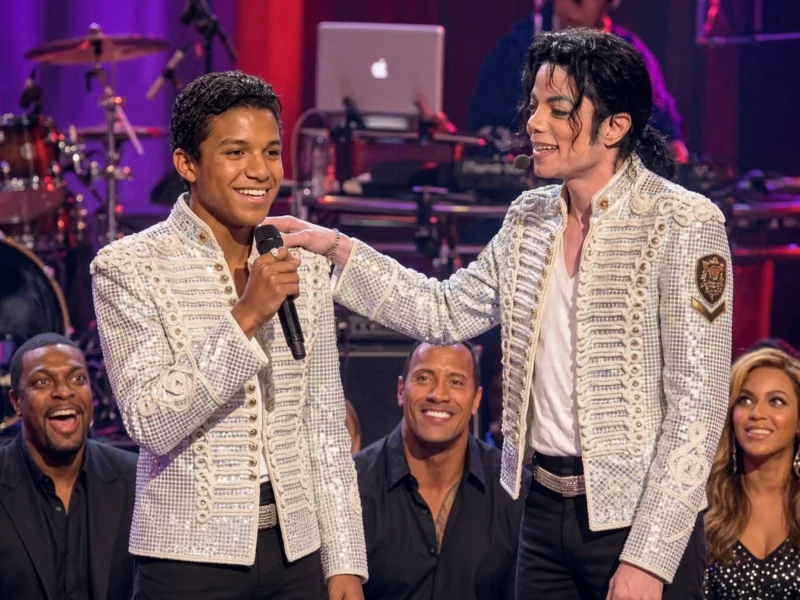
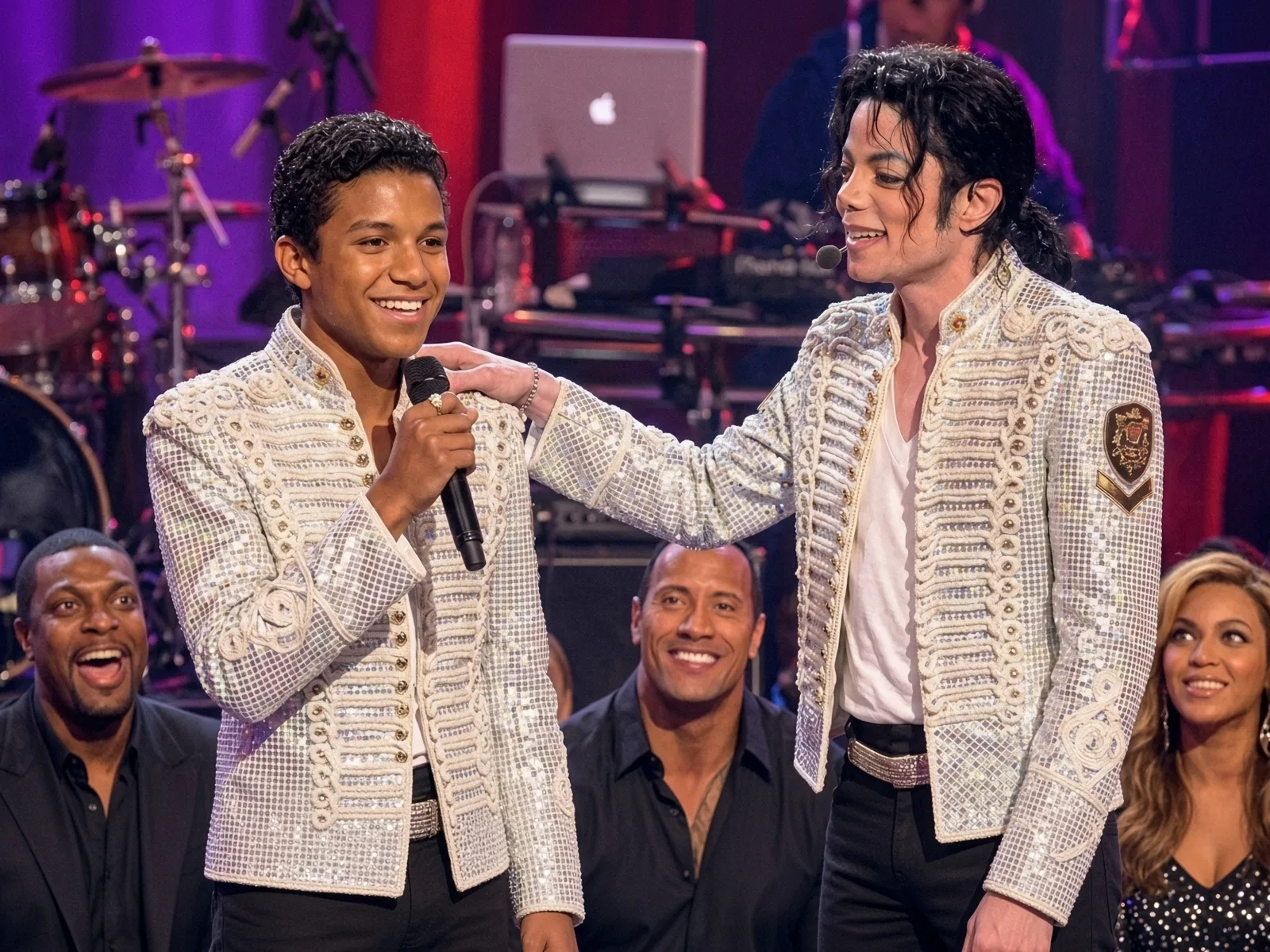
The video also shows a famous-looking photo of a young performer in a silver sequined jacket standing beside Michael, with stars like Chris Tucker, Dwayne Johnson, and Beyoncé in the crowd. The narrator admits the story behind it is murky and that its authenticity is unclear.
So treat that one as unverified.
Here is where the transformation begins.
Jafar, the video says, slept on the floor of Michael’s childhood bedroom at the family’s Havenhurst home to feel close to his late uncle. When it came to dancing, though, he went straight to the estate’s rehearsal room.
Those floorboards had seen decades of work, worn down by the same spins repeated endlessly.
Jafar trained there for weeks, inside the same mirrored room where Michael once perfected his own routines.
“It smelled of polished wood and old dust, decades of rehearsal quietly trapped inside its walls.”
That’s the narrator’s imagery, not a quote from Jafar.
Jafar himself insisted the experience was practical, not spiritual. Crew members still noticed a change. He was quieter, more contained, and more present on set.
The room taught him economy. Every gesture needed a clear purpose, or it got cut.
To Jafar, Havenhurst was never a museum or a shrine. It was a workshop that was still open for business.
And in those old mirrors, the video says, two reflections briefly overlapped across the decades: uncle and nephew standing in the same worn spot.
Then the training got brutal.
He ran 16 full run-throughs of the Motown 25 routine. The choreographers, brothers Rich and Tone Talauega, had worked with Michael directly, and they stood with their arms crossed, unimpressed.
They weren’t after imitation. They wanted fluency, the kind where the body stops thinking.
Jafar’s feet blistered. He taped them and kept going.
One afternoon his calves seized mid-spin and he collapsed on the studio floor. He got up, shook it off, and started again from the top.
He described the routine simply: dance for hours every day, and treat it like a full-time job.
By month three, muscle memory had caught up with ambition. He could run an entire concert set without stopping.
And the Talauegas gave him something better than praise. They gave him quiet permission to move forward.
Only a handful of dancers before him had crossed that line.
Jafar finally understood something. Michael’s dancing was never just technique. It was an expression that happened to move.
But the real work happened before the cameras ever rolled.
Before director Antoine Fuqua had officially signed on, the video says, Jafar was already alone in a rented studio. There was a mirror in front of him and a laptop open beside him.
He was rehearsing a role he hadn’t technically landed yet.
Two years went by like that. There was no audience, no feedback, just repetition.
He built a private archive of concert footage. He cared less about the big moves and more about the transitions between them, the split-second decisions.
Michael’s personal journals gave him an unexpected key. A single entry mentioning fear became his emotional way in.
He studied how Michael held a microphone, how he adjusted a jacket mid-verse, and how he timed a breath between phrases.
Friends called constantly. He stopped answering.
“The mirror became his only real conversation partner for months.”
Again, that’s the narrator’s line.
He also hunted for mistakes. Rehearsal clips where Michael dropped a spin or missed a beat mattered more to him than polished performances, because those slips revealed the human being under the icon.
He watched Motown 25 so many times he could call out the camera cuts before they happened.
He traced another thread too, how Michael borrowed lightness and precision from Fred Astaire and bent it into something his own.
In a folding chair, with a spiral notebook on his knee, he filled page after page with diagrams, timestamps, and open questions.
Slowly, the video says, isolated steps stopped looking like steps. They became full sentences.
Then came the voice.
Jafar worked on it the same way. He looped a single phrase, “I love you. Thank you,” for an entire afternoon until it dissolved into nonsense and slowly rebuilt itself into meaning.
He read newspapers aloud in Michael’s register. Then poetry. Then script pages.
He sang a cappella takes and measured them against the originals, adjusting vibrato and attack with surgical care.
Some mornings his voice gave out completely, and he whispered instead of speaking. He rested, then went right back in.
Affirmations covered his rehearsal walls, spoken in Michael’s cadence until the borrowed voice started to feel native.
And no, he didn’t start from zero.
While classmates focused on sports and social lives, he was picking out chords by ear at a piano bench, studying classic R&B and soul until his fingers ached.
When reality cameras came for Living with the Jacksons in 2015, he slipped away to the practice room down the hall. Failure, he figured, didn’t need an audience.
A small background credit on his father’s 2021 video, “Love One Another,” taught him the invisible mechanics of a set: lighting cues, retake timing, the machinery underneath.
By 22, thousands of unpaid, unglamorous hours had piled up behind him.
He had no idea he was building the exact muscle memory a movie set would demand.
Then the call came, or rather the tape.
Thousands of actors worldwide were chasing this role, and the video says casting took two years. Jafar sent in an audition with a folding chair, a single camera, no costume, and no music.
When Fuqua watched it, the video says, he paused and rewound. He wasn’t looking at the face.
He was watching the hands, the way they rested and the way they moved without thinking when the character spoke.
Producer Graham King’s internal memo, the video says, described Jafar as someone who “organically personifies Michael.”
At 26, with no feature credits, Jafar was suddenly carrying a film reported at $100 million.
His phone buzzed for six straight hours. Then his father, Jermaine, came on the line with two blunt words.
“Prove it.”
The announcement landed fast. Fuqua posted it on Instagram, and by afternoon every major outlet had picked it up.
Estate co-executive John Branca gave a brief statement of approval.
The cast announcement followed: Colman Domingo as Joe Jackson, Nia Long as Katherine, Miles Teller as John Branca, Kendrick Sampson as Quincy Jones, and young Juliano Krue Valdi for the early Jackson 5 years.
Jafar’s reaction wasn’t celebration. The video says he switched his phone off for two days and sat alone in his apartment, staring at the ceiling.
Millions were about to judge whether he could honor his uncle’s legacy.
And then his grandmother called.
Katherine Jackson didn’t just approve from a distance. She phoned him herself.
“You have his eyes. Use them.”
According to the video, that single sentence outweighed every studio press release combined.
From there, the family’s support turned practical. His father watched rehearsal tapes daily over video calls, correcting the tilt of a chin, the pause before a line, and the exact height to hold a microphone.
Jafar dedicated an entire second monitor in his apartment to his father’s feedback.
The real test came when an early rough cut screened for the family.
Katherine sat through 20 silent minutes. Then she quietly admitted she’d forgotten. For a moment, she was watching her own grandson perform.
He nearly broke down right there.
Texts poured in from brothers and cousins. The whole family had quietly become his safety net.
On set, the work was relentless.
The shoot ran from January through May 2024. Fuqua kept things tight, with long takes, few monitor checks, and no digital shortcuts.
In one case, a single dance sequence took 18 takes across three straight days. Jafar’s knees swelled, he iced them overnight, and he showed up again the next morning without complaint.
John Logan’s script balanced arena-sized numbers with quiet studio scenes, and Jafar spent long hours in makeup and hair tests with prosthetics and lace wigs to match Michael’s face across different decades.
Reshoots stretched post-production, and he re-recorded two key vocal scenes.
By the end, cast and crew felt less like colleagues and more like family.
Then the internet asked the question everyone was thinking.
Is that really him singing?
Fans argued for weeks over whether Michael’s voice had been digitally resurrected for the big numbers. The video says the truth was simpler and less glamorous.
On the Today show, Jafar explained: “I’m singing on top of Michael’s vocal. It’s a blend.”
That blend applied to the concert scenes, sung live into a boom mic on set. The studio recording scenes worked differently. There, the video says, the mix dropped away, leaving only Jafar’s raw voice.
Music supervisor John Warhurst reportedly confirmed those solo takes were strong enough to stand alone, and said the layering elsewhere was an artistic choice, not a fix.
Casual listeners couldn’t tell where Michael ended and Jafar began. Longtime fans could still hear the seams.
Both reactions, the video says, proved the same point.
It even tells a story about a sound engineer who once stopped mid-session to ask whether Michael’s original vocal files had been accidentally mixed into Jafar’s take. Jafar just smiled and stayed quiet.
That is the narrator’s anecdote, and no source is given.
Before the film, Jafar had tested himself in another way.
In June 2019, he released a song with nothing to do with his uncle’s legacy. “Got Me Singing” was a sun-soaked Latin pop track, shot on Rio’s painted staircases, with a hook he co-wrote himself.
The results were modest. The numbers were mid-tier, radio play was light, and there was no viral breakout.
A planned album was shelved.
But the video says Jafar wasn’t chasing charts. He was running a private test. Could he stand on a stage without his surname doing the work?
Mostly, he found, yes.
And the single taught him about breath control, mic distance, and the gap between studio polish and live grit.
Then came the reviews, and they were not kind.
The video says the film’s Rotten Tomatoes score flashed at 27% that first Tuesday morning, then crept toward 35% over the following weeks.
Words like “shallow” and “sanitized” showed up again and again, aimed at the screenplay’s cautious choices.
Jafar reportedly read the headlines alone in a hotel room and closed his laptop before finishing a single review.
But one pattern held. Even harsh critics praised his physical and vocal transformation. The word “uncanny” kept appearing.
One critic summed it up: a great performance trapped inside a film too afraid to take real risks.
Jafar didn’t argue. The cautious choices, he felt, belonged to other people.
He texted Fuqua four words.
“Told you I’d try.”
Fuqua’s reply came back within seconds.
“You didn’t try. You did.”
Another review, the video says, went further and said he hadn’t just imitated Michael but become him. Fuqua forwarded one glowing review with a two-word caption.
“Print this out.”
Audiences, meanwhile, told a different story.
The video says the first teaser, released in November 2025, pulled in 116 million views in 72 hours. Lionsgate’s marketing team sat glued to a counter that wouldn’t stop climbing.
Fans froze frame after frame, lining up Jafar’s silhouette against decades-old clips of Michael.
Jafar saw the numbers during a lunch break in his rehearsal studio and felt something closer to dread than celebration. The hype, he understood, had just raised expectations to an almost impossible height.
That evening he went straight back to work, running a single spin until his calf cramped again.
Then came opening weekend.
According to the video, the film opened April 24, 2026, and took in $97.1 million domestically by Sunday night. Lionsgate’s finance team reportedly recalculated the number three times before believing it.
Worldwide estimates passed $150 million, beating the opening records of Straight Outta Compton and Bohemian Rhapsody.
Sold-out signs went up in New York, London, and Paris, and theaters added late-night screenings.
Jafar skipped the party. He attended the premiere briefly, then went back to his hotel, ordered room service, and watched the box office climb in silence.
One question was answered that Sunday. Audiences would show up on opening weekend.
A harder one was still open: would they come back for a second viewing once the mixed reviews settled in?
Critics gave the film mixed marks, but the video says everyday audiences handed it an A- CinemaScore and wouldn’t let it go.
One scene captures it. After a sold-out Chicago screening, a group of teenagers spilled into the lobby singing “Wanna Be Startin’ Somethin'” at full volume.
Jafar scrolled through thousands of mentions that night. There was a mother writing that her daughter wanted to hear Michael’s albums for the first time.
He skipped the technical breakdowns and read the personal, unpolished, sometimes misspelled messages instead.
They weren’t reviewing his craft. They were thanking him for bringing someone they’d lost back into the room, even if only briefly.
The ripple effects spread.
Vinyl copies of Off the Wall reportedly sold out in London and Los Angeles. Some older tracks tripled their daily streams within a week.
TikTok filled with side-by-side clips of Jafar’s choreography against Michael’s original footage.
The conversation shifted away from old scandal and toward craft: studio sessions, vocal arrangements, and the dance innovations that reshaped pop.
For a generation that never saw Michael perform live, the film became an introduction. For everyone else, it became a reintroduction.
By the end of its run, the video claims, the film had outgrown every music biopic before it, including Bohemian Rhapsody, Oppenheimer, and Straight Outta Compton. It also says international markets accounted for nearly two-thirds of the worldwide total.
That’s the video’s claim, and the comparison is a loose one. Oppenheimer isn’t a music biopic, so take the “biggest ever” label with some caution.
But the biggest moment of all, the video says, had nothing to do with money.
At the premiere, Katherine Jackson nodded once. Just once.
Jafar caught it from the corner of his eye, across the room.
That single moment, not the glowing reviews, went straight into his memory beside his old rehearsal notes.
Critics could praise him loudly today and forget him tomorrow. His grandmother’s quiet nod wasn’t going anywhere.
In his own private ranking of credit, the video says, Michael came first, Fuqua second, the crew third. His own contribution sat somewhere around fourth or fifth.
That never bothered him. If anything, it sent him back to reading scripts.
So what does it all add up to?
A boy who gave up golf. Two years in front of a mirror. Blistered feet, swollen knees, and a voice built one wrong note at a time. A film that critics split on and audiences embraced.
Jafar came out of it changed, the video says, not because he became Michael Jackson, but because he finally understood what it cost to be him.
The box office numbers, in the end, were just numbers.
The real achievement was keeping a promise to a grandmother who nodded once, from across the room.









