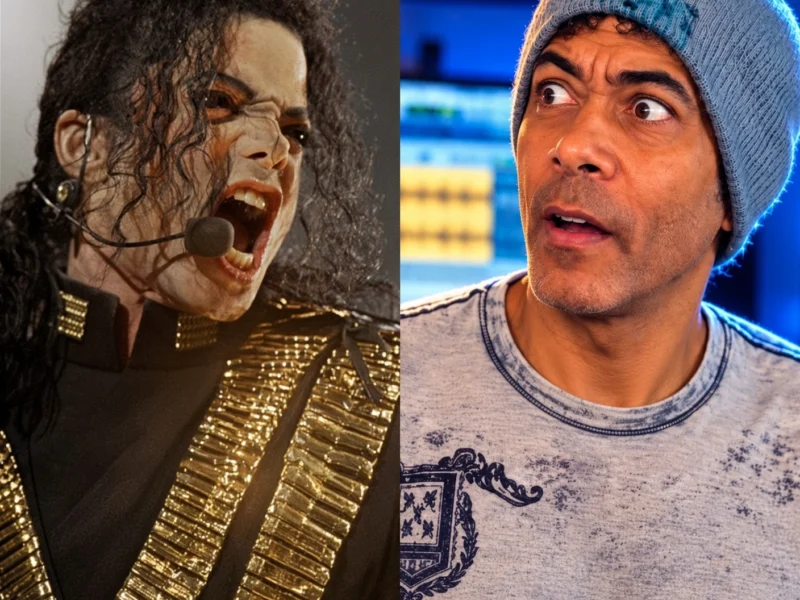
Michael Jackson Estaba Loco: La Brutal Revelación De Su Guitarrista Greg Howe

Michael Jackson held the highest standards you could possibly imagine.
He was intimidating because he was listening to everything.
He heard everything.
You know?
When you see him move the way he moves, when you see him literally connected to the music, it is because everything is in its place.
If it is not, he knows, because he feels that something is not quite right.
In fact, on one of the songs, I had a very simple part, like a one-note funk line.
I remember after one of the shows, we were walking toward the tour bus, and Michael usually walked with his small entourage around him.
He traveled with three or four people who were always with him, and we almost never had the opportunity to interact with him.
But one time, we were walking toward the tour bus, and he separates from his small entourage and keeps walking.
I look back and think, “Hey, it looks like he is coming toward me.”
Like he is coming toward me.
It cannot be.
I keep walking, and I see him getting closer.
Michael is coming toward me.
Michael is approaching me.
So he gets to me and says, “Hey, you know, you are doing a very good job, and you are doing this, but on that song—I do not remember which one it was—when you play that part, you can push it back a little. You are a little bit ahead of the beat, so pull it back a little.”
And I am like, “What?”
Because at that moment, Michael is, I do not know, on the opposite side of the stage.
I think he is on some kind of flying machine or something.
I do not know what he is doing or how he manages to hear me.
He came directly to talk to me, which is interesting.
I am not sure why.
Maybe to make sure I knew that it really meant something, you know?
Today I am with the legendary guitarist Greg Howe, and the first thing I ask him is about his decision to stop playing with artists like Michael Jackson, NSYNC, Justin Timberlake, and focus fully on his solo career.
“It was very difficult because a couple of things happened to me. You know? Everyone’s career has its own personal challenges, and in my case, I really had not made much money. One of the things I discovered after signing with Shrapnel Records was that fame and fortune do not necessarily go together. You can be famous and not have much fortune. And that is exactly what happened to me. I had all that fame—or, well, not fame, but I did have a lot of notoriety as a guitarist. And still I was thinking, ‘Hey, where is the money? How can it be that I do not—’ I mean, Paul Gilbert is putting together this band called Mr. Big, and now they are doing enormous things, literally. Marty Friedman gets into Megadeth and other things, you know? Richie Kotzen had projects going around and signed with Interscope and then got the gig in Poison. And I was there thinking, and well, yes, I got the Michael Jackson thing, I have to say that, but it was something that lasted a short time, only five weeks, and then it was over. That was it. So, you know, I was looking for things to do. I mean, I had the rock band with my brother, but my brother was having a hard time. He had the substance abuse problem his whole life and finally passed away a couple of years ago. But anyway, at that time, even we were—I was having a hard time. So, do I continue with this rock band or do I start making instrumental records? And if I make instrumental records, how many people are buying them? You know? I get these small advances from the record label, but it is not that much money. So these jobs in the pop world were very attractive to me because they pay very well, and that is why I took them, and they were a good experience. I will not lie, they were good. I learned a lot from them. But at a certain point, I realized that my fan base was starting to shrink. I have to—I do not want to abandon my fans, right? And there were also certain political issues that happen in that world. If I am honest, there are things that happen in that environment that I do not sync with. When you enter the world of big money, really big money, you start to see the politics and you start to see things that test your moral compass. So there were things I was noticing, things I did not want to be part of anymore, things I simply did not agree with. And it was difficult because, you know, Justin Timberlake went solo and they were happy with me as a guitarist. I came from the NSYNC band and moved to Justin Timberlake when he launched solo. And also my mother was sick at that time, so I was worried about her, and I was thinking about taking care of her. But to make it short, I basically told them, ‘I need to get off this tour, I need to go back to being Greg Howe, the guitarist, the artist.’ And they told me, ‘Well, you know, we have a twenty-two-month tour ahead of us, we can pay you very good money, very good, really.’ And I was like, ‘No, you know what? Thank you, but no, thank you.’ And well, I got off. And it was difficult, you know? Because we had just moved. My girlfriend at the time and I had just moved to California. And California is an expensive place to live. We had a lot of bills to pay, we had a lot of things to buy, so we really could have used that money. But my peace of mind and my integrity were worth more than just money. So I had to walk away, and it was hard. You know? We had a rough time for a while, but I finally managed to rebuild my career a bit and little by little I picked it back up from there. And from that moment on, things were pretty good. It was not easy to walk away from that world. And I understand why people sometimes hold on. Because one of the problems people have is that when they enter that world, they get used to earning that kind of money and they do not want to leave. And then they start making decisions. They make life decisions based on the expectation that that money will always be there. So, ‘Oh, I just bought a Lexus and I have the car payment. I just bought a house, I have the mortgage payment, and now I cannot leave this job. I have to keep it because there is no way to maintain this lifestyle if I do not have that kind of income.'”
“Working as a session guitarist. When and how did you start working as a session guitarist? I know you were friends with Jennifer Batten.”
“She was probably the main ingredient for me entering that world. I went directly from being a Shrapnel artist to being with Michael Jackson. You jumped straight to playing with Michael Jackson. And that was thanks to her. We met, I think, at a NAMM show. And I always admired her playing, and she was a fan of what I did. So we met and talked, and she gave me to understand that she might be leaving the tour and that she thought I would be the ideal replacement. And I thought, ‘My God, that is incredible.’ I mean, you know? Out of all the people, out of all the guitarists in the world, she thinks to recommend me. I think she actually approached me because I was getting a lot of press, I was getting a lot of interviews. I think she came up and said, ‘Hi, I just want you to know my name is Jennifer Batten. I am a big fan of yours.’ And I was like, ‘Jennifer Batten. My God, you are Michael Jackson’s guitarist. You are incredible.’ So we had a mutual admiration, you know? We admired each other. There was a mutual admiration. And well, I thought it was incredible that she really thought I would be the perfect choice if she left for Michael Jackson, because there are so many, there are so many incredible guitarists on this planet. So for me to be chosen is a very, very special blessing, truly. And that was a long story, it was a difficult path because then a new chapter came, which is that her mom, her mother, was getting sick and finally got sick. And then Jennifer contacted me again and said, ‘Almost certainly, almost certainly, I will be leaving the tour at some point in the near future. So please, stay ready.’ And she was so kind that she even sent me all the rehearsal demos with a microphone near her amp so that I could hear specifically what she played on each song. She was very meticulous and very generous with all of that. For months I was preparing, just practicing, getting ready for that phone call, and I was like that for a good while. And then many weeks pass, many months pass, and there were certain opportunities I was missing because I did not want to miss that call. You have to remember that this is the mid-90s. Right. Oh, there was no social media or WhatsApp. There were not even cell phones yet, right? Right, no cell phones either. It was only in ’99 that cell phones arrived, so I turned down a job. It was a tour to go to Japan, and I turned down another thing too. There were two important things I turned down, but after a while, I finally said, ‘I have to get back to my life. I cannot waste my whole life waiting for a call that maybe never comes.’ So I stopped waiting and went back to my life. And I truly did not even listen to the songs. I had not listened to them for months. Why? On a Monday night, I am giving a guitar lesson. It is like eight at night, and I get a call from Brad Buxer, who was Michael Jackson’s musical director, and he says, ‘Hey, Greg, it is Brad. I need you to get on a plane at six in the morning. We booked you a flight at six in the morning from the New York airport, and I need you for a show that is going to be Wednesday in Amsterdam in front of—’ So now I get this call that I did not even think was ever going to happen, and I could hear the desperation in his voice because I think she must have gotten an urgent call and had to leave immediately. Jennifer. Jennifer. That is right. But you had not been practicing anything. You were not prepared. You had not listened to anything for months. And now Brad tells me, ‘I need you on that plane tomorrow morning.’ And I said, ‘Okay.’ I told him, ‘Brad, when is the next show after Wednesday?’ He told me Friday. I said, ‘If it could be that one, if you let me start there, I can be ready.’ He said, ‘I do not need you for the Wednesday one. If you cannot, Greg, I am going to have to find someone else.’ So I thought, ‘I have to do this. I have to do it.’ But in my head I was thinking, ‘This is crazy, right? Because it is eight at night, it is two hours to the airport, I have to leave at four.’ You did not even have time to practice or to touch the guitar. I have to be there at four because it is international. I have to leave at two in the morning. So I have six hours to be completely prepared to learn, to relearn the songs, gather the clean clothes, grab my strings, my guitars, my gear. I mean, it was madness. And how did you handle the pedalboard and the effects Jennifer used? Luckily I had to use her gear. Oh, you used hers. It was madness because, you know, I am sitting with the guitar, I am going over a couple of things with the Walkman on, listening. Then I have to go change the laundry and pack the suitcase, fold the clothes and get them ready, and then I have to run out to the store to buy deodorant. It was a delirium, but I ended up doing it, and I got there, and it was actually a Concorde flight. Oh, right, the Concorde. The Concorde still existed at that moment, so I got to Europe in four hours. We left at six in the morning, I got to Europe around ten, I got to the hotel at noon, and luckily I could listen a little more, practice a little more, because it is already Tuesday and tomorrow is the day. It is madness. So, you know, but you could sleep that night. I think I did sleep that night because I had been awake practically all the previous night. No, I never went to bed, and I was studying even on the Concorde flight, listening to things, and then I arrived. So yes, I could rest that night, but early the next morning, the day of the show, they wanted to do a rehearsal with me just to make sure everything was fine, right? So we did the rehearsal around ten in the morning, and everyone was irritated, right? Because the tour had been going on for a long time. So now everyone has to get up early. Everyone was partying the night before, and nobody wants to get up for the new guy, so everyone is looking at me badly. You were not welcome at all. Exactly. And it was so agonizing, right? Because we are rehearsing on the real stage, and in that arena, I think sixty-five or seventy thousand people go in, and it was just barbaric. And on top of that, it is outdoors. All the shows are outdoors. So I am very nervous. But we start the set, I get through the song, I am playing pretty well, and I think, ‘Wow, you know?’ And I start to get that feeling of, ‘I think we can do this.’ It was working. Yes, it was working. Like I think I am going to pull it off. After about four songs, the production manager comes up to me and says, he says, ‘Sounds good, Greg? Sounds very nice, very good job. And now let us talk about the choreography.’ And there was a lot, it is madness. And I am like, ‘The what?’ And he says, ‘Yes, the choreography. Did nobody talk to you about this?’ ‘No, yes, there are a lot of things we have to go over. There are all kinds of things, and there were a lot, and one of them was this guitar that was actually an explosive device. It fired an explosive from the headstock, right? You hold it like this and it goes boom. It is a weapon, right? And the trigger was back here somewhere, and you had to trigger it. I had to use it. Oh, you had to fire it. I had to do it. I had to fire it. And so he is explaining it to me. He tells me, ‘You are going to take a step forward and then you are going to spin twice to the left for the dancers. You are going to move to the right side of the stage. You are going to hit the switch because that turns on whatever. And then you are going to wait for Michael. After that, you run, right? You are going to hit the other switch and now you activated the other thing, whatever. Be very careful at this point because this gets hot in the back. Oh, and then you are going to wait for Michael to come out on the walkway and you are going to run out there with him. When you hear this cue, you hold the thing like this and you pull this lever here and keep it away from your face or you will blow your face off.’ No, what madness. It was madness, and there were a lot of things like that. I had to walk with him while playing the Beat It solo. I had to literally walk with him. I made myself a kind of poster-sized cheat sheet that went all the way around the pedalboard and everything else. And it basically said something like, ‘Song one, verse preset 013, chorus preset 41. Back to the verse. Second verse, preset 013, step forward, spin twice, wait for the dancers.’ I mean, I had to have absolutely everything mapped out. And on each song it was something different, it was quite delirious. In the first shows, luckily, the guitar tech was there, and sometimes he would tap my shoulder and remind me of things like, ‘Hey, remember, remember that right after this you have to do—’ ‘Ah, thank you.’ Yes, it was madness. It was madness, but it was really, really good. It was an incredible experience. I do not really like using in-ears, and on that tour we did not use in-ears. All the big pop bands I worked with afterward did use them, but on that one they would have come in handy because that stage was so big that, you know, you are looking at the drummer like this, but you are not hearing him. It reaches you like half a second later. And in fact, one night it ruined me because we had to play the song ‘I Want You Back’ that starts with guitar. The Jackson 5. And I am playing that thing and I guided myself by what I heard the drummer doing, but it was wrong. Because I was hearing the echo. So I start, and the whole band—I will never forget this—the whole band looks at me like, ‘What is wrong with this guy?’ Because they heard me do it wrong and I was wrong. And I remember that while I was doing it, playing it, the whole band came in at a really weird moment, and I was thinking, ‘What are they doing? Why is everyone—what?’ It was really madness, you know? It was an incredible experience. And it also showed me that musicality, high-level musicality, is not always measured in virtuosity, because a lot of people can play virtuous things, they can go crazy and not know how to groove, right? And not have groove, you know? Not know how to make a common song feel good. When you have a real high-level musician, a drummer, for example, when you sit down with a professional drummer, a really serious drummer, he does not need to play anything technical. He can play an AC/DC groove straight and you feel the quality of someone with craft, you feel that this guy is serious. Because there are a lot of subtle things happening with the hi-hat and with ghost notes. There are little things that happen and that are subtle. David Cook, one of my friends I met on the NSYNC tour, he was the keyboardist on the NSYNC tour, an incredible keyboardist, and now he is Taylor Swift’s musical director, right? So most people probably do not imagine that he can play jazz in an impressive way. He is a very high-level jazz pianist, and yet, you know? He is the musical director of a pop band, a very, very pop band. So I have the feeling that there are a lot of people in this industry who are very high-level and we do not even know it because they are not doing that. But you can tell. The rhythm guitarist David Williams played all the rhythm parts on the Thriller album and on Michael’s previous album—what was it called? Off the Wall. He was the one who played all those guitar chords, all the funky stuff, all those things, you know? And all that super funk, you know, with a clean sound. And I had to stand right next to him when we played. And I had never given much importance to that technique. I just never thought there was anything that difficult about it, but when he did it standing right next to you with that clean sound really loud, the hair on my arms would stand up because it was so precise, it was so incredibly good. And I thought, ‘I never imagined that rhythm guitar could be that, could be a technique and an art form of that level.’ And that is what I learned from that tour, that high-level musicality is not necessarily going to be delivered in the form of high-level notes and things like that. It is delivered another way. It is delivered in a feel. You feel the music.”
“How did you start playing guitar? What were your first influences?”
“When I was very little, nine, eleven years old, my younger brother was two years younger than me. We had an instinctive attraction to music. I mean, we understood music, we knew—we understood how to harmonize without anyone having taught us, we understood rhythm, and we watched a show from the ’70s called Don Kirshner’s Rock Concert. Every week there was a live concert, and it was one of the ’70s bands, like the Rolling Stones or Sly and the Family Stone or Alice Cooper. And so we always tried to pretend we were them. We would grab tennis rackets and pretend we were in a band. But at some point, my parents had an acoustic guitar lying around the house, and I tried to play it. I think it had super high action, but my goal was simply to play chords so that when my brother and I sang, we had a harmonic base to sing against. So I did not think of the guitar as anything more than a thing you use to give singers a base. And then over time, you know, I learned the open chords—open D, C, G, all that. I could play some guitar and we could sing songs and harmonize, usually things we heard on the radio, like Beatles songs. And then at some point, my parents started taking in foster kids. I do not know if you know what foster kids are, but it means kids who need a place to live for a while because they have problems at home. So my parents started taking in some of those kids, and I was about ten years old, and the kids they brought were like fifteen or sixteen. One of them, one of them also played guitar similar to me, mostly chords. And he sang, and we sang together, and well, we had fun playing guitar that way. He finally left and came back like a year later just to visit us. And I said to him, ‘Hey, let us play guitar.’ And when we did, he did something I had never seen before. He grabbed a note on the guitar and bent it. I said, ‘What was that?’ And he showed me. For the next month, I do not know, the next month or two months, I was doing that, and sort of without meaning to, I discovered the pentatonic scale, and I just knew it because my ear was always pretty good. If I heard a song on the radio, I more or less knew where to go and play it. I did not know why those notes were the right ones, but I knew they were. They are good. They are good. And that was more or less the beginning of lead guitar. And then I am listening to the radio and I think, ‘Wait, people do this. Other people are doing this. Everyone is doing this. There is lead guitar everywhere.’ But then I got into seriously listening to Jimmy Page and Led Zeppelin. Of course, it was a time when lead guitar was right up front. Yes, absolutely. And surprisingly, I could learn a lot of those things pretty easily, without really spending much time on it. You know? After school I would pick up the guitar a bit, learn the Jimmy Page lick, but when Van Halen appeared in ’78, that changed the game, because nobody really understood what he was doing, because he was doing so many new things, so many things that had never been heard before. And I ended up obsessing over trying to figure out what Van Halen was doing, because nobody really understood the tapping thing, everything that was in the books, because some books with the sheet music came out at that time. There was no YouTube, there were no tutorials, there was no YouTube, there was nothing, there were no clinics on CD or videotape. I had a record player that was, you know, a regular record player, and I took one of the belts, that band that makes the thing spin. I basically disconnected it from the motor, but the sound still worked, and I could spin the record at my own speed. I made it go super slow. The super-fast licks I could slow down and listen to the sequence of notes, but then I had to transpose them. Unlike today, where there is software where you can keep the same pitch. Right, it is easy today. Yes, it is great. So everyone had things written wrong, because everyone, when Van Halen did, you know? All that extreme tapping. They had it written as a flamenco technique where it is one note per string with an arpeggio of finger picking. Ah, like an arpeggio with the fingers on different strings. An arpeggio. Right, that is how they had it written, right? And I, in fact, took classical guitar lessons for like two months with a guy because I thought that was the answer, and he could indeed play the end of, I think, ‘Eruption’ or ‘Spanish Fly,’ one of those Van Halen ones, in the classical way, and it sounded pretty good, and I remember thinking, ‘It sounds pretty good, but it was not the same.’ Right, it was not the same. So I finally went to see him live at the Nassau Coliseum. I remember a group of friends took me. I was not old enough to drive yet, and I went to see him live, and I had the binoculars with me. And on the very first song, he comes out, you know? And he does that classic thing of his. And I was like, ‘My God, I know exactly what he is doing.’ So that night they dropped me off at my door. I ran up to my room, grabbed the guitar, and I did it, and I played the end of ‘Eruption.’ I was the first kid in my town, in my little small town, who cracked the code. Nobody else knew. It is true, there is a myth that says Van Halen in those days, when he did that tapping trick, he did it with his back turned to hide it. I think I heard that. Yes, I heard that too. But at that show he was facing the audience. Right, he was not turned around. I saw exactly what he was—I had the binoculars, we were way in the back, and I remember thinking, ‘Ah, that is how it is done.’ That is what it was, you know? And it is true innovation. I do not know if he invented that. I do not think he invented it, but he undoubtedly invented the concept of turning that into a common part of playing lead guitar.”
“After that I became obsessed with the guitar and I wanted to be like Eddie Van Halen. And then we put together a band and I learned a lot of those solos and a lot of the songs. And right after high school we started playing, you know? Playing at a lot of parties, playing at a lot of local fairs. We finally got a date at a nightclub, and it was in the town. It was great for us in terms of developing live craft and performance skills. And well, playing live is always good practice.”
“Was there a singer in the band?”
“Yes, my brother was the singer. He is two years younger than me. He sang. He was still in school when we put the band together, and we had to lie, use fake IDs to get into some places and play. And at that time we dreamed of being professional musicians. Yes, I really wanted to be in a rock band. It is still what I want to do. But well, in the process of trying to become a great guitarist, I started to really fall in love with music, and I was listening to a lot because I was trying to draw influences from everywhere. And then, of course, I am listening to Van Halen, listening to a lot of the guys who came after him—George Lynch, Warren DeMartini, all those guys from LA. And then at some point Yngwie appeared in the early ’80s and he took things to another level, because he was really precise and fast and all with a pick. And so I was listening to that, but I was also falling in love with the jazz thing. I got into Larry Carlton and I was really struck by the phrasing I was hearing in that kind of music. Because rock tended to be very, very straight, you know? Very—and that is fine, there is nothing wrong with that, but I was very drawn to the more syncopated stuff. The jazz cinco pa’—the jazz accents and the groove. Exactly, that really attracted me, and I was not getting it from many rock guitarists or any, really. I only got it from people like Larry Carlton, people like Lee Ritenour, people like John Scofield, people like Pat Metheny, fusion, that type of musician, right? So I was listening to a lot of that stuff in secret, and you know, we still had a rock band. Of course, I was a metal guitarist, but in my free time I was listening to a lot of that stuff, and that left me thinking. After a while I started to think, you know, why is the fire always on the side of the rock musicians and the intellect or sophistication always on the side of these other guys? How—why can we not put the two together? Why do those two worlds have to be separate? Exactly. That was always my concern. And you know, I was such a Van Halen fanatic that I was really trying—I was starting to sound exactly like him, the same vibrato, the same everything, even in improvised solos. And I knew I had to break away from that. I thought, ‘You know? Even if I can sound exactly like him, that is not my development, that is not my voice.’ That was even more motivation to listen to a lot of different people. And in the process of listening to a lot of different things and trying to develop lines that had some of those displaced accents and that syncopation, I think I started to find a little of my own voice, because it was like, ‘Well, it is not impossible to have some of that inside rock. You can do it if it is done well. If you do it, you know? If you do it right, keeping the fire, keeping the aggression, rock—rock can have that.'”
“We were trying to get a record deal, we were writing, we were recording throughout the ’80s, still with the band, with my band. The band was called Duke. The original members were me and my brother Al. The bassist was a guy named Dan Bracy, who is still a great friend today. And the drummer is also a great friend today. His name is Joe Pachoni, or Peconi, depending on how you pronounce it. That was the original band, and we made quite a local reputation in our small town. My brother and I kept playing with different drummers and bassists. We did a lot of auditions for different record labels. The truth is we were not entirely ready, so they passed us by. Everyone passed us by. And at some point my sister was already working in a factory, and I asked her if she could get me a job there, and she said yes. Just before I started, I made a demo on cassette for Mike Varney, who had a column in Guitar Player magazine called Spotlight. Every month he highlighted three unknown guitarists from around the world, right? And I did not know if I was going to be featured. I did not even think they were going to feature me. And that is exactly what happened. And so I started working at that factory. I worked there only about three days. I called my mom during the lunch break and she said, ‘Somebody named Mike Varney called today. He is interested in talking to you about recording a record.’ And I thought, ‘Wow, you know? That is incredible.’ My parents were divorced at that time, so I was living with my mom. She was very happy that I got the contract. My dad was not as happy. He had always wanted me to go to college. Get a real job. A real job. He always thought I was wasting my time with this guitar thing. Well, that is typical. Yes, very common. This was in late 1987. Of course, at that time there were no home studios, no. It was barely a four-channel demo, a direct-take demo of very low quality, and that was what I was using to make those recordings. So when I talked to Mike that night he said, ‘I received your demo. I like it, I like how you play. Would you be interested in recording a record?’ And I was in shock, literally in shock. I did not even expect this to reach anyone’s ears, much less a record deal. Do you remember what style of music you had recorded? Was it rock or fusion? Was it something like similar to your first album? No, it actually was not. That is a very good question, because it was not super rock. Because as I said, even though I played in a rock band, I was listening to a lot of other things. So when he heard the demo he said, ‘I like how you play, I like this, but you know, I am a heavy metal label, right?’ Oh, it was a heavy metal label. Yes. Mike Varney discovered Yngwie Malmsteen, but then Mike went on and discovered Tony MacAlpine. He is the one who signed him. He discovered Paul Gilbert, signed Racer X, Vinnie Moore, Jason Becker, Marty Friedman—I mean, all legends. And now you were in the same club. Right, in the same category. It was intimidating. Mike told me, ‘I received your demo. I like it, but this is a heavy metal label.’ And at that time it was very heavy. So you are going to have to write songs that fit this genre. You cannot send me these soft rock things. You have to send something real. And I knew how to do that, because you know, our band played Judas Priest and Van Halen and AC/DC and Black Sabbath. We were a heavy metal band, but at the same time I was listening to a lot of other things. So in the end I started sending him demos that fit. I would say in two weeks I sent him like fifteen songs. Finally I was really into it. I spent all day in the studio, all day thinking. Those became the creation of the first record. So the very first record, which is called Greg Howe, which is considerably heavier—right, more rocking, it was also more bluesy than everything he had done before. After he had enough of my demos, he had me fly to California and we recorded it. This is your first album, Greg Howe, from 1988. January 1988 he had me fly out there. We recorded and he got Billy Sheehan to play bass, and Billy Sheehan is a huge star. At that time he was in Mr. Big, he was in David Lee Roth’s band. Oh right, in David Lee Roth’s band with Steve Vai. Greg Bissonette was the drummer. Yes, exactly. So he was everywhere. He was on MTV, he was on the cover of every magazine, everywhere. So the fact that he was on my record was enormous. I had jumped straight to the big leagues.”
“When Mike Varney picked me up from the airport in San Francisco, we drove around San Francisco for a while. He was showing me the city, and while we were driving, he had a cassette in the car playing at very low volume, but I could hear it a little, and it was just guitar played in an insane way, insane, like I had never heard before. Madness. And I finally said to him, ‘What is that I am hearing?’ And he said, ‘Ah, that is Jason Becker.’ And I said, ‘Wow, I have never heard anything like it.’ And he says, ‘He is going to be in the studio while you are there recording your first record.’ And I was like, ‘It cannot be.’ I was terrified. And I was thinking, ‘My God, this guy is insane.’ So when I recorded my first record, Jason and Marty were both there. They were recording the Cacophony record at the same time I was recording mine, and that is how I became friends with them, and they both turned out to be, you know, incredible people, super nice guys, very humble, and both incredible. And so sometimes we would jam after being in the studio, the three of us would sit down and trade solos and things like that. I learned so much from them, and it was, you know? Because they are so different, you know? Marty is so different from Jason. Jason is so different. The three of us are totally different. And it was really, really fun to see that. And I knew—I knew both of them were going to end up being legends. There were a couple of times I got to watch them record their solos, and I think they got to watch me record a couple. It was mind-blowing, it was really incredible.”
“Mike Varney was always a very smart businessman. So he always connected his artists with guitar companies, because at that time guitar companies were taking out ads in magazines and highlighting up-and-coming artists because it benefited them. We wanted to do something a little different, so we went directly to Fender, and Fender had just come out with a guitar called the HM Strat. HM. It meant metal strat. The ’80s were very different because after Van Halen, all the guitar companies were coming out with these post-Van Halen guitars. One thing a lot of young people have to understand is that before Van Halen, you basically either played a Gibson Les Paul or you played a Strat. There were no guitars that combined those two things. Van Halen was the one who decided. His band did not like it when he played a Strat because it sounded too weak. They liked him playing the Les Paul, but he liked the versatility and the tremolo and the things you could do with a Strat. So he had a body routed for a humbucker in a Strat body. And he was really the first to do that. That was his Frankenstein. Exactly. That was the black and white one that later became the red and white one. But that first record was so successful that afterward everyone decided to do the same. Companies like Kramer and Charvel and a bunch more, even Carvin, were all making that type of guitar. And Fender came very late. Fender finally got on board around ’87 with what is called the HM Strat, and Mike Varney contacted them and they literally flew to the studio near San Francisco where we were recording the record. So Dan Smith, the legendary Dan Smith, and I think a guy named John Grunder and a couple more people from Fender flew to the studio just to present these guitars to me to see if I liked them. You have to understand that my first guitar and the only guitar I had in my life up to that point was a piece of junk. Literally the body was a body from a company called Hondo, which is very low budget, you know? A beginner guitar, but I had taken the body, stripped all the hardware, and I ordered a neck, I think from JB Player or maybe Warmoth or JB Player. I bought a neck, ordered all the hardware from Allparts, and then I got a couple of pickups and, you know, I wired my own guitar because that is how much of a Van Halen fanatic I was, literally everything. And I did not have any money. And at that time cheap guitars were really very bad guitars. Today you have Chinese guitars that more or less work, right? That is a good point. So I built my own guitar, and at one point I even installed a Floyd Rose, which was a disaster because when I put the bridge in, it turned out it sat a little too far back, so the intonation was off. So I had to grab a drill and cut the part that rests on the post so I could slide it forward and fix the intonation, and it worked. But when I used the tremolo it made all kinds of noise because it was no longer resting on the correct pivot. So every time I used the tremolo it was all that noise. It was a disaster. And I recorded my first record with that guitar. With that guitar that you had built. Yes, with that cheap guitar, the whole first album. But it sounds incredible. Thank you. So when Fender came and presented these guitars to me and said, ‘The new HM Strats, what do you think of them?’ I thought, ‘What do I think of them? What do you mean what do I think of them? This is a real guitar.’ Were you driving a Ferrari? Exactly. The HM Strats had a twenty-five-inch scale, so they were shorter than a typical Fender. They were not twenty-five and a half, they were twenty-five, and that was really comfortable. Those guitars played very well. It is a shame that I sold almost all of my HM Strats. I think I have two left, but they were very, very nice guitars. Right. And Fender was always a very traditional brand. It was rare for them to have put out those models. It was very unique, and it was very good for me because Mike Varney was very, you know? He told Fender—it was kind of weird. I was in this business meeting, we were in Los Angeles. I think it may have been during the NAMM show. We had a dinner with them and Mike was like, ‘Well, this is one of the up-and-coming artists. He is a great guitarist, blah blah blah.’ He was selling me hard. And he says, ‘So if you want to work with him, there are a lot of people interested in him. We need full-page color ads in all the major magazines. You have to get him a lot of guitars every year, clinics and amplifiers.’ And I was thinking, ‘Do not ruin this for me.’ But Fender accepted everything, and it was an incredible relationship because, you know, for a while, I would say for about two or three years, they were running full-page color ads with me in Guitar Player magazine, in Guitar World magazine. And at that time there was a magazine called Guitar for the Practicing Musician, which was also big, and they even ran ads occasionally in Musician magazine. So I was getting a lot of press, and of course, in the ad there would be a photo of my record, right? So it said, ‘Listen to Greg play the HM Strat. Listen to Greg Howe, the Greg Howe debut record.’ The first record was simply a blast, I mean, so many things came out of it. They sent me amplifiers, they sent me guitars. Every week, you know? A big truck would stop in front of my mom’s house and they would say, ‘We brought you two 4×12 cabinets and two guitars.’ It was madness.”
“The contract I had signed with Mike Varney almost did not get signed because he almost did not accept. I told Mike, ‘I want to sign with you, but I have a band with my brother that has been going for six years, so I cannot just come and make four instrumental records for you. I am not going to abandon my band just like that.’ So I would like two of the records to be with my band, with vocals. That is why the first four records. The first is Greg Howe, which is the instrumental record with Billy Sheehan. The second is a record called High Gear, which is the band record I did with my brother. And the bassist at that time was a guy named Burn Parsons and the drummer was Joe Nevolo. And I am still proud of that record, you know? For that genre, for that late-’80s thing, I felt very good about that record. The third record was another band record called Now Hear This, and then the fourth record of that contract was Introspection. In the late ’80s, the era of metal, of hair metal, was coming to an end. It was ending. It was finishing. Now everything in the pop world was more the grunge thing. Right, Nirvana, all that, and so the whole shred guitar thing was not as popular anymore, and all this time I had been listening to all this great fusion and not rock music. And also when I did Introspection, Mike wanted to do something different regarding the budget, because, you know, as I told you, his label was no longer selling 60,000 records, 70,000. Now it was selling much less, it had expanded quite a bit. So he came up with the subsidiary labels. Blues Bureau was one of the labels, I think he had a fusion label, Tone Center, maybe, where he did things with Scott Henderson and, you know, Victor Wooten. I think he did some things with Frank Gambale, so he was trying to adjust budgets and he said to me, ‘What do you think if the budget includes me getting you, you know, a portable studio, a studio with—and you record your record at your house and send it to me?’ And I thought, ‘Okay, that is great.’ This is right when the ADAT machines had just come out. Yes, I remember. We had to have two because they were only eight channels. So if I was going to record live drums, I needed at least eight for the drums and then the other eight for everything else, and they had to be synchronized with each other. So it was very cumbersome, it was very difficult with those machines because sometimes they would not sync, but it was digital and it did finally allow you to have something that resembled a professional studio recording. The drummer I used on that record was the one who played on the previous band record. He played on Now Hear This, Kevin Sofera. We recorded the drums at his house and then I took everything to my little studio, to my rental. At that time I was renting a little house in Easton and I had my studio set up. There I decided that I was going to record the music I wanted to record, and I was taking a big risk because there was a chance I would send this to Mike Varney and he would say, ‘No, I cannot. This is too much. I need something more rocking.’ I did not know what I was going to do. Excuse me. So you recorded Introspection at your house before home studios existed. It was like one of the first home studios. Yes, totally. But it sounds really great. Thank you. Thank you. I also did something very interesting with the guitar because it sounds unique on that record, and what I did was, at that time Hughes & Kettner had just come out with a device called the Red Box. They were the first DI with cabinet simulation. They were the first. They were before Line 6, before all the—right. Before the POD. I was at a live show. We were doing a show and the sound guy comes up to me, comes to my amplifier and he is, you know, putting microphones everywhere, and he goes away from my amplifier and I notice there is no microphone in front of my cabinet. So I went up to him and said, ‘What are you doing with my amplifier?’ And he says, ‘With you, we are going direct.’ And I said, ‘Oh, no, with me you are not going direct. There is no way you are going to do that.’ Because, you know, the only direct I knew was a DI from the preamp stage, right? Which sounds absolutely horrible. And I said, ‘No, you are not going to do that.’ He said, ‘No, no, this is different, Greg. What I am doing is I have a speaker output after your output stage. This red box goes there and also the line continues to your cabinet, but I am taking a DI through XLR to the console from that box.’ And I thought, ‘Really?’ He said, ‘Yes, trust me.’ And he says, ‘Listen to it when it comes time for soundcheck.’ So when it came time to check my guitar, I went out, walked to the front, and I am listening to it and I think, ‘Wow, this sounds like a real amplifier. It sounds like a miked cabinet, and in fact it sounds cleaner because there is no bleed from the drums, no noise gets in, and if someone jumps on the stage, the microphone does not move.’ And I was thinking, ‘Wow, this is incredible.’ So I went and bought one, of course, and when I took it to the studio, I realized that I was indeed getting this sound. It was a sound with a lot of gain, a lot of gain, but almost without that fizz, very smooth, but with all the touch sensitivity in the world. And I said, ‘This is so weird. I do not even understand what is happening.’ So that record was recorded direct, basically direct, way before the Quad Cortex and all that, you know? Yes, of course. When I sent the record to Mike Varney, I was thinking, ‘I hope he likes it, I hope he likes it.’ And he said, ‘Yes, this is good.’ We were ready. The moment was just right for that, because everyone was a little tired of heavy metal, a little, to be honest. And I was also at a point where I did not know what I could do on guitar that would impress anyone or stand out. I am not going to beat Paul Gilbert in speed, you know? I am not going to beat Jason in arpeggios. I mean, I have to expand in another direction. That is why my reasoning was that I was going to try to expand, to try to expand in terms of composition and expand in terms of harmony instead of just trying to, you know, shred, to run faster than someone else. And I think it really worked because I think that record at a certain level somehow established a new standard. Right, of course. The first song on that album is ‘Jump Start.’ Right, that blew everyone’s mind. I remember when I first heard that album. It was the first album I heard of yours, and it was something like, ‘What is this?’ It was like Malmsteen, Gilbert, but on steroids, with harmonies. It was a different way of playing guitar, very sophisticated, with a lot of vibe, and those melodies and arpeggios at the beginning of ‘Jump Start’ were really something different. Yes, that was the point. And I was really—I was really proud. I am still proud of that record. It came out very nice. It really exemplified precisely the sonic vision I had. My first record would have sounded a little more like that if it had not been, you know, if I had not been given the instructions to make sure it sounded like, you know, young heavy metal. But I do not think—I do not think it would have sounded exactly like that, because I had also grown a lot by that record. In fact, there was a record that influenced me enormously, called Players. Nobody knows that record. It is an incredible fusion record with Scott Henderson on guitar, Jeff Berlin on bass, Steve Smith on drums, and a guy named T. Lavitz on keyboards. And a lot of it is live. Scott plays on it. Scott was doing a little of what I had always had in my head, you know? He was playing these lines that were very similar to a saxophone, with distortion, but with a very sophisticated vocabulary. And I thought, ‘Yes, that is it, this is what I like, this is good.’ And he has a blues in the jazz vein on that record on a track called ‘The Creeping Terror.’ I think to this day it is still one of the most incredible solos I have ever heard in my entire life. So I was really trying to get into the spirit of that. That record influenced me enormously. It influenced me enormously. Yes. Just the energy of that record. At that time I was also listening a lot to a Cuban keyboardist named Michel Camilo, a Latin keyboardist, an incredible jazz musician. And my real intention with ‘Jump Start’ was to have a track with a Latin sound. Yes, the B section has that vibe. The B section feels a little, right? But it was a kind of failed attempt at something. But it came out—it came out something different, something new. It came out something new. It was—sometimes it is really good. Even if your inspiration comes out wrong, sometimes just because you were inspired, something good comes out, but sometimes it comes out better because you are incorporating a style that you do not have in your vocabulary and in some way you transform it and turn it into something totally new and original. That is exactly right. Yes.”
“And what happened with Introspection? How was it taken? How did the critics and the people receive it? Because it was quite different from what you had done on your first album.”
“Yes, sir. Yes, very different. And so I did not know—I did not know how it was going to be received. I had no idea what was going to happen. No idea, but it was received very well by the critics, and for the first time I saw my name appearing—instead of seeing my name next to Vinnie Moore and, you know, Marty Friedman, I saw my name appearing next to Scott Henderson, next to Frank Gambale, because I did not hear myself—I did not hear myself as that type of—I did not hear myself as a fusion jazz musician. I did not hear myself like that, and I still do not hear myself like that. I am a rock guitarist, but it was very flattering to see my name appearing next to that and to be compared to that type of musician, because I was listening to a lot of that stuff, a lot of that. So I was—I was pleasantly surprised and very flattered.”
“Let me ask you a question. Because you tell me you were self-taught? You did not study at Berklee or any of those schools? I can understand that you had the ability to see a technique or a lick from Van Halen and replicate it. I could not do it, but you managed to do it with a lot of practice and whatever. But how did you manage to incorporate those complex jazz harmonies? The scales, the substitutions, the arpeggios, and all those complicated jazz resources that you then use to improvise, because without knowing the theory it seems impossible to me.”
“I love the mystery. I do not love solving the problem, because if I have to solve it, then I understand it. If someone just tells me, ‘You know? Go up a half step and play melodic minor over an altered chord.’ I do not know, that, no. So I say, ‘Why? Why do I do that?’ You know? I want to understand it, and I want to find it myself. But to answer your question, by reading a lot, experimenting a lot, asking a lot of questions, trying things, and transcribing a lot of things and asking myself why he is playing those notes over this, what is this for—’Ah, wait a moment. And what is that called?’ ‘Ah, he is going to the flat second, the flat third,’ you know? Doing a lot of math, a lot of equations, listening a lot. Right, because if you play rock with a couple of scales and patterns you are safe, but in jazz you are practically in the air. And that is exactly right. And because, of course, in the jazz world you can choose—it is not that I have ever been a jazz musician, because I am not—but by being influenced by that world, you realize that, well, if I have four bars over this chord and then I am going to have an unrelated chord, I do not have to play the Dorian mode, I do not have to play the Aeolian mode. I can, you know? Maybe I can play anything minor that I want, I can approach it chord by chord, I do not have to approach the whole progression as a diatonic family, and so that becomes more fun. You have many more options, it also becomes a little more challenging, but you have more freedom. But you have more freedom, and it is simply fun. It is very hard to explain. It always attracted me. It always attracted me because, to be honest, if I am playing over diatonic things, if I am playing over things that sound like a Journey song all the time, it just becomes boring. I get—I get harmonically fatigued. My ear needs to hear something else. I need new landscape, new sounds. That is just how I am, and I am also the type of person who is not content. I do not feel fulfilled when I am fulfilled. Well, let me explain. I do not like to be too comfortable in something. I do not like it, and I truly envy guitarists—I will not mention names—but there are guitarists who do the same thing, the same thing over and over for years. And that is perfect, that is great. I wish I were like that. But I am not.”
“You do not enjoy playing the same thing all the time. When you achieve something you could already control, you get bored and you have to look for or explore other things. I need the undiscovered. I need unexplored territory. A little. I need some of that in my life all the time. That is how I stay inspired, because otherwise I lose inspiration. Now I envy those guys because I wish I could just say, ‘This is what I do, I am happy with this, and I am only going to do this.’ Because that would make my life much easier.”
Do not miss the next part of this incredible interview.
Also, I had the opportunity to do an epic jam alongside Greg.
I recommend you watch it because it was an incredible experience.
And if you want to see everything Greg is doing, you can follow him on his social media and subscribe to his newsletter, because he is about to announce his 2027 European tour.
Also, Greg has a lot of his historic gear for sale on Reverb.com.
And finally, I recommend his new book dedicated to the creative use of arpeggios in guitar improvisation.
I will leave all the links in the description.
Oh.