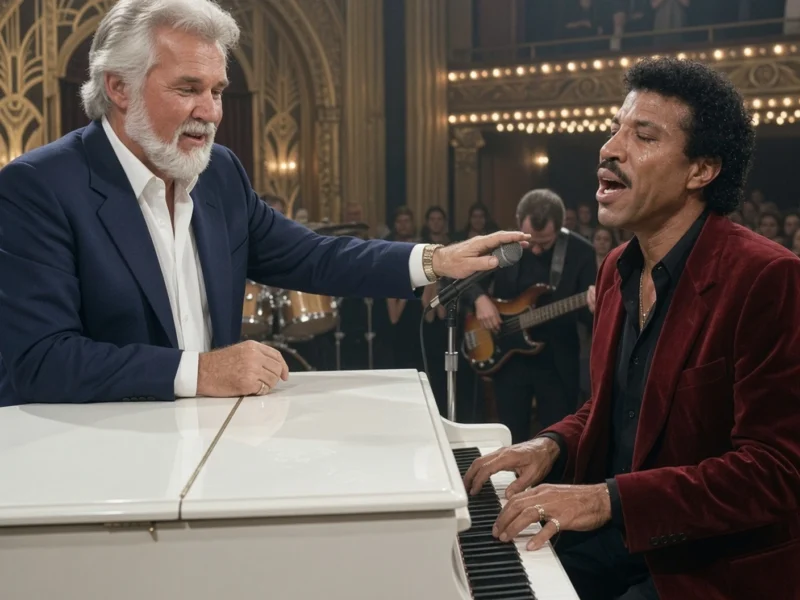
Kenny Rogers DARED Lionel Richie to Sing Lady Live — Nobody Was Ready For THIS…
January 25, 1985. The Pantages Theatre, Hollywood.
Before the night was over, nearly 3,000 people would be standing in the aisles with tears on their faces. Lionel Richie would be sitting at a white grand piano, singing a song he had written but never once sung on a stage.
A small folded note in Kenny Rogers’s handwriting would be sitting on top of that piano. Lionel would carry it with him three nights later into the most famous recording session in music history.
But none of that was supposed to happen. When Lionel Richie walked into that theater, he was carrying a fear he had not admitted to anyone. Not his band, not his manager, not even his wife.
He was afraid that the most important song he had ever written wasn’t good enough.
And before the night was over, Kenny Rogers would ask him a single question in front of 3,000 strangers. It was a question no journalist had thought to ask in five years, and the answer would bring the whole theater to its knees.
It was supposed to be a simple evening, a winter benefit for children’s hospitals. It was one of those Hollywood nights where the music business puts on its best clothes and reminds everybody that somewhere under all the platinum records and stretch limousines, there are still people who remember where they came from.
The organizers had put together a lineup that looked like a page out of the year-end charts. But the name at the top of the marquee, the name that had sold every seat in that grand old art deco palace inside a single morning, was Kenny Rogers.
In January of 1985, Kenny was one of the most beloved voices in the world. He had the silver beard, the easy smile, and a voice like warm gravel and good coffee on a cold morning.
He had “The Gambler” and “Lucille.” He had “Islands in the Stream” with Dolly Parton, which had spent the fall of 1983 on top of the charts and was still playing in every diner and truck stop from Maine to Mexico.
And he had “Lady,” six straight weeks at number one, the biggest single of his entire career. It was the song brides walked down the aisle to, and the song husbands sang badly in the car on the way home from anniversary dinners.
It was a song Kenny Rogers did not write.
That was the thing most people in the audience didn’t know, or had forgotten. “Lady” had been written by a young man from Tuskegee, Alabama, who at the time was the lead singer of the Commodores. His name was Lionel Richie.
The story of how that song came to be, of the night it was born and the one person Lionel had been thinking about when he wrote it, was a story he had never told anyone. Not in a single interview, not in five years.
By 1985, Lionel was no longer just the young man from the Commodores. He was one of the biggest stars on the planet. “All Night Long” had set the whole world dancing. “Hello” had made millions of people cry in their living rooms.
He was about to host the American Music Awards in three days. And in secret, at that very moment, he was finishing a song that was supposed to help feed millions of starving people on the other side of the world.
Nobody knew that yet. Not the photographers outside, and not the fans lined up along Hollywood Boulevard in their winter coats.
For the past two weeks, Lionel had been writing that song with Michael Jackson, night after night, at Michael’s house in Encino. The two of them sat at a piano until the sun came up, trying to find words big enough to carry the weight of what they were trying to do.
The recording was set for Monday night, right after the awards show. Forty-five of the biggest artists in America would walk into one room and sing it together. Kenny Rogers would be one of them. The whole world would hear it.
And Lionel was terrified.
He had been writing songs his entire adult life, and he knew what a good song felt like. But this one was different. This one wasn’t about love or heartbreak or dancing all night. This one was supposed to save lives.
Every night he lay awake wondering whether the words were too simple, whether the melody was too plain, whether he was about to stand in front of the greatest singers of his generation and hand them something that wasn’t worthy of them.
He hadn’t slept more than four hours a night in two weeks. Twice that afternoon, he had picked up the phone to tell the organizers he wouldn’t be coming to the benefit after all. Twice, he had put it back down.
He had agreed to come only to present an award. One minute onstage, say something nice, shake a few hands, go home, and get back to the piano. He had no intention of singing.
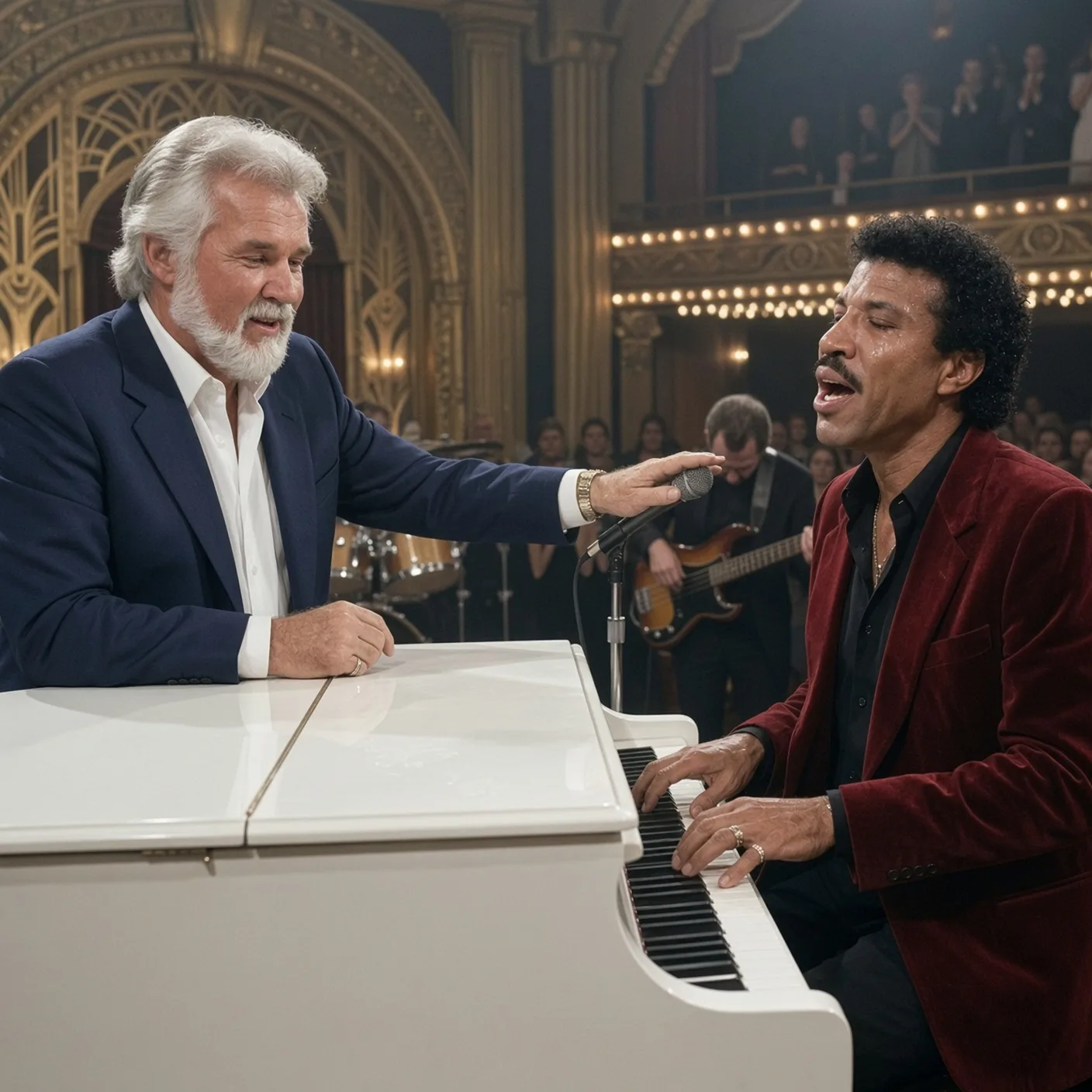
What he did not know, and what nobody in that building knew, was that Kenny Rogers had a very different plan.
Kenny arrived at the Pantages a little after five, slipping in through the stage door on Argyle Avenue the way he always did when he didn’t feel like being a celebrity for a few minutes.
He wore a navy blue suit and an open-collared white shirt, his silver beard trimmed neat. He had the relaxed, rolling walk of a Texas man who had spent 25 years in and out of every kind of theater, honky-tonk, and arena there is.
He shook hands with every stagehand he passed. He asked a young usher where she was from, and when she said Houston, he stopped, laughed out loud, and spent five full minutes talking to her about the best barbecue on the north side of town while his road manager checked his watch.
That was Kenny. He had grown up in the San Felipe Courts housing project in Houston, one of eight kids. His daddy was a hardworking man who played fiddle at family gatherings, and his mama was a nurse’s aide who came home tired and still found a reason to sing.
He never forgot what it felt like to be the kid on the outside looking in. So he went out of his way every day of his life to make sure the people nobody noticed felt like they’d been noticed.
He found his dressing room, hung up his jacket, and was halfway through a cup of coffee when his road manager poked his head in.
“Thought you’d want to know,” the man said. “Lionel Richie’s here. He’s presenting the award before your set.”
Kenny set the cup down. “Lionel’s here tonight?”
“Came in the back about ten minutes ago. He looks rough, Kenny. Like he hasn’t slept in a week.”
Kenny sat very still for a moment. He knew exactly why Lionel looked like that.
Kenny’s own manager, Ken Kragen, was the man organizing the Monday night recording, and Kenny had heard the rough demo of the new song only four days earlier. He had heard the song, and he had heard something else under it.
He knew that sound, because he had heard it once in his own voice years earlier, back when he was sure his career was over and too proud to tell anybody. It was the sound of a man straining under a weight nobody should have to carry alone.
“He’s not singing tonight?” Kenny asked.
“Just presenting. In and out.”
Kenny looked at the floor for a long moment, his thumb moving slowly across his beard, the way it always did when his mind was running ahead of his mouth.
Then he reached for a notepad on the counter, tore off a small sheet, and wrote something on it in a few quick lines. He folded it once, then again, and slipped it into his shirt pocket.
“Do me a favor,” he said. “Go find the stage manager. Tell him I want the white piano out on stage for my set. The grand, not the upright.”
His road manager frowned. “You don’t play piano, Kenny.”
“I know I don’t,” Kenny said, and a slow smile crept into the corners of his eyes. “But somebody in this building does.”
Down the hallway, in a dressing room so small it barely fit a chair and a mirror, Lionel Richie was sitting with his head in his hands.
His wife had stepped out to find him a cup of tea. The room was quiet except for the hum of the lights around the mirror and the muffled sound of the orchestra warming up somewhere beneath the stage.
Lionel had a sheet of paper in his lap covered in crossed-out lines. It held the lyrics to the song he and Michael had been fighting with for two weeks. He had read them so many times that the words had stopped meaning anything.
Every line looked too simple. Every rhyme looked too easy. He kept hearing a voice in the back of his head. Who do you think you are, trying to write a song that big?
He thought about Tuskegee. He thought about growing up on the campus of the Tuskegee Institute, in a house where books were stacked on every table and there was a piano in the front room that nobody was allowed to play carelessly.
He thought about his grandmother Adelaide, who had been a classical piano teacher. She used to sit him down on that bench when he was a little boy and play Bach and Beethoven with her eyes closed.
She never scolded him when he couldn’t read the notes. She only ever told him one thing, over and over, in a voice so soft he had to lean in to hear it.
He hadn’t thought about what she used to tell him in years, and he couldn’t quite remember it now. That bothered him more than he wanted to admit.
A knock came at the door. A young stage manager with a clipboard leaned in.
“Mr. Richie, you’re on in forty minutes. The humanitarian award, and then you’re free to go.”
“Thank you,” Lionel said, and folded the lyric sheet into his jacket pocket without looking at it again.
The young man hesitated in the doorway. “Also, sir, I don’t know if this matters. Mr. Rogers asked for the white grand piano to be moved onstage for his set. He told me to make sure you knew about it.”
Lionel looked up. “Kenny doesn’t play piano.”
“That’s what I said, sir.” The young man shrugged. “He just smiled at me.”
Lionel sat there for a long time after the door closed. Something was stirring in his chest that he couldn’t name. It wasn’t dread exactly. It was closer to the feeling you get right before a summer storm, when the air goes still and heavy and the birds stop singing and you know something is about to break open.
His wife came back a few minutes later with a cup of tea and found him sitting in exactly the same position, staring at the closed door.
“What happened?” she asked.
“I don’t know yet,” Lionel said. “Kenny’s up to something.”
She set the tea down in front of him and studied his face the way only someone who has loved you for a long time can.
“Whatever it is,” she said, “maybe you ought to let him. You’ve been carrying this thing by yourself for two weeks. Maybe it’s time somebody else picked up a corner of it.”
Lionel didn’t answer. But he didn’t reach for his coat, either.
The show began at eight. The Pantages was full to the gilded ceiling, nearly 3,000 people packed into that old movie palace with its soaring gold arches and starburst chandeliers.
They were dressed in everything from sequined gowns to leather jackets. Hollywood producers sat three seats down from truck drivers who had saved up for months. Grandmothers sat next to teenagers in parachute pants.
It was that rare kind of crowd you only get at a benefit, where the only thing everybody has in common is that they came because they wanted to do some good and hear some music while they did it.
The first hour went by in a warm blur of performances and speeches. Then, at a quarter to nine, the house lights dimmed, and a voice over the speakers announced that the evening’s humanitarian award would be presented by Lionel Richie.
The crowd came to its feet.
Lionel walked out in a deep red jacket over a black shirt, that famous warm smile switched on for the cameras. For about 90 seconds, he was everything the audience expected him to be. Charming, funny, easy in his own skin.
He told a joke about Alabama that made the whole front row laugh. He presented the award to a pediatric nurse from Watts who had spent 30 years caring for children whose families couldn’t pay.
When she started crying at the microphone, he put his arm around her shoulders and held her until she could finish. Then he waved to the crowd and walked offstage.
Job done. In and out.
He was pulling his coat off the rack in the wings when he felt a hand on his shoulder. He turned. Kenny Rogers was standing there in his navy suit, grinning like a man who had just been dealt a very good hand.
“Leaving so soon?” Kenny said.
Lionel laughed, and the two men embraced the way old friends do. One arm around the back, a couple of slaps on the shoulder.
“I was going to come find you. I’m sorry, man. I’ve got to get home. You know what Monday is.”
“I know exactly what Monday is,” Kenny said. “That’s why I need you to do me one favor before you go.”
“Anything.”
“Stay for my set. Stand right here in the wings. Don’t leave until I’m done.”
Lionel looked at him for a long moment. Kenny’s face was friendly and easy. But there was something in his eyes that Lionel had never seen there before, something steady and serious, like a man who had made up his mind about something important and wasn’t going to be talked out of it.
“Kenny,” Lionel said slowly, “what are you up to?”
“Just stay,” Kenny said, and patted his shoulder once more. Then he walked out onto the stage.
The roar that went up when Kenny Rogers walked into the lights was so loud that Lionel could feel it through the floorboards. Nearly 3,000 people rose at once.
A woman in the balcony screamed his name so loud the band laughed. Kenny walked to the center microphone, raised one hand, and smiled that easy smile, and the whole grand theater felt as though it had been wrapped in a warm quilt on a cold night.
He opened with “The Gambler,” and the crowd sang the chorus so loud he stepped back and let them take it. He played “Lucille.” He played “Coward of the County.” He played “Islands in the Stream,” and when he got to Dolly’s part, he held the microphone out toward the audience, and 3,000 people sang it for her.
Between songs, he talked the way he always did, like he was chatting with old friends on a back porch. He told them about the housing projects in Houston, about his mama singing in the kitchen, about the night he almost gave up music and went to work selling insurance.
Lionel stood in the wings and watched every second of it with his coat folded over his arm. Slowly, without noticing it happening, his shoulders came down from around his ears. For the first time in two weeks, he wasn’t thinking about the lyric sheet in his pocket.
He was thinking about a night in the summer of 1980.
It was a recording studio in Los Angeles, the air thick with cigarette smoke and cold coffee. Kenny had called him out of the blue and asked if he had anything.
Lionel had shown up with half a song, one verse and one chorus. He played it once on the studio piano and then sat there, waiting for Kenny to politely tell him it wasn’t finished enough.
Instead, Kenny had leaned back in his chair, closed his eyes, and said, “Play it again.”
Then he said it a third time. Then he stood up and said, “Where’s the rest of it?”
When Lionel admitted there wasn’t any rest of it, Kenny just smiled. “Well, I’ve got all night, and I’m not going anywhere.”
So Lionel had gone off by himself to a little room down the hall with a pencil and a legal pad while the musicians tuned up. He wrote the rest of “Lady” right there, with the tape machines waiting.
When he came back and played the whole thing through for the first time, Kenny had not said a single word. He had just walked over, put a hand on Lionel’s shoulder, and squeezed it.
Lionel had never forgotten that squeeze. It was the first time anybody in the music business had made him feel like the songwriter was the most important person in the room.
Back on the stage, the stagehands rolled the white grand piano out to center. The crowd murmured. Everybody in that theater knew Kenny Rogers didn’t play piano.
Kenny walked over and rested one hand on the gleaming white lid. He looked down at it for a moment, the way you look at a photograph of somebody you love. Then he looked out at the crowd.
“Folks,” he said, and his voice was quieter now, that warm gravel softened around the edges, “I want to tell you a story tonight, and I hope you’ll bear with me.”
The murmuring stopped.
“Back in 1980, I was looking for a song. I’d had a good run, and I was worried it was over. And a friend of mine said, ‘You ought to call that young man in the Commodores.’ So I did.”
“And he told me he had half of a song. Just half. A verse and a chorus. He’d been carrying it around for a while, and he didn’t know if it was any good.”
Kenny paused. “Well, he came down to the studio, and while the band was setting up, he went off by himself and finished the rest of it in one night. And that song became ‘Lady.'”
The theater burst into applause. Kenny waited for it to settle.
“‘Lady’ went to number one,” he said. “It stayed there for six weeks. It’s the biggest record I ever made. And I’ve sung that song at every single show for four and a half years. Probably two thousand times now.”
He shook his head slowly. “But there’s something that has bothered me about it for a long time, and tonight I want to fix it.”
In the wings, Lionel had gone completely still.
“The man who wrote that song,” Kenny said, “has never once sung it on a stage. Not one time. He gave it away to me, and I’ve been singing it ever since. And he’s just been standing off to the side, letting me take the bows.”
Kenny turned toward the wings. “Well, he’s standing off to the side right now. Lionel, would you come out here, please?”
Lionel’s heart dropped into his shoes. For one long second, he thought seriously about walking straight out the stage door and into the parking lot.
He had not sung a note in public in weeks. He was exhausted down to the bone. His voice was tired from staying up every night working on the new song. And the idea of sitting down at that piano in front of 3,000 people and singing “Lady,” Kenny’s song, in front of Kenny, felt like standing at the edge of a cliff.
But nearly 3,000 people were already turning in their seats and craning toward the wings, and a spotlight was swinging toward him.
Lionel set his coat down on a road case. He took a breath, then another. Then he walked out into the light.
The theater erupted. People were on their feet before he reached the piano. Kenny met him halfway across the stage and wrapped him in a hug, and when they pulled apart, Kenny kept one hand on his shoulder.
“You sure do know how to ambush a man, Kenny Rogers,” Lionel said into the microphone, and the crowd roared with laughter.
“I learned from the best,” Kenny said. “I learned it from a young songwriter who ambushed me with the best song I ever sang.”
More laughter. Then Lionel leaned in, his voice dropping low just for Kenny, though the microphone caught enough of it that the first few rows could hear.
“Kenny, man, I can’t. It’s your song. Everybody here knows it as your song. I’m not going to stand up here and sing it in front of you.”
Kenny looked at him, and his face was kind but completely serious.
“Lionel, let me ask you something, and I want you to tell me the truth. When you wrote that song, who were you thinking about?”
Lionel blinked. Nobody had ever asked him that. Not one interviewer, not one journalist, not in five years of that song being played on every radio station on the planet.
“What do you mean?”
“I mean, every great love song is written to somebody,” Kenny said gently. “Maybe not somebody you were in love with. Maybe somebody who taught you what love sounded like. I’ve sung that song two thousand times, and I have always known there was a person underneath it. Somebody real. I just never knew who.”
“And I think tonight, with everything you’re carrying into Monday, you need to remember who that was.”
The theater had gone absolutely silent. Nearly 3,000 people held their breath, watching two grown men stand at a white piano and have a conversation so private it almost felt wrong to be hearing it.
Lionel looked down at the piano keys for a long time.
“My grandmother,” he said finally, so quietly that the microphone barely caught it. “Adelaide. She taught piano. She used to sit me on the bench next to her when I was a little boy and play with her eyes closed.”
“Then here’s my dare,” Kenny said, and something in the room pulled tight like a string being tuned. “Sit down at this piano and sing ‘Lady’ for her. Not for me. Not for these folks. For her. The way you heard it the night you wrote it.”
A murmur rolled through the theater like wind moving across a wheat field. Somebody in the balcony called out, “Come on, Lionel!” A few others picked it up, soft and warm and encouraging.
“And what if I can’t get through it?” Lionel asked.
Kenny leaned in close. The microphone almost didn’t catch it.
“Then I’ll be standing right here,” he said. “That’s what friends are for.”
The silence lasted five seconds. Five full seconds of nearly 3,000 people barely breathing.
Five seconds doesn’t sound like much when you say it out loud. But sit in front of a white grand piano, under a spotlight, with the biggest song you ever gave away hanging in the air above you, and tell me those five seconds don’t feel like five years.
Lionel looked at Kenny. He looked out at the crowd. Then he looked at the piano bench, and something in his face settled the way a lake settles when the wind finally stops.
He sat down.
Before he could touch a key, Kenny reached into his shirt pocket, pulled out the small folded note he had written in his dressing room, and set it on top of the piano, right where Lionel could see it.
He didn’t say a word about it. He just tapped it once with two fingers and stepped back.
Lionel glanced at it. He didn’t open it. There was no time, because the whole theater was waiting.
He placed his hands on the keys. He closed his eyes. For one moment, the Pantages Theatre in Hollywood felt exactly like a front room in Tuskegee, Alabama, with the afternoon light coming through the curtains and an old woman sitting on the bench beside a little boy, playing with her eyes closed.
He began. Not the way Kenny sang it, not the smooth, polished, rolling version that everybody in America knew by heart.
Lionel started with a few quiet, wandering chords that didn’t sound like “Lady” at all. At first they sounded like church, like something you’d hear on a Sunday morning drifting out of an open window.
Then, very slowly, the melody surfaced out of those chords, the way the moon rises out of the clouds, and the people in the front rows realized what they were hearing and put their hands over their mouths.
His voice, when it came, was tired, softer than anybody had ever heard it. It wasn’t the soaring, confident voice of “Hello” or “All Night Long.” It was a smaller voice, a voice that sounded like it was singing to one person sitting right next to it on a piano bench.
The first line came out almost like a whisper, and the whole theater leaned forward to catch it.
The song that everybody thought they knew became something else entirely. It wasn’t a wedding song anymore, and it wasn’t a radio hit. It was a grown man at a piano, talking to the woman who taught him that music was supposed to mean something.
Every word that had always sounded like a love letter to a wife or a girlfriend suddenly sounded like something else. It sounded like gratitude, like a little boy saying thank you 40 years too late to somebody who wasn’t there to hear it.
By the second verse, the theater had changed. People stopped shifting in their seats. People stopped whispering. They went still.
It wasn’t polite stillness. It was the kind that only happens when a room full of strangers realizes that what they are hearing isn’t a performance anymore. It’s a man opening a door he’s kept closed his whole life and letting them all see what’s inside.
The crowd was crying. Not one or two people, but hundreds.
A big man in a leather jacket near the aisle had both hands pressed over his eyes. An older woman in the balcony was rocking gently back and forth, her lips moving along with the words. A teenage girl in the third row was holding her mother’s hand so tight her knuckles had gone white.
And Kenny Rogers stood just a few feet from the piano, not moving, not smiling, tears running into his beard.
When Lionel reached the bridge, the middle part of the song, the part he had finished alone in one night five years earlier, his voice caught for just a second. It was a small crack in the middle of a word, the sound of a man who had just remembered something he hadn’t let himself think about in a very long time.
His hands kept playing, but his voice stopped. For one terrible moment, it looked like he wasn’t going to be able to go on.
Kenny walked over. He didn’t rush. He came and stood right beside the piano, the way you’d stand next to a friend at a graveside, and he laid one hand gently on Lionel’s shoulder.
Then he started to sing.
He didn’t sing loud, and he didn’t sing over him. He sang low and warm, under his breath, picking up the line exactly where Lionel’s voice had broken off. He carried it the way you carry somebody’s groceries up the stairs when their arms are full.
Lionel heard him and opened his eyes. He looked up at Kenny, and what came across his face in that moment was something nobody in that theater would ever forget.
It wasn’t relief exactly. It was something deeper. It was the look of a man who has been carrying something heavy alone for a very long time and suddenly feels somebody else take hold of the other end.
Then he found his voice again, and the two of them sang the rest of it together.
Lionel’s voice was soft and sweet and full of church, full of Alabama summers and old hymns and a grandmother’s hands on the keys. Kenny’s was Texas gravel, warm and rough, the sound of every porch and every honky-tonk he’d ever played.
Where Lionel’s voice trembled, Kenny’s held steady. Where Kenny’s roughened, Lionel’s smoothed it over. The song that one of them wrote and the other made famous finally belonged to both of them at the same time.
Behind them, Kenny’s band had stopped playing altogether. Nobody told them to. The guitar player simply lifted his hands off the strings. The drummer laid his brushes down across the snare. The bass player took one step back from his amplifier and stood there with his head bowed.
Twenty years later, that bass player would tell a reporter that in all his years on the road, it was the only time he could remember a band choosing to stop playing because the music was better without them.
By the final chorus, the entire theater was on its feet. They weren’t cheering, and they weren’t clapping. They were standing because sitting down felt wrong.
The last chord hung in the air for what felt like a full minute. Lionel’s hands stayed resting on the keys. Then there was silence, the silence of a crowd that has just been handed something precious and doesn’t know yet where to put it.
Lionel stood up from the bench. His eyes were wet, and he wasn’t hiding it. He turned to Kenny, and his voice, when it came, was thick and rough.
“Kenny,” he said into the microphone, “I wrote that song five years ago, and I gave it to you, and I thought I knew what it was. I thought it was a love song.”
He stopped and swallowed. “Tonight, I finally figured out who it was for.”
The theater broke. Whatever had been holding nearly 3,000 people together gave way all at once.
People were hugging strangers. The pediatric nurse who had received the humanitarian award stood at the side of the stage with both hands over her heart. Somewhere in the balcony, a man shouted, “Thank you, Lionel!” and his voice cracked in the middle.
In the front row, an elderly woman in a lavender church hat dabbed her eyes with a handkerchief. When a reporter found her in the lobby afterward and asked what she had thought of the show, she said only this.
“I came to hear Kenny Rogers sing ‘Lady.’ I didn’t know I was going to hear where it came from.”
Kenny pulled Lionel into a hug and held on. When they finally let go, Kenny said, loud enough for the microphone to carry, “It was always your song, brother. I was just keeping it warm for you.”
An hour later, the backstage hallways of the Pantages had that strange, hollow quiet that always follows something extraordinary.
Lionel found Kenny in a small rehearsal room at the end of the corridor, sitting on a folding chair next to a battered old upright piano with a paper cup of coffee in his hand.
“Got a minute?” Lionel asked.
“For you?” Kenny said. “I’ve got all night.”
Lionel sat down at the upright. For a while, neither of them said anything. Then Lionel reached into his jacket, pulled out the lyric sheet he’d been carrying for two weeks, the one covered in crossed-out lines, and set it on the music stand.
“You heard the demo,” he said. “Of Monday’s song.”
“I heard it.”
“Tell me the truth, Kenny. Is it good enough?”
Lionel stared at the page. “Because I’ve been up every night for two weeks, and every line I write looks too simple, too plain. I’m about to hand this to 45 of the greatest singers alive, and I’m scared to death they’re going to look at it and think, ‘That’s it? That’s all he’s got?'”
Kenny set his coffee down.
“Lionel, let me ask you something. Tonight, when you sat down at that piano and sang ‘Lady’ for your grandmother, did you try to make it fancy?”
Lionel slowly shook his head.
“Did you try to make it impressive? Did you add a bunch of big notes to prove something?”
“No.”
“And 3,000 people cried like babies,” Kenny said. “Because it was simple. Because it was true. Simple isn’t weak, brother. Simple is what’s left when you take away everything that isn’t true.”
Lionel didn’t answer for a long time. Then something surfaced in his face, slowly, like a memory coming up out of deep water.
“That’s what she used to say,” he whispered. “My grandmother. I couldn’t remember it this afternoon. I’ve been trying for two weeks. She used to put her hand over mine on the keys and say, ‘Baby, don’t play for the whole room. Play for the one person who needs it most, and the whole room will follow.'”
“Well,” Kenny said softly, “there’s a lot of people on the other side of the world who need that song on Monday. Play it for them.”
Lionel put his hands on the keys of that old upright and played the new song all the way through, right there in that little room, just for Kenny. It was simple, plain, and true.
When he finished, Kenny didn’t say anything at all. He just nodded, slow and deep, with tears in his eyes.
“Why did you do it, Kenny?” Lionel asked after a while. “Tonight. The piano, all of it. You didn’t have to do any of that.”
Kenny turned the paper cup slowly in his hands.
“In 1976, the First Edition broke up,” he said. “I was 37 years old, and I was in debt up to my eyebrows, and everybody in this business had already decided I was finished. A has-been with a beard.”
“And there was one man, a producer in Nashville named Larry Butler, who sat me down and said, ‘Kenny, I don’t care what anybody says. I believe you’ve got your best songs in front of you.’ A year later, we made ‘Lucille.'”
Kenny shrugged. “He didn’t have to do that, either. But he did. And I made a promise to myself that if I ever got to the top of the mountain, I’d spend the rest of my life reaching back down for the next fella climbing.”
Lionel looked at him for a long moment. “I’m not exactly climbing, Kenny. I’ve had a few hits.”
“Everybody’s climbing something, Lionel,” Kenny said softly. “Tonight, yours was just a little steeper than usual.”
Three nights later, on January 28, 1985, after hosting the American Music Awards, Lionel Richie walked into A&M Studios in Hollywood, where 45 of the biggest artists in America had gathered to record “We Are the World.”
Kenny Rogers stood among them and sang his solo line in that warm gravel voice.
Before the session started, in a room crowded with legends, Lionel caught Kenny’s eye from across the studio and touched the pocket of his jacket, right over his heart. Kenny saw it, smiled, and gave him the smallest nod. Nobody else in the room had any idea what passed between them.
When it was Lionel’s turn to guide the room through the song he had been so afraid of, he did it simply, without apologizing for a single line. He did it the way a grandmother once taught him to play, for the one person who needed it most.
The song went to number one in countries all around the world and raised tens of millions of dollars to fight famine in Africa.
Twenty-seven years later, in 2012, Lionel released an album of his greatest songs reimagined with country artists. It was named after his hometown, “Tuskegee.” For the song “Lady,” he chose only one partner. Kenny Rogers.
The two of them sang it together one more time, two old friends in their 60s and 70s. Anyone who knew the story of that night at the Pantages could hear it in every note.
Near the end of that session, between takes, Kenny leaned over and asked him, half joking, whether he still had that note from the Pantages.
Lionel didn’t answer. He just reached up and tapped the inside pocket of his jacket, right over his heart. And Kenny Rogers laughed so hard the engineer had to stop the tape.
Kenny Rogers passed away peacefully at home on March 20, 2020, at the age of 81. Lionel spoke of him with deep love, as a friend and a brother who had shaped his life.
That night, radio stations from Houston to Tuskegee played “Lady” again and again. Somewhere in all those living rooms, people who had never heard the story of the Pantages sang along without knowing exactly why it made them cry.
And the folded note Kenny set on top of the white piano? Lionel opened it in the car that night, on the way home, under the streetlights on Hollywood Boulevard.
His wife was driving. She glanced over and saw him unfold that small square of paper, read it, and then turn his face toward the window so she wouldn’t see him cry. She didn’t ask. She just reached over and held his hand the rest of the way home.
He had read it three times before they pulled into the driveway. Then he folded it back up and carried it in his jacket pocket into A&M Studios on Monday night, where it stayed through the entire session.
It was only ten words long, in Kenny’s rough handwriting.
“You wrote ‘Lady’ in one night. You can do this.”









