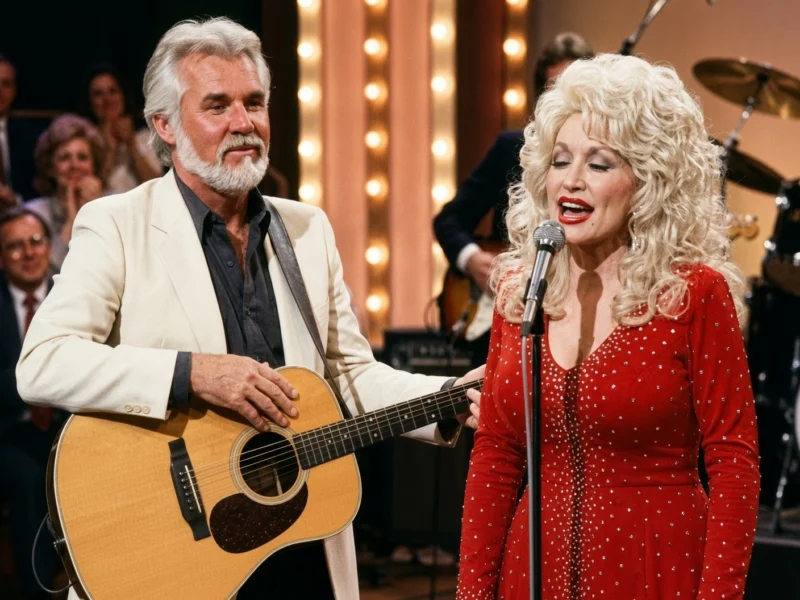
Kenny Rogers DARED Dolly Parton to Sing The Gambler Live — Nobody Was Ready For THIS…
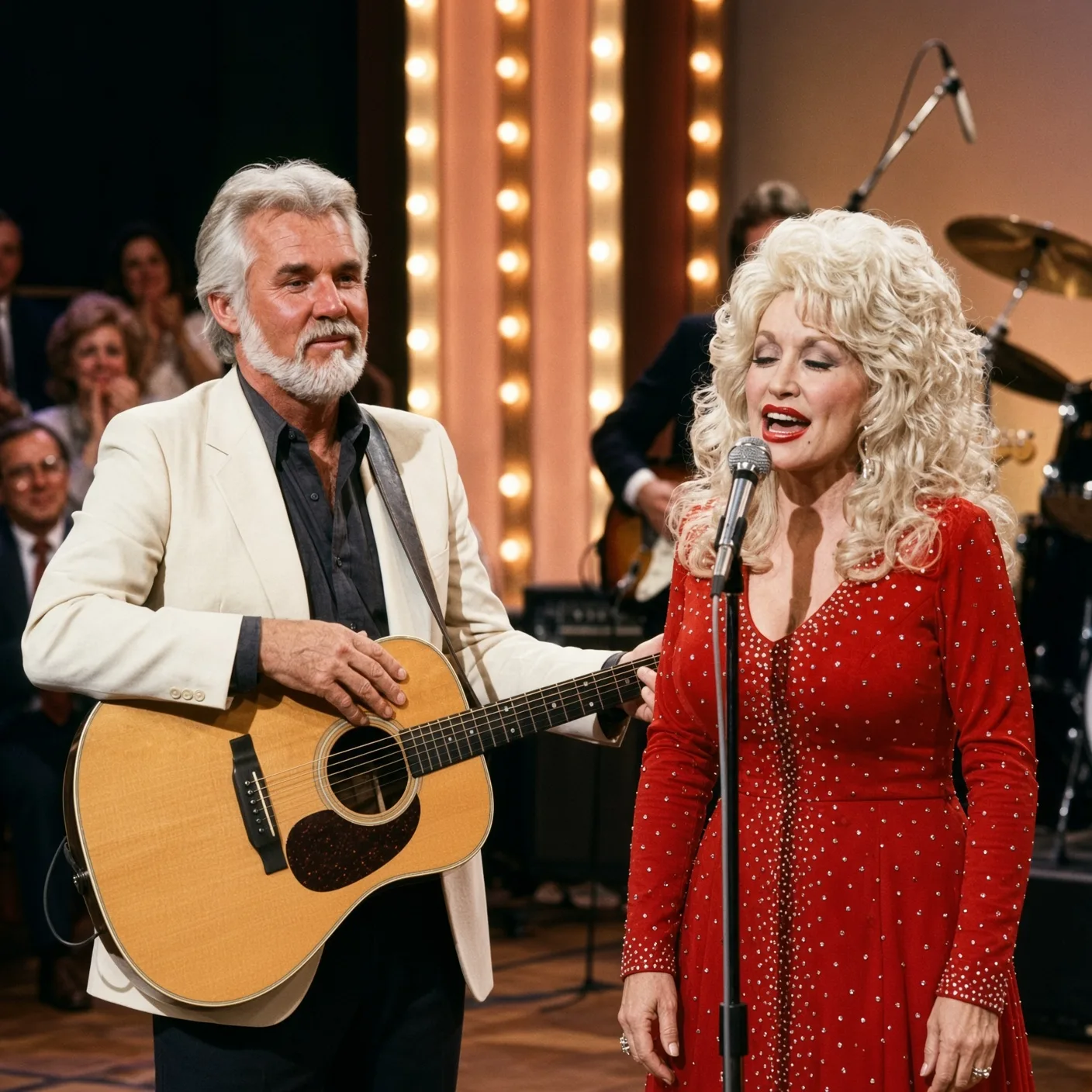
April 16th, 1983. The Shrine Auditorium, Los Angeles.
Before the night was over, more than six thousand people would be on their feet with tears running down their faces.
Dolly Parton would be standing center stage singing a song she had never once sung in public.
And Kenny Rogers would be holding a folded piece of paper in his jacket pocket that he would keep for the rest of his life.
But none of that was supposed to happen.
Because when Kenny Rogers walked into that building, he was carrying a secret he had not told his band, his manager, or the thousands of fans lined up outside.
He had decided that tonight would be the last time he ever sang the song that made him a legend.
It was supposed to be just another charity gala.
One of those glittering spring evenings the music business puts together when it wants to remind the world that somewhere underneath all the gold records and the limousines, there is still a heart beating inside the machine.
The event was called A Night of Hope, a one-night-only benefit for hunger relief.
And the organizers had spent the better part of five months building a lineup that looked like a page torn out of the Billboard charts.
Lionel Richie had confirmed early. Anne Murray was flying down from Toronto. Glen Campbell had moved two shows to be there.
But the name that sold out every one of those six thousand seats inside the first morning tickets went on sale was Kenny Rogers.
In the spring of 1983, there was no bigger voice in America.
He had the silver beard, the easy smile, the voice that sounded like warm gravel and good whiskey and a porch light left on for somebody who was late getting home.
Lucille had made grown truck drivers pull over to the side of the highway. Lady had been number one for six straight weeks. Coward of the County had turned a story song into a small-town legend.
And then there was The Gambler.
The song that had become so big it wasn’t a song anymore.
It was a television movie. It was a second television movie in production. It was a costume, a character, a nickname that followed him into every restaurant, every airport, every hotel lobby from Houston to Honolulu.
Nobody knew it yet.
Not the photographers waiting by the stage door, not the fans three deep behind the barricades on Jefferson Boulevard, not even the crew setting up the lights.
But Kenny had almost pulled out of the show.
Twice that week he had picked up the phone to call his manager and tell him he couldn’t do it.
Not because he didn’t care about the cause.
Kenny cared about hunger more than almost anything.
He had grown up in a housing project in Houston, one of eight children in a family where there were nights the supper table was thinner than anybody wanted to admit.
He knew exactly what an empty stomach sounded like at two in the morning.
That was the whole reason he had said yes.
But something else had been sitting on his chest for months. Something quiet and stubborn that he couldn’t put a name to.
Every night he walked out on some stage in some city and sang The Gambler.
And every night the crowd sang it back to him louder than he could sing it himself.
And every night he walked off feeling a little further away from the man who had first heard that song in a small office in Nashville five years earlier.
He had sung it, by his own rough count, more than a thousand times.
And somewhere along the way he had stopped hearing it.
He was saying the words the way you say a phone number you’ve dialed so often your fingers know it better than your mind does.
He had not told a soul.
Not his band, not his manager, not even his wife, Mary Ann, who could usually read his moods from across a crowded room before he had finished walking through the door.
He had just made a quiet decision alone in the back of a tour bus somewhere outside Tulsa.
Tonight, in Los Angeles, for a good cause, in front of the biggest crowd of the spring, he would sing The Gambler one last time.
Sing it right.
And then he would take it out of the show and let it rest.
He even had the new set list folded in the inside pocket of his jacket, with the song already crossed out in blue ink.
What he did not know, what nobody in that building knew yet, was that the organizers had made a last-minute change to the lineup barely two days before showtime.
A phone call had come in from a movie studio lot across town.
Dolly Parton was in Los Angeles working on a film project, and when she heard about the benefit, she picked up the phone herself and asked if they had room for one more girl with a guitar.
They made room before she finished the sentence.
Dolly pulled up to the Shrine a little after three that afternoon, stepping out of a black town car into the hard California sunshine wearing a red dress covered in rhinestones that caught the light and threw it back across the parking lot like somebody had scattered a handful of stars on the pavement.
Guitar case in one hand, a handbag the size of a small suitcase in the other, and hair piled so high she had to duck on her way out of the car.
She moved through the backstage hallways the way she moved through every room she had ever walked into, like the room was lucky to have her, and she was even luckier to be there.
She greeted every stagehand she passed. She learned their names in thirty seconds. She told a young lighting tech that he had kind eyes and to call his mama more often.
And by the time she found her dressing room, half the crew was grinning like they had just been handed a raise.
She was not nervous.
Dolly Parton did not do nervous.
She did something closer to electricity. A low, steady hum under the skin that told her when a night was going to matter more than most nights do.
She had felt it the first time she walked onto the stage of the Grand Ole Opry at thirteen years old.
A skinny mountain girl from Locust Ridge, Tennessee, with a borrowed guitar and a dream too big for her frame.
She had felt it the night she left the Porter Wagoner show to go out on her own, when everybody in Nashville said she was making the biggest mistake of her life.
She was feeling it again now.
Standing in a hallway that smelled like dust and old velvet, tuning her guitar against her hip and humming something only she could hear.
They’d given her two songs. Two bright, happy numbers to open the second half. Warm the crowd up and get off the stage before the headliner came out.
She knew exactly what to do with two songs. She had been doing it since before she could spell her own name.
What she did not know, what she had no way of knowing, was that Kenny Rogers was about to change the plan for the entire night.
And the collision between those two plans, under the lights of the Shrine Auditorium, in front of six thousand people who thought they knew exactly what they had paid to see, is the reason this story is still being told more than forty years later.
Kenny arrived a little before six, slipping in through a side door on the far end of the building, the way he always did when he didn’t feel like facing cameras.
No entourage. Just his road manager walking a half step behind him carrying a garment bag.
And Mary Ann beside him holding his hand.
The two of them quiet in that comfortable way that only happens between people who have figured out that not every silence needs to be filled.
He looked tired. Not the kind of tired a good night’s sleep could fix.
The deeper kind. The kind that settles in behind the eyes and stays there no matter how many hours you spend lying in the dark.
He wore a plain cream-colored suit and a dark shirt open at the collar. No hat, no flash, nothing that shouted his name to anyone who wasn’t already looking.
He nodded at the crew who recognized him, shook a few hands, signed a program for a security guard’s daughter, and asked the girl’s name twice so he’d get the spelling right.
Then he found his dressing room, closed the door, and sat down in front of the mirror without really looking at himself.
Mary Ann leaned in the doorway for a moment.
“You want me to stay?”
“No, darling,” he said softly. “Just give me a few minutes with myself before all this starts.”
She knew that voice.
She had heard it maybe three times in six years of marriage.
She touched his shoulder once, the way you touch someone when you want them to know you’re right there on the other side of the wall.
And she closed the door behind her so gently that the latch barely clicked.
Kenny sat alone in that little room with its ring of bright bulbs and a vase of yellow roses somebody had left on the counter.
And he thought about Houston.
He thought about the San Felipe Courts, the brick apartments where he had grown up with seven brothers and sisters, and a mother who worked long shifts as a nurse’s aide and still came home singing.
He thought about his daddy, Floyd, a quiet man who worked hard with his hands, never had much money, and never had much to say, but who could pick up a fiddle at a family gathering down in East Texas and make an entire yard full of tired people forget about the rent for an hour.
Kenny had been a little boy sitting on an overturned bucket, watching those rough hands move across the strings, and thinking that there was nothing on God’s earth more powerful than a song played by a man who meant every note of it.
He missed that boy sometimes.
The one who sang because it felt like breathing.
The one who didn’t need a crowd to know the music was real.
He hadn’t sung anything that felt real, truly real—not performed, not delivered, but felt—in longer than he wanted to admit.
Every show lately had been smooth. Every note had landed exactly where it was supposed to.
And somehow that was the whole problem.
A knock pulled him back.
His road manager’s voice came through the door.
“Kenny? Figured you’d want to know. Dolly Parton’s here. They added her to the show. She’s opening the second half.”
Kenny turned all the way around in his chair for the first time since he sat down.
“Dolly?” he said.
And something shifted in his eyes. Something that hadn’t been there a minute ago.
“Dolly Parton is here? Tonight?”
“Got here about three hours ago. She’s two doors down.”
Kenny sat still for a moment.
And then something happened that his road manager would later describe as the first real smile he had seen on Kenny’s face in weeks.
Not the stage smile. Not the one for the cameras.
A real one. Small and slow, starting at the corners of his mouth and climbing up into his eyes like sunrise coming up over a Texas field.
“You know,” Kenny said, almost to himself, “I’ve shaken that woman’s hand at three different award shows and never once had the nerve to tell her that Coat of Many Colors is the best song anybody’s written in my lifetime. I played that record on the bus till the band threatened to throw it out the window.”
“You want me to set up a hello before the show?”
“No,” Kenny said.
And the smile turned into something else now. Something sharper. Something that looked a lot like the beginning of an idea.
“No, I don’t want to meet her before the show. I want to hear her first. I want to hear what she sounds like in this room before I say a single word to her.”
He reached into the inside pocket of his jacket and touched the folded set list, the one with the blue line through The Gambler.
He didn’t take it out. He just rested his fingers on it for a long moment, like a man checking that a letter he’s afraid to send is still there.
“Is everything all right?” his road manager asked.
“I think,” Kenny said slowly, “tonight might matter after all.”
The show started at eight sharp.
The Shrine was packed to the rafters, six thousand people filling that enormous old hall with its painted ceiling and its red velvet seats, dressed in everything from sequined evening gowns to denim jackets and cowboy boots.
It was that strange mix you only find at a Los Angeles benefit, where Hollywood and Nashville end up breathing the same air for one night, and neither one is quite sure what to make of the other.
The first half went by in a warm blur of big voices and bigger applause.
And then the house lights dipped for the second half, and a small woman in a red rhinestone dress walked out into a single white spotlight.
The applause was polite. Friendly. The kind you give someone you’ve heard of but haven’t made up your mind about yet.
She looked so small against that massive stage, guitar hanging off her shoulder, that for one split second the crowd wasn’t sure whether to be charmed or worried for her.
Then she opened her mouth.
Her first song was fast and bright and bouncing. A sunny, foot-stomping thing that filled that cavernous hall the way morning light fills a room when somebody throws the curtains open all at once.
Her voice was enormous, far bigger than her frame had any business producing, clear as a creek and sharp as a whistle.
By the second chorus, the whole building was clapping along without deciding to. Hands moving on their own like they’d received instructions the brain hadn’t approved yet.
She had that rare, impossible thing that nobody can teach and nobody can fake.
The ability to walk into a room full of strangers and make every single person feel like she had driven all the way there just to sing to them.
By the end of her second song, the applause had changed.
It wasn’t polite anymore. It was the real kind. The kind that surprises the people making it.
People in the front rows turned to each other with that look that says, “Did you know she could do that?”
And the answer on every face was the same honest no.
Kenny was standing in the wings the entire time, half hidden behind a black curtain, arms folded, not moving.
His road manager later said he never once looked away from her. Not during the jokes, not during the guitar break, not even when a stagehand bumped past him carrying a microphone stand.
He just stood there listening, with his head tilted slightly to one side, the way a man listens to the weather when he’s trying to decide whether it’s going to rain.
Dolly came off that stage glowing. There isn’t any other word for it.
Cheeks flushed pink, grin so wide you could have counted her teeth from the balcony.
A stagehand met her in the wings with a bottle of water and a towel, and she thanked him like he’d just handed her a Grammy.
She had done exactly what she came to do. Two songs, warm them up, get out of the way.
She was halfway to her dressing room when a voice stopped her.
“Ms. Parton?”
She turned around.
A young man with a headset, maybe twenty-three, looking like someone had just trusted him with a message he didn’t completely understand.
“Mr. Rogers asked me to tell you something,” he said carefully, like he’d memorized it in a hurry. “He says, ‘Please don’t leave.’ He says stay close to the stage. He says he’s going to need you later.”
Dolly tilted her head.
“He’s going to need me later? For what?”
The young man shrugged.
“He didn’t say, ma’am. He just said you’d know when the time came.”
“Well,” Dolly said, looking back toward the stage where the crew was already resetting for the next act. “That’s about the most mysterious thing a man has said to me since my daddy told me the mule knew the way home better than he did.”
The young man blinked, not sure if he was allowed to laugh.
Dolly patted his arm and smiled at him. The kind of smile that tells you everything is fine, even when you have no idea what’s going on.
Then she found a spot in the wings where she could see the stage without being seen, leaned her guitar case against the wall, folded her arms, and waited.
Her heart was doing something it didn’t usually do.
It was beating fast.
Not from nerves, and not from the performance she’d just given, but from something she couldn’t name yet.
The hum she had felt all day was getting louder now. Closer.
Like a thunderstorm that has been building on the horizon all afternoon and is finally near enough that you can smell the rain.
At a quarter to ten, the house lights went all the way down, and the Shrine Auditorium came apart.
There is no other way to describe it.
When Kenny Rogers walked out onto that stage, six thousand people rose to their feet at the same time.
The roar was so loud it hit you in the chest like a physical thing, like sound had weight and all of it had landed on your ribs at once.
Women screamed his name from the balcony. Somebody near the front was waving a hand-painted sign that said, “Lucille loves you, too.”
Kenny walked to the center microphone in that cream suit, raised one hand, and smiled that easy smile.
And the whole room felt like it had been wrapped in a warm blanket.
That was the thing about Kenny Rogers.
The man who had been so tired an hour ago became somebody else the moment the lights hit him.
The tiredness didn’t disappear. It just stopped being the loudest thing in the room.
He opened with Lady, and the crowd sang every word so loud he let them take the second verse by themselves.
He played Lucille, and he played Coward of the County, and he played Through the Years, each one bigger than the last.
Each one pulling the audience deeper into that place where nothing exists except a voice and a story and the man telling it.
He talked between songs the way he always did, like he was chatting with old friends on a front porch, telling them about growing up in Houston, about the First Edition, about the night he almost got thrown off a plane for singing too loud in the back row.
And then, at the peak of all of it, with the whole building charged like the air right before a lightning strike, the band started the unmistakable opening of The Gambler.
The roar that went up was the biggest of the night.
This was the one. This was the song they had all come to hear, the one they had sung in their cars and at their weddings and at their fathers’ funerals.
Kenny stepped up to the microphone, opened his mouth to sing the first line, and then did something nobody in that building expected.
He stopped.
He raised one hand, and the band went silent behind him, one instrument at a time.
The drums, then the bass, then the last trailing note of the piano.
The crowd noise dropped away like somebody had pulled the plug on the whole building.
Six thousand people holding their breath at the same time, and the silence was so sudden that it almost made a sound of its own.
Kenny stood there, center stage, and looked out at that crowd with an expression none of his band had ever seen before.
Not showmanship. Not charm.
Something underneath all of that. Something unguarded that had no business being on a stage that big.
“Folks,” he said into the microphone, and his voice was quieter now. That warm gravel turned soft around the edges.
“I need to do something a little different tonight, and I hope you’ll forgive me.”
A curious murmur rippled through the hall.
“About an hour ago, a lady walked out on this stage and sang you two songs. And I’m going to be honest with you, because I think you deserve that. Most of you were being very polite, waiting on me.”
A ripple of nervous laughter moved through the crowd.
“I know, because I’ve done the same thing. But I was standing back there in the dark, listening, and I want you to know you were in the presence of one of the greatest voices God ever put on this earth. I’ve heard a lot of voices in twenty-five years of doing this. I don’t say that lightly.”
He paused, letting it land.
“Dolly,” he said, turning toward the wings, “would you come on back out here, please? I’ve got something I need to ask you, and I think these folks deserve to hear the answer.”
Back in the wings, Dolly’s stomach turned all the way over.
For one second, she thought about pretending she hadn’t heard him. Just staying right there in the dark, safe, invisible.
But six thousand heads were already turning toward the side of the stage, and a spotlight was swinging her way like a searchlight looking for an escaped convict.
She took a breath, then another.
Then she did what Dolly Parton has always done when life throws something unexpected at her.
She picked up her guitar, pulled her shoulders back, and walked out into the light like she’d been expecting this all along.
The crowd erupted.
Not the polite applause from before. This was louder and warmer. The sound a room makes when it realizes it is about to see something that was never in the program.
Kenny watched her cross the stage toward him. Rhinestones flashing, boots clicking on the wooden boards, that famous smile fixed firmly in place, even though her mind was racing fast enough to power the building.
He was grinning at her with the look of a man who knew exactly what trouble he was about to cause and was enjoying every second of it.
“Well,” Dolly said into the microphone, looking way up at him, because Kenny had a good foot on her even with her hair counted in. “You sure do know how to put a country girl on the spot, Mr. Rogers.”
“I’ve been told that once or twice, Ms. Parton,” Kenny said, and the crowd laughed.
That easy, rolling laugh that only happens when two people on a stage have chemistry so obvious the audience can feel it like heat coming off a campfire.
“Now, your young man back there told me you were going to need me for something,” Dolly said, shifting her guitar strap and studying his face for a clue.
“So here I am. What exactly are you cooking up?”
Kenny turned to face her fully, and when he did, something in his expression changed.
The playfulness was still there around the edges, but underneath it was something serious. Something that looked almost like hunger.
The look of a man who has been searching for something a long time and thinks he might have finally found it standing right in front of him in a red dress and rhinestone boots.
“Dolly,” he said, and his voice dropped lower, like the two of them were the only people in the building.
“I want to ask you something, and I want you to answer me honest.”
“Honey, I don’t know any other way,” Dolly said.
“Before Nashville,” Kenny said slowly, every word placed with care. “Before the movies, before the number ones and the television shows and all the rest of it. Back when you were just a little girl up in those Tennessee mountains, singing on a porch because singing was the only thing that made the world feel like it fit right. What did the music feel like then?”
The smile on Dolly’s face flickered.
Not gone. Just changed.
Something behind her eyes shifted the way a sky shifts when the first cloud slides across the sun.
“It felt like breathing,” she said quietly. “It felt like the most natural thing in the world.”
“That’s what I figured,” Kenny said, nodding slowly. “Because that’s what it felt like for me, too. Sitting on a bucket in the dirt, watching my daddy play the fiddle, before any of this.”
The crowd had gone completely still.
Six thousand people listening to two of the most famous voices in America have a conversation so private it almost felt wrong to overhear it.
“So here’s my dare,” Kenny said, and something in the room pulled tight like a wire.
“I want you to sing something tonight. Not one of your songs. One of mine.”
Dolly’s eyebrows climbed halfway up her forehead.
“One of yours?”
“The Gambler,” Kenny said.
The words dropped into that room like a stone into a still pond.
The crowd gasped. Not a small, polite gasp, but a full six-thousand-person intake of breath that rolled through the Shrine like thunder through a canyon.
People grabbed each other’s arms. Somebody near the front said out loud what half the room was thinking.
“He can’t be serious.”
But Kenny Rogers was looking at Dolly Parton like he had never been more serious about anything in his life.
“Now hold on just a minute,” Dolly said, raising one hand, palm out. “The Gambler? Your Gambler? Kenny, that’s not a song. That’s a monument. They made two movies out of it. Half the men in America think it’s the Bible with a guitar part. And you want me, a mountain girl from Locust Ridge, to stand up here and sing it in front of you and six thousand of your closest friends?”
“That’s exactly what I want,” Kenny said.
“And what if I make a mess of it?”
Kenny leaned in close, close enough that the microphone almost didn’t catch what he said next.
Almost. Six thousand people leaned forward in their seats to hear it.
“You won’t,” he said, barely above a whisper. “Because that song was never about cards, Dolly. It’s about an old man who knows he doesn’t have much time left, giving away the only thing he’s got worth giving. And nobody in this building knows how to sing about that better than a girl who grew up watching her daddy work himself to the bone for twelve kids.”
Dolly stood there looking at him, guitar heavy on her shoulder, the biggest dare of her career sitting right in front of her in a cream suit and a silver beard.
She could have laughed it off. Nobody would have blamed her.
The Gambler was Kenny Rogers’ crown. Singing it in front of the man who owned it was either the bravest thing a singer could do or the craziest.
The silence lasted six seconds.
Six full seconds of six thousand people barely breathing.
Six seconds doesn’t sound like much when you say it out loud, but stand under a spotlight with the most famous story song in America hanging over your head and tell me those six seconds don’t feel like six years.
Dolly looked at Kenny. She looked at the crowd. She looked down at her guitar, that old friend that had carried her through every moment she wasn’t sure she could carry herself.
Then she looked back at Kenny, and something in her face went still, the way a pond goes still after the last ripple reaches the bank.
“All right,” she said into the microphone, and her voice was different now. Lower. Coming from somewhere further back than performance.
“All right, Kenny Rogers. You want honest? I’ll give you honest.”
She turned to the band.
“Boys, I’m going to take this one slow. Real slow. You just follow me, and if I get lost, I’d appreciate it if you got lost right along with me.”
The band leader looked at Kenny. Kenny gave him one small nod, the kind that says, “Trust her and don’t ask questions.”
Dolly closed her eyes, and for a moment the biggest room in Los Angeles felt exactly like a wooden porch in the Smoky Mountains. Quiet enough to hear the crickets. Small enough to hold every voice that ever mattered.
She began, not the way Kenny sang it, not with that easy, rolling storytelling swing that everybody in America knew by heart.
She took the tempo and cut it in half.
She sang the opening verse almost like a hymn, just her voice and the soft brush of her fingers across the guitar strings. So quiet, the people in the back rows had to lean forward to hear her.
And the song that everybody thought they knew became something else entirely.
It wasn’t a cowboy tale anymore. It wasn’t a movie or a nickname or a costume.
It was a tired old man on a train at night, talking to a young stranger, trying to hand him everything he had learned before it was too late to hand it to anybody.
By the second verse, something had shifted in that hall.
People stopped shifting in their seats. People stopped reaching for their drinks. They went still.
Not polite still. The kind of still that happens when a room full of strangers realizes that what they are hearing isn’t a performance anymore.
It’s a confession.
Because Dolly wasn’t singing about a gambler.
Anyone who knew her story could hear it. She was singing about her daddy.
Robert Lee Parton. A man who never learned to read, who worked tobacco fields and construction jobs until his hands cracked, and who was still the wisest man she had ever known.
Every word of advice in that song, she sang like it had come across a kitchen table in a two-room cabin.
And when she reached the chorus, the part that six thousand people had sung at the top of their lungs a thousand times, she didn’t belt it.
She almost whispered it. Like a secret passed from a father to a child in the dark.
The crowd was crying.
Not one or two people. Hundreds of them.
Big men in Stetson hats wiping their eyes with the backs of their hands. Women gripping the armrests with white knuckles.
People who had come for a charity gala and a famous chorus had walked straight into something raw and human and true, and it had gone right past every defense they had brought with them.
And Kenny Rogers, standing just a few feet away, had stopped smiling.
He walked over to the edge of the stage where his acoustic guitar was resting on a stand.
He lifted it slowly, carefully, the way you pick up something that belonged to somebody you loved.
He didn’t plug it in. He just stepped up behind Dolly, a little to one side, and began to play under her voice.
Not the full rhythm. Just a few soft, simple chords.
The guitar equivalent of a hand resting on a shoulder, saying, “I’m right here. You don’t have to carry this by yourself.”
Dolly heard him come in, and her eyes opened. Not wide. Just enough to let the light in.
And what came through them was recognition.
That look one musician gives another when they realize they are not performing separately anymore, but breathing together.
When she reached the last chorus, she turned toward him, covered the microphone with one hand, and whispered something in his ear.
Nobody in the audience heard it.
For years, the people in the front rows argued about what she might have said. Kenny only told the story much later, and when he did, his voice cracked every single time.
Then he stepped to the microphone and sang with her.
His voice came in low and rough, almost under his breath, wrapping around hers from underneath. Not competing. Just holding her up the way the ground holds up a tree.
Her voice was mountain mist and pine smoke. His was Texas gravel and warm whiskey.
Together, they made something neither of them could have made alone.
Where her voice ached, his steadied. Where his wavered under the weight of whatever he had been carrying for months, hers held firm.
The same way she used to hold the harmony for her little brothers and sisters on that porch when their voices gave out.
By the final line, the whole hall was on its feet.
Not cheering. Not clapping. Just standing, because sitting down felt wrong.
The last note hung in the air for what felt like a full minute.
Then silence. The silence of a crowd that has just been handed something precious and doesn’t know yet what to do with it.
Kenny’s eyes were wet, and he wasn’t hiding it.
Dolly’s mascara had run in two thin lines down her cheeks, and she hadn’t noticed or didn’t care.
Kenny lifted his guitar strap over his head, set the instrument down, and turned to her.
“I’ve sung that song more than a thousand times,” he said, and the microphone carried every rough syllable to the back of the balcony. “And tonight, for the first time in five years, I finally heard what it was about.”
The crowd broke.
Whatever dam had been holding back six thousand people’s feelings gave way all at once.
Strangers were hugging strangers. An old man in the fourth row stood with both hands pressed against his face, shoulders shaking, not even trying to hold it together.
Dolly reached out and took Kenny’s hand in both of hers, the way her mama used to hold hers during mountain thunderstorms.
“Kenny,” she said, her voice splitting clean down the middle on his name. “That’s about the kindest thing anybody’s ever said to me.”
“It’s not kind,” Kenny said, shaking his head. “It’s true. There’s a difference.”
An hour later, the hallways of the Shrine had that strange, hollow feeling that always follows something extraordinary.
Dolly was sitting on a flight case near the loading dock, still in her red dress, mascara still streaked, when Kenny came around the corner in his shirtsleeves and sat down next to her.
For a long time, neither of them said a word.
Then Kenny reached into his jacket, pulled out the folded set list, and handed it to her.
She opened it. She saw the blue line drawn straight through The Gambler.
“I was going to retire it,” he said quietly. “Tonight was supposed to be the last time. I’d stopped hearing it, Dolly. I was just saying the words.”
“And now?”
“Now I know why I kept seeing that old man on the train every night,” Kenny said. “It was always my daddy. I just got too busy to notice.”
Dolly didn’t say anything for a moment.
Then she dug a pen out of that enormous handbag, smoothed the paper out on her knee, and wrote something next to the crossed-out line.
She folded it back up and pressed it into his hand.
“Don’t read it now,” she said. “Read it when you need it.”
Kenny slipped it back into his breast pocket, right over his heart.
He didn’t open it that night, or the next night, or the one after that.
Five months later, in a recording studio in Los Angeles, Barry Gibb of the Bee Gees was producing a new song for Kenny called Islands in the Stream.
And it wasn’t working.
Kenny had sung it for days, and something was missing.
Barry said the song needed a second voice. A woman’s voice.
And Kenny said one name before Barry could finish the sentence.
By that October, Islands in the Stream was the number one song in America, and Kenny and Dolly became the most beloved duet partners country music has ever known.
Kenny never retired The Gambler.
He sang it at nearly every show for the rest of his career.
And on October 25th, 2017, at his farewell concert in Nashville, a night they called All In for The Gambler, Dolly walked out on stage one last time to sing with her old friend.
They held hands through the entire song.
Kenny Rogers passed away peacefully at home on March 20th, 2020, at the age of eighty-one.
Dolly said her heart was broken and that she would always love him.
That night, radio stations across the country played Islands in the Stream and The Gambler back-to-back, again and again, until the sun came up.
And that folded set list?
It stayed with Kenny for thirty-seven years. The paper soft as cloth from being opened so many times.
Next to the blue line through The Gambler, in Dolly’s looping handwriting, were four words.
“Never fold this one.”
And now you know what she whispered to him before that last chorus, too.
Because Kenny finally told it years later, with tears in his eyes.
She leaned in and said, “Sing it to your daddy, Kenny. He’s the one who taught you how to hold.”