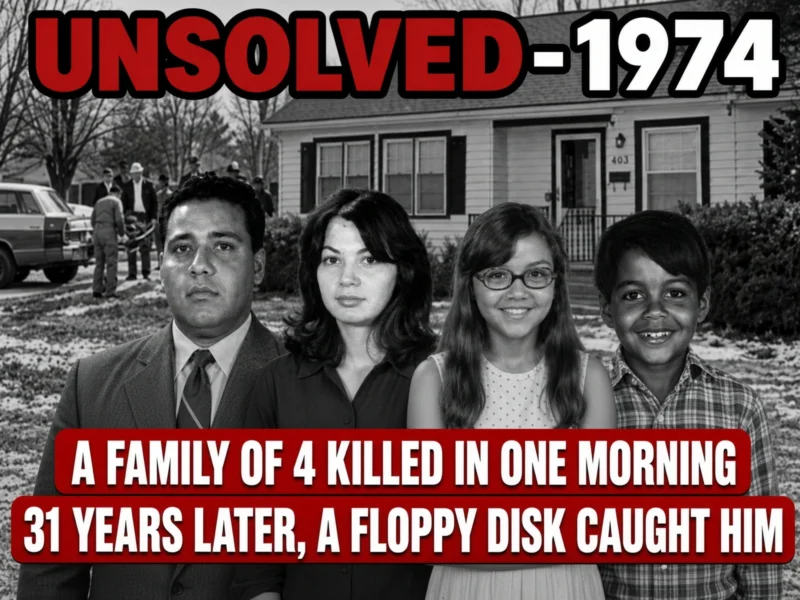
KANSAS 1974 Cold Case Solved After 31 Years — Justice for the Otero Family
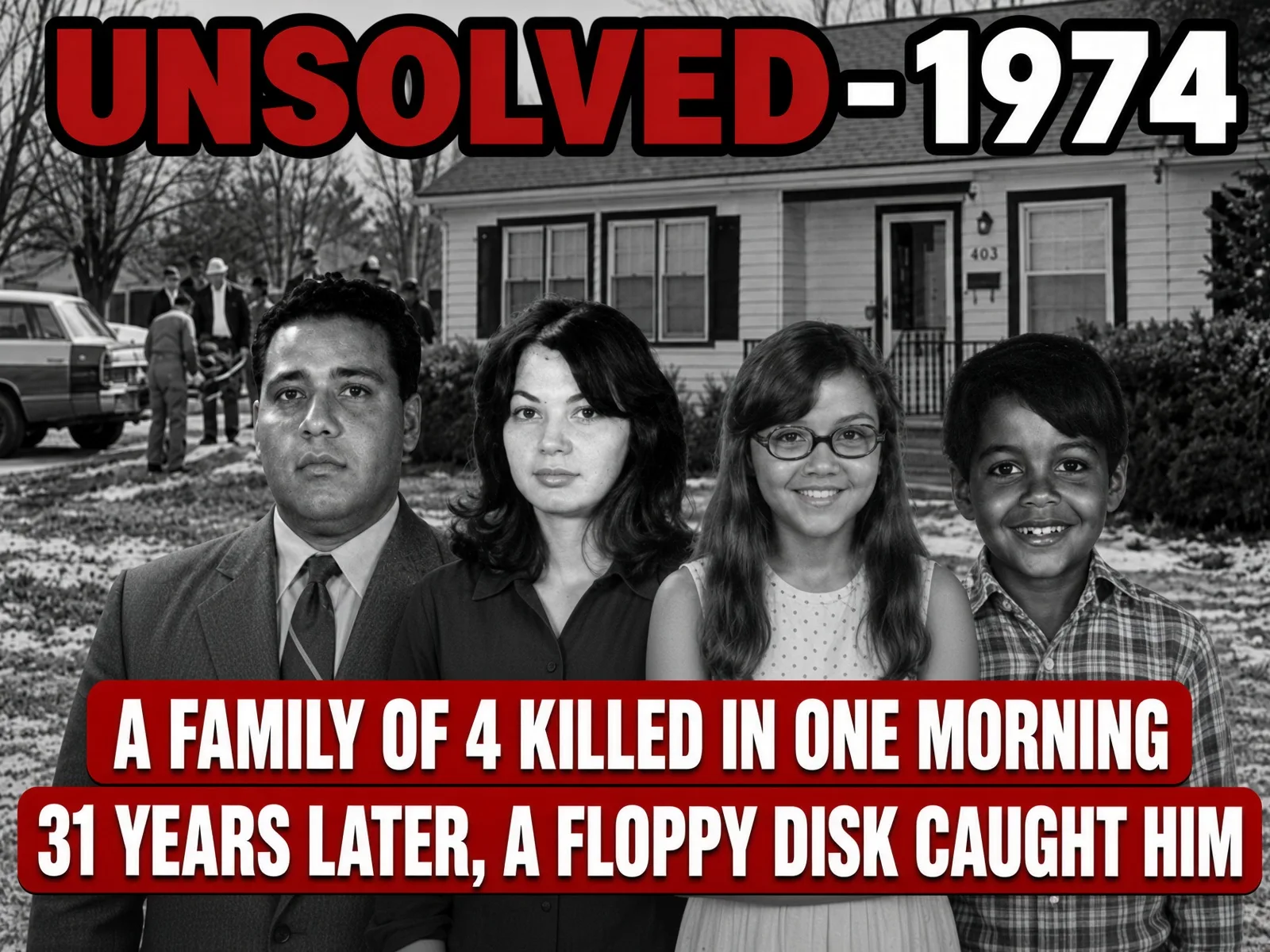
On the morning of January 15, 1974, Charlie Otero, fifteen years old, walked home from junior high school in Wichita, Kansas.
He had just passed a biology test, was starting to make friends in the new city, and was planning to follow his father into the Air Force.
His family had moved to Wichita less than six months earlier.
His father was a retired Air Force master sergeant after more than twenty years of service, and his mother was a woman skilled in judo who taught her children self-defense.
For the first time, life seemed to be settling down.
Charlie never walked into the house the same way he had walked out that morning.
The dog, Lucky, was standing outside in the yard, something that had never happened.
Inside his father lay face down on the bedroom floor, wrists and ankles bound with drapery cord, his neck strangled with a leather belt.
His mother was bound and strangled on the bed.
His sister Josephine, eleven, was hanging by a rope in the basement.
His brother Joey, nine, had suffocated under three bags over his head.
Four people in one family, bound, tortured, and murdered in a single morning.
The phone line had been cut.
There was no sign of forced entry.
The killer had spent considerable time with each victim, then vanished completely.
Police arrested three suspects. All three were wrong.
Then a letter arrived at the newspaper claiming responsibility, describing unpublished crime scene details, and signed with three letters.
BTK. Bind. Torture. Kill.
The killer was not caught. He went on to murder six more people over seventeen years.
Then he disappeared, living right in the community, going to church every Sunday, leading Boy Scouts, working as a city compliance officer, only a few miles from 803 North Edgemore.
It took thirty-one years, a 1.44-megabyte floppy disc, his own uncontainable arrogance, and a DNA test taken from his own daughter before the case was solved.
This is the story of the Otero family, of the killer who called himself BTK, and of how justice finally caught up with a man the whole city once trusted.
And it began long before that morning.
To understand why the Otero family was in Wichita in January 1974, you have to know where Joseph Otero came from.
Joseph Otero was born in Puerto Rico and grew up in Spanish Harlem, New York, among narrow streets where Spanish echoed from every window and the smell of black coffee drifted from every alley corner.
He joined the United States Air Force in 1952 when he was only seventeen and spent the next more than twenty years in uniform.
He did not merely serve. He excelled.
He rose to master sergeant, became an Army boxing champion, and built a reputation as a tough, disciplined man who was nevertheless full of warmth for his family.
The military took him everywhere.
His oldest son, Charlie, was born in England, where Joseph was stationed in the early years of his career.
From England, the family moved to Camden, New Jersey, where they lived on Clinton Street and became the neighbors the whole block loved.
Mandy Alvarado, a former neighbor, later remembered that the Oteros used to sell candy at the corner store and that every child in the neighborhood adored them.
Maria Feliciano, another resident, remembered that Joseph drove to Fort Dix every day, probably as an aircraft mechanic.
Memories of them remained vivid decades later. That was the kind of family you remember.
After Camden, the military took the Otero family to Panama, where Joseph spent seven years at the Inter-American Air Forces Academy.
There he taught military personnel from all over Latin America how to repair Phantom fighter jets and C-130 transport planes.
Charlie later said his father would often vanish for weeks at a time, flying missions he refused to discuss.
“He never talked about those flights. He never explained why he had to go. He just went, then came back, and life continued as if nothing had happened.”
From Panama, the family moved to Puerto Rico, where the children lived with their grandparents while Joseph looked for a future after the service.
He had just spent more than two decades of his life serving the country since he was a teenager, and now he was looking for the best opportunity for his wife and children.
Then one day he called and said the whole family was coming to Wichita, Kansas.
He had found a job at Cook Airfield, a small airport maintaining private planes.
Charlie remembered that moment very clearly.
He left the beautiful tropical island of Puerto Rico and landed in the middle of Kansas wheat fields.
The change could not have been greater.
Julie Otero, Joseph’s wife, was also born in Puerto Rico and grew up in New York like her husband.
She was a woman anyone who met her remembered.
Neighbors in Camden described her as beautiful and full of life, just like her daughter.
But beneath that graceful exterior was a surprisingly tough woman.
She was skilled in judo and did not keep that skill to herself.
She insisted that all the children be trained in self-defense.
In a military family that moved constantly, where new cities and strange faces were a permanent part of life, Julie wanted her children to know how to protect themselves no matter where they were.
In Wichita, she worked at the Coleman Company, a well-known regional manufacturer of camping equipment.
The Oteros had five children.
Charlie and Danny, both fifteen, were the oldest in the house.
Carmen was thirteen, old enough to understand the world but still young enough to need her parents.
Josephine, whom the family called Josie, was eleven.
And Joseph Jr., whom everyone called Joey, was nine, the youngest.
Joey was the most energetic child, sharing his parents’ love of pets and always running around the fenced backyard.
Josie looked most like her mother, beautiful and stylish, even as a little girl.
The house at 803 North Edgemore Street on the east side of Wichita was where the family began a new chapter.
It looked ordinary from the outside. A modest wood-frame house with a fenced backyard where the children and the dog Lucky could play every afternoon.
From many angles, this was the perfect picture of the American dream.
A veteran who had served the country for more than two decades, his wife, five children, a steady job, a new house, and a city where everything could start over.
They had been in Wichita less than six months.
Charlie especially was starting to find his rhythm.
He had always been a good student and an energetic athlete, outgoing and well-liked by friends.
But the move from tropical Panama to the middle of Kansas’s flat wheat fields had thrown him off balance for a while.
Now things were gradually getting better.
He had just passed a biology test. He was making new friends.
He planned to go to Wichita State University after graduation, then join the Air Force like his father and become a jet pilot officer.
His father expected a great deal of him, and Charlie wanted to prove he was worthy of those expectations.
Then came the morning of January 15, 1974.
Wichita weather was cold by Kansas winter standards, a high of thirty-eight degrees and a low of twenty with no snow.
It was an ordinary morning by every definition.
Charlie, Danny, and Carmen left for school as they did every day.
Joseph drove Charlie to Robinson Junior High just as he did every morning.
Nothing unusual, no warning signs, no reason to believe that today would be different from any other day.
At home, Joseph and Julie stayed with Josie and Joey.
Four people in an ordinary house on an ordinary street on the east side of Wichita, Kansas.
The children may have eaten breakfast. Joseph may have been getting ready to go to work at the airfield. Julie may have been cleaning the kitchen, but no one was left alive to tell exactly what those final minutes looked like.
Between about seven and seven-thirty that morning, just after the three oldest children had left for school, a man walked into 803 North Edgemore through an unlocked back door.
He carried a handgun and a bag containing rope, pre-cut drapery cord, and plastic bags.
He had prepared.
This was not an impulsive act.
This was a plan calculated in advance by someone who had watched this family, studied their routines, and knew exactly when the older children left and when the remaining four would be alone.
There was no sign of forced entry, no broken glass, no lock smashed.
He walked in as if he were walking into his own house.
At gunpoint, the killer forced all four into the back bedroom. He ordered them to lie down.
Then he began to bind them.
He used cord cut from the drapes in that very house, twisting it around each person’s wrists and ankles one by one.
He bound Joseph first, then Julie, then the two children.
Four people lay on the bedroom floor, helpless in their own home, watching a complete stranger take control of their lives.
Think about that for a second.
A combat-trained veteran, a wife skilled in judo who had taught her children self-defense.
And none of them could do anything, because self-defense skills do not work when a gun is pointed at your child’s head.
Once all four were bound, the killer began trying to kill the parents by putting plastic bags over their heads.
Joseph bit through the bag.
The reflexes of a soldier, a man who fights to the last second, even with his hands and feet tied.
The killer looked at the hole in the plastic bag and changed tactics.
He wrapped several T-shirts around Joseph’s head so he could no longer bite, then put a new plastic bag over that, then tightened a leather belt around his neck.
Joseph Otero died on the floor of the master bedroom, lying face down, hands and feet bound with drapery cord, his neck strangled with a belt and a clothesline.
There was vomit on the floor near his body. He had fought. He had lost.
Julie watched her husband die.
During the bagging she had lost consciousness but was still alive.
When she came to, half-conscious, she saw that her husband was dead and she did the only thing any mother would do.
She begged for her children’s lives. Not for her own life. For her children.
The killer tightened a cord around her neck while she was pleading.
Julie Otero, thirty-three, the woman skilled in judo, the mother who taught her children self-defense, died bound on the bed in her own bedroom.
Then he turned to the children.
Joseph Jr., nine, Joey, the energetic child who loved pets and ran around the backyard every afternoon, was strangled.
The boy’s body was found with three bags over his head, his hands tied behind his back.
Nine years old. Three bags.
The killer did not stop there.
He took Josephine, eleven, down to the basement, separating the girl from the bodies of her parents and little brother.
Alone, eleven years old, in the basement.
He hanged her with a rope tied to a sewer pipe.
Josie’s body was found hanging, her clothing partially removed.
She looked most like her mother, beautiful and stylish. She wore glasses.
Her glasses were found in the southwest bedroom, far from the basement.
He had spent considerable time in that house. No hurry, no panic.
He had cut the phone line before entering, making sure no one inside could call for help.
He used materials from the house itself, drapery cord, clothesline, plastic bags, as if the master of this house were not the family, but him.
Then he left.
No one saw him go out the door. No one saw him on the street. He vanished completely.
At 3:30 p.m., Charlie Otero stepped off the school bus and walked home under the clear winter sky of Kansas.
He was almost excited. He had passed his biology test. He was making new friends.
The future looked bright for the first time since leaving Puerto Rico.
Then he saw the dog.
Lucky was standing outside in the yard. That had never happened. The dog was always inside.
Charlie walked in and immediately knew something was wrong.
He later said he could smell the fear inside the house, that when you walked in, you could smell death.
In the master bedroom, his father lay face down on the floor, motionless, bound.
On the bed, his mother lay motionless, bound and gagged.
Charlie, fifteen, stood in his parents’ bedroom, looking at two bodies, and the world he knew collapsed in a few seconds.
He later described that moment in words no one who hears them can forget: “as if someone ripped open my chest and tore my heart out.”
Danny and Carmen also came home from school and walked into the same scene.
Carmen, thirteen, ran to her mother and did what a child’s instinct told her to do.
She tried to save her mother with the only tool she had in her hands, a pair of nail clippers.
Carmen tried to cut the cloth gagging her mother.
Her mother had been dead for hours. But Carmen, at thirteen, did not know that, or would not accept it, and she kept cutting, a pair of nail clippers on the gag of a dead woman.
That is the image that would follow Carmen Otero for the rest of her life.
Charlie and his siblings could not find Josie and Joey.
Police and a chaplain later told them that the two younger children were also dead.
One morning, four lives, one family torn apart.
When police arrived at 803 North Edgemore, they walked into a crime scene no one in the Wichita police force had ever seen before.
Wichita in 1974 was not a city familiar with this kind of violence.
This was the heart of Kansas, the aviation capital with Cessna and Beechcraft plants, a place where people left their doors unlocked and children walked to school alone.
Four members of one family, bound and murdered in their home in daylight in a quiet neighborhood, was something that had never happened here. Never.
News spread across the city within hours.
Neighbors locked their doors. Parents kept their children inside.
A fear never felt before settled over Wichita, because if this could happen to the Otero family on an ordinary street on an ordinary morning, it could happen to anyone.
The investigation began that same night and quickly became the largest case in Wichita police history.
Police Chief Floyd Hannon held press conferences at least twice a day to release details, speculate about motive, and list the lines of inquiry being pursued.
Local newspapers, especially the Wichita Eagle and the Beacon, reported every new development.
The whole city watched, the whole city waited, and the police began with a problem for which they had no equation to solve.
Ordinarily, in family murders, there is a connection, an acquaintance, a conflict, a motive that can be traced.
In the Otero case, there was nothing.
No sign of forced entry, no property clearly stolen, no known enemies, no link between this family and any criminal activity.
Police pursued three hypotheses in parallel.
The first hypothesis was that the killer might be someone in the family.
Officer Bullis even suggested this to Charlie at the scene that afternoon.
Investigators quickly ruled that out. The three surviving children had all been at school all morning, confirmed by dozens of witnesses, and there was no evidence pointing toward them.
The second hypothesis was a drug connection, perhaps originating from the family’s time in Panama or Puerto Rico.
Chief Hannon personally flew to Panama and Puerto Rico to pursue this lead. He came back empty-handed. Nothing.
The third hypothesis was that someone was specifically targeting Julie. That theory also led to a dead end.
Every door the police opened led to a wall.
Susan Peters, a journalist and news anchor at KAKE TV in Wichita, later summed up the investigators’ confusion with a simple observation.
“Usually there is some kind of connection, and in this case there was no connection at all. They knew nothing. What caused this? What was the Otero family’s background? No one had an answer.”
While the police spun in circles, Charlie Otero had a theory of his own.
He believed his father’s military career included secret work.
Joseph often vanished for weeks at a time in Panama, flying missions he refused to discuss with the family.
He never said where he was going. He never explained what he was doing.
Charlie clung to the idea that the murders were connected to his father’s double life in the military, that someone from that hidden past had followed the family to Wichita for revenge.
It was a reasonable theory for a fifteen-year-old boy trying to find a reason for the unexplainable.
But it was also wrong.
Under pressure to show progress, police arrested three suspects.
The news spread. The city exhaled in relief. Maybe the nightmare was over.
But it was not over.
All three suspects were just talking to get media attention. They knew nothing about the Otero case.
And the only person who knew the truth was watching it all from a distance, angry that others were getting credit for what he had done.
In October 1974, nearly nine months after the murders, the Wichita Eagle received a letter.
That letter changed everything.
The writer claimed responsibility for the Otero family murders and provided details about the crime scene that had never been released to the public.
He described the position of each body, how each victim was bound, the materials used, the location of objects in the house.
He described Josephine hanging in the northwest part of the basement, mentioned a dryer or freezer north of the body, listed every cord, every knot, every piece of cloth.
That level of detail could not have come from anyone except the person who had been in that house that morning.
And in the letter, he wrote that the three people arrested were just talking. “I did it by myself and no one helped me.”
Then he signed with three letters Wichita would never forget.
BTK. Bind. Torture. Kill.
He gave himself a nickname. He wanted to be known. He wanted recognition.
And he wanted Wichita to know he was still out there.
That first BTK letter was not a confession. It was a declaration.
And it proved the worst thing police could imagine.
The killer had not murdered the Otero family out of personal hatred, drugs, money, or any motive that could be traced.
He killed them because he wanted to kill, and he had not stopped.
On April 4, 1974, less than three months after the Otero murders, Kathryn Bright, twenty-one, was stabbed to death in her home in Wichita.
Her brother Kevin was shot twice in the head but miraculously survived.
The Brights’ phone line had also been cut. The same method, the same calculation.
Police later concluded she was a BTK victim.
Three years of silence passed.
Then on March 17, 1977, Shirley Vian, twenty-four, was found strangled in her home.
She was partially bound, had a plastic bag over her head and cord wrapped around her neck, hands, and feet.
Shirley had three small children in the house at the time. They were not harmed.
BTK later wrote that a phone call interrupted his plan to kill them.
Shirley’s five-year-old son was the one who opened the door for the killer.
On December 8, 1977, Nancy Fox, twenty-five, was strangled with nylon pantyhose in her home.
The phone line was cut. She was partially bound.
And this time the killer did something no one expected.
He called the police dispatcher to report the crime.
His voice was recorded. For the first time, police had BTK’s voice.
In January 1978, a poem referring to the Shirley Vian murder was sent to the Wichita Eagle Beacon.
In February 1978, another letter from BTK was sent to KAKE TV in Wichita claiming responsibility for the deaths of Vian and Fox, along with another unnamed victim.
Police Chief Richard LaMunyon announced what the whole city had feared but no one had dared say out loud.
There was a serial killer operating in Wichita, and he had threatened to strike again.
In August 1979, police broadcast the recording of BTK’s voice from the 1977 call on radio and television and received more than one hundred tips on the first day. None of them led to the killer.
Also in 1979, BTK broke into a house and waited inside, but left before the sixty-three-year-old woman who lived there returned.
He later sent her a letter telling her he had been in her home.
That was not a warning. That was a boast.
A secret task force named Ghostbusters was formed to hunt BTK.
Detectives spent thousands of hours analyzing letters, comparing handwriting, checking suspect lists, combing military records, utility company employees, plumbers, anyone with a legitimate reason to get close to people’s homes.
They chased hundreds of leads. Not one lead pointed to the right person.
Then BTK went silent.
After 1979, there were no more letters, no more poems, no more calls, no more murders linked to him for years.
The Ghostbusters team continued investigating for a few more years and then disbanded.
The case officially became a cold case.
Wichita tried to forget.
The city wanted to believe BTK was dead, or had been arrested for another crime somewhere else, or had moved far away.
Any explanation that would let people sleep at night.
But not everyone forgot.
When journalist Susan Peters moved to Wichita in 1983, her colleagues immediately asked whether she knew about the BTK serial killer.
Nine years after the last known murder, and that name was still the first thing people mentioned when they talked about this city.
BTK had not only killed seven people. He had killed a city’s sense of safety.
And in Wichita, his name became something like the weather, always there even when no one wanted to mention it.
But throughout those years, there were people who were never allowed to forget.
The three surviving Otero children carried the murders every day.
One afternoon, when their world had ended after the funeral, the three surviving Otero children left Wichita and tried to start life over in New Mexico.
No parents, no Josie, no Joey, no house on Edgemore Street.
No future Charlie had imagined when he sat in biology class and dreamed about the Air Force.
All of it had been taken in one morning by a person they had never met, for a reason no one could explain.
Adjusting was nearly impossible.
PTSD hit each child in different ways, but all equally devastating.
Danny began to rebel, behaving the way a teenager who has lost his anchor behaves when the world no longer makes sense.
Charlie chose a different path that was no less dangerous. He started racing motorcycles to release the aggression boiling inside him.
He described himself in that period as very aggressive, very reckless with his life, with his body.
Not long after graduating high school, Charlie had a serious motorcycle accident.
The handlebar went through his helmet and into his throat. His whole life flashed before his eyes in a few seconds.
And when he woke up, instead of fear, his first thought was indifference.
Who cares?
Why build a future if someone is going to come and take it away?
That was the question Charlie lived with for years.
Not a rhetorical question. It was the actual philosophy of a person who had seen proof that everything you love can be destroyed in a few hours for no reason at all.
The three Otero siblings maintained an existence. Not a life. An existence.
Charlie used that exact word. They just maintained an existence.
Meanwhile, thousands of miles away in Wichita, Kansas, the man who had destroyed the Otero family was living the most ordinary life you could imagine.
And this is where the story becomes frightening in an entirely different way.
Dennis Lynn Rader was born on March 9, 1945, in Pittsburg, Kansas.
The oldest of four brothers born to William and Dorothea Rader.
He grew up in Wichita, attended Wichita Heights High School, and graduated in 1963.
He joined the United States Air Force and served from 1966 to 1970, stationed at bases in the United States and overseas.
After leaving the service, he returned to Wichita and began building a life that, on the surface, looked like that of any middle-class man in the heart of Kansas.
He married. He had two children. He bought a house in Park City, a suburb of Wichita.
From 1974 to 1988, he worked at the Wichita branch of ADT Security Services, holding positions that gave him access to customers’ homes.
Think about that.
Throughout the period he was killing people and sending taunting letters to police, Dennis Rader was working for a company that installed home security systems.
He knew how alarm systems worked. He knew how to disable them.
He had a legitimate reason to go into strangers’ houses, observe the layout, and assess weaknesses.
The job of protecting people was also the job that allowed him to hunt.
After leaving ADT, Rader became a municipal compliance officer for the city of Park City.
That was a job in which neighbors saw him every day, driving around the neighborhood, checking building code violations, measuring fence heights, counting dogs in yards.
People who lived in Park City described him as strict, sometimes awkward in conversation, controlling to an uncomfortable degree.
He was the kind of person who knocked on your door because the lawn was uncut or the trash can was in the wrong place.
Unpleasant, yes. But no one looked at him and thought serial killer.
And then there was church.
Dennis Rader was an active member of Christ Lutheran Church in Wichita.
Not just an ordinary member.
He was president of the church council, the head of the congregation, the person everyone in the church looked up to as a moral example.
Every Sunday he sat in the pews, sang hymns, and led council meetings.
He was also a Cub Scout leader, guiding neighborhood children in outdoor activities and teaching them about responsibility and character.
Father, husband, churchgoer, Scout leader, city compliance officer.
That was the Dennis Rader the outside world saw.
While Charlie raced motorcycles toward death in New Mexico and wondered why he should keep living, Dennis Rader, a few miles away, was leading Scouts on camping trips and running Wednesday night church council meetings.
While Danny Otero rebelled and Carmen Otero carried the image of nail clippers on her mother’s gag through every night, Dennis Rader was driving to ADT Security every morning and installing alarm systems for families who never knew that the man protecting them was the greatest threat they could face.
He lived only a few miles from 803 North Edgemore.
He shopped in the same grocery stores. He drove the same roads. He breathed the same air as the city he had terrorized.
And no one knew.
The question everyone asked after Rader was arrested was always the same.
How did he get away with it for thirty years?
The answer is more frightening than any detail of the murders.
He got away with it because there was no reason to suspect him.
In 1974 there was no DNA database.
Fingerprints were only useful if a suspect already had a record in the system, and Rader had never been arrested for anything before.
The voice recorded in 1977 was broadcast widely, but no one recognized him, or if anyone did, they did not believe that the churchgoing Scout leader they knew could be BTK.
He did not fit any psychological profile the public imagined for a serial killer.
He was not a recluse living alone in a dark apartment.
He was not a drifter with no job and no family.
He was your neighbor. He was the man who fixed your fence. He was the man who took your child camping.
And that is exactly why he was not caught.
After the murder of Dolores Davis in 1991, the tenth and final victim, BTK went completely silent.
No letters, no poems, no calls.
For thirteen years, Wichita lived in that strange silence, half wanting to believe he was dead, half fearing he was only waiting.
In 2004, a local newspaper published an article speculating that BTK might be dead or sitting in prison for another crime somewhere.
That article, written in an almost reassuring tone, almost treating the case as a closed chapter of history, seemed to touch something inside Dennis Rader.
He was not dead. He was not in prison.
He was reading that article from his house in Park City, and he could not stand being forgotten.
In March 2004, a letter arrived at the Wichita Eagle.
Inside was a photocopy of the driver’s license of Vicki Wegerle, the twenty-eight-year-old woman strangled in her home in 1986, along with photographs of her body.
Before that, the Wegerle case had never been officially linked to BTK.
Now it was linked. Police confirmed the connection.
And what Wichita feared most became real.
BTK was still alive. BTK was still in Wichita. And BTK wanted everyone to know he was still here.
BTK’s return in 2004 was not the act of a killer planning another attack.
It was the act of an ego that could not bear anonymity.
Dennis Rader had lived thirteen years in silence, going to church, leading Scouts, measuring fence heights for the city of Park City.
And with each passing day he became a little more ordinary, a little more invisible, and that ate him from the inside.
He was BTK. He had killed ten people. He had terrified an entire city for nearly two decades, and now no one mentioned him anymore.
The March 2004 letter to the Wichita Eagle was only the beginning.
Over the months that followed, Rader sent a series of packages, letters, and puzzles to police and local television stations.
Each package contained clues, sometimes from old cases, sometimes crossword puzzles with hint words like military, surveillance, stalking, and telephone company.
He sent dolls bound in plastic bags. He sent copies of victims’ personal documents. He sent jewelry taken from crime scenes decades earlier.
Every package was a reminder that he was still here, that he still controlled the game, that after thirty years Wichita police still did not know who he was.
And from the investigators’ point of view, this return was an opportunity they had never dared hope for.
Every package was potential evidence. Every letter was a lead. Every contact was a chance for him to make a mistake.
And instead of treating these communications as a game that had to be won by the killer’s rules, detectives treated each exchange as evidence to be collected.
They were patient. They waited.
They knew BTK’s arrogance would eventually betray him. They just did not know how quickly it would happen.
In January 2005, police recovered a cereal box left at a public location.
Inside was a note from BTK posing the question that later became the decisive turning point of the entire case.
He asked police whether, if he sent a floppy disc, they would be able to trace him through that disc.
Stop here for a second.
A serial killer who had escaped every hunt for thirty-one years was asking the very people hunting him whether the next technology he planned to use was safe.
He was asking the prey whether the trap would work.
And the police lied.
They ran an ad in the Wichita Eagle with a line only BTK would understand.
“Rex, it will be okay. Rex, everything will be fine. The floppy disc will be safe. Go ahead and send it.”
Rader read that ad and believed it.
He had asked. He had received an answer. And he had no reason to suspect that police would lie, because in his mind the relationship between him and the police was a relationship between two opponents who respected each other and played by the rules.
He never considered the possibility that police would break the rules of the game he himself had set.
In February 2005, television station KAKE in Wichita received a letter with a purple 1.44-megabyte Memorex floppy disc inside.
The disc contained the messages Rader wanted to convey, but it also contained something he did not want to convey and did not know was still there.
Computer forensic analysts examined the disc and found more than Rader intended to send.
A deleted Microsoft Word document could still be recovered from the disk.
That document contained the agenda for a church council meeting.
And more important, the document’s metadata recorded two pieces of information.
The document was last saved by a user named Dennis, and the registered organization was Christ Lutheran Church.
Dennis. Christ Lutheran Church.
A simple internet search showed that the president of the church council at Christ Lutheran Church in Park City was a man named Dennis Rader.
After thirty-one years of hunting, after thousands of leads, after the Ghostbusters team, after hundreds of suspects eliminated, the answer lay in the metadata of a deleted Word document on a floppy disc the killer himself had voluntarily sent.
And he had asked beforehand whether this would be safe.
But a name on a floppy disc was not enough for an arrest warrant.
Police needed physical evidence linking Rader to the crime scene.
They had DNA samples collected from scenes years earlier, including a sample from under the fingernails of Vicki Wegerle, the 1986 victim.
But they needed Rader’s DNA to compare, and they could not take a sample directly from him without revealing that he was a suspect.
Instead, they found a detour.
Investigators obtained a court order to get a Pap smear sample from Rader’s daughter, Kerri Rader, from the medical clinic at Kansas State University, where she had been a patient.
DNA from that sample was sent to a lab in Topeka.
The results came back within twenty-four hours.
The DNA sample showed a direct blood relationship to the DNA found at the crime scene.
Kerri Rader’s father was BTK.
Science had spoken, and science does not lie.
With both digital evidence and biological evidence in hand, police put Rader under surveillance.
They tracked his daily movements, vehicles, schedule.
When they drove past his house, they noticed a black Jeep Cherokee parked in the driveway, the same type of vehicle that had appeared in old security camera footage related to one of BTK’s package drops.
Every piece had fallen into place.
On February 25, 2005, in the middle of the lunch hour, Wichita police stopped Dennis Rader’s car as he was driving home from the Park City compliance office.
The arrest was quiet and undramatic.
No chase, no gunfire, no confrontation.
The man who had terrorized a city for three decades was handcuffed beside his car in a quiet neighborhood on an ordinary afternoon.
Rader appeared genuinely surprised when he was arrested, and his first reaction during questioning revealed more about his psychology than any expert analysis.
He expressed shock that police had lied to him about the floppy disc.
A man who had bound, tortured, and killed ten human beings, including two children ages nine and eleven, was shocked that police had not kept their word to him.
In Dennis Rader’s mind, he and the police had an agreement, a relationship based on mutual trust.
He asked an honest question. He received an answer. And they had broken the agreement.
The moral outrage of a serial killer at being lied to. That was Dennis Rader.
In more than thirty hours of interrogation after his arrest, Rader confessed to all ten murders.
He provided details, directed investigators to a cache of photographs, drawings, and handwritten documents he called the mother lode.
Thousands of pages of meticulously recorded material about his killing career, including photographs he took of himself wearing victims’ clothing and drawings that restaged the murders like film scenes.
In June 2005, Dennis Rader appeared in court and pleaded guilty to ten counts of first-degree murder on the first day.
No appeal. No defense. He pleaded guilty to all of them.
And the way he pleaded guilty made those present in the courtroom shudder.
He described each murder in a flat, emotionless voice, as if he were reading a work report.
Many observers remarked that he spoke as if he were giving a presentation.
He called the victims projects. Not people. Projects.
Each murder was a project he had planned, carried out, and completed.
The Otero family was the first project.
The sentencing hearing began on August 17, 2005, at the Sedgwick County Courthouse in Wichita and lasted two days, becoming one of the most watched trials in Kansas history.
For the first time, the public heard the full scope of Dennis Rader’s crimes, not only from the evidence, but from his own mouth.
Through interrogation recordings presented in court, Kansas Bureau of Investigation agent Larry Thomas testified that after killing Josephine’s parents and little brother, Rader took the eleven-year-old girl down to the basement alone.
Prosecutors projected onto the screen Rader’s account of the last exchange between him and Josie before she died.
“What’s going to happen to me?” the girl asked.
Rader answered, “Well, honey, you’re going to be in heaven with the rest of your family.”
Then he hanged her. Then he defiled her body.
The courtroom was completely silent when that testimony was read.
And Rader added something during the interrogation that those who heard it would never forget.
He said the Otero family would serve him in the afterlife.
A family consisting of a father, a mother, an eleven-year-old daughter, and a nine-year-old son, in his diseased mind, existed to serve him both in life and after death.
Throughout the sentencing hearing, Rader sat calmly, drank water, occasionally took notes on legal paper, occasionally looked away for a few seconds when crime scene photos were shown on the screen, then turned back with a normal expression.
He described the murders in a detached and unrepentant way, almost indifferent, as if discussing a weekly work schedule.
Many observers of the trial remarked that his emotional detachment was more frightening than the details themselves.
On the other side of the courtroom, the three surviving Otero siblings sat and heard everything.
Thirty-one years after the afternoon they walked into 803 North Edgemore and the world collapsed, they were sitting only a few meters from the person who had caused it all.
Carmen Otero clutched an afghan throughout much of the hearing, nervously tapping her foot on the floor.
She was thirteen when she used nail clippers to try to cut the cloth gagging her mother.
Now she was a grown woman sitting in a courtroom listening to her mother’s killer describe his actions as if reading a shopping list.
Charlie and Danny sat with their arms folded most of the time, occasionally wiping away tears.
But when prosecutors projected a close-up photograph of Josephine onto the screen, Charlie Otero collapsed.
His face flushed. He dropped his head onto his thigh and wept.
Josie. The girl who looked most like her mother. The girl who wore glasses. The eleven-year-old who was promised she would go to heaven with her family before being hanged in the basement of her own home.
When it was the victim’s family’s turn to speak, each person was given five minutes to address Rader and the court directly.
Carmen Otero stepped forward and said what she had carried for thirty-one years.
“In my opinion, Dennis Rader does not deserve to live. I want him to suffer the way the victims suffered. This man needs to be thrown into a deep dark hole and left to rot. He should never see sunlight.”
That was not impulsive anger. That was thirty-one years of pain compressed into five minutes.
Before being sentenced, Rader stood and delivered a final speech lasting twenty minutes.
Those present in the courtroom compared it to an Oscar acceptance speech.
He cried. He admitted his faults. He thanked his supporters.
And then, astonishingly, he compared his own situation to that of the victims, as if he too were someone who had suffered in this story.
Twenty minutes of pure narcissism from a man who had killed ten people and still believed he deserved to be heard.
Judge L. Breland Hilburn sentenced Dennis Rader to ten consecutive life sentences with no possibility of parole for a minimum of 175 years.
Because his murders occurred during the period when Kansas banned the death penalty, he was not eligible for execution.
He would die in prison, but he would die of natural causes, not by lethal injection or the electric chair.
Prosecutor Ed Peters summed up the result in one sentence.
“A boastful killer has been convicted.”
Rader was taken from the courtroom and transferred to El Dorado Correctional Facility in Kansas, where he was placed in solitary confinement. He remains there to this day.
Charlie Otero spoke about the verdict with painful honesty.
“It was a relief when he confessed, but in terms of closure, it is still a long way off. It turned my life 180 degrees and left me with no hope for the future I had seen before the murders. My life went from wonderful and peaceful to dark and bleak.”
Closure.
That word appears in every interview with victims’ families, and it always comes with the same message.
There is no closure. There is no moment when the pain ends and life starts again.
There is a verdict. There is a sentence. There is justice in the legal sense.
But four people are still dead. And three children still have to live the rest of their lives with that afternoon.
But Charlie Otero did not let that afternoon define his entire life.
And that is perhaps the most extraordinary part of this story.
In the years after the trial, Charlie gradually found a path from existence to an actual life.
The boy who once raced motorcycles toward death and asked who cares gradually became a man who chose to live with purpose.
The boy who once wanted revenge gradually became a man who spoke about forgiveness.
Not forgiveness for Rader, but forgiveness for himself, for having survived when his family did not.
In January 2019, Charlie appeared on ABC’s 20/20 and Good Morning America, where he described the journey of moving past the initial feelings of revenge and anger.
He emphasized that his journey was about redemption, about how to find meaning again after all meaning had been taken away.
The documentary “I Survived BTK” aired on January 15, 2012, on the thirty-eighth anniversary of the Otero family murders.
The film recounted Charlie’s journey from the fifteen-year-old boy who found the bodies to the man facing his past and trying to reconcile with it.
In 2025, Netflix released “My Father, the BTK Killer,” in which Kerri Rawson, Dennis Rader’s daughter, offered a view from the killer’s family, a woman forced to face the truth that the father she loved and respected all her life was the man who killed ten people.
The Otero case left a legacy far beyond a trial or a sentence.
The 1.44-megabyte floppy disc Dennis Rader voluntarily sent to police became one of the most cited examples in digital forensics curricula around the world.
It proved that metadata, the hidden data users do not see and often do not know exists, can break a case that decades of traditional investigation could not solve.
The use of familial DNA, taking a sample from Rader’s daughter instead of from him, became a precedent for a forensic tool that would later be used to solve a wave of other cold cases across the United States.
But perhaps the real legacy does not lie in the floppy disc or the DNA or the trial.
It lies in the story of Charlie Otero.
On the morning of January 15, 1974, a fifteen-year-old boy walked into the house at 803 North Edgemore in Wichita, Kansas, and discovered that his family had been destroyed.
That boy could have let that moment swallow the rest of his life.
And for many years, it almost did.
But Charlie Otero is still here, more than half a century later, telling his story, talking about trauma and recovery, talking about the darkest things human beings can do to one another and about the ability to survive them.
The man who once asked why build a future if someone is going to come and take it away now spends his life proving that an answer to that question exists.
Dennis Rader will die in a solitary cell in El Dorado. Ten life sentences, no parole, no sunlight.
The house on Edgemore Street still stands there, looking ordinary from the outside, like most houses where history has happened.
A thirty-one-year cold case, a floppy disc, an ego that could not bear anonymity, and twelve letters in the metadata that ended it all.
Dennis. Christ Lutheran Church.
The dog was standing outside in the yard, the floppy disc was sitting in a KAKE-TV mailroom, and the Pap smear was sitting in a clinic file at Kansas State University.
None of them knew what they were holding. All of them helped end a thirty-one-year silence.









