Johnny Carson Dared Kenny Rogers to Sing “Whitney Houston’s Song”on Live TV – What Happened Next
Thursday, May 15, 1986. Kenny Rogers was sitting in the green room of NBC Studio 1 in Burbank, California.
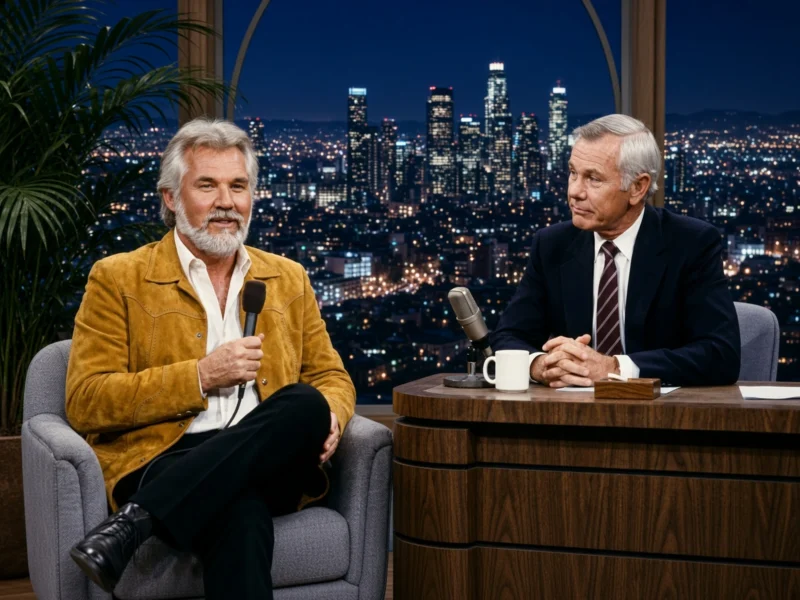
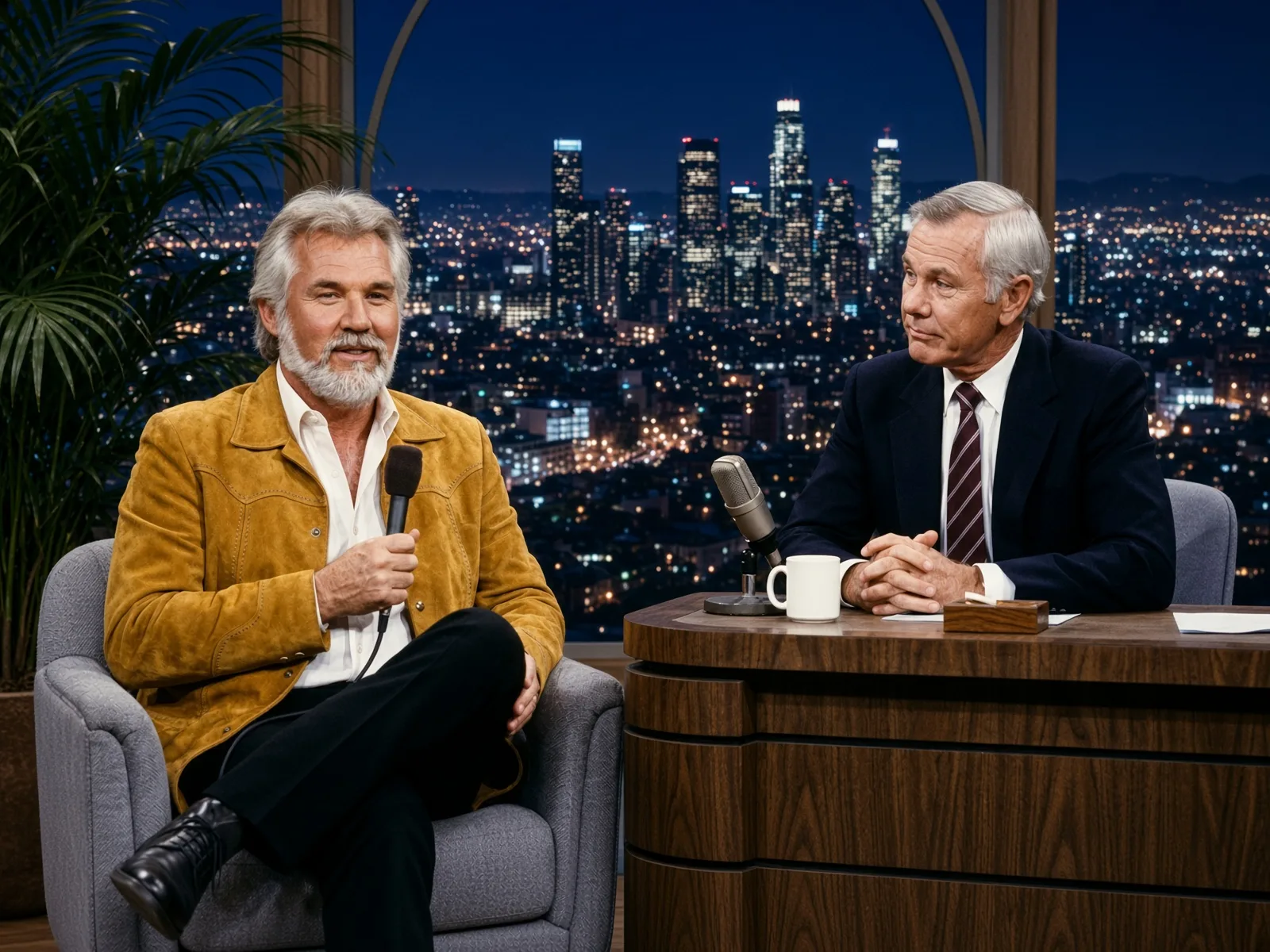
He was 47 years old, and his beard had gone almost completely silver, trimmed close and neat. He wore a mustard-gold suede western jacket over a crisp white shirt open at the collar.
He sat on a beige couch with one boot propped on the opposite knee, turning a paper cup of coffee slowly in his hands, the way he always did when his mind was somewhere else.
In exactly 11 minutes, Johnny Carson would walk into that green room, sit down across from him, and ask him to do something every singer in America would have called impossible. It would lead to five of the most unexpected minutes in the history of late-night television, and to 400 strangers holding hands in the dark.
But Kenny didn’t know that yet. Nobody did.
“The Tonight Show Starring Johnny Carson” had been on the air for 24 years. Every weeknight, somewhere between 15 and 20 million Americans tuned in. The studio held about 400 people, and that night every seat was full.
Doc Severinsen and the band were already onstage, warming up the crowd with the brassy swing that had opened every show for as long as anybody could remember.
Kenny had been on the show many times, and he knew the routine. Walk out, shake Johnny’s hand, tell a story about the road, make Johnny laugh, plug the record, wave goodbye.
But tonight he wasn’t there to plug a record.
He was there because in 10 days, on Sunday, May 25, 1986, something was going to happen that had never happened before. Millions of Americans were going to step out of their homes, walk to the side of a road, and hold hands with strangers.
It would be a single human chain stretching 4,000 miles, from the Pacific Ocean in Long Beach, California, to the Atlantic in New York City, raising money for the hungry and the homeless in their own country. They called it Hands Across America.
The man who had dreamed it up and organized it was Kenny’s own manager and best friend, Ken Kragen. A year earlier, Ken had helped bring together the biggest stars in music to record “We Are the World.”
Kenny had sung on that record. Now he had spent months traveling the country, doing interviews, calling in favors, and asking ordinary people to give up one Sunday afternoon and a $10 donation to hold a stranger’s hand for 15 minutes.
It was the cause he cared about more than any song he had ever sung.
Kenny Rogers had grown up in a housing project in Houston, Texas. He knew what an empty supper table looked like, and he knew what it felt like to be a kid nobody noticed.
The problem was that 10 days out, the line wasn’t full. There were gaps.
There were long stretches of empty highway in the deserts of New Mexico and Arizona, and empty miles on the plains of Texas and Missouri. In those places, they simply didn’t have enough people signed up.
If the line had gaps, the whole idea fell apart. That was what had kept Kenny awake every night that week. Not his career and not his next album. Those empty miles.
That afternoon, Ken had called him at his hotel. Kenny could still hear the exhaustion in his old friend’s voice.
“Kenny, I’ve got maps on every wall of this office,” Ken had said. “Red pins where we’ve got people. And I’m looking at New Mexico right now, and it’s nothing but white. Two hundred miles of white. If we don’t fill it, the newspapers are going to write that America couldn’t even hold hands.”
There had been a long pause on the line.
“Say something on Carson tonight,” Ken said. “Anything. I don’t care what. Just make them feel it.”
Kenny had promised he would try. He had no idea how.
A production assistant with a clipboard and a headset appeared in the doorway.
“Mr. Rogers, ten minutes.”
Kenny nodded without looking up. His eyes were fixed on the television monitor in the corner, which showed the live feed from the studio. Johnny was at his desk, finishing with a comedian, wrapping up with that easy Midwestern laugh.
On the coffee table next to the couch, somebody had left a copy of that week’s Billboard magazine. Kenny had picked it up out of habit and flipped to the Hot 100.
There, at number two and climbing fast toward the top, was a song by a 22-year-old singer from Newark, New Jersey, whose voice people were already calling the greatest instrument of her generation. Whitney Houston, “The Greatest Love of All.”
Kenny had heard it a hundred times that spring. Everybody had. It was on every radio station in America, a slow, soaring ballad about learning to love yourself, about believing in children and teaching them to stand tall.
It ended with a climb so high and so powerful that most professional singers wouldn’t dare try it in a karaoke bar, let alone on live television.
It was a young woman’s song, a diva’s song, a voice that could hit notes Kenny Rogers couldn’t reach standing on a ladder.
He set the magazine down.
The door to the green room opened, and Johnny Carson stepped inside.
He was 60 years old, with silver hair combed neatly back, wearing a dark navy suit and a thin burgundy-striped tie. He moved the way he always moved, unhurried, hands in his pockets, as if the world would wait for him. It always did.
“Kenny,” he said, extending his hand. “Good to have you back.”
Kenny stood and shook it. “Always good to be here, Johnny.”
Carson sat on the arm of the chair across from him. He had read the notes his producers prepared. He knew Kenny was here to talk about Hands Across America, and he knew it mattered to him.
He also knew something his producers had passed along that afternoon, after a phone call with Kenny’s office.
“I hear the line’s got some holes in it,” Carson said quietly.
Kenny nodded. “Arizona, New Mexico, parts of Texas. We need a few hundred thousand more folks, Johnny, and we’ve got ten days to find them.”
Carson studied him for a moment, the way he studied guests when he was calculating something. Then his eyes drifted down to the Billboard lying open on the coffee table, to the number-one song, and something flickered in his face.
“Kenny,” he said slowly, “how many people do you think would sign up if they saw something on this show they’d never forget?”
Kenny looked at him. “What did you have in mind?”
Carson tapped the magazine with one finger. “I dare you to sing that.”
Kenny looked down, then back up. Then he laughed out loud.
“Johnny, that’s Whitney Houston.”
“I know who it is. That girl’s got a voice like a cathedral, and she’s 22 years old.”
“I’m a 47-year-old man with a voice like a gravel truck,” Kenny said. “I couldn’t hit the end of that song if you put me on a trampoline.”
Carson grinned. “That’s what makes it a dare.”
He stood and straightened his tie. “Here’s the deal. You sing Whitney Houston’s song on my stage tonight, live. No rehearsal, no backing track. If you can get through it, I’ll tell everybody in America to go sign up for that line of yours, on the air, as long as you want. I’ll make it the whole segment.”
Kenny stared at Johnny Carson. In 24 years of “The Tonight Show,” Carson had never dared a guest like that. It wasn’t an invitation. It was a challenge, and it was built on purpose to look impossible.
Kenny thought about the empty highway in New Mexico. He thought about the gaps in the line.
Then that easy smile crept back into his beard.
“Johnny,” he said, “you’ve got yourself a deal. But I’m going to do it my way.”
“I wouldn’t expect anything else,” Carson said, and walked out of the room.
The production assistant in the doorway was staring at Kenny with her mouth open.
“Mr. Rogers,” she whispered, “are you really going to sing ‘The Greatest Love of All’ on live TV?”
Kenny picked up the Billboard again and looked at the song title for a long, long moment.
“Darlin’,” he said quietly, “I believe I’m going to try.”
What Kenny didn’t tell her, and what he didn’t tell Johnny, was that he had a reason for wanting to sing that song that had nothing to do with a dare. He had read about it in a small newspaper item just a few weeks earlier, and it had made him put the paper down and sit very still at his kitchen table.
Before the night was over, he was going to tell 400 people and 20 million television viewers exactly what that reason was.
Ed McMahon’s voice rolled across the studio. “Ladies and gentlemen, please welcome Kenny Rogers!”
The audience burst into warm applause. This was a crowd that knew Kenny Rogers. They had grown up on “The Gambler” and “Lucille” and “Lady,” and some of them had danced to “Islands in the Stream” at their weddings.
They loved him the way you love a favorite uncle at a family reunion.
He walked out from behind the striped curtain in that mustard-gold suede jacket, waved to the crowd, shook Johnny’s hand, and sat down in the guest chair. Johnny was already leaning on his desk with that amused look on his face.
For the first few minutes, it went exactly the way a Kenny Rogers appearance always went.
He told a story about a hotel in Oklahoma where the manager had mistaken him for Santa Claus. Big laugh. He told a story about getting lost on his own farm in Georgia. Bigger laugh.
Johnny was having a good time, and so was the audience.
Then Johnny shifted his tone. “Kenny, I want to talk about something serious for a minute. Hands Across America. Tell people what it is.”
And Kenny told them.
He told them about the line and the 4,000 miles. He told them about the hungry families in their own country, in their own towns, sometimes on their own street, and how the money would go to food banks and shelters.
Then he told them honestly about the gaps, the empty stretches of highway in the desert, the places where the line was going to break.
He told them how it had started with a simple question Ken Kragen had asked over breakfast one morning. What if, instead of asking famous people to sing about helping, we asked everybody to show up?
“Not a concert, not a telethon,” Kenny said. “Just people standing next to each other. Ken said, ‘Kenny, the problem with charity is everybody watches it on television. Let’s make something you can’t watch. Something you have to be in.'”
He looked straight into the camera. “We need you. We need every one of you.”
The audience applauded politely. It was a good cause, and it was a nice speech. But it was the same kind of nice speech they’d heard a hundred celebrities give on a hundred talk shows.
Johnny Carson knew it. He had known it in the green room, and that was why he had made the dare.
“Kenny,” Johnny said, leaning back in his chair, “I want to try something tonight, and I want to be upfront with the folks at home about it.”
The audience quieted, curious.
“The biggest song in America right now,” Johnny said, “is Whitney Houston’s ‘The Greatest Love of All.'”
The crowd applauded. Several people cheered.
“Folks are calling it the greatest vocal performance of the year, maybe of the decade. That ending, that climb at the end. People say nobody else could ever sing it.”
He paused. “Backstage, I dared Kenny to sing it right here, right now. No band, no backing track, no rehearsal. And I told him if he gets through it, I’ll spend the rest of this segment telling every one of you to go sign up for his line.”
The studio went quiet. It wasn’t the polite quiet of an audience waiting for a joke. It was the deep quiet of 400 people who had just realized something unexpected was about to happen.
Somebody in the third row laughed nervously. Somebody else whispered, “He can’t.”
A camera operator shifted his position. Doc Severinsen, with his trumpet resting on his knee, leaned forward and raised both eyebrows.
Everybody in that room knew what everybody in America knew. Kenny Rogers was a lot of things. He was a storyteller and a crooner, with a voice like warm gravel and good whiskey.
But Kenny Rogers was not a belter. He did not hit high notes. And “The Greatest Love of All” was a mountain made entirely out of high notes.
Kenny looked out at the audience, then back at Johnny.
“You understand what you’re asking me?” he said, his voice easy, almost amused. “You’re asking a country boy with a three-note range to stand up in front of God and everybody and sing a song that belongs to the best young singer in the world.”
“That’s exactly what I’m asking,” Johnny said.
Kenny was still for a long moment. Then he stood up from the guest chair.
He didn’t stand quickly, and he didn’t make a show of it. He just rose, the way a man rises from a church pew when it’s his turn to speak. He buttoned the middle button of that gold suede jacket.
“Where?” he said.
Johnny pointed toward the center of the stage, just past his desk. A single microphone stand had been placed there during the commercial break, under one white spotlight. There was nothing else around it. No piano, no guitar, no band. Just a microphone and empty air.
Kenny walked toward it, and the audience tracked every step. He didn’t look at them. He looked at the floor and then at the microphone, the way a man looks at a road he’s about to drive at night.
When he reached it, he wrapped his hand around the stand and lowered it about two inches. Then he turned his head toward the band.
“Doc,” he said. “I know Johnny said no band, but would you do me one favor?”
Doc Severinsen leaned forward. “Name it.”
“Give me one note. Just one, down low, about as low as you can play it and still call it music. I’m going to take this song somewhere Whitney never took it, and I’m going to need a place to start.”
The audience laughed. Johnny laughed. Doc grinned, lifted his trumpet, and played a single soft, low note, much lower than the key the song was written in. It was so low that the musicians in the band looked at each other.
Kenny listened to it, nodded, and held up his hand. The note stopped.
The studio was silent. There were 400 people, the cameramen, and the sound engineers behind the glass, and every person in that building was completely still.
Kenny closed his eyes, but he didn’t start singing. Not yet.
Instead, he opened his eyes again, looked out at the audience, and said quietly into the microphone, “Before I do this, I want to tell you folks something, because I think you ought to know who you’re really listening to.”
The audience didn’t move.
“Most people think this is Whitney Houston’s song,” Kenny said. “And she sings it better than anybody alive. But she didn’t write it. It was written years ago by two people. A man named Michael Masser wrote the music, and a young woman from Philadelphia named Linda Creed wrote the words.”
He paused.
“Linda Creed was diagnosed with breast cancer when she was still in her twenties. A young wife, a young mother with two little girls. And they say that while she was fighting it, she sat down and wrote the words to this song about what she wanted her own children to know. About not being afraid. About finding the strength inside yourself, because sometimes there’s nobody else around to give it to you.”
He looked down at the floor for a moment.
“I read in the paper a few weeks ago that Linda Creed passed away last month. April. She was 36 years old, and she died just as this song was climbing to the top of the charts with Whitney singing her words to the whole world. She never got to see it get there.”
A soft gasp moved through the studio. A woman in the second row put her hand over her mouth.
Behind his desk, Johnny Carson had gone completely still. Up on the bandstand, Doc Severinsen slowly lowered his trumpet onto his knee. He had known Linda Creed’s name, as most musicians in town did, but he hadn’t heard that she was gone.
“So I’m not going to try to sing this like Whitney,” Kenny said. “Lord knows I couldn’t. And I’m not going to sing it like a dare, either. Johnny, with all respect, I don’t care about the dare anymore.”
He smiled faintly. “I’m going to sing it the way I think a mama might sing it to her two little girls at bedtime, when she knows she might not be there to sing it much longer.”
He closed his eyes. The studio was so quiet you could hear the hum of the lights in the rafters.
And Kenny Rogers began to sing.
It was low, lower than anybody in America had ever heard that song, an octave and a half below the record. He sang it down in the warm, rough bottom of his range, where his voice had always lived most comfortably, the place where he told stories.
That was exactly what he did. He didn’t perform the song. He told it.
He sang the opening lines so softly that the first few rows had to lean forward to hear him. He was half singing and half speaking, the way a parent talks to a child in the dark.
Every word that Whitney Houston had sung like a declaration, Kenny Rogers sang like a secret.
The lines about the children, about teaching them well and letting them lead the way, didn’t sound like a pop anthem anymore. They sounded like a promise somebody was making to a little girl asleep in the next room.
By the end of the first verse, something had changed in that studio.
A man in the fifth row had set down the drink he’d been holding for 20 minutes. A young woman in a college sweatshirt near the aisle was crying openly. The production assistant who had stood in the green room doorway was standing in the wings with both hands pressed against her heart.
What was happening onstage wasn’t a cover version, and it wasn’t an imitation. It wasn’t a country singer trying to keep up with a 22-year-old diva and falling short.
It was something else entirely. It was Kenny Rogers taking a song the whole world believed belonged to one voice and proving, word by word and breath by breath, that a great song doesn’t belong to anybody. It belongs to whoever needs it most.
That night, it belonged to a young woman from Philadelphia who had written it for her daughters and hadn’t lived long enough to hear the world sing it back.
Johnny Carson had not moved. His hands were folded on his desk. His face, the face that had stayed calm through 24 years of live television, had changed. His eyes were wet.
In the control room behind the glass, a senior producer had forgotten to call camera switches. He stood perfectly still with one hand on his headset, staring at the monitor.
Kenny sang into the second verse, the part of the song about walking alone, about everybody searching for a hero and not finding one, and learning to depend on yourself.
When he sang it, his voice cracked a little. Just a little, and not from strain, but from something else.
Kenny Rogers knew a little about growing up without anybody coming to rescue you. For those few lines, the people in that room weren’t sure anymore whether he was singing Linda Creed’s story or his own.
And then he reached it. The climb.
It was the moment at the end of “The Greatest Love of All” where the song rises like a wave that refuses to break. It was where Whitney’s voice soared higher and higher, holding a note that had made the whole country put down their forks at the dinner table.
It was the moment every singer in America approached with fear, the moment where voices crack and careers come undone.
Every person in that studio knew Kenny Rogers couldn’t reach it. And Kenny Rogers knew it, too.
So he didn’t try.
Right before the climb, right at the edge of the cliff, he did something nobody in that studio could possibly have expected. Not Johnny Carson, not Doc Severinsen, not a single soul in the audience.
He stopped singing.
He opened his eyes. He looked out at those 400 faces, and he held out his hand. Not to Johnny, and not to the band. To the audience.
“I can’t get up there by myself,” Kenny said softly into the microphone. “Nobody can. That’s the whole point of this song. So I’m going to need some help.”
Nobody moved. Nobody understood.
“Everybody stand up,” Kenny said. “Please. Every one of you.”
Slowly, uncertainly, 400 people rose to their feet.
“Now take the hand of the person next to you,” Kenny said. “I don’t care if you know them or not. I don’t care if they’re your wife or a stranger from Ohio. Take their hand.”
The audience looked at each other. And then, row by row, awkwardly at first and then faster, people reached out and took each other’s hands.
A businessman in a gray suit took the hand of a teenage girl in a denim jacket. An elderly couple from Texas reached across the aisle and took the hands of two young sailors on leave. A row of tourists from Japan who barely spoke English linked hands with a family from Minnesota.
In 30 seconds, every person in that studio was standing connected, hand in hand, from one wall to the other in a single unbroken line.
Then Kenny turned around. “Johnny,” he said, “that includes you.”
Johnny Carson stared at him.
Then, for the first time in 24 years of “The Tonight Show,” Johnny Carson got up from behind his desk in the middle of a performance. He walked down the two steps at the edge of the stage and took the hand of a woman in the front row.
He reached back with his other hand, and Ed McMahon came down from the couch and took it.
Doc Severinsen took the hand of his drummer. The drummer took the hand of the bass player. The cameramen took their hands off their cameras and took the hands of the stagehands beside them.
The director in the control room, watching the monitors, let the cameras sit on a wide shot and didn’t change it for the next two minutes.
Kenny Rogers stood in the middle of the stage with his hand held out toward the audience, and the woman at the end of the front row reached up and took it.
The line was complete.
Kenny looked out at all of them. “Now,” he said quietly, “sing it with me.”
And 400 people holding hands sang the climb.
They weren’t professionals. Half of them were off key, and some of them didn’t know all the words. A man near the back was singing an octave too high, and a woman near the front was mostly crying.
But together, 400 voices did what no single voice in that room could have done. They climbed that final, impossible chorus all the way to the top.
And Kenny Rogers, standing in the middle of them, didn’t try to reach the high note. He didn’t need to. He just held the melody down low, like the bottom of a bridge, while everybody else carried it up.
It was the sound of a whole room holding each other up.
When the last note faded, nobody let go. They just stood there, 400 people in a television studio holding hands with strangers, many of them crying, none of them quite sure what had just happened to them.
Johnny Carson was standing in the front row of his own audience, holding hands with a woman from Pasadena, wiping his eyes on the shoulder of his navy suit.
Then the applause came. But it was strange applause, because nobody wanted to let go of the hands they were holding to clap.
So they raised their joined hands over their heads, the whole room all at once, and cheered.
It took almost two full minutes before anybody in that studio let go. When they finally did, slowly, almost reluctantly, people sat back down and looked at the strangers beside them a little differently than they had five minutes earlier.
The businessman in the gray suit shook hands with the teenage girl in the denim jacket like they’d just closed a deal. The elderly couple from Texas hugged both sailors. One of the tourists from Japan was taking pictures of everybody.
Johnny Carson walked back up the two steps to his desk and sat down. He straightened his tie. He looked at Kenny, who was walking back toward the guest chair.
For a long moment, the king of late-night television didn’t say anything at all.
When he finally spoke, his voice was different. The smooth, polished professionalism was gone. What was left was something rough and honest.
“I owe you an apology,” Johnny said.
Kenny sat down. “What for?”
“I called it a dare,” Johnny said. “I set you up. I thought it would be funny to watch Kenny Rogers try to hit Whitney Houston’s high note.”
He shook his head slowly. “I didn’t understand what I was dealing with.”
“Johnny,” Kenny said gently, “I didn’t hit it.”
“No,” Johnny said. “You didn’t. You did something better. You made 400 people hit it for you.”
The audience applauded. Some of them stood up again.
Johnny turned and looked straight into camera one. “Folks at home, I made Kenny a promise backstage. I told him if he got through that song, I’d spend the rest of this segment telling you to go sign up for Hands Across America. Well, I’m going to keep that promise, and I’m going to do better than that.”
He picked up a card from his desk and read the phone number for Hands Across America out loud, slowly, twice. Then he set the card down.
“There are holes in that line,” Johnny said. “In Arizona, in New Mexico, in Texas. Places where there aren’t enough people. Kenny just showed you what happens when a room full of strangers holds hands. Ten days from now, on Sunday, you can do it with six million of them.”
He paused. “I’ll be honest with you. In 24 years, I’ve never asked my audience to do anything. I’m asking now. Go find a gap in that line and stand in it.”
The applause was so loud the band had trouble playing the music into the commercial break.
What Johnny Carson said after the cameras stopped rolling is a part of this story very few people have ever heard. It’s the reason the people who worked on that show never forgot that night.
Backstage after the taping, Kenny was standing in the green room putting on his coat when Johnny Carson appeared in the doorway, hands in his pockets, in that familiar Carson stance.
“Kenny,” he said, “that woman, Linda Creed. Is that true, what you said out there?”
“Every word, Johnny.”
Johnny was quiet for a moment. Then he said, “My producers tell me the switchboard is lit up like a Christmas tree. Calls from all over the country. Half of them want to know where they can sign up for your line. The other half want to know who Linda Creed was.”
Kenny smiled. “Good. Both of those are good.”
Johnny looked at him for a long time. “Twenty-four years,” he said finally. “I’ve had presidents on this show. Astronauts. Sinatra. I have never once seen a guest make my own audience do something.”
He shook his head. “You know what the funny thing is? I was sitting at that desk thinking, he’s going to fall flat, and it’s going to make great television. And then you stuck your hand out, and I was halfway down those steps before I even knew I’d stood up.”
Kenny laughed. “That’s how it works, Johnny. Somebody reaches out, and your hand just goes.”
“Well,” Johnny said, “next time, I won’t dare you. I’ll just ask.”
“Next time,” Kenny said, “you won’t have to do either. I’ll just show up.”
Johnny shook his hand and started to leave. In the doorway, he stopped.
“One more thing,” he said without turning around. “When you were singing it, that song. What were you thinking about?”
Kenny didn’t answer right away.
“A little boy in the projects in Houston,” he said finally, “who used to wonder if anybody out there would ever take his hand.”
Johnny Carson nodded slowly. Then he walked out into the hallway without another word.
That night’s episode aired at 11:30 Eastern and Pacific. By the next morning, the Hands Across America offices in Los Angeles had a problem nobody had expected. The phones wouldn’t stop ringing.
For 10 days, people had been politely interested. Now they were calling in by the thousands.
A truck driver in Amarillo said he’d watched the show in a motel room and couldn’t sleep afterward. A schoolteacher in Albuquerque signed up her entire third-grade class and their parents.
A retired couple in Tucson drove 200 miles to stand in a stretch of empty desert, because, the wife said, “that man on Johnny Carson said there was a hole, and we thought somebody ought to fill it.”
There were church groups, bowling leagues, motorcycle clubs, and high school marching bands. There were families who had never done anything like it in their lives. They called, and they kept calling.
The next night, Johnny Carson opened his monologue the way he opened every monologue, with a couple of jokes about the weather in Burbank and the traffic on the freeway.
Then he paused, looked out at a brand-new audience, and said, “I want to apologize to the folks who were here last night. Some of you may have gone home holding hands with a stranger. If you still haven’t let go, please see an usher.”
The audience roared. Then he added, more quietly, “And if you have let go, go find another stranger.”
It was the closest Johnny Carson ever came to giving a speech on his own show.
On the radio the next morning, a disc jockey in Phoenix played Whitney Houston’s “The Greatest Love of All.” When it ended, instead of going to a commercial, he said that song was written by a woman named Linda Creed, who had died last month.
“Kenny Rogers told us about her on Johnny Carson last night,” he said. “If you’re listening in Arizona, we’ve still got empty miles out in the desert. Go stand in them.”
Then he played it again.
That same week, “The Greatest Love of All” reached number one on the Billboard Hot 100, and it stayed there for three weeks. In magazines and newspapers across the country, writers began mentioning the name of the young woman from Philadelphia who had written the words, and not just the name of the singer.
On Sunday, May 25, 1986, at 3:00 in the afternoon Eastern time, more than 6 million Americans stepped up to the side of a road and took the hands of the people next to them.
They stood in city streets and on country highways, on bridges and in parking lots, and in the middle of open farmland. Movie stars stood next to factory workers. Children sat on their fathers’ shoulders.
Strangers who had never met and would never meet again held hands for 15 minutes while radio stations across the country played the same songs at the same time. They played “We Are the World,” “America the Beautiful,” and the anthem written just for that day.
Millions of voices sang along at the side of the road, off key and unashamed, exactly the way 400 people had sung in a television studio in Burbank 10 days before.
The line wasn’t perfect. There were still gaps in the deepest stretches of desert, places where the highway simply ran too long and too empty for anybody to fill.
Organizers stretched ribbons and ropes across some of them. In other places, people just spread out as far as they could, arms stretched wide, fingertips barely touching.
But there were people standing in places that had been empty 10 days earlier. A lot of them.
Out in the New Mexico desert, on a stretch of highway that had been nothing but white on Ken Kragen’s map, a woman from Pasadena stood in the hot wind holding the hands of two strangers.
She had been sitting in the front row of “The Tonight Show” 10 days earlier. She was the woman Johnny Carson had walked down the steps to hold hands with.
When she got home that night, she had told her husband she didn’t care how far it was. They were driving to the emptiest place on the map. They drove 11 hours.
When a reporter from an Albuquerque newspaper asked why she’d come so far, she just held up her hand. “Johnny Carson held this hand,” she said. “Seemed like a waste not to pass it on.”
And somewhere in that line, Kenny Rogers stood holding hands with strangers on both sides, just like everybody else.
There was no stage, no spotlight, and no microphone. There was just a man in a ball cap and sunglasses, holding the hand of a woman on his left he had never met and the hand of a little boy on his right who had no idea who he was.
Halfway through, the little boy asked him, “Mister, are you famous?”
Kenny laughed. “Not today, buddy. Today, I’m just part of the line.”
Hands Across America raised tens of millions of dollars for food banks, shelters, and programs for the hungry and the homeless across the United States.
It wasn’t a perfect event. Critics would argue about it for years, about the costs and the gaps and the money.
But for 15 minutes on a Sunday afternoon in May, millions of Americans reached out and held on to each other. Many of them said afterward that it was the first time in a long time they had felt like they belonged to something bigger than themselves.
Kenny Rogers never made a big deal about that night on “The Tonight Show.” He rarely talked about it.
In all his years of interviews, when people asked about his greatest moments, he talked about “The Gambler” and “Islands in the Stream” and his children. He almost never mentioned the night Johnny Carson dared him to sing a song he couldn’t sing.
But those who knew him said that for the rest of his life, whenever “The Greatest Love of All” came on the radio, in a car or a restaurant or a hotel lobby, Kenny Rogers would stop whatever he was doing.
When the song reached the climb at the end, that impossible high note, he would close his eyes and smile and sing it down low, an octave and a half underneath, like the bottom of a bridge.
Kenny Rogers passed away peacefully at home on March 20, 2020, at the age of 81. Johnny Carson had passed away 15 years earlier, in 2005. Whitney Houston was gone too, in 2012, far too young.
And Linda Creed had been gone for more than three decades, though her words were still being sung at graduations and weddings and talent shows all over the world by people who had never heard her name.
All four of them are gone now, but the song is still here. So is the lesson that one night in Burbank taught 400 strangers, a talk show host, and a country singer who couldn’t hit a high note.
None of us can reach the highest notes in life by ourselves. Not grief, not fear, not the long, empty stretches of road where it feels like nobody is coming.
We spend so much of our lives believing that strength means standing alone, holding the note by ourselves, never asking for help.
But the greatest thing Kenny Rogers ever did with his voice that night wasn’t singing. It was holding out his hand, admitting he couldn’t get there alone, and watching a whole room reach back.
So the next time you find yourself at the edge of something you can’t climb, remember a man in a gold suede jacket standing under a single spotlight in Burbank, California, with his hand held out toward a room full of strangers.
He didn’t hit the high note. He did something better. He let everybody hit it together.









