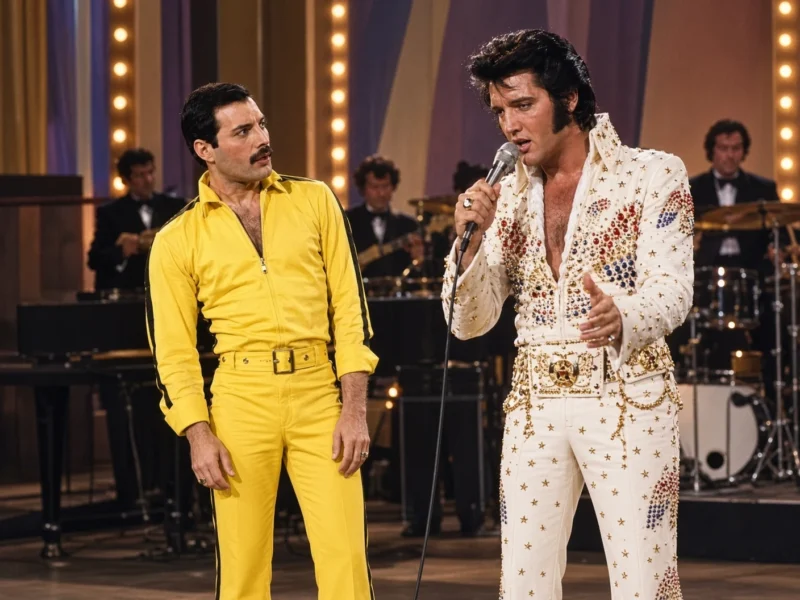
Freddie Mercury Dared Elvis to Sing “Bohemian Rhapsody”—Nobody Expected His Answer
The laughter inside the packed London theater died the moment Freddie Mercury pointed directly at Elvis Presley.
Thousands of faces turned toward the front row.
Freddie stood beneath a white spotlight holding a silver microphone in one hand. A playful smile rested beneath his mustache, but something serious burned behind his eyes.
“Everyone calls you the King,” Freddie said. “But can the King sing Bohemian Rhapsody live?”
The theater erupted.
Some people cheered. Others laughed, believing Freddie had made an impossible joke.
The orchestra had never rehearsed the song with Elvis. There was no arrangement prepared for his voice, no sheet music waiting at the piano, and no safe way to escape if he missed the notes.
Journalists immediately lifted their cameras. One critic opened his notebook and wrote a headline before Elvis had even answered.
“The King finally falls.”
Elvis remained seated beneath the blinding lights. His hands rested together. His face revealed nothing.
Around him, celebrities whispered. One television producer leaned toward another and said, “He will never accept. He knows what they’ll do to him tomorrow.”
Freddie extended the microphone farther.
“Well, Elvis?”
A nervous smile moved through the audience. They expected Elvis to wave, make a joke, and protect his reputation.
Instead, he slowly raised his eyes.
There was no anger in them. There was something far more dangerous. An old pain awakened by a new challenge.
Elvis stood.
The laughter stopped.
He buttoned his black jacket and walked toward the stage. With every step, the applause grew louder, but he never looked at the crowd.
His eyes remained fixed on Freddie.
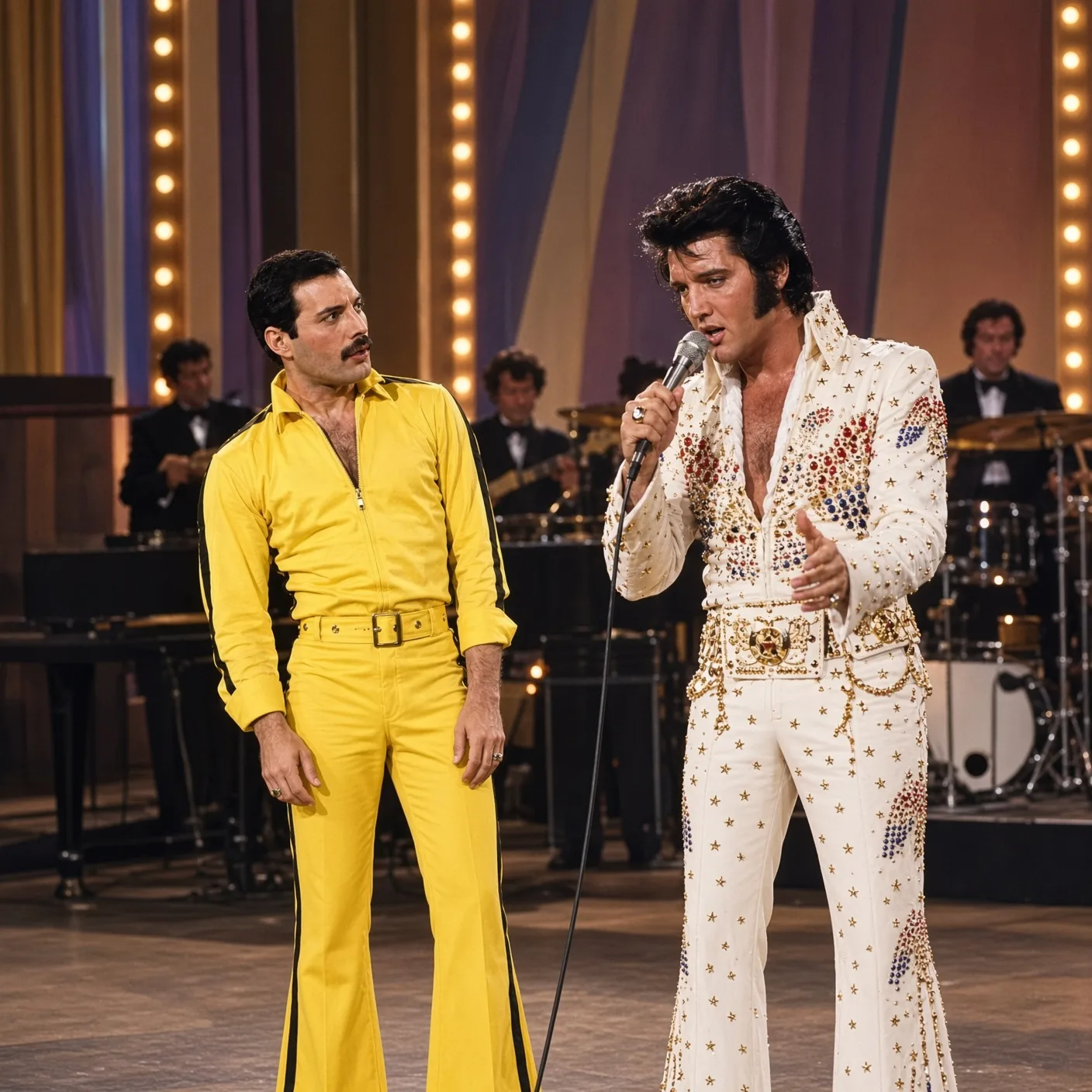
When Elvis reached him, he leaned close and whispered six words that erased Freddie’s smile.
“I won’t sing it like you.”
Freddie stared at him.
Elvis gently took the microphone.
“I’ll sing it like me.”
The audience went completely silent.
But before Elvis could reach the piano, his manager hurried from backstage and seized his arm.
“You don’t know the arrangement,” he warned. “If this goes wrong, they’ll destroy you.”
Elvis looked toward the thousands of people waiting to judge him.
“They already think they know who I am.”
His voice softened.
“Maybe it’s time they heard the man behind the King.”
What nobody inside the theater understood was that Elvis had not accepted the challenge to defend a crown.
He had accepted because Freddie’s question had opened a memory Elvis had spent years trying to silence.
Hours earlier, Elvis had stood alone inside his dressing room.
A black performance jacket hung near the mirror. Photographs from his greatest concerts covered the walls. Outside, reporters argued about whether the King of Rock and Roll still possessed the voice that had once shaken the world.
“He was extraordinary once.”
“Freddie will overpower him.”
“Elvis survives on memory now.”
The comments should not have mattered. Elvis had faced mockery before.
But that morning he had received a small package from Tennessee. Inside was a worn metal locket containing a photograph of his mother, Gladys.
On the back, someone had written: “She never doubted the voice inside you.”
Elvis sat before the mirror and opened the locket.
The photograph returned him to a small room in Tupelo. He was a frightened boy again, singing beside an old radio while his mother listened. There were no stage lights, critics, or jeweled suits. Only Gladys.
After he finished, she placed one hand over his heart.
“Never sing to prove you’re better than somebody,” she told him. “Sing so a lonely person knows they aren’t alone.”
Elvis had carried those words into every theater, but fame had slowly made them harder to hear.
Crowds no longer asked him merely to sing. They asked him to prove he was still the King. Every performance became a trial against his younger self. Every imperfect note became evidence that time was defeating him.
When Freddie’s invitation arrived, Elvis nearly refused.
His manager warned him that the London event was designed around Freddie’s music and voice.
“You’ll be entering his world,” he said.
Elvis closed the locket.
“Maybe I’ve been hiding inside mine too long.”
That evening, the theater overflowed with musicians, actors, critics, and television crews.
Freddie commanded the stage with fearless energy. He moved as though the lights belonged to him, and every person in the building had arrived by personal invitation.
Elvis watched from the front row. He admired Freddie’s courage, but he also recognized something beneath it.
Freddie joked between songs, smiled at the audience, and controlled every second. Yet whenever the applause faded, loneliness passed across his face like a shadow.
During an intermission, the two men met beside the curtain.
Freddie greeted Elvis warmly.
“You look too calm,” he said.
“I’m saving my panic for later.”
Freddie laughed. Then his expression became serious.
“Do you ever become tired of people asking whether you are still the King?”
Elvis looked toward the audience.
“Every day.”
“What do you do?”
“I sing until they stop asking.”
Freddie studied him.
“And if one day the voice doesn’t come?”
Elvis touched the locket beneath his shirt.
“Then I pray the man remains after the King is gone.”
The stage manager called Freddie back into the light. Before leaving, Freddie looked over his shoulder.
“Perhaps tonight we should find out.”
Elvis assumed he was joking.
He was wrong.
Now, beneath the gaze of thousands, Elvis approached the grand piano. The musicians searched through their sheets. The conductor asked what key he wanted. Producers shouted conflicting instructions from backstage.
Freddie followed him.
“I can help you with the structure,” he offered.
Elvis shook his head.
“If I follow your path, they’ll only hear where I fail to sound like you.”
“What do you need?”
“One soft chord.”
Elvis looked toward the gospel singers standing behind the orchestra.
“And when I raise my hand, give me a distant harmony. Nothing more.”
His manager stepped closer.
“Elvis, reconsider this.”
Elvis removed the locket from beneath his shirt and wrapped its chain around his fingers.
“My mother once told me to sing something that frightened me.”
He looked at the piano.
“I think I finally found it.”
The theater lights faded. One white beam surrounded Elvis as he sat before the keys.
For the first time that evening, uncertainty appeared on his face. His fingers hovered above the piano. The audience stopped breathing. A camera moved close enough to capture the tremor in his hand.
Elvis looked toward an empty chair in the front row. In his mind, Gladys was sitting there.
Freddie remained in the shadows, waiting. The conductor lifted his hand.
Elvis drew one deep breath.
Then he pressed the first key.
A low chord entered the silence.
Elvis opened his mouth, but no sound came.
The low piano chord faded beneath the white spotlight. Thousands of people waited. A reporter in the front row slowly lifted his pen. Someone near the balcony laughed nervously. Behind the curtain, Elvis’s manager closed his eyes as if preparing for tomorrow’s headlines.
Freddie Mercury took one careful step toward the piano.
“Elvis.”
Elvis did not respond. His fingers remained above the keys, but his body had become perfectly still.
He could hear every warning that had followed him to London. You do not know the arrangement. You cannot match Freddie’s range. One broken note will become the moment everyone remembers.
For an unbearable second, Elvis believed them.
The enormous theater disappeared. He saw only the empty chair in the front row and the photograph of Gladys curled inside his palm.
He remembered singing to her as a boy. His voice had not always obeyed him then, either. Sometimes fear trapped the first note inside his chest. Gladys never laughed. She waited until he found the courage to begin.
Elvis lowered his head.
“I’m sorry, Mama,” he whispered.
Then he pressed another key.
This chord was softer, darker. It carried none of the theatrical power the audience associated with Bohemian Rhapsody. It sounded almost like the beginning of a hymn in a poor Southern church.
Elvis breathed in.
The opening note finally came.
It was low, fragile, and filled with such loneliness that the reporter’s pen stopped moving.
Elvis did not imitate Freddie. He removed the operatic confidence and transformed the song into a confession. Each phrase sounded like it came from a man sitting alone after the crowd had gone home.
The audience leaned closer.
Freddie stood in the shadows with his arms folded. At first, confusion crossed his face. The rhythm was slower than his arrangement. The melody bent toward gospel and country, moving through pauses Freddie had never written.
Yet Elvis was not changing the song carelessly. He was uncovering another path through it.
The conductor raised his baton, ready to bring in the orchestra.
Elvis shook his head.
“Not yet.”
He wanted the theater to hear the emptiness around his voice.
In the front row, a woman lowered her camera. A violinist forgot to turn the page. An elderly usher stood motionless beside the door.
They had expected spectacle. Instead, they were listening to a man remove his armor one note at a time.
Elvis’s voice carried the exhaustion behind the rhinestones. It carried the hotel rooms where applause still echoed after midnight, but nobody truly knew how frightened he felt. It carried the terrible loneliness of being loved by millions while wondering whether anyone loved the man beneath the famous name.
Freddie’s expression changed.
He had written the song from his own storm of doubt, identity, fear, and defiance. Hearing Elvis reshape it should have felt like an invasion.
Instead, it felt like recognition.
Two men had reached the same loneliness by different roads.
Freddie slowly approached the conductor.
“Follow him,” he whispered. “We don’t have an arrangement. Then listen.”
The pianist seated near the orchestra studied Elvis’s left hand and added a distant chord. A cello entered beneath it. Elvis did not look up, but his shoulders relaxed.
The music began building around him, not forcing him toward Freddie’s version, following the truth inside his own.
Behind the orchestra, the gospel singers waited for the signal.
Elvis raised two fingers.
Their voices entered like light through a cracked church window. A wave of emotion moved through the theater. Several people who had laughed at the challenge now sat with tears in their eyes.
Elvis lifted his head. His voice grew stronger.
The song stopped sounding like a competition between musical legends. It became the story of a man facing everything fame had taken from him.
Near the wings, Elvis’s manager watched in disbelief.
“He changed the entire song,” a producer whispered.
“No,” Freddie replied from the shadows. “He found the part of it we never heard.”
Elvis reached the first great rise. The orchestra prepared to explode behind him.
He held up one hand.
Every instrument stopped.
Silence fell.
Then Elvis continued alone.
His unaccompanied voice trembled across the theater. It was not perfect. One note cracked at the edge. A younger Elvis might have forced it, trying to hide the weakness. This Elvis allowed the fracture to remain, and because he did, everyone heard the pain inside it.
Freddie lowered his eyes. He understood what Elvis had done.
A flawless note could impress an audience. A broken one could tell the truth.
The reporter who had written The King finally falls tore the page from his notebook.
Elvis continued, his hands pressed deeper into the piano. The melody became heavier, and the orchestra entered again, this time with no conductor guiding it. The musicians were following his breath.
Gospel harmonies rose behind him. A guitar answered from the darkness. The drums entered with a slow heartbeat instead of Freddie’s familiar thunder.
The song no longer belonged to opera, rock, country, or gospel. It belonged to the moment.
Freddie moved closer to the piano.
Elvis saw him but did not stop.
For several measures, the two men stared at each other.
Freddie had issued the challenge to discover whether Elvis would protect his crown or risk exposing the man beneath it. Now the answer sat before him.
Elvis was risking everything. Not because he wanted to defeat Freddie, because for the first time in years he was singing without hiding behind the version of himself the world expected.
The music climbed. Elvis’s voice shook the theater. The orchestra surged behind him, finally understanding the language he had created.
Violins rose. The choir became a wall of sound. The drummer struck with enough force to send the rhythm through the wooden floor. People began standing.
Elvis’s manager smiled for the first time.
Then he noticed something near the lighting rig. A technician was pointing toward a smoking cable. Another ran toward the electrical panel.
The spotlight above Elvis flickered. Once. Twice.
The orchestra continued. Elvis reached the most dangerous section of the performance. His breathing grew heavier, but his voice refused to retreat.
Freddie stood only a few feet away now. He extended one hand toward Elvis, not to interrupt, but to promise that he would be there if the song became too heavy.
Elvis saw the gesture.
Then every light in the theater went out.
The piano became silent. The orchestra vanished in the same instant. Darkness swallowed the stage.
Audience members screamed. Producers shouted from behind the curtain.
“Close it. Lower the curtain.”
A stage manager ordered everyone to remain seated. Technicians rushed toward the electrical room, but the emergency lights failed to appear.
The performance was over.
At least that was what everyone believed.
Freddie moved through the darkness toward the piano.
“Elvis,” he called.
There was no answer.
For several seconds, the theater contained only frightened whispers.
Then a voice emerged from the darkness.
Elvis was still singing. No microphone carried him. No speaker strengthened him. His natural voice traveled into the theater, stripped of electricity, protection, and illusion.
People stopped moving. The curtain operator released the rope. The curtain remained open.
Freddie found the edge of the piano and placed one hand against it.
Elvis continued alone.
His voice was quieter now, but the darkness forced everyone to listen more deeply.
Freddie sat beside him. He searched for the keys, pressed one, and heard nothing. The piano required power.
Elvis reached the end of the phrase. Silence waited for the next.
Freddie leaned toward him.
“If the piano cannot follow us,” he whispered, “we will follow you.”
He took one breath and joined Elvis without a microphone.
Two unamplified voices rose together in the darkness.
The audience stopped breathing.
Then Elvis’s voice suddenly broke. He lowered his head. A tear fell onto the silent piano. Freddie felt his shoulders trembling. This was no longer fear of the song. Elvis was remembering someone.
“Don’t hide now,” Freddie whispered. “Not when they’re finally listening.”
Elvis opened the locket in his hand. In the darkness, he could barely see his mother’s face.
Then the first emergency light flickered on. A pale beam crossed the empty chair in the front row.
Elvis stared at it. In his mind, Gladys was sitting there.
He tried to sing again, but this time grief closed around his voice, and nothing came out.
Elvis Presley stared at the empty chair. His mother was not there. Only a pale emergency light rested across the vacant seat.
The theater waited in darkness while Elvis tried to force another sound through the grief closing around his throat. Nothing came.
Freddie Mercury remained beside him at the silent piano. He could feel Elvis trembling, but he did not reach for the audience or call for the curtain. He placed one hand on Elvis’s shoulder.
“Who do you see?” Freddie whispered.
Elvis opened the locket wrapped around his fingers.
“My mother.”
Freddie looked toward the empty chair.
“Then don’t sing to us.”
Elvis turned toward him.
“Sing to her.”
The words struck somewhere beneath the fear.
Elvis closed his eyes. Once again, he was a poor boy inside a tiny Southern home. Rain touched the roof. An old radio glowed near the wall. Gladys sat before him with tired eyes and a smile that made the room feel warm.
He heard her voice. Not clearly. Memory had softened it with time, but he remembered what she had taught him.
Never sing to prove you are better than somebody. Sing so a lonely person knows they are not alone.
Elvis lowered the locket against his heart.
Then he began again.
The first note was barely audible. Freddie joined him beneath it, not with the commanding voice the world expected, but with a gentle harmony designed to hold Elvis without covering him.
The two unamplified voices traveled into the darkness.
People in the front rows leaned forward. Those in the balcony closed their eyes. Nobody could see the costumes, the cameras, or the famous faces. Stripped of light, the theater no longer contained the King of Rock and Roll and the fearless leader of Queen. It contained two frightened men singing because silence had become more painful than exposure.
Elvis reached the passage that had broken him. His voice shook.
Freddie’s hand tightened on his shoulder.
“Stay with it,” he whispered between breaths.
Elvis continued.
A tear slipped down his face. He did not wipe it away.
The audience heard the struggle inside every phrase. The imperfections made the song feel more honest, as though Elvis were confessing something fame had forbidden him to say.
He was tired. He was afraid. He missed his mother. And beneath every scream of admiration, part of him still wondered whether the world loved Elvis Presley, or only the crown it had placed upon his head.
Freddie understood.
He had spent years building a stage identity large enough to protect the private man beneath it. He knew what it meant to command thousands and still fear being truly seen.
Now, beside Elvis, he recognized the same prison.
Their voices met, not as rivals, as witnesses.
In the control room, technicians fought to restore power. A producer reached for the emergency curtain switch.
Elvis’s manager grabbed his hand.
“Leave it open.”
“We cannot broadcast this.”
“You’re already broadcasting the only part that matters.”
Battery-powered cameras continued recording. Their small red lights glowed like distant embers.
A stagehand found a candle and carried it near the piano. Then another appeared. Members of the audience began lighting matches and cigarette lighters. Tiny flames spread through the darkness until the theater resembled a night sky.
Under their glow, Elvis’s face became visible. So did Freddie’s.
Neither man looked powerful.
That was what made the moment powerful.
Freddie moved from harmony into a gentle answer, reshaping his own composition around Elvis’s slower rhythm. Elvis responded instinctively. They no longer followed an arrangement. They listened.
When Elvis weakened, Freddie carried the line forward. When Freddie’s emotion threatened to overpower the melody, Elvis steadied him with a low gospel phrase.
The challenge disappeared completely. No one remembered who had been expected to win.
Near the front row, the critic who had prepared tomorrow’s humiliating headline slowly closed his notebook. A woman reached for the hand of a stranger sitting beside her. One violinist silently wept. The conductor lowered his baton because there was nothing left to conduct.
Then the electrical system flickered. A low hum moved through the theater. The piano returned with a single accidental note beneath Freddie’s fingers.
He looked at Elvis.
Elvis nodded.
Freddie played a delicate chord. The emergency lights strengthened. One violin entered, then a cello. The orchestra returned instrument by instrument, not with an explosion, but like people quietly entering a church.
Elvis continued singing.
His manager watched from the wings, tears running down his face. He had feared that an unfamiliar song would expose Elvis’s limitations. Instead, it exposed the cost of everything Elvis had achieved.
The drums returned with a slow pulse. The gospel singers rose behind the orchestra.
Freddie stood from the piano and extended his hand.
Elvis looked at it.
“Come on,” Freddie said. “No more hiding behind the keys.”
Elvis accepted.
They walked toward the center of the stage as the lights returned above them. The audience saw Elvis holding his mother’s photograph. He did not conceal it.
Freddie took one microphone. Elvis took another.
The orchestra began climbing toward the final movement.
Freddie’s voice rose first, brilliant, fearless, and sharp enough to cut through the theater.
Then he turned toward Elvis.
Elvis answered with a voice shaped by gospel churches, Southern nights, grief, and years of performing beneath expectations no human being could satisfy.
The contrast should have divided them. Instead, it made both voices stronger.
Freddie carried the fire. Elvis carried the wound.
Together, they transformed the song into something the orchestra had never rehearsed and the audience would never hear again.
The drums thundered. The choir surged. The stage lights burned through the remaining darkness.
Freddie moved across the stage with renewed energy, but he never tried to dominate Elvis. Each time the arrangement rose, he turned and gave the moment back to him.
Elvis understood the gesture. Freddie had offered the challenge. Now he was offering trust.
The final section approached.
Elvis looked toward the empty chair. This time he did not see absence. He saw every sacrifice Gladys had made so her son could dream beyond poverty. He remembered the clothes she had repaired, the meals she had surrendered, and the faith she offered when nobody else knew his name.
His voice grew stronger.
Freddie watched in astonishment. The uncertainty disappeared from Elvis’s face. He no longer sang like a man protecting a title. He sang like a son answering his mother across time.
The orchestra reached full force.
Elvis lifted the locket.
“For you, Mama,” he whispered.
Then he entered the final passage with everything he had left.
His voice rose through the theater like a storm breaking open the sky. Freddie joined him. The choir became thunder behind them.
One spotlight struck Elvis in white. Another surrounded Freddie in gold. At the center, their voices met above the piano and carried toward the highest balcony.
People stood without realizing they had moved.
The critic dropped his pen. A cameraman lowered his eye from the viewfinder because he could no longer watch through glass.
Elvis reached for the final note. His breath was nearly gone.
Freddie stepped closer and supported the harmony beneath him.
For one suspended moment, both men stood shoulder to shoulder, pouring every wound, doubt, and unspoken fear into the same sound.
Then the note ended.
The orchestra stopped. The lights remained still.
Elvis lowered the microphone. Freddie stared at him, chest rising violently.
Nobody applauded. Not one person moved.
The silence lasted so long that fear returned to Elvis’s face. He looked toward his manager. Had the experiment failed? Had he broken Freddie’s song beyond recognition? Had thousands witnessed the King finally fall?
Then an elderly woman rose alone in the highest balcony.
She raised her hands, and the first clap echoed through the silent theater.
One clap echoed from the highest balcony.
Then another person stood. A third joined them.
Within seconds, the entire London theater rose. The applause exploded like thunder. People shouted Elvis Presley’s name. Some cried openly. Others remained frozen with both hands pressed against their faces, unable to understand how a familiar song had revealed a soul they had never seen before.
Elvis remained at the center of the stage. His chest rose and fell beneath the black jacket. Tears glistened in his eyes as he looked toward the empty chair where moments earlier he had imagined his mother sitting.
The applause grew louder.
Elvis had spent most of his life hearing crowds scream for the King. This sounded different. They were not celebrating his title. They were answering the man beneath it.
Freddie Mercury stood beside him, staring into the roaring theater. He had expected excitement, perhaps even argument over whose voice had conquered the song, but nobody was comparing them. The audience had forgotten the challenge. They had witnessed two artists refuse to abandon each other in the darkness.
Freddie slowly lifted his microphone.
The applause continued. He waited.
At last, the theater became quiet enough for him to speak.
“I challenged Elvis tonight because I wanted to know whether the King was still alive.”
A nervous murmur moved through the audience.
Elvis looked at him.
Freddie’s voice trembled.
“But I asked the wrong question.”
He turned fully toward Elvis.
“The King was never in danger.”
Freddie pointed toward the locket in Elvis’s hand.
“The man carrying that crown was.”
Elvis lowered his eyes.
Freddie continued.
“When the lights failed, he could have stopped. Nobody would have blamed him. When his voice broke, he could have hidden behind the orchestra.”
The musicians listened in silence.
“But he gave us the part of himself applause can never demand.”
Freddie stepped closer.
“Tonight you reminded me that the man was always greater than the crown.”
The theater erupted again.
Elvis’s face collapsed with emotion. He reached for Freddie and pulled him into an embrace. The crowd rose louder as the two men held each other beneath the lights.
There was no winner, no defeated singer, no crown changing hands. Only respect born in the moment competition disappeared.
When they separated, Elvis placed the microphone back into Freddie’s hand.
“A powerful voice can amaze people,” Elvis said. “But an honest heart can make them feel less alone.”
Freddie nodded.
“And tonight you did both.”
The audience began calling for another song.
Elvis glanced toward the orchestra. His manager waited anxiously in the wings, expecting him to refuse. Elvis had already risked more than anyone planned.
Instead, Elvis walked back to the piano.
Freddie followed.
This time, there was no challenge. They chose a simple gospel melody neither audience nor musicians expected. Elvis played the first chords while Freddie stood beside him without theatrical movement.
Their voices entered gently. After the emotional storm of the previous performance, the simplicity felt almost sacred. The gospel choir joined. Then the audience did too. Thousands of voices filled the theater. Some were beautiful. Others missed every note. Nobody cared.
Elvis smiled through his tears.
For the first time that evening, he no longer looked toward the empty chair. He could feel Gladys in the song surrounding him.
The final note faded.
Freddie and Elvis bowed together. The curtain closed slowly as applause followed them into the darkness.
Backstage became chaos. Journalists shouted questions. Producers argued over the damaged electrical system. Musicians embraced one another while television executives demanded copies of the recording.
Elvis slipped away. Freddie noticed and followed him down a quiet corridor.
He found Elvis standing alone before a darkened dressing room mirror. Without the stage lights, his black jacket no longer appeared regal. His shoulders looked tired. The locket hung between his fingers.
Freddie closed the door behind him.
For several seconds, neither man spoke.
Then Freddie asked the question everyone wanted answered.
“Why did you stop?”
Elvis looked at his reflection.
“I thought I saw her.”
“Your mother?”
Elvis nodded. He opened the locket and showed Freddie the worn photograph.
“She always wanted to hear me sing something that frightened me.”
Freddie took the locket carefully.
“Was that song what frightened you?”
“No.”
Elvis sat before the mirror.
“What frightened me was letting people hear I couldn’t control everything.”
His voice softened.
“When you spend long enough being called the King, people forget kings are allowed to tremble.”
Freddie looked toward the photograph.
“I know something about being protected by a stage.”
Elvis raised his eyes.
Freddie leaned against the dressing table.
“Out there, I can become everything I’m afraid I’m not. I can command a room before anyone decides whether I belong inside it. And when the room empties—”
Freddie’s smile faded.
“Then I have to meet myself again.”
Elvis nodded slowly.
“That’s the hardest audience.”
The two men laughed quietly. For the first time, they were not legends speaking beneath cameras. They were simply two performers who understood the loneliness waiting after applause.
Freddie returned the locket.
“Did you accept because I embarrassed you?”
“At first, I didn’t know why I stood.”
Elvis closed the photograph inside his hand.
“Then I remembered what Mama said. Never sing to prove you’re better than somebody.”
Freddie sat beside him.
“So you weren’t trying to beat me?”
Elvis smiled.
“Couldn’t if I tried.”
Freddie laughed, but tears gathered in his eyes.
“Then who were you singing for?”
“My mother.”
Elvis looked toward the wall separating the dressing room from the theater, and every lonely person who has ever been loved for what they represent instead of who they are.
Freddie lowered his head. The answer had reached him, too.
Before leaving, he stopped at the door.
“For what it’s worth, Elvis.”
Elvis looked up.
Freddie’s voice became gentle.
“She heard you.”
Elvis smiled through his tears. He opened the locket once more.
“I hope so.”
“No,” Freddie said. “A song like that doesn’t disappear. It finds whoever needs it.”
Then he left Elvis alone.
The following morning, newspapers struggled to describe what had happened. Some called it the greatest unexpected performance ever witnessed. Others described it as the night two musical worlds collided.
The critic who had prepared the headline The King Finally Falls published a different one.
“The Night Elvis Removed His Crown.”
But the people inside that theater remembered something no headline could capture.
They remembered the silence after the first chord. They remembered the darkness swallowing the stage. They remembered Freddie sitting beside Elvis when the piano died.
Most of all, they remembered the moment Elvis’s voice broke, and how he chose to continue.
He had not performed the song perfectly. Perfection would have been easier to admire and easier to forget.
Instead, Elvis allowed thousands to hear his fear, grief, and loneliness. He transformed another man’s masterpiece into a window through which the audience could see the human being behind his own legend.
Freddie’s challenge was meant to discover whether Elvis could carry an unfamiliar song.
Elvis answered a deeper question. Could a man buried beneath fame still risk being truly known?
That night, he did.
Not by singing louder than Freddie Mercury. Not by defending his title. Not by proving that one legend was greater than another.
Elvis rose because he stopped protecting the crown and finally revealed the wounded, courageous man carrying its weight.
And somewhere beyond the lights, beyond the applause, and beyond the reach of every camera, a poor Southern boy sang one more song for his mother.
This time, the whole world listened with him.









