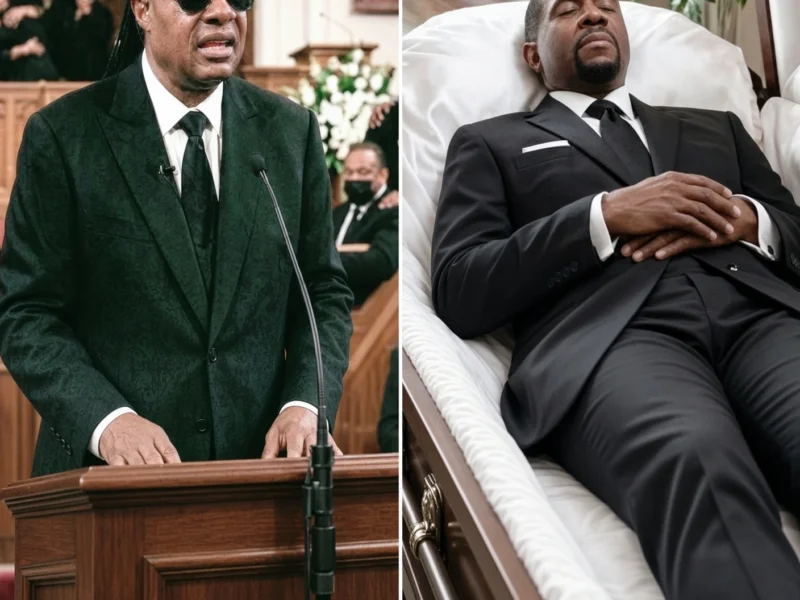
Freddie Jackson Funeral: Stevie Wonder STUNS The Entire World With Powerful Tribute
There are moments in music history when everything just stops.
When a room full of legends, people who have won every award, sold out every stadium, and seen everything this industry has to offer, are brought to absolute silence.
That is exactly what happened when Stevie Wonder walked up to the microphone, sat down at his keyboard, and spoke about a man he called his brother in soul, Freddie Jackson.
For decades, Freddie Jackson was the voice that defined love, heartbreak, and late-night quiet storm radio across America.
Hits like Rock Me Tonight and You Are My Lady didn’t just top the charts.
They became the soundtrack to millions of lives .
But behind that smooth, effortless voice was a private, painful battle that Freddie fought in silence until his final days.
And when news broke that Freddie had passed, the world lost a piece of classic R&B history .
What no one expected, though, was what Stevie Wonder did next.
Stevie’s tribute didn’t just honor a friend.
It sent shockwaves through the entire music world and left everyone who heard it stunned.
If you grew up in the 1980s, or if you ever turned on the radio late at night looking for real music, you know the voice of Freddie Jackson.
It was smooth as silk, warm, and hit you right in the chest from the very first note.
But before his voice was playing in millions of living rooms across the country, Freddie was just a kid growing up in Harlem, New York, surrounded by noise, community, and gospel music .
Like so many soul greats, Freddie learned how to sing in church.
As he got a little older, Freddie knew music wasn’t just a hobby for him.
It was his calling.
But breaking into the music industry in the late 1970s and early 1980s wasn’t easy.
New York was filled with hungry young singers trying to get noticed.
Freddie didn’t let that intimidate him.
He took every opportunity he could find.
He moved out to the West Coast for a brief period to join a funk group called Mystic Merlin as a lead vocalist, lending his voice to songs like Just Can’t Give You Up .
It gave him a real taste of the recording studio and live touring.
But something pulled him back home to New York.
When he returned, Freddie made a connection that changed everything.
He linked up with the incredible R&B icon Melba Moore.
Melba recognized Freddie’s rare talent immediately.
She didn’t just hire him as a background singer.
She made him a key part of her touring band.
Night after night, Freddie stood on stage behind Melba, learning the ropes of professional show business, watching how a real superstar held an audience and perfecting his craft.
Behind the scenes, musicians and industry folks started asking, “Who is that guy with the golden voice back there?”
It wasn’t long before producers realized Freddie Jackson was far too talented to stay in the background.
In the mid-1980s, he caught the ear of Capitol Records.
In 1985, Capitol released Freddie’s debut studio album titled Rock Me Tonight .
Nobody was quite prepared for what happened next.
In 1985, the music landscape was changing fast.
Pop and R&B were getting faster, heavier on synths, and turning toward drum machines.
But Freddie Jackson brought back pure, unadulterated soul.
When the album’s lead single, Rock Me Tonight (For Old Times Sake), hit the airwaves, it blew up across the country .
It didn’t just enter the R&B charts.
It exploded to number one and stayed there for six consecutive weeks.
Radio stations couldn’t play it enough.
People called in constantly to request it.
It was slow, intimate, passionate, and sung with an ease that made it feel like Freddie was right there in the room with you.
Shortly after, he dropped You Are My Lady.
That track cemented Freddie Jackson as an absolute superstar .
You Are My Lady crossed over into the Billboard Hot 100 top 20 and topped the Black singles chart for four weeks.
Suddenly, Freddie Jackson wasn’t just a Harlem kid with a good voice.
He was the premier balladeer of 1980s R&B.
His debut album went double platinum.
Critics were amazed at how a debut artist could command so much authority on record.
Freddie became the king of the quiet storm radio format, that smooth nighttime radio style that catered to adult R&B lovers.
While pop acts were doing dance routines and wearing flashy gear, Freddie stepped onto the stage in tailored suits, holding a microphone, letting pure vocal mastery do the talking.
What made Freddie special during this golden era was his consistency.
A lot of artists hit big with one album and then fade away when the pressure mounts.
Freddie did the opposite.
He followed up Rock Me Tonight with his second album Just Like the First Time in 1986 .
The title was fitting because it matched the massive commercial success of his debut.
Hits like Tasty Love, Have You Ever Loved Somebody, and Jam Tonight dominated radio .
Throughout the mid to late 1980s and into the early 1990s, Freddie Jackson achieved something incredible.
He scored 10 number one R&B hits on the Billboard charts .
Every time he released a single, it was almost guaranteed to hit the top spot.
Tracks like Hey Lover, Love Me Down, and Do Me Again proved that he owned the Quiet Storm lane.
Beyond the chart numbers, Freddie built a deeply loyal worldwide fan base.
He toured extensively across the United States, Europe, and Asia.
People loved him because he stayed humble.
In interviews, he came across as a gentle, soft-spoken guy who was genuinely grateful for his fans and his gift.
He didn’t chase wild trends or change his sound to fit whatever was pop on MTV.
He stuck to deep soul, classic melodies, and lyrics about real love and respect.
As the late 90s and 2000s arrived, the music industry shifted again toward hip-hop soul, contemporary R&B, and digital production.
Many 80s legends struggled to keep their footing.
But Freddie kept touring, recording, and connecting with his audience.
Over his career, he put out 15 studio albums, earned multiple Grammy nominations, and kept his live vocals razor sharp well into his later years .
To his fans and fellow artists, Freddie Jackson represented an era of R&B when vocals were raw, pitch perfect, and straight from the soul.
But as the years went on, keeping up with demanding tour schedules and the physical toll of decades on the road began to take a secret toll on his health.
Setting the stage for a private fight no one saw coming.
Behind the glamour of sold-out concerts, gold records, and international spotlight, the life of a touring legend is relentless.
For decades, Freddie Jackson lived on the road, pouring every ounce of energy into his performances.
But as time went on, the wear and tear of a grueling career began to intersect with a deeply personal, quiet struggle.
For years, rumors had occasionally surfaced among fans who noticed shifts in his physical appearance or brief pauses in his tour schedule.
Freddie, however, was always a proud, dignified artist who believed in keeping his private life private.
He didn’t want his audience to worry, and he certainly didn’t want any health battle to overshadow the joy and healing power of his music.
He kept his head down, continued to write and perform, and focused on delivering the best shows possible every time he stepped on stage.
Eventually, the reality of his health condition could no longer be kept entirely behind closed doors.
Freddie had been quietly managing chronic kidney disease for a significant period .
Living with a severe kidney condition requires drastic lifestyle adjustments, regular medical interventions, dialysis, and constant monitoring.
For someone whose entire life was centered around high-energy stage performances and continuous travel, managing such a heavy medical load was an immense daily hurdle.
In early 2024, Freddie decided it was time to share his journey directly with the people who had supported him for nearly 40 years .
Rather than letting speculation run wild across social media and blogs, he addressed his health openly.
In a series of heartfelt statements and updates, he acknowledged his ongoing battle with kidney disease.
He spoke candidly about the challenges.
But true to his nature, his message was anchored in faith, gratitude, and resilience.
He thanked his medical team, expressed deep love for his fans, and made it clear that his spirit remained unbroken.
The public response was an immediate wave of love and support.
Fans from around the globe sent prayers, shared stories of how his records had carried them through their own tough times, and commended him for facing his diagnosis with such open grace.
Fellow artists from the R&B community reached out, offering words of encouragement and solidarity.
Despite the physical limitations imposed by his illness, Freddie tried to remain as active and engaged as his body would allow.
He cherished moments spent with family, close friends, and longtime musical collaborators who had been by his side since his early days in Harlem and his breakthrough years in the 1980s.
As the months progressed into 2026, those close to him noticed that his physical health was beginning to decline more rapidly.
The toll of chronic kidney failure became increasingly heavy, requiring more intensive care and rest.
Yet, even during his weakest physical moments, those who visited him spoke of his unchanging warmth, his bright smile, and his sharp memory for music, laughter, and brotherhood.
On October 2nd, 2026, Freddie Jackson reached a major milestone, his 70th birthday .
Surrounded by family and loved ones in New York, the occasion was a quiet, intimate celebration of a life dedicated to love, family, and extraordinary artistry.
Though frail, Freddie was surrounded by the people who mattered most, reflecting on a journey that took him from a neighborhood church choir in Harlem all the way to global stardom.
Just three days later, on October 5th, 2026, Freddie Jackson passed away peacefully in Harlem, surrounded by his family .
He was 70 years old.
When the news of his passing was confirmed, shockwaves rippled through the music industry and across generations of R&B lovers.
His family released an official statement confirming that the legendary singer had transitioned peacefully, leaving behind a timeless body of work and a legacy of kindness .
Almost instantly, social media and news outlets were flooded with tributes.
Fans shared their favorite tracks, You Are My Lady, Rock Me Tonight, Jam Tonight, and Tasty Love, reminiscing about how Freddie’s smooth voice had been the soundtrack to their marriages, anniversaries, late-night radio sessions, and quiet moments of solitude.
Musicians and longtime peers expressed profound sorrow.
Melba Moore, who had given Freddie one of his earliest major breaks as a background singer and touring member, posted an emotional tribute remembering his remarkable gift, his humility, and the unmistakable voice that could light up any venue .
Radio hosts who had played his records for 40 years dedicated entire broadcast hours to his discography, ensuring that his melodies filled the airwaves once again.
The world was mourning the loss of a true titan of quiet storm soul.
But amidst the widespread grief, nobody anticipated the incredible moment that was about to unfold.
A tribute that would bring the entire music world to a complete standstill.
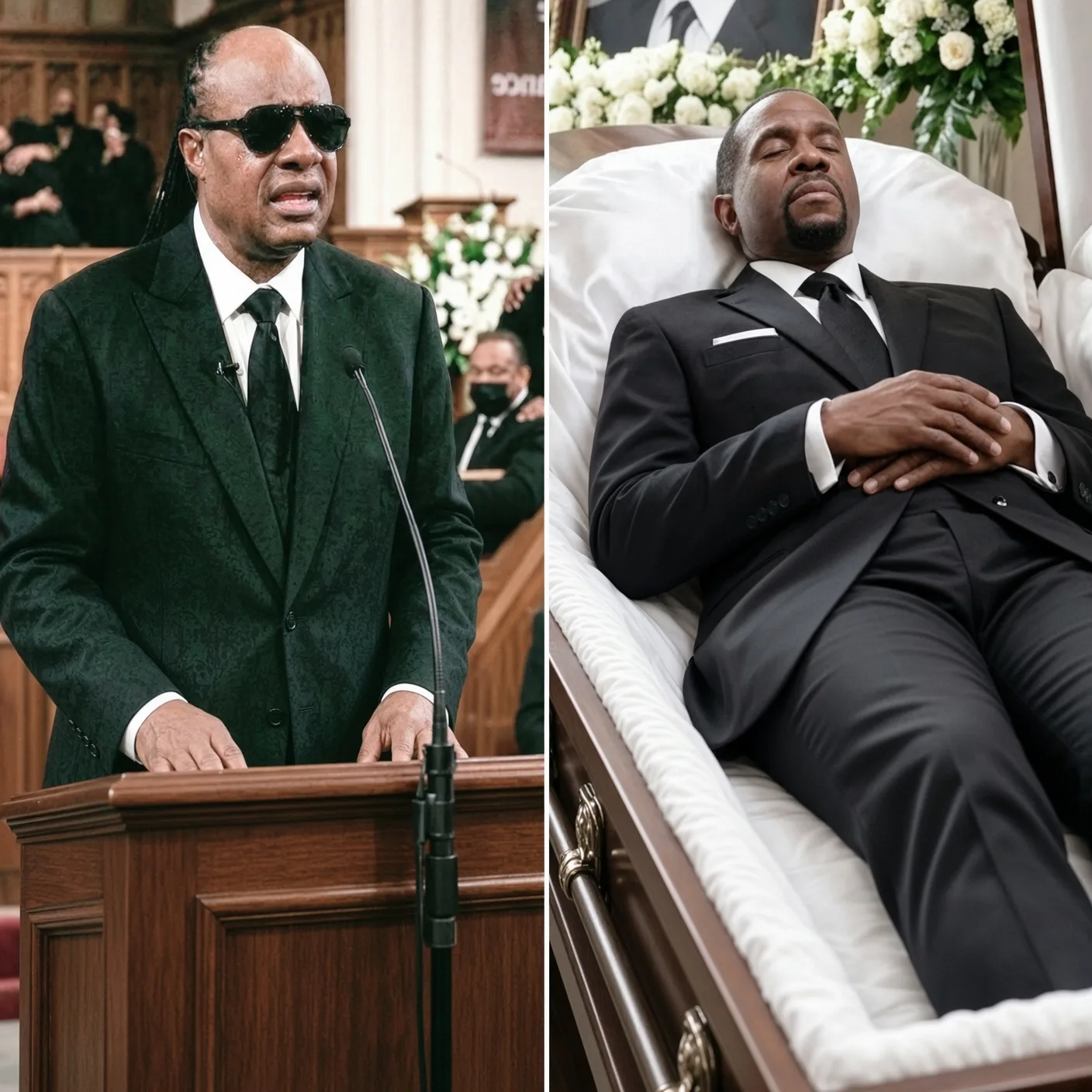
When the memorial gathering was held in New York to honor Freddie Jackson, the room was filled with the royalty of soul and R&B.
Industry executives, veteran producers, backup singers who had shared stages with him for decades, and fellow hitmakers were all gathered under one roof.
The atmosphere in the chapel was heavy, soaked in both deep grief and profound gratitude.
Pictures of Freddie smiling in his signature tailored suits, microphone in hand, were displayed around the altar alongside massive displays of white roses.
People were sharing quiet memories, hugging each other, and softly humming phrases from Rock Me Tonight and You Are My Lady.
It was already an emotional gathering, but the intensity in the room completely shifted when a sudden murmur rippled through the back of the venue.
The heavy wooden doors opened and Stevie Wonder stepped into the sanctuary accompanied by his close team .
Stevie’s presence in any room is electric.
But on this day, his arrival brought a palpable sense of reverence.
He wasn’t there as a world-famous pop icon or a 25-time Grammy winner.
He was there purely as a brother in music, coming to pay homage to a fellow craftsman whose voice had touched millions.
The sanctuary fell into a complete, expectant hush as Stevie was guided slowly down the center aisle toward the front podium and keyboard setup.
When Stevie took the microphone, he didn’t launch into a canned speech or read from prepared notes.
He stood there for a few moments, taking a deep, heavy breath, letting the silent love in the room surround him.
When he finally spoke, his voice was tender, warm, and cracked with emotion.
“When you talk about soul music,” Stevie began, his voice echoing gently through the room.
“You aren’t just talking about pitch, rhythm, or hit records. You are talking about the spirit.”
“You are talking about what comes out of a person when they have nowhere else to hide.”
“Freddie Jackson was pure spirit.”
Stevie spoke about the unique place Freddie held in music history.
He reminded everyone in the room about the era when Freddie broke through in the mid-1980s.
Back in 1985, Stevie said, the world was changing fast.
Everybody was running toward drum machines, synthesizers, and fast-tempo pop.
People were forgetting how to take their time.
But Freddie walked into the studio, stood in front of a microphone, and said, “No, we are going to slow down. We are going to talk about love. We are going to feel something real tonight.”
Stevie chuckled softly, recalling how Freddie’s music used to capture the airwaves.
You couldn’t get in your car on a Friday night without hearing Freddie.
He had a way of hitting those high notes where it didn’t feel like he was straining.
It felt like he was floating.
It was effortless.
That kind of grace only comes from one place, and that’s a heart that really loves people.
Stevie then shared a personal memory that brought smiles to the tear-filled faces in the audience.
He talked about hearing Freddie sing live for the first time back in the late 1980s.
Stevie recalled sitting backstage, listening to Freddie hit the signature sustained notes in You Are My Lady.
“I remember turning to someone next to me,” Stevie smiled and saying, “Who taught that boy how to breathe?”
“Because he held those notes with so much warmth and control. You felt like he was holding the entire room in his hand. He was a master of his craft.”
“He carried the torch of classic R&B when a lot of people thought that torch was going out.”
Stevie turned toward Freddie’s seated in the front rows, offering them words of comfort that touched everyone present.
He reminded them that while Freddie’s physical presence was gone, the vibration of his voice remains immortal.
“Music is the one thing God gave us that doesn’t rot, doesn’t age, and doesn’t disappear,” Stevie said quietly.
“When a man leaves behind songs that brought people together, songs that healed broken hearts, songs that brought children into this world, that man never truly leaves us.”
“Freddie’s voice is woven into the tapestry of our lives forever.”
After finishing his words, Stevie turned around and moved toward the grand piano positioned on the side of the stage.
The room was deathly quiet.
You could hear a pin drop as Stevie sat down on the bench and placed his hands gently over the keys.
He didn’t start playing right away.
He ran his fingers lightly over the keys, finding a gentle, gospel-infused chord progression in a major key.
Then he began to play.
What followed was a masterclass in musical tribute.
Stevie began playing the opening chords of Freddie’s immortal hit, You Are My Lady.
But he didn’t just perform a cover.
He stripped the song down to its absolute emotional core.
As his fingers glided over the keys, Stevie began to sing the iconic chorus in his unmistakable soul-drenched tone.
He stretched out the phrasing, turning the romantic ballad into a sacred prayer of farewell.
As Stevie sang, “You are my lady and I’m your man,” he subtly altered the lyrics, singing, “You are our brother and you sang your song so grand.”
The entire room gasped as Stevie seamlessly transitioned from You Are My Lady into his own iconic ballad, Ribbon in the Sky .
He blended the two masterworks together, creating a tapestry of sound that had veteran musicians in the audience openly crying.
Stevie’s vocal performance was raw, dynamic, and full of raw gospel power.
He hit high runs that soared to the chapel ceiling.
His voice trembling with genuine grief yet rising with triumphant joy.
He brought the tempo down to a slow, pulsing rhythm, ad-libbing phrases of gratitude for Freddie’s life and music.
“Thank you, Freddie,” Stevie sang softly into the microphone as the chords faded into a gentle sustain.
“Thank you for the love. Thank you for the music.”
When Stevie played the final resolving chord and let his hands lift off the keyboard, the chapel stayed completely silent for three full seconds.
A moment of collective awe before breaking into a thunderous standing ovation.
People weren’t just clapping, they were shouting out in praise, wiping tears from their eyes, and holding on to one another.
Stevie Wonder had not just paid a tribute.
He had elevated Freddie Jackson’s legacy to the highest heavens, giving one of R&B’s greatest balladeers the grand, unforgettable sendoff he so deeply deserved.
In the days following the memorial, video clips of Stevie Wonder’s tribute performance began circulating online, triggering an unbelievable response across the globe.
What took place in that New York sanctuary was no longer just a private moment of mourning.
It turned into a worldwide celebration of soul music.
Across social media platforms, music forums, and news outlets, millions of people watched Stevie’s raw, tearful performance.
Radio stations played Stevie’s spoken words back-to-back with Freddie Jackson’s timeless hits.
Comment sections were filled with young listeners discovering Freddie’s catalog for the very first time alongside lifelong fans sharing memories of how his songs defined the most important moments of their lives.
Musical commentators and music historians highlighted how Stevie Wonder’s tribute perfectly captured the heart of Freddie’s contribution to American music.
Freddie Jackson wasn’t just another singer with a hit record.
He was a bridge between generations.
When music in the mid-1980s was moving heavily towards synthesized sounds and high-octane pop production, Freddie stood firm in traditional, unvarnished soul .
He proved that no matter how much technology changes the way music is produced, nothing can ever replace the power of a pure, velvety vocal delivered straight from the heart.
Over his remarkable career, Freddie Jackson left behind an astonishing body of work: 15 studio albums, 10 number one R&B hits, multiple Grammy nominations, and a collection of Quiet Storm classics like You Are My Lady, Rock Me Tonight, Jam Tonight, and Tasty Love .
These weren’t just commercial successes.
They were cultural touchstones that became the backdrop for millions of love stories, evening drives, and family gatherings across generations.
What made Freddie’s journey so inspiring was his unwavering authenticity.
From his early days singing in Harlem church choirs to the world’s biggest arenas, he never lost his warmth, his gratitude, or his deep respect for his audience.
Even when facing his quiet, painful battle with chronic kidney disease in his final years, he met every challenge with dignity, grace, and an unbroken faith .
Stevie Wonder’s tribute brought that incredible journey full circle.
It was a moment where two giants of Black music met in spirit.
One honoring the other not with flash or spectacle, but with deep reverence, shared brotherhood, and timeless melody.
Freddie Jackson may no longer be with us in person, but as Stevie so beautifully reminded the world, true soul music never fades away.
Every time You Are My Lady plays on a late-night radio station, every time a new listener discovers Rock Me Tonight, and every time someone turns to music for comfort and romance, Freddie’s voice will be right there, smooth, warm, and eternal.
Freddie Jackson, a voice that defined an era, a man who faced his final days with silent grace, and a legend whose memory was honored in the most unbelievable way by the great Stevie Wonder.