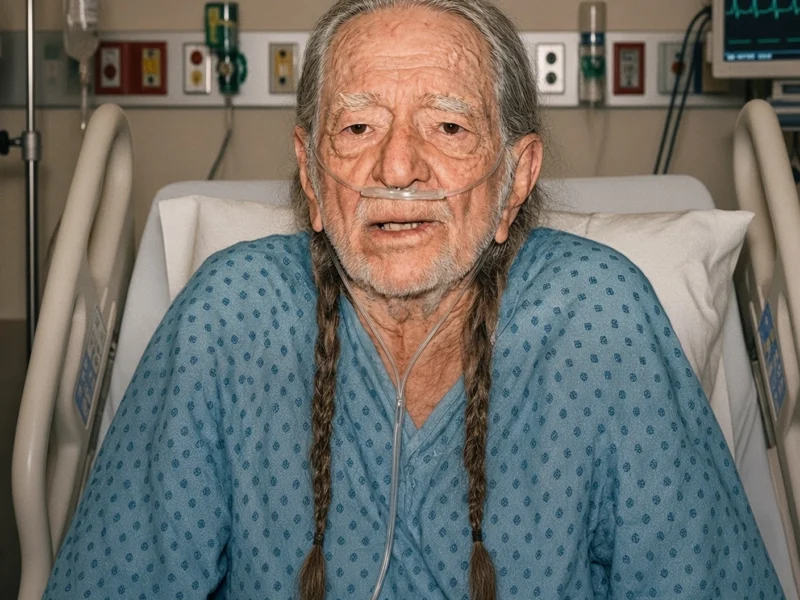
At 92, Willie Nelson Reveals Who He Doesn’t Want at His Funeral
At 92, Willie Nelson had already lived through more endings than most people could imagine.
Friends had disappeared. Family members had passed away. Fellow musicians who once stood beside him on stages across America were gone. Entire chapters of his life had closed, one after another.
And yet Willie kept moving. He was still writing, still performing, and still talking about death with the strange mixture of humor and honesty that had always made him different.
But then came a question that sounded almost shocking. Who exactly did Willie Nelson not want at his funeral?
The answer is not as simple as the headline suggests. When you look closely at what Willie has actually said about death, funerals, friendship, family, and the people he has lost, something much deeper begins to emerge.
This is not really a story about an unwanted guest. It is a story about a man who has spent decades learning how to face the end without pretending it isn’t there.
For most of his life, Willie Nelson seemed almost impossible to stop. He survived poverty, professional disappointment, financial disaster, personal loss, changing musical fashions, and the relentless passage of time.
He became one of the most recognizable figures in American music without ever completely fitting into the world that created him.
He could write a heartbreaking ballad and then make a joke about death seconds later. He could stand on a stage in front of thousands of people and sing about loneliness, regret, love, and mortality as if he were talking privately to an old friend.
That ability became part of his identity. And as Willie grew older, death stopped being an abstract subject. It became personal.
The people who had shaped his life began disappearing around him. Some were family. Some were musicians. Some were friends who had shared years of highways, recording studios, backstage rooms, and late-night conversations.
Each loss changed the landscape of the world Willie knew. Yet he never seemed interested in giving death the final word.
That may be the most important clue to understanding the funeral question. Willie Nelson has never treated death quite the way most people do.
He has joked about it. He has written about it. He has sung about it. He has planned around it. And sometimes, in the most unexpected ways, he has turned it into another reason to celebrate being alive.
Long before the world knew him as the legendary singer with the red hair, bandana, battered guitar, and unmistakable voice, Willie Hugh Nelson was simply a boy growing up in Depression-era Texas.
He was born in 1933 in Abbott, Texas, during a period when life was difficult for millions of American families. He and his sister Bobbie were raised largely by their grandparents after their parents separated.
Music became part of their lives early. It wasn’t some glamorous career plan. It was something connected to community, church, family, and survival.

Bobbie would become one of the most important people in Willie’s life. The two siblings carried music with them for decades.
But the young Willie was not destined to become an overnight star. His path was far more complicated.
He wrote songs before he became famous for singing them. He wrote songs that other artists recorded and turned into major hits. His songwriting ability became increasingly respected, while his own recording career struggled to find the right direction.
That contradiction would define much of his early life. Willie could create songs that moved millions of people, yet the music industry did not always know what to do with Willie Nelson himself.
He was too unconventional, too relaxed, too independent, and too unwilling to behave like the polished country singers the business expected.
At one point, he moved to Nashville and worked as a songwriter. His compositions found success in the voices of other performers. Songs such as “Crazy” became associated with Patsy Cline, helping establish Willie as a songwriter of extraordinary emotional depth.
But there was a problem. The industry could understand Willie’s songs more easily than it could understand Willie. He did not fit neatly into the system.
Eventually, he returned to Texas. And that decision helped change country music.
The Texas music scene gave Willie room to become himself. Instead of trying to sound like everyone else, he began developing the loose, personal style that would become central to the outlaw country movement.
The story is often told as though Willie suddenly became a rebel. But the reality was more gradual.
He had spent years discovering that the more he tried to fit inside someone else’s idea of success, the less comfortable he became. So he stopped trying.
That choice came with consequences. It also gave him freedom.
Willie’s career eventually exploded, but by then he had already learned something many artists never learn. Success means very little if you have to become someone else to achieve it.
That philosophy would later shape the way he thought about almost everything, including death.
By the 1970s, Willie was no longer simply a songwriter admired by other performers. He had become a cultural force.
Albums such as “Red Headed Stranger” helped establish a new version of country music. His voice sounded worn but intimate. His phrasing was unusual. His guitar playing was unmistakable.
His songs did not always follow the polished formulas Nashville expected, and audiences responded. The more Willie became himself, the more people wanted to hear him.
He was joined by other artists who were similarly unwilling to remain inside traditional boundaries. Waylon Jennings became one of the most important figures in Willie’s musical life, and together they became central to the outlaw country movement.
Their friendship was not simply a marketing partnership. It was part of a larger cultural shift. They represented artists who wanted control over their music and their identities.
Willie and Waylon did not look like the future Nashville had imagined. They became the future anyway.
But success did not protect Willie from loss. In fact, the bigger his life became, the more people there were for him to eventually lose.
Waylon Jennings died in 2002. For Willie, it was not merely the death of a famous musician. It was the loss of someone who had shared a crucial part of his life.
Their relationship had contained music, humor, disagreements, loyalty, and years of history. They had become symbols of an era, but behind the public image were two men who had known each other through success and struggle.
When Waylon was gone, Willie was left carrying memories that no new collaborator could simply replace.
Then came other losses. Johnny Cash died in 2003. Kris Kristofferson died in 2024.
Each represented a different part of the musical world Willie had helped create. The Highwaymen had brought Willie, Waylon, Johnny, and Kris together as something larger than four solo careers.
They were older musicians with enormous histories, but their chemistry came from something much simpler. They knew one another’s lives. They understood the roads. They understood the pressure.
They understood the strange combination of fame and loneliness that could come with being an American music legend.
When one member disappeared, the shape of the group changed forever. When another died, another piece of that shared history vanished. Eventually, Willie was the one still standing.
And that is where the funeral question becomes more meaningful. When you are young, a funeral is something that happens to someone else. When you are 92, it becomes part of your own horizon.
Willie has never seemed frightened by that reality. Instead, he has often treated mortality with irreverence.
One of the clearest examples came through the title of one of his songs, “Roll Me Up and Smoke Me When I Die.” The title alone tells you something about Willie Nelson.
A different artist might approach death with solemnity. Willie could turn it into a joke. But beneath the humor was something more serious.
The song reflected a long-running part of his personality. He did not want death to erase the joy, freedom, and humor that had defined his life. He was not interested in becoming a solemn monument. He wanted to remain Willie even after death.
That attitude helps explain why so many headlines about Willie and mortality attract attention. People know he is old. They know he has lost friends. They know he has spent decades singing about life and death.
And they know that at some point every living person must confront the question of what happens afterward.
But the idea that Willie has publicly named a specific person he refuses to have at his funeral requires caution. A dramatic headline can make it sound as though he delivered a shocking confession naming an enemy. The documented story is more complicated.
There is a difference between a celebrity joking about funerals, expressing preferences about how they want to be remembered, or discussing death in general, and actually naming one particular person they do not want present. Those are not the same thing.
Willie Nelson’s life deserves more than a sensational answer invented to fit a headline.
The deeper story is far more interesting, because Willie has spent his entire life resisting the idea that other people should define how he lives. Why would death suddenly be different?
From the beginning of his career, Willie challenged expectations. He challenged musical conventions. He challenged fashion. He challenged the Nashville establishment.
He challenged the idea that a country singer needed to look a certain way, sound a certain way, or behave a certain way. He built his career by refusing to let other people decide who Willie Nelson was.
That independence eventually became part of the reason millions of people trusted him. He seemed authentic because he did not appear to be performing authenticity. He simply lived according to his own instincts.
And perhaps that is what people hear when they listen to him talk about death. There is no elaborate philosophy. There is no need to make mortality sound beautiful.
Sometimes Willie simply jokes about it. Sometimes he sings about it. Sometimes he accepts it. But he keeps living.
That last part matters, because Willie Nelson’s story is not really about death. It is about persistence.
He kept going after Nashville rejected his style. He kept going after personal relationships ended. He kept going after financial trouble. He kept going after physical limitations that might have convinced another performer to retire.
He kept going after the deaths of friends. And he kept going as the music industry around him transformed.
That persistence became almost impossible to separate from his identity.
When Willie encountered one of the most painful financial crises of his life in the 1990s, it could have destroyed his career. The Internal Revenue Service claimed he owed millions in back taxes. The story became national news.
Willie had made money, but complicated financial circumstances and investments left him facing enormous tax debt. The government seized assets, and his financial troubles became part of his public identity.
For a performer who had already spent years building a reputation as an independent outsider, the situation could have been devastating.
Instead, Willie turned the crisis into another chapter. He recorded and sold material in creative ways. He continued performing. He worked. He paid the debt. And eventually, the crisis ended.
The lesson was not that Willie had somehow avoided consequences. He had not. The lesson was that consequences did not stop him.
That distinction would become important later in his life. People often imagine resilience as a dramatic moment when someone suddenly becomes strong. Willie’s resilience was much quieter. It was simply the decision to get up again.
Another show, another song, another road, another morning. That pattern continued for decades.
And then came the losses that could not be solved by another performance.
His sister Bobbie remained one of the central people in his life for much of his career. She was not merely his sibling. She was a musician who performed with him and became part of the sound and identity of his band.
Their connection stretched back to childhood. They had grown up together. They had experienced hardship together. They had carried music forward together.
When Bobbie died in 2022, Willie lost one of the last people who had known him before the world knew Willie Nelson.
That kind of loss is different. Fans can remember an artist. Friends can remember a performer. But a sibling who grew up beside you remembers the person before the legend. The child, the young man, the mistakes, the dreams, the ordinary moments.
Bobbie represented a living connection to a Willie who existed before the fame. When she was gone, another bridge to that earlier life disappeared.
That is the kind of loss that makes old age feel different. At 30, you look forward. At 50, you may still imagine decades ahead. At 70, you begin thinking differently about time. At 90, time itself becomes part of the story.
Every year contains people who may not be there for the next one. Every reunion carries the possibility of becoming a final reunion. Every performance becomes part of an increasingly long history.
And yet Willie kept performing. That is perhaps the most Willie Nelson thing of all.
He did not respond to mortality by disappearing from life. He responded by continuing to participate in it.
Farm Aid became another major part of that story. Willie co-founded it in 1985 with Neil Young and John Mellencamp to support family farmers. Decades later, he was still associated with the organization.
For many people, the image of Willie on stage is inseparable from his advocacy. He became more than a singer. He became a symbol.
But Willie never completely separated activism from music. For him, both were expressions of the same basic idea. People matter. Farmers matter. Families matter. Communities matter. The individual matters.
That worldview also helps explain why Willie has always maintained such a strong relationship with his audience.
His songs often sound personal without being private. He sings about heartbreak, loneliness, regret, aging, love, and loss in a way that allows listeners to place their own lives inside the words.
That is why songs such as “On the Road Again,” “Always on My Mind,” and “Angel Flying Too Close to the Ground” became larger than recordings. They became emotional reference points.
People used Willie’s music to remember people, to survive breakups, to celebrate reunions, to travel, to mourn, to grow older, and eventually to think about death.
The strange thing about Willie Nelson is that his music has often been present at moments when people feel most vulnerable. Yet the man who created it rarely presented himself as someone who had all the answers.
That may be one reason his mortality feels so human. He does not appear to be standing outside the human experience explaining it. He is inside it.
He is aging. He is losing people. He is remembering. He is adapting. And he is still trying to make sense of the same questions everyone else eventually faces.
What remains after a person is gone? Who remembers them? What matters? What does a funeral actually mean? And who gets to decide how a life should be remembered?
For Willie, the answer seems to be that the life itself matters more than the ceremony. The funeral is the final public moment, but the real story happened before it.
The songs, the friendships, the mistakes, the family, the roads, the people who laughed with you, the people who disappointed you, the people you forgave, the people you never had the chance to forgive. That is where the meaning lives.
Willie’s long career is filled with people who played those roles. Some remained close. Some drifted away. Some became legends, some became memories, and some became wounds. That is true of almost every long life.
The difference is that Willie’s life has been lived in public. His friendships became stories. His disagreements became headlines. His marriages became part of his biography. His financial troubles became national news. His songs turned private emotions into public experiences.
He never had the luxury of growing old anonymously. Every new decade brought another round of questions.
Would he retire? Would his voice change? Could he still perform? Was another album coming? Was he healthy? Was this the final tour? Was this the final performance?
Again and again, Willie answered those questions in the same way. He kept working. He kept recording. He kept showing up.
That became almost its own form of rebellion. At an age when most people would be expected to slow down, Willie continued to move forward.
Not because time had stopped. It had not. He knew exactly what time was doing.
His music increasingly reflected that awareness. His later work contains a deeper sense of memory. There is more reflection, more awareness of people who are gone, and more willingness to look directly at aging.
But even then, Willie rarely sounds defeated. That distinction is important. Sadness is not the same as surrender. Aging is not the same as giving up. Remembering someone is not the same as living in the past.
Willie has spent years demonstrating that. One of the most revealing examples is his 2018 album, “Last Man Standing.”
The title itself carries enormous weight. By then, Willie had outlived many of the people who had helped define his generation. He was still here, still recording, still touring, still writing.
The title could have sounded tragic. Instead, Willie treated it with humor.
That humor became a survival mechanism. He could acknowledge the painful reality without allowing the reality to control him.
That is very different from pretending death does not exist. Willie knows it exists. He simply refuses to let fear of it become the organizing principle of his life.
That philosophy became even clearer with later work. In 2024, Willie released “The Border.” But another project attracted particular attention because of its title and themes: “The Last Leaf on the Tree.”
The image of the final leaf hanging on a tree is powerful. It is a leaf surrounded by emptiness. A leaf that has survived longer than the others. A leaf that knows winter is coming.
It is an image of aging, of survival, of loneliness, but also of endurance.
Willie has often seemed comfortable with that contradiction. He can be the last one standing and still smile. He can lose people and still sing. He can think about death and still make jokes. He can acknowledge the end without allowing it to erase the present.
That is why reducing his funeral philosophy to “Willie Nelson doesn’t want this person there” misses the larger story.
Maybe the more revealing question is not who Willie wants excluded. It is who he wants remembered. And when you look at his life, the answer becomes clearer.
Family matters. Friends matter. Music matters. The people who shared the road matter. The people who stood beside him when the career was uncertain matter. The people who believed in him before he became Willie Nelson, the legend, matter.
And perhaps most importantly, the people who loved him without needing the legend matter.
That is why Bobbie’s presence in his story is so significant. That is why Waylon matters. That is why Johnny matters. That is why Kris matters. That is why Paul English matters.
Paul English was not simply another member of Willie’s working world. He became one of the most enduring figures in Willie’s inner circle. English worked with Willie for decades, serving as drummer, road manager, and close companion.
Their relationship became part of Willie’s mythology. There was loyalty. There was humor. There was conflict. There was history.
When English died in 2020, Willie lost another person who had traveled through an enormous portion of his life with him. Again, the public saw the loss through the lens of a celebrity. But for Willie, it was a personal absence.
The chair is empty. The phone does not ring. The familiar voice is gone. Those are the realities of aging that never appear in a headline.
And eventually, those absences accumulate. One friend, then another, then another. A sister, a musical partner, a longtime companion, a generation.
At some point, a person becomes a keeper of memories simply because so many of the people who shared them are no longer alive. Willie Nelson reached that point.
He became one of the surviving witnesses to a musical era that no longer exists in the same form. That makes his continued presence extraordinary.
He is not simply an old performer. He is a living connection to decades of American culture.
He remembers people whom younger generations know only through recordings. He remembers stages that no longer exist. He remembers roads that have changed.
He remembers a music business before streaming, before social media, before modern celebrity culture, and he has watched almost all of it change.
That perspective gives his comments about death a different weight. He has seen enough endings to know that they are inevitable. But he has also seen enough beginnings to know that endings are not the entire story.
The death of one person does not erase everything they created. A song remains. A story remains. A photograph remains. A memory remains. A joke remains. Sometimes even a phrase remains for generations.
That is the strange gift of a public life. The person disappears. The work continues.
For Willie, music has always been the place where that continuation happens. He can lose a friend and still sing the friend’s name. He can remember a childhood and put its emotion into a song. He can think about mortality and turn the thought into humor. He can feel grief and turn it into melody.
That is why his career has endured. The songs do not simply describe life. They carry pieces of it forward.
And perhaps that is what Willie means when he refuses to take death too seriously. Not that death is unimportant, but that life deserves more attention while it is still happening.
That idea appears again and again in the way Willie has lived. He continued to tour. He continued to collaborate. He continued to record. He continued to support causes he cared about.
He continued to spend time with family. He continued to make people laugh. He continued to write.
That is not the behavior of someone who believes life is finished. It is the behavior of someone who knows life is temporary and therefore wants to use whatever time remains.
There is a difference. When people hear that a 90-year-old musician is still performing, they sometimes see it as an act of defiance against age. But Willie has never needed to defeat age. He simply refuses to let age make every decision for him.
If he can perform, he performs. If he can write, he writes. If he can laugh, he laughs. If he can remember, he remembers.
And if he needs to talk about death, he talks about death. He does it without pretending, without panic, and without turning it into a tragedy before it happens.
That is why the funeral question ultimately leads somewhere unexpected. It leads away from the idea of enemies. It leads toward the idea of identity.
Who should be there? Who should not? What should the room feel like? What should the music sound like? Should people cry? Should they laugh? Should they remember the difficult moments? Should they celebrate the good ones?
Willie has spent his entire life giving people clues about how he wants to be remembered. Not through one dramatic funeral statement, but through the life he built.
He has given those clues through the songs he wrote, the people he loved, the causes he supported, and the humor he used to make uncomfortable subjects easier to face. And he has given them through the refusal to let anyone turn him into something he was not.
That is why the image of Willie Nelson’s funeral should probably not be imagined as a gloomy final scene. If anything, the spirit of Willie suggests something very different.
Music, stories, and laughter. People remembering the road, talking about the songs, and telling stories that Willie himself might have interrupted with a joke, because that is how he has always handled life.
Even when things were painful, he found a way to make them human. Even when things were serious, he found a way to laugh. Even when the world expected him to behave like a legend, he often behaved like a regular man who happened to have written some extraordinary songs.
That may be his greatest protection against becoming a monument. He remained human.
And perhaps that is why people care so much about what he thinks about death. They are not really asking about a funeral. They are asking how someone who has lived this long can continue facing the inevitable without becoming consumed by it.
Willie’s answer seems remarkably simple. Live. Keep moving. Love people. Make music. Laugh when you can. And when someone leaves, remember them.
There is something almost radical about that simplicity. Modern celebrity culture often turns aging into a problem that must be hidden. Wrinkles are edited. Gray hair is covered. Retirement is treated like disappearance. Death is discussed in euphemisms.
Willie does almost the opposite. He lets himself be old. He talks about mortality. He makes jokes about dying. He writes songs about getting older. And he keeps appearing on stage.
There is no illusion that he will live forever. The remarkable thing is that he seems to have made peace with that.
His legacy does not depend on immortality. It depends on what he leaves behind. And he has already left behind more than most artists could hope to create.
He has given us thousands of performances, hundreds of recordings, songs that became standards, a distinctive guitar style, and a unique voice. He has given us a cultural movement, a political and social presence, a family history, and a body of work that spans generations.
And perhaps most importantly, he has left memories. Millions of them.
Some belong to strangers. Someone remembers hearing “On the Road Again” while driving across the country. Someone remembers “Always on My Mind” because of a person they lost. Someone remembers a Willie Nelson concert with a parent who is no longer alive.
Someone remembers a childhood car ride. Someone remembers a wedding. Someone remembers a difficult year when his music helped them survive.
That is the strange mathematics of a long artistic life. One person’s songs become millions of people’s memories.
So when Willie eventually has his funeral, whenever that day comes, the people in the room will not be the only people affected. There will be people across the country and around the world who never met him but feel as though they knew something about him.
That is what music can do. It creates a relationship without requiring an introduction.
Willie has spent decades participating in that relationship, and the funeral will not be the end of it. The recordings will continue. The performances captured on film will continue. The songs will continue. The stories will continue.
Someone will discover Willie for the first time years after his death. A young listener will hear the voice and wonder why it sounds so different. Another will find the lyrics. Another will hear the guitar. Another will learn about Farm Aid.
Another will discover the Highwaymen. Another will find Bobbie. Another will hear the story of the IRS troubles and wonder how he survived. And another will hear one of Willie’s jokes about death and laugh.
That is how a legacy survives. Not as a statue, but as a conversation.
The most important thing about Willie Nelson’s relationship with death may therefore be the fact that he has never allowed death to become the most interesting thing about him.
His life is more interesting. The people are more interesting. The music is more interesting. The mistakes are more interesting. The survival is more interesting. The love is more interesting. The road is more interesting.
Death is simply the boundary around all of it. And Willie has spent his life paying attention to what happens inside the boundary.
That may also explain why he never needed to manufacture a dramatic enemy for the end. The idea of someone being banned from his funeral sounds like a perfect celebrity headline because it creates conflict. But Willie Nelson’s real story has never depended on conflict alone. It depends on character.
And his character has always been difficult to reduce to one sentence. He is rebel and traditionalist. He is comedian and songwriter. He is activist and entertainer. He is father, brother, friend, husband, collaborator, and survivor.
He is an icon who often seems uncomfortable being treated like one. He is a man who has lived long enough to become part of history while still behaving as though he has another show tomorrow.
That contradiction is Willie. And maybe it is the best way to understand why he keeps talking about death without sounding defeated by it.
He has never believed that taking life seriously means taking yourself seriously. There is room for grief. There is room for laughter. There is room for memory. There is room for fear. And there is room for a joke.
His approach to death is therefore not a rejection of sadness. It is a refusal to let sadness erase everything else.
When Bobbie died, the loss mattered. When Paul English died, the loss mattered. When Waylon died, the loss mattered. When Johnny died, the loss mattered. When Kris died, the loss mattered.
But Willie did not disappear with them. He carried the memories forward.
That may be one of the hardest things about surviving. You become the person who remembers, and remembering can hurt. But it can also be a form of love. To remember someone is to admit that their existence changed yours.
Willie has spent much of his later life doing exactly that. His songs increasingly feel like conversations with people who are no longer here. Sometimes the names are obvious. Sometimes the memories are hidden inside a line. Sometimes the emotion is all that remains.
But the past continues to live in the music. That is why his later work can feel so moving. It does not sound like a young artist pretending to understand mortality. It sounds like an old man who has earned the right to talk about it.
He has buried friends. He has lost family. He has experienced failure. He has experienced success. He has seen people come and go. And still, somehow, he is here.
That is what “Last Man Standing” meant. That is what “The Last Leaf on the Tree” evokes. Not victory over death, but survival in the presence of death.
There is a subtle but important difference. The last leaf does not defeat winter. It simply remains on the branch a little longer.
And perhaps that is Willie Nelson’s story at 92. He does not have to defeat time. He only has to live the time he has.
One more song. One more conversation. One more performance. One more laugh. One more memory. That is enough.
And so when people ask who Willie Nelson does not want at his funeral, the honest answer may be less sensational than the headline. There is no reliable basis for turning the question into a confirmed story about a named enemy unless a specific documented statement supports it.
What we can see, however, is much more revealing. Willie has spent decades telling us what he values.
He values people who were there. He values family. He values friendship. He values music. He values freedom. He values humor. He values the road. He values memories. And he values the simple privilege of still being alive.
Those values tell us more about his eventual funeral than any sensational rumor ever could. A person’s funeral is shaped by the life that came before it.
And Willie Nelson’s life has never been small. It has been complicated, messy, beautiful, painful, funny, successful, financially disastrous, romantic, lonely, collaborative, independent, and deeply human.
He has made mistakes. He has survived mistakes. He has lost people. He has loved people. He has disappointed people. He has been disappointed.
He has been celebrated. He has been criticized. He has been underestimated. And somehow, after all of it, he kept playing.
That is the real revelation. Not that Willie has discovered some secret way to avoid death. He has not. Not that he has found a way to stop losing people. He has not. Not that he has escaped aging. He has not.
The revelation is that he has learned how to live while knowing all of those things are unavoidable. And that may be harder than any song, because everyone eventually loses. Everyone eventually grows old. Everyone eventually says goodbye.
The difference is what we do with the time before that goodbye arrives. Willie Nelson chose music. He chose family. He chose friendship. He chose activism. He chose humor. He chose the road, again and again.
And maybe that is why his music has lasted. People recognize themselves inside that choice.
They know what it means to lose someone. They know what it means to keep going. They know what it means to laugh when they probably should be crying. They know what it means to carry an old memory into a new day.
Willie simply found a way to put those feelings into songs.
That is why his legacy is bigger than a funeral. A funeral lasts one day. A song can last a century.
A funeral gathers the people who can physically be there. A song reaches people who were never born when it was written. A funeral closes a life. A song can reopen it.
Someone presses play, and Willie comes back. The voice, the guitar, the words, the feeling. For a few minutes, the past is present again.
Maybe that is the closest thing to immortality Willie Nelson has ever needed. Not living forever, but being remembered honestly. Being heard, being felt, being part of somebody else’s life long after his own has ended.
And if there is one thing Willie Nelson’s long relationship with death seems to teach, it is that the end does not need to become the entire story.
There is a temptation, especially with someone who has reached such an advanced age, to reduce everything to the final chapter. Who will attend? Who will speak? Who will cry? Who will be missing?
But Willie has spent more than nine decades proving that the final chapter is only meaningful because of everything that came before it.
The boy in Abbott. The songwriter in Nashville. The musician searching for his sound. The Texas rebel. The outlaw. The Highwayman. The activist. The father. The brother. The friend. The survivor.
The man who owed the IRS millions and somehow kept working. The man who watched friends disappear and kept singing. The man who lost his sister and kept carrying the music they shared. The man who reached his 90s and still found reasons to laugh.
All of those people are Willie Nelson. None of them can be separated from the others. And when the final moment eventually comes, it will not erase them. It will simply place a boundary around the story.
Until then, Willie still has something most people never receive at the end of a very long life. Another day. Another chance to remember. Another chance to make music. Another chance to make someone laugh.
Another chance to step onto a stage. Another chance to look at the road ahead and say, in his own unmistakable way, that there is still somewhere to go.
That may be the final lesson of his life. You cannot decide how long the road will be. You cannot decide who leaves before you. You cannot prevent every goodbye. But you can decide what you do with the miles that remain.
Willie chose to fill them with music.
And after more than nine decades, perhaps the most fitting thing to say about Willie Nelson is not that he finally reached the end of the road. It is that for as long as he could, he kept traveling.