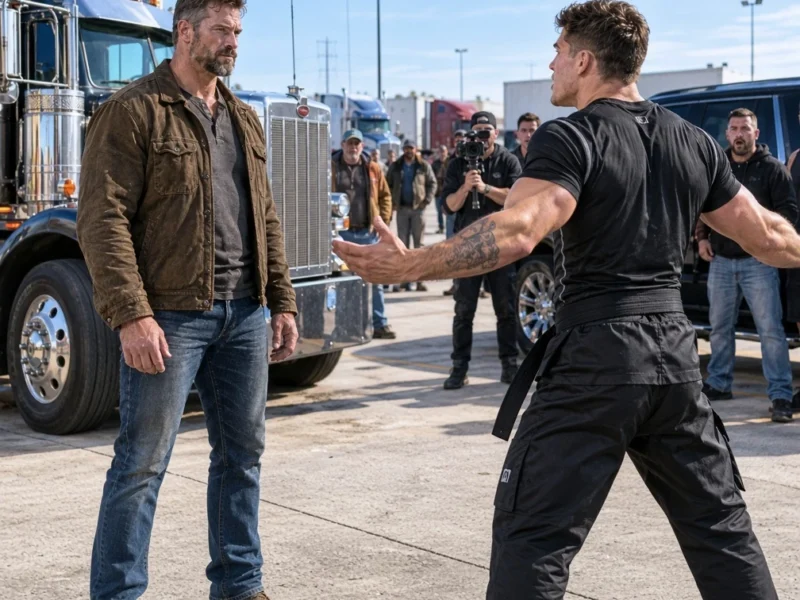
An Undefeated Black Belt Challenged a Calm Truck Driver — Unaware He Once Led an Elite SEAL Team
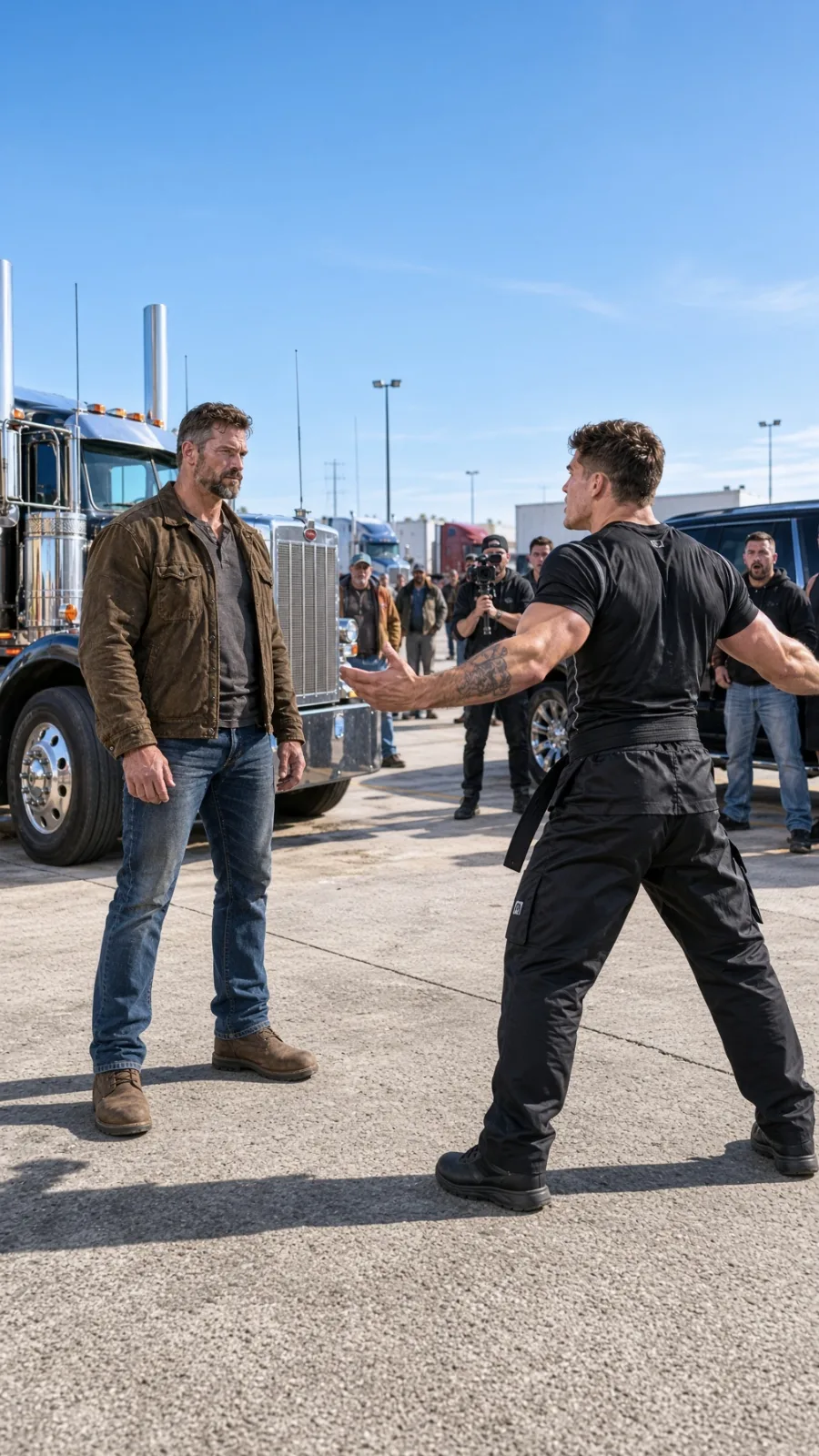
Some men are loud because they want you to know they’re dangerous.
Other men are quiet because they already know.
When an undefeated regional fighter walked into a dusty roadside diner looking to shoot a viral prank, he picked the biggest, quietest guy in the room to humiliate.
He saw a tired trucker in a faded flannel shirt eating cold eggs.
He didn’t see the faded scars, and he certainly didn’t know he’d just cornered a former Tier 1 operator who hadn’t thrown a punch in five years and was trying very, very hard to keep it that way.
The diner smelled of stale fry grease, bleached countertops, and the sharp tang of diesel exhaust that bled through the front doors every time a rig downshifted on the interstate.
It was 2:00 in the morning on a Tuesday in West Texas, the kind of hour where the world strips away its polite fictions, leaving only the weary, the running, and the lost.
Thomas Kesler sat in the back booth.
He was a broad-shouldered man, thick through the chest and neck, though the bulk was hidden beneath a worn canvas jacket.
His face was a map of hard miles and bad weather, framed by a short, graying beard.
He stared into a mug of black coffee, watching the dark liquid vibrate slightly as a passing freight train shook the foundation of the building.
Kesler drove an 18-wheeler now, hauling timber, auto parts, whatever paid the diesel bill and kept him moving.
The highway was a beautiful, mindless thing.
It demanded nothing but forward momentum.
You held the wheel.
You watched the lines.
And if you did it long enough, the roaring in your head eventually dulled to a quiet hum.
He liked the solitude.
He liked the anonymity.
Nobody out here asked him about the valleys of the Hindu Kush.
Nobody asked him about the night the extraction chopper took fire or the metallic smell of blood on the ramp.
Out here, he was just a log book, a CB radio handle, and a shadow passing in the night.
He took a slow sip of the coffee.
It tasted like burnt copper.
Perfect.
The diner was mostly empty.
A pair of older women in nursing scrubs sat at the counter.
A gaunt kid in a hoodie slept over a half-eaten plate of fries in the corner.
Behind the register, a waitress named Betty, according to her faded plastic name tag, leaned heavily on her elbows, doing a crossword puzzle.
It was a fragile, quiet ecosystem.
Then the bells on the front door violently jingled and the ecosystem shattered.
Four men walked in, or rather they invaded.
They carried the restless, aggressive energy of people who desperately needed to be perceived.
At the center of the pack was Derek Cobb.
Derek was 24, built like a brick wall wrapped in expensive athleisure wear.
His neck was thick, his ears slightly cauliflowered, and his jaw permanently set in a tense, jutting angle.
He was currently 11-0 in the regional mixed martial arts circuit, a fact he made sure everyone in his immediate vicinity knew within five minutes of meeting him.
But in the modern world, being a good fighter wasn’t enough.
You had to be a brand.
You had to be a personality.
You needed clicks, views, and algorithms to feed the beast.
That was why one of the men flanking him was holding a professional-grade camera on a handheld gimbal.
A bright LED ring light casting a harsh white glare into the dim diner.
“I’m telling you, bro,” Derek said, his voice carrying effortlessly over the low hum of the refrigerators.
He tapped the table.
“The ref just didn’t see it. The guy was practically begging for his life in the second round.”
His entourage laughed.
A chorus of sycophants.
Kesler didn’t look up from his coffee.
He didn’t need to.
Decades of training, deeply ingrained and impossible to turn off, had already mapped the room.
He knew Derek weighed around 210 pounds, carried his weight slightly forward on the balls of his feet, and had a slight stiffness in his left shoulder, probably an old rotator cuff injury.
He knew the camera guy was distracted and off balance.
He knew the other two were just noise.
Kesler shifted his gaze to the window, watching the rain streak the glass.
He just wanted to finish his eggs.
He had another 400 miles to push before sunrise.
Derek and his crew slid into a booth in the center of the room, taking up as much space as physically possible.
The camera kept rolling.
Derek was playing to the lens, loud and animated, turning the quiet diner into his personal stage.
“Hey, sweetheart.”
Derek snapped his fingers in the air toward the counter.
Betty, the waitress, didn’t flinch, but her jaw tightened.
She carefully set down her pen, smoothed her apron, and walked over to the booth, notepad in hand.
She looked to be in her late 50s, her eyes lined with the kind of exhaustion that no amount of sleep could ever fix.
“What can I get you boys?” she asked, her voice flat.
Professional.
“Yeah, look.”
Derek leaned back, stretching his arms across the top of the booth.
“We need protein. Lots of it. I’m talking a dozen eggs raw, a couple steaks, and whatever you got that isn’t soaked in that cheap grease I can smell from the parking lot.”
The cameraman snickered, bringing the lens closer to capture Betty’s reaction.
“We got the steak and eggs special,” Betty said evenly.
“I don’t serve raw eggs. Health code.”
Derek sighed loudly, looking directly into the camera lens with exaggerated disbelief.
“Health code? She’s worried about the health code in a place that looks like a crime scene. Classic.”
He looked back at Betty.
“Just bring the food, lady, and make it quick. I burn more calories in 10 minutes than you do in a week.”
Betty stopped writing.
She looked at him, really looked at him, with a mixture of pity and profound annoyance.
“I’ll put the order in.”
She turned on her heel and walked back to the kitchen.
Kesler took another slow, deliberate sip of his coffee.
His heart rate rested at a steady 50 beats per minute.
He felt the familiar cold tug at the back of his mind, the instinct to step in, the instinct to correct a situation.
He breathed out a long, controlled exhale through his nose and let the urge pass.
“Not your circus,” he told himself.
“Not your monkeys.”
Ten minutes passed.
The diner fell back into a tense, uneasy silence, punctuated only by Derek’s loud complaints about the state of the table and the poor lighting for his stream.
He was agitated.
The high from his recent win was fading, replaced by the desperate itch for more validation.
He needed a moment, a clip, something that would get stitched on TikTok and shared on Twitter.
The food arrived.
Betty carried a heavy tray, setting down three plates of steak and eggs, a mountain of toast, and four coffees.
As she reached across the table to set Derek’s plate in front of him, her elbow grazed the edge of a water glass.
It tipped, spilling ice and water across the laminate table, a few drops splashing onto Derek’s pristine branded sweatpants.
The reaction was instantaneous.
Derek slammed his hand on the table, the plates rattling violently.
“Are you kidding me?” he barked, shoving the table forward slightly.
Betty jumped back, startled.
“I’m sorry. I’ll get a towel.”
“You’re sorry?”
Derek stood up.
He wasn’t just tall.
He was wide, projecting an intimidating, coiled aggression.
The cameraman immediately adjusted his angle, capturing the confrontation.
“Do you know how much these pants cost? You’re out here serving garbage food in a garbage town and you can’t even put a plate down without making a mess.”
“Sir, it was an accident,” Betty said, her voice shaking just a fraction.
She took another step back.
“Get your manager out here,” Derek demanded, stepping out of the booth, towering over her.
“Right now.”
In the back booth, Kesler set his coffee mug down.
There was no click, no noise.
He simply placed it on the saucer with precise control.
He didn’t want this.
He hated this.
For years, Kesler had navigated the world trying to pretend he was a normal man.
But underneath the flannel, beneath the trucker cap, and the quiet demeanor, he was a machine built by the United States government to process violence with cold, terrifying efficiency.
He had spent a decade operating in environments where a loud voice or a sudden movement meant someone was going to die.
He watched Derek.
He didn’t see an arrogant kid.
He saw a threat matrix.
Target is agitated.
Posture is dominant but untrained for lethal encounters.
Chin is exposed.
Hands are dropped near the waist.
The cameraman is a non-factor.
The other two will freeze if the primary threat is neutralized quickly.
Kesler closed his eyes for a microsecond.
He thought of his truck, the diesel engine warming up in the lot.
He thought of the open road.
“I am the manager on duty,” Betty said quietly.
“I’ll take the meal off your bill, sir. Please sit down.”
Derek laughed, a harsh, ugly sound.
“Take it off the bill? You’re damn right you will. I shouldn’t even have to look at you right now.”
He reached out and forcefully shoved the plate of steak and eggs off the edge of the table.
It crashed to the floor, porcelain shattering, food scattering across the dirty linoleum.
Betty froze, staring at the mess.
Derek leaned in, pointing a thick finger at her face.
“Clean it up and bring me another one.”
The silence in the diner was absolute.
The two nurses had stopped eating.
The kid in the corner was wide awake.
Kesler sighed.
It was a heavy, mournful sound.
The sound of a man who realized the inevitable had arrived.
He slid out of his booth.
He didn’t rush.
He didn’t posture.
He just stood up.
All 6’3″ of him pulling his broad frame to its full height.
The heavy, rhythmic sound of Kesler’s work boots hitting the floor drew the attention of Derek’s entourage.
One of the guys tapped Derek on the shoulder and nodded toward the aisle.
Derek turned, expecting to see a local cop or a rent-a-cop security guard.
Instead, he saw a trucker.
Kesler was wearing faded denim, scuffed leather boots, and a jacket that looked like it had survived a war.
His hands were shoved deep into his jacket pockets.
He walked with a loose, relaxed gait, completely devoid of the aggressive posturing Derek was used to seeing in the cage.
Kesler stopped about six feet from Derek, outside striking distance, but close enough to command the space.
He didn’t look at Derek.
He looked at Betty.
“You okay, Betty?”
Kesler’s voice was deep, gravelly, and entirely calm.
It didn’t bounce off the walls.
It seemed to absorb the tension in the room.
Betty nodded quickly, stepping back from the mess on the floor.
“I’m fine, Tom. It’s okay.”
“It doesn’t look okay,” Kesler said mildly.
Derek turned his full attention to Kesler, a smirk pulling at the corner of his mouth.
This was even better.
A local hero stepping up.
The content was writing itself.
He gestured to the cameraman to make sure he was getting both of them in the frame.
“We got a problem, old man?” Derek asked, rolling his shoulders, slipping effortlessly into his fighter persona.
Kesler finally shifted his gaze to Derek.
His eyes were dark, flat, and completely dead.
There was no anger in them, no fear, no ego.
It was the look of a man staring at a flat tire or a broken windshield wiper.
An inconvenience.
“You dropped your food,” Kesler said quietly.
“She spilled water on me,” Derek countered, taking a half step forward, testing the waters.
“So I made a point. You got something to say about it, Smokey and the Bandit?”
Kesler didn’t blink.
“I think you should apologize to the lady, pay for the plate you broke, and leave.”
Derek’s entourage chuckled.
Derek grinned, shaking his head.
He looked at the camera.
“You getting this? This guy thinks he’s John Wayne.”
He turned back to Kesler.
“Look, buddy, I don’t know if you don’t own a TV, but my name is Derek Cobb. I fight for a living. I hurt people for a living. You go back to your truck, go to sleep, and pretend you didn’t see anything, because if you take one more step, I’m going to fold you in half in front of your little girlfriend here.”
Kesler’s posture didn’t change.
His hands remained in his pockets.
He was perfectly still.
In a chaotic world, stillness is a weapon.
“I don’t know who you are,” Kesler said, his voice dropping an octave, slipping into a quiet, surgical register.
“And I don’t care. I’m asking you nicely. Apologize. Pay. Leave.”
The camera was inches away now.
Derek felt the heat of the ring light.
He felt the eyes of his crew.
His ego, fragile and monstrous, demanded a sacrifice.
You don’t back down in front of a camera.
You don’t let a nobody disrespect you.
“Are you deaf?” Derek sneered.
He closed the distance, stepping deep into Kesler’s personal space, aggressively crowding him.
Derek puffed out his chest, angling his chin down, a textbook fighter stance, ready to slip a punch and counter.
“I said, mind your own business.”
To emphasize his point, Derek raised his right hand and shoved Kesler hard in the center of his chest.
It was a heavy, explosive shove, the kind meant to knock a man off balance, send him stumbling backward, and establish absolute physical dominance.
Kesler didn’t stumble.
He didn’t even rock on his heels.
Instead, the force of the push seemed to vanish into Kesler’s torso, absorbed by a core as solid as an oak stump.
Kesler’s boots remained rooted to the linoleum.
The only thing that moved was the fabric of his jacket.
For a fraction of a second, confusion flashed across Derek’s eyes.
He had hit a wall.
A yielding, breathing wall that didn’t obey the laws of physics he was used to.
Kesler looked down at where Derek’s hand had just impacted his chest, then slowly looked back up at Derek’s face.
The temperature in the diner seemed to plummet.
The flat, dead look in Kesler’s eyes vanished, replaced by something ancient and infinitely sharp.
“You shouldn’t have done that,” Kesler said.
The words weren’t a threat.
They were a statement of fact.
A doctor reading a terminal diagnosis.
Derek felt a sudden, inexplicable cold sweat prickle the back of his neck.
His lizard brain, honed by thousands of hours of sparring and fighting, was screaming at him.
Danger.
Extreme danger.
This wasn’t a civilian.
The way the man stood, the way he breathed, the absolute lack of an adrenaline dump, it was wrong.
But Derek’s ego overrode his instinct.
He couldn’t back down now.
Not on camera.
“Oh yeah,” Derek barked, trying to inject venom into his voice to mask the sudden uncertainty.
“What are you going to do about it, old man? You want to go? Let’s step outside right now, you and me. Unless you’re scared.”
Kesler stared at him.
He didn’t feel anger.
He felt a profound, exhausting sadness.
He had tried to leave the violence in the sand overseas.
He had tried to bury the man who kicked down doors in Fallujah and cleared compounds in the Korengal Valley.
But the world never let you rest.
The world always demanded the monster.
Kesler slowly took his hands out of his pockets.
His knuckles were thick, scarred, pale with a webbing of white lines from things he would never talk about.
“I don’t fight,” Kesler said quietly.
Derek smirked, feeling a rush of relief.
The guy was backing down.
“Yeah, that’s what I thought. Smart choice, trucker. Now, step aside before I—”
“I said I don’t fight,” Kesler interrupted, his voice cutting through Derek’s bravado like a razor blade.
“Fighting implies a contest. It implies rules, a referee, a mat.”
Kesler leaned in just an inch, his voice dropping to a terrifying whisper meant only for Derek.
“If we go outside, son, I am going to dismantle you. I’m going to break things inside you that doctors won’t know how to fix. I’m going to end your career in about four seconds. And I will not lose a single second of sleep over it.”
Derek swallowed hard.
His mouth had gone bone dry.
“So,” Kesler said, stepping back, giving Derek space.
“You have a choice. You can be the big man for your camera, or you can pay the waitress, get in your car, and go live a long, healthy life.”
The silence stretched.
The camera guy had lowered the lens slightly, sensing that the dynamic had shifted in a way he didn’t understand.
Derek’s hands twitched.
He wanted to swing.
He visualized the overhand right, the double leg takedown.
But every time his brain ran the simulation, it ended with the quiet trucker staring at him with those hollow, terrifying eyes.
Derek looked at Betty.
He looked at the broken plate on the floor.
“Man, whatever.”
Derek scoffed loudly, stepping back, trying to salvage a shred of dignity.
“This place is a dump anyway. Not even worth my time. You’re lucky I’m in a good mood.”
He reached into his pocket, pulled out a crumpled $100 bill, and threw it on the table.
He didn’t look at Kesler again.
He turned to his crew.
“Pack it up. We’re out of here.”
The entourage scrambled, grabbing the camera and their jackets, moving with nervous, hurried energy.
They pushed through the front doors, the bells jingling wildly as they spilled out into the rainy night.
Kesler stood perfectly still, watching the glass doors swing shut.
He waited until the taillights of their SUV flared red in the parking lot and pulled out onto the highway, disappearing into the dark.
Only then did Kesler let out a long, slow breath.
The tension bled out of his shoulders.
The monster went back into its cage, locking the door from the inside.
He turned to Betty.
“You okay?”
Betty let out a breath she seemed to have been holding for a minute straight.
She nodded, reaching for a broom.
“I’m fine, Tom. Thank you.”
Kesler reached into his pocket, pulled out a $10 bill, and set it on the counter for his coffee.
“Keep the change. I got to get on the road.”
He didn’t wait for a thank you.
He zipped up his faded canvas jacket, pushed open the front doors, and stepped out into the rain.
The cold air felt good on his face.
Across the sprawling, oily asphalt, his Peterbilt sat idling.
A massive beast of iron and chrome waiting for its master.
Kesler climbed into the cab, the seat groaning under his weight.
He released the air brakes, the pneumatic hiss sounding like a heavy sigh.
He shifted into gear, easing the enormous truck out of the lot, aiming the headlights down the endless black stretch of I-40.
He was just a driver again.
Just a shadow moving in the night.
Undefeated and entirely unknown.
The interior of the matte black SUV smelled of stale energy drinks, expensive cologne, and sudden, suffocating doubt.
Rain hammered against the windshield.
The wipers thrashed back and forth in a frantic, losing battle against the deluge.
Derek sat in the passenger seat, staring straight ahead at the twin cones of the headlights piercing the dark highway.
He chewed the inside of his cheek until he tasted copper.
Nobody was talking.
Twenty minutes ago, they had been kings of the world.
Untouchable.
Now the silence in the car was a physical weight pressing down on all of them.
In the back seat, Ledger, the cameraman, was hunched over his digital monitor.
The glow of the screen cast a sickly pale blue light across his face.
He was scrolling through the footage, rewinding, playing, rewinding again.
He wore a pair of heavy noise-cancelling headphones, entirely absorbed in the digital reality he was trying to mold.
Derek couldn’t take it anymore.
The phantom pressure of the trucker’s solid, unmoving chest still radiated through his right palm.
He had pushed the man with enough force to put an average guy through a wall.
The trucker hadn’t even shifted his weight.
It defied the physics Derek had spent 10 years mastering on the mats.
“Delete it,” Derek said.
His voice was raspy.
Ledger slid one earphone off.
“What? The footage? Delete it. Wipe the card. We never went into that dump.”
Ledger hesitated, looking down at the screen.
He tapped the playback button.
He hadn’t realized his output was still routed to the camera’s external speaker.
The audio, crisp and terrifyingly clear beneath the ambient hum of the diner’s refrigerators, filled the SUV.
“I’m going to break things inside you that doctors won’t know how to fix. I’m going to end your career in about four seconds, and I will not lose a single second of sleep over it.”
The voice didn’t sound like a man making a threat.
It sounded like an undertaker reciting a price list.
Cold.
Fact-based.
Absolute.
“Turn that off,” Derek barked, twisting violently in his seat, his hand shooting out to grab the monitor.
Ledger yanked the rig back, shielding it.
“Hey, chill out, man. I’m just looking at the framing.”
Ledger swallowed hard, reading the frantic, volatile energy radiating off his meal ticket.
“Look, Derek, this is bad. We teased the stream an hour ago. We told the sponsors we were doing a roadside challenge video. If we just go dark, the Reddit threads are going to start. People saw us go in there. The waitress, those nurses.”
“I don’t care,” Derek snapped.
He faced forward again, running a trembling hand over his close-cropped hair.
“The guy was a psycho. You look in his eyes, he was on something. Meth. PCP. You don’t mess with junkies.”
“He didn’t look like a junkie, bro,” muttered Greg, Derek’s training partner, from the driver’s seat.
He kept his eyes locked on the road, his grip white-knuckled on the leather steering wheel.
“He looked like stone. You shoved him and it was like hitting a bridge pylon.”
“Shut up, Greg,” Derek spat.
The shame was a living, breathing thing now.
It gnawed at the lining of Derek’s stomach.
He was a professional fighter.
He had sponsors.
He had a blue check mark.
He had legions of young men who paid $49.99 a month for his workout programs and alpha male lifestyle coaching.
And he had just tucked his tail and run from a middle-aged man hauling lumber.
If this got out, he was done.
The fighting world was ruthlessly Darwinian.
The moment they smelled blood, the moment they saw weakness, the memes would start.
The sponsors would pull back.
The aura of invincibility, the very foundation of his lucrative career, would disintegrate.
“We can’t just leave it,” Ledger said quietly from the back.
“You know how the internet works. If we don’t control the narrative, someone else will. That kid in the corner of the diner. I saw him holding a phone. If he recorded you walking away—”
Derek felt his chest tighten.
Panic, sharp and metallic, flared in his throat.
Ledger was right.
You didn’t survive in the modern attention economy by running away.
You survived by dominating the narrative.
He looked down at his hands.
They were large, heavily calloused, dangerous tools.
He had knocked out three men in the first round this year.
He was a weapon.
The trucker was just an old man with a creepy stare who got lucky with his footing.
That was it.
Just an old man playing mind games.
“How fast was he going?” Derek asked.
Greg glanced in the rearview mirror.
“Who?”
“The truck, you idiot. The Peterbilt. How fast do those things top out at?”
“I don’t know. 70, maybe 75 if the governor is removed. Why?”
Derek’s jaw clenched.
The fear evaporated, replaced by a desperate, blinding rage.
He needed his pride back.
He needed to see that old man bleed.
He needed the camera to capture it, to prove to himself and his followers that Derek Cobb didn’t back down from anyone.
“Turn around,” Derek ordered.
“Derek, come on, man.” Greg sighed, easing off the accelerator.
“Let it go. We won the fight tonight. Let’s just get to the hotel.”
“I said turn the car around, Greg,” Derek roared, the volume shocking the interior of the SUV.
He slammed his fist against the dashboard, cracking the plastic trim.
“He’s hauling 80,000 pounds. He can’t outrun us. He took Interstate 40 west. There’s a weigh station and a fuel stop about 30 miles up. He has to pass it. We catch him. We get out. We roll the cameras and I put him to sleep. I’m not letting some dirty gear jammer ruin my life.”
Greg stared at him for a long moment.
Then, wordlessly, he checked his mirrors, hit the brakes, and swung the heavy SUV into an illegal U-turn across the muddy median.
The tires tore through the sodden grass, spinning onto the westbound lanes.
In the back seat, Ledger quietly swapped a fresh battery into the camera rig.
He didn’t know what was going to happen, but he knew it was going to go viral.
Mile marker 112.
The rain had tapered off to a fine, freezing mist, leaving the asphalt slick and black like an oil slick.
Thomas Kesler downshifted, the engine brake engaging with a deep, guttural roar that vibrated through the floorboards and up into his boots.
Ahead, the harsh flickering sodium lights of a deserted commercial fuel island cut through the gloom.
It was a miserable stretch of concrete flanked by skeletal pine trees and miles of nothing.
His log book mandated a rest, and his left steer tire had been humming a half-note out of pitch for the last 20 miles.
He needed to thump it.
He eased the massive rig into the expansive empty lot, the air brakes hissing as he brought the 80,000-pound beast to a gentle, precise stop under the harsh yellow canopy.
He killed the engine.
The sudden silence was absolute, heavy, and ringing in his ears.
Kesler sat in the dark cab for a full minute.
He closed his eyes.
He could still feel the adrenaline trying to claw its way out of his adrenal glands.
His body, trained over two decades of relentless, unyielding warfare, was confused.
It had been triggered.
The threat had been identified.
The proximity breached.
The physical contact initiated.
In Fallujah, in Ramadi, in the blacked-out valleys of Afghanistan, that sequence ended only one way.
With kinetic, overwhelming force.
He rubbed his face with both hands, feeling the rough grit of his beard.
He was tired.
A soul-deep exhaustion that sleep could never touch.
He didn’t want to hurt the kid in the diner.
He knew what the kid was.
A peacock.
All feathers and noise, raised in a sanitized world with padded floors and referees who stepped in when things got too dark.
The kid didn’t know the dark.
Kesler lived in it.
He grabbed a heavy wooden tire thumper, essentially a shortened baseball bat, from behind the seat, pushed open the heavy door, and climbed down the metal steps.
The freezing mist felt good against his skin.
He walked slowly around the rig, swinging the thumper, listening to the solid, satisfying thwack of the wood against the thick rubber of the tires.
Everything was tight.
The hum was just the road playing tricks on his tired mind.
He reached the front of the cab and stopped.
Headlights swept across the wet concrete.
A vehicle was approaching fast.
Far too fast for a fuel stop.
The engine whined with high RPMs before the driver slammed on the brakes.
A matte black SUV fishtailed slightly on the slick surface, correcting violently before skidding to a halt directly in front of Kesler’s rig, blocking his exit.
Kesler didn’t move.
He stood by the massive chrome grill of his truck, the tire thumper resting casually against his thigh.
He watched as four doors opened simultaneously.
The environment instantly shifted in his mind.
The fuel pumps became cover.
The slick concrete became a hazard.
The illumination overhead was a tactical advantage.
He was in the shadows of the truck while they were stepping into the harsh yellow light.
Derek Cobb marched out of the passenger side.
He had taken off his jacket and his shirt.
Despite the freezing mist, he was bare-chested, his heavily muscled torso gleaming with sweat and rain.
It was an intimidation tactic, the posture of a silverback gorilla beating its chest in the jungle.
Behind him, the cameraman hoisted his rig, the blinding white ring light illuminating Derek’s back.
Greg and the fourth man flanked them, hanging back slightly, their faces tight with nervous anticipation.
“Hey, trucker,” Derek yelled, his voice echoing off the metal canopy above them.
Kesler sighed, the sound lost in the cold air.
The universe, it seemed, had a terrible sense of humor.
“You think you can disrespect me and just drive away?”
Derek closed the distance, stopping about 10 feet from Kesler.
He was practically vibrating.
The cage fighter persona was fully engaged.
He bounced lightly on the balls of his feet.
His hands raised in a loose guard, chin tucked.
“We’re not in the diner anymore. No waitresses, no cops. Just you and me. Let’s see how tough you are when you have to back it up.”
Kesler looked at the camera.
Then he looked at Derek.
“Son,” Kesler said, his voice carrying the calm, steady rhythm of a metronome.
“Put your shirt on. Go home. You’re cold. You’re embarrassed. And you’re making a mistake you can’t undo.”
“Screw you,” Derek spat.
He took two rapid, sliding steps forward, closing the gap to striking distance.
“Defend yourself.”
Kesler didn’t raise his hands.
He didn’t shift into a fighting stance.
He just stood there.
He tossed the wooden tire thumper softly onto the ground.
It rolled away with a hollow clatter.
To Derek, it looked like surrender.
It looked like the old man had finally realized he was out of his depth.
Derek launched the first strike.
It was a beautiful, technically flawless piece of violence.
A faint with the left jab to blind the vision, followed instantly by a devastating overhand right aimed directly at Kesler’s jaw.
It was a punch that had separated highly trained athletes from their consciousness on national television.
It carried the weight of Derek’s hips, his shoulders, and his bruised ego.
But Kesler wasn’t there.
There was no block, no wild dodging.
Kesler simply slipped inside the arc of the punch with a microscopic, deeply economical shift of his head and torso.
The heavy fist grazed the collar of Kesler’s jacket, hitting nothing but freezing mist.
Derek’s momentum carried him forward, pulling him slightly off balance.
In the cage, Derek would have recovered in a fraction of a second, tying up the clinch or spinning out.
But this wasn’t a cage.
As Derek’s overhand right missed, Kesler’s left hand shot out.
He didn’t throw a punch.
He drove the rigid V-shaped web of his hand directly into the junction of Derek’s throat and collarbone.
It wasn’t meant to kill.
It was meant to disrupt the vagus nerve and collapse the airway just enough to induce absolute panic.
The impact sounded like a wet sandbag hitting concrete.
Derek choked, his eyes going wide, the breath violently expelled from his lungs.
His brain, expecting the satisfying impact of knuckles on bone, was suddenly overwhelmed by a blinding, flashing pain in his neck.
Before Derek could even register the strike, Kesler’s right hand moved.
He grabbed the fabric of Derek’s expensive sweatpants at the hip, pivoted sharply on his left boot, and used Derek’s own forward momentum against him.
It was a throw born not of sport wrestling, but of close-quarters combat designed to put an enemy on the ground with bone-breaking finality.
Derek’s feet left the concrete.
The world spun in a horrifying, uncontrollable blur.
He hit the wet, oil-stained pavement with a sickening crack.
All 210 pounds of muscle and ego slammed onto the unyielding surface.
The air left Derek’s lungs in a ragged, high-pitched wheeze.
Kesler didn’t back away to let him recover.
He didn’t wait for a referee to separate them.
He flowed with the momentum, dropping his knee directly onto Derek’s right bicep, pinning the arm to the concrete with the crushing weight of a 6’3″ man.
At the exact same time, Kesler’s right hand clamped down on Derek’s jaw, not punching, but gripping the bone, twisting Derek’s face sideways against the freezing, filthy pavement.
The fight had lasted exactly 1.4 seconds.
Silence slammed back down on the fuel island.
The only sound was the harsh, ragged whistling of Derek trying to suck air into his bruised throat.
Kesler leaned over him.
The trucker’s face was inches from Derek’s.
And for the first time, Derek saw what was behind the old man’s eyes.
It wasn’t the competitive fire of an athlete.
It was a vast, cold, empty void.
It was the abyss.
“I told you,” Kesler whispered, his voice completely unchanged from when he was sitting in the diner, his heart rate barely elevated.
“I don’t fight.”
In the background, the cameraman stood frozen, the ring light casting long, grotesque shadows across the concrete.
Ledger wasn’t filming a viral knockout anymore.
He was filming a man holding a ghost.
Derek Cobb knew pain.
He had broken his orbital bone in a sparring session when he was 19.
He had torn his meniscus during a grueling camp in Thailand.
He knew the sharp, electrical agony of a joint pushed past its anatomical limit.
And he knew the heavy, concussive fog of taking a shinbone to the temple.
But he had never known terror.
Not true terror.
True terror was the realization that the man holding him down wasn’t angry.
Anger was predictable.
Anger burned hot and fast, and eventually it burned itself out.
The man pinning his face to the freezing, oil-slicked concrete wasn’t operating on anger.
He was operating on an algorithm.
Derek tried to thrash, a purely instinctual panic response from a brain starved of oxygen and desperate to escape a trap.
Kesler didn’t strike him.
He simply adjusted his weight.
It was a microscopic shift of his hips, transferring another 30 pounds of downward pressure directly onto the fulcrum of Derek’s pinned bicep.
The tendons in Derek’s shoulder shrieked.
It felt like thick nylon ropes fraying under the weight of a suspended anvil.
A sharp, involuntary whimper escaped Derek’s lips.
A pathetic sound completely devoid of the bravado he had carried into the night.
“Don’t move,” Kesler said.
The voice was directly in his ear.
It was devoid of adrenaline, devoid of the ragged, heavy breathing that accompanied every fight Derek had ever been in.
Kesler’s breath was slow, steady, and terrifyingly warm against the freezing mist settling on Derek’s skin.
“If you twist your hips again,” Kesler continued, speaking with the patient cadence of a mechanic explaining a broken transmission, “your humerus is going to snap just above the elbow. It’s a spiral fracture. It takes about nine months to heal, and the arm will never rotate the same way again. If you try to kick, I am going to drop my body weight directly onto your cervical spine. Do you understand?”
Derek couldn’t speak.
The rigid grip Kesler had on his jaw prevented it.
He just stared sideways at the filthy concrete, his peripheral vision locked on the thick, scuffed toe of Kesler’s leather work boot.
He tapped his free left hand frantically against the wet pavement.
Tap.
Tap.
Tap.
The universal signal of submission.
The safety valve of the modern gladiator.
Kesler looked down at the frantically tapping hand.
“There’s no referee out here, son,” he whispered.
“Tapping means you want me to stop. But I haven’t even started.”
A few feet away, Greg finally snapped out of his paralysis.
He took a hesitant, stuttering step forward.
He was a large man, a heavy bag for Derek to beat on during camp.
But he possessed the deeply ingrained loyalty of a cornerman.
“Hey,” Greg stammered, his voice cracking in the frigid air.
“Hey, man, let him go. You made your point. He’s done.”
Kesler slowly rotated his head, keeping the crushing pressure perfectly isolated on Derek’s arm and jaw.
He locked eyes with Greg.
It was a look that stripped away thousands of years of human evolution and polite society.
Greg saw the ancient, unforgiving void of the predator.
He saw the blacked-out mountains of the Hindu Kush, the silent helicopter rides, the blood-soaked dirt of compounds whose names he couldn’t pronounce.
Greg wasn’t looking at a trucker anymore.
He was looking at a machine designed by the government to dismantle human anatomy in total darkness.
“Take another step,” Kesler said, the volume of his voice barely rising above the hum of the distant highway, “and you go on the ground next to him.”
Greg stopped.
His heavy chest heaved, but his boots felt cemented to the asphalt.
His survival instinct, ancient and undeniable, screamed at him to stay perfectly still.
He didn’t raise his hands.
He didn’t speak.
He surrendered to the sheer gravitational pull of the violence radiating from the man on the ground.
Behind Greg, Ledger stood frozen, the camera rig shaking violently in his hands.
The harsh white glare of the ring light illuminated the scene like a crime scene photograph.
Ledger looked through the digital monitor, watching the frame.
It looked ugly.
It didn’t look like an athletic contest.
It looked like an execution.
The aura of invincibility surrounding Derek Cobb, the carefully cultivated brand of alpha masculinity, was disintegrating in real time, replaced by the pathetic reality of a young man weeping silently on the ground.
Ledger slowly lowered the camera.
He reached up with a trembling thumb and flicked the power switch.
The recording stopped.
The ring light died.
The sudden darkness felt like a shroud dropping over the fuel island, leaving only the sickly yellow glow of the canopy lights.
Kesler felt the light die.
He let out a long, slow exhale.
The tension in his shoulders finally broke.
The cold, mechanical grip he held on the violence began to thaw, replaced by a crushing, familiar exhaustion.
It was the same exhaustion he felt every time he had survived an engagement.
A bone-deep weariness that reminded him that every time he opened that door in his mind, it became a little harder to close.
He didn’t want to break the kid’s arm.
He didn’t want to end a career.
He just wanted to be left alone.
Kesler slowly lifted his knee off Derek’s bicep.
He released the iron grip on the fighter’s jaw.
He stood up, moving with a fluid, silent grace that defied his massive frame, stepping back out of striking distance.
Derek didn’t move.
He lay curled on his side on the wet pavement, gasping for air, clutching his right shoulder.
The adrenaline was finally dumping into his system, sending violently cold shivers down his spine.
The cold concrete seeped through his sweatpants, chilling him to the core.
He had never felt so small, so utterly fragile.
Kesler looked down at him.
There was no triumph in the veteran’s eyes, only a profound, heavy sadness.
“You think you’re a killer because you step into a cage with rules, a referee, and an ambulance waiting outside,” Kesler said quietly, his voice carrying clearly in the quiet night.
“You think this is a game of who can hit the hardest. It’s not.”
Derek slowly rolled onto his back, wincing, unable to look up at the towering silhouette.
“Violence isn’t a show,” Kesler continued, grabbing the wooden tire thumper from the ground.
“It’s a disease. It’s an ugly, chaotic, miserable thing that ruins everyone it touches. I spent 10 years swimming in it so people like you could play your games on television and pretend you’re dangerous.”
Kesler turned his back on them.
He didn’t check over his shoulder.
He didn’t posture.
He simply walked back to his truck.
Greg scrambled forward, dropping to his knees beside Derek, reaching out to help him up.
Derek slapped his hand away, not in anger, but in shame.
Derek forced himself to his feet, swaying slightly, his right arm hanging limp at his side.
His chest was covered in dark, filthy motor oil and muddy water from the pavement.
They watched in absolute silence as Kesler opened the heavy metal door of the Peterbilt.
The cab light illuminated the worn interior, the faded seat, the thermos on the dashboard.
It looked so aggressively normal.
Kesler climbed in, pulled the door shut, and turned the key.
The massive diesel engine roared to life, coughing a thick plume of exhaust into the cold air.
The headlights flared, blinding the four men standing in the rain.
Kesler shifted into gear.
He didn’t rev the engine.
He didn’t look at them in his side mirrors.
The 80,000-pound rig slowly rolled forward, the air brakes hissing, the heavy tires crunching over the wet pavement.
He pulled out of the fuel island and merged onto the dark, endless stretch of Interstate 40, his taillights fading into red dots before disappearing entirely into the mist.
The drive away from the fuel island was worse than the silence that had preceded it.
It was the silence of a funeral procession.
Greg drove, his eyes locked straight ahead, his knuckles white on the steering wheel.
In the back seat, the fourth member of the entourage sat completely motionless, staring out the window at the passing darkness.
Ledger sat in the middle row, the expensive camera rig resting dead on his lap.
Derek sat in the passenger seat.
He had put his jacket back on, shivering uncontrollably as the vehicle’s heater blasted dry, hot air into his face.
The physical pain in his arm and neck was dull, a throbbing ache that would likely be gone in a few days.
The psychological damage, however, was catastrophic.
He stared at his hands.
For a decade, those hands had been his identity.
They were hammers.
They were instruments of his ego.
They bought him cars, followers, and the illusion of absolute security.
In less than two seconds, a tired man in a canvas jacket had proven that those hands meant absolutely nothing in the real world.
Derek closed his eyes, and all he saw was the void in the trucker’s stare.
The absolute absence of fear.
“Ledger,” Derek said.
His voice was a rasp, stripped of its usual booming resonance.
It sounded like an old man’s voice.
“Yeah, Derek,” Ledger replied softly from the dark.
“Give me the card.”
Ledger didn’t argue.
He didn’t bring up the sponsors, the algorithm, or the Reddit threads.
He unlatched the side compartment of the camera, pressed his fingernail against the small SD card, and let it pop out.
He handed it forward between the seats.
Derek took the thin piece of plastic.
It weighed a fraction of an ounce.
On it was the digital proof of his own mortality.
Proof that the monster he pretended to be was nothing compared to a man who had actually lived in the dark.
Derek didn’t snap the card.
He didn’t throw it out the window.
He just held it in his calloused palm, staring at it.
“We don’t talk about this,” Derek said quietly, not looking at anyone.
“Ever. If any of you ever open your mouths about what happened tonight, you’re out. Done.”
“Nobody’s talking, Derek,” Greg said, his voice thick with relief.
“It never happened.”
But it had.
And Derek knew it.
He knew that the next time he stepped into a press conference and shouted about being the most dangerous man on the planet, a small, quiet part of his soul would know it was a lie.
He would forever be haunted by the ghost of a man hauling freight on a lonely highway.
A man who possessed the power to destroy him, but chose mercy instead.
Miles away, heading further into the desolate beauty of the American West, the Peterbilt hummed a steady, hypnotic rhythm against the asphalt.
Thomas Kesler sat in the driver’s seat, his large hands resting lightly on the steering wheel.
The rhythmic thump of the tires.
The drone of the diesel.
The hypnotic yellow lines flashing past.
It was the only therapy that had ever worked.
He reached over and turned on the CB radio.
Static crackled through the cab, a comforting white noise that drowned out the echoes of the past.
“Breaker nine, anybody got a copy on the westbound side?” a gravelly voice asked through the static.
“Got a heavy load of structural steel looking for a break check on the downgrade past Flagstaff.”
Kesler reached up and grabbed the mic.
“I copy you, westbound,” Kesler said smoothly.
“Downgrade is clear. Little slick on the right shoulder, but the bears are asleep. You’re good to roll.”
“Appreciate it, driver. Stay safe out there.”
“You too.”
Kesler hung up the mic.
The adrenaline was entirely gone now, leaving him feeling hollowed out, empty, and strangely at peace.
The monster was back in its cage.
The heavy iron door was locked.
He didn’t know how long it would stay shut this time.
But out here on the road, the odds were better.
Out here, there were no cages, no cameras, no egos to defend.
Just the lines on the road and the miles left to burn.
Kesler reached over to the thermos sitting on the passenger seat.
He unscrewed the cap, the smell of dark, bitter coffee filling the small, confined space of the cab.
He took a sip.
It was lukewarm, just the way he liked it.
He rested his elbow on the window frame, staring out into the absolute blackness of the desert night.
He didn’t think about Derek Cobb.
He didn’t think about the viral video that would never exist.
He thought about the sunrise, still a few hours away, and the quiet satisfaction of a job that only required him to keep moving forward.
The world was full of loud men desperate to prove their worth.
Kesler was content to be a ghost, a quiet guardian of a violent past, driving heavy freight through the dark, forever undefeated.
Some battles aren’t fought in cages, and the most dangerous men rarely announce their presence.
If this story of quiet discipline triumphing over loud arrogance resonated with you, do me a favor.
Hit that like button.
Drop a comment below on what you think makes true strength, and share this video with someone who needs a reminder that real power is silent.
Don’t forget to subscribe and turn on notifications so you never miss our next deep dive into the raw, hidden stories of the human condition.
Until next time, stay grounded.









