A Former Navy SEAL Heard Them Laugh at the Widow—His Next Move Silenced Them
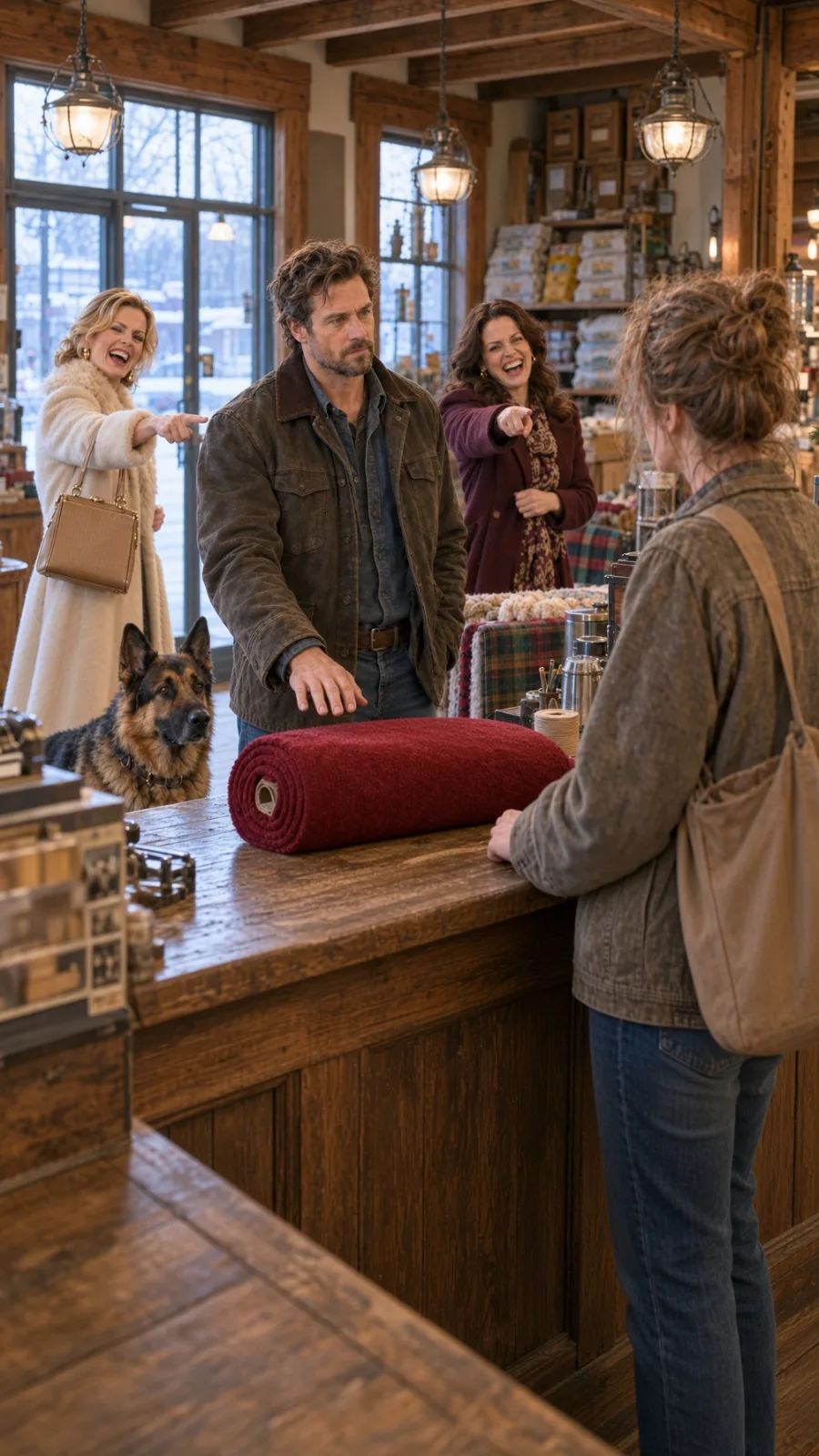
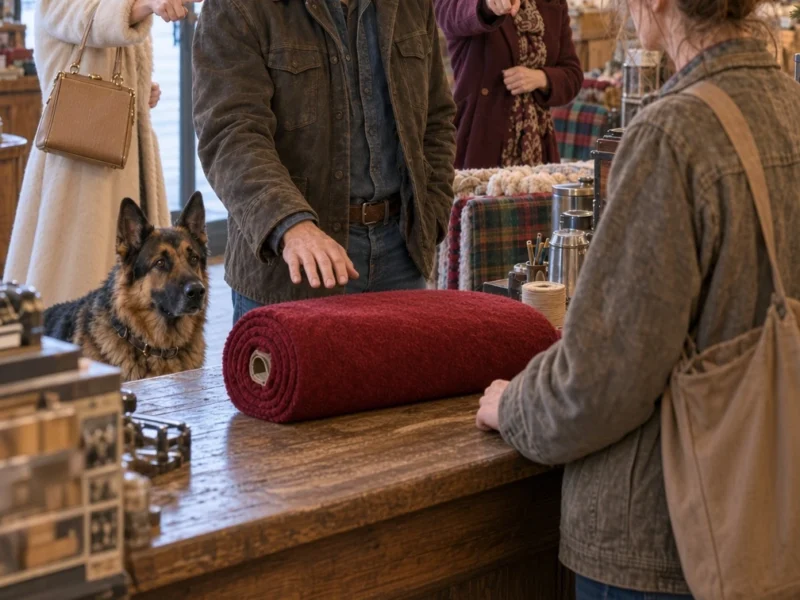
“That red wool is nearly forty dollars a yard,” Denise Voss announced, loud enough for half the store to hear.
Her friend Gwen Talbot looked from the luxurious fabric to Clara Whitmore’s faded work coat and laughed.
“Sweetheart, judging by those clothes, I’d say expensive fabric is the least of your problems.”
Clara quietly returned the thread she couldn’t afford to the counter, folded her receipt, and reached for her canvas bag.
“Everyone knows she can barely keep that farm anymore,” Denise added. “Some people simply don’t know when it’s time to let go.”
The laughter followed Clara toward the door.
Neither woman noticed the man standing near the entrance, his German Shepherd resting beside his boots.
Ethan Mercer had heard every word.
The forty-three-year-old former Navy SEAL didn’t raise his voice, confront the women, or give them the dramatic scene they seemed to expect.
He simply walked to the counter, looked at the deep red wool they had been admiring, and turned to the storekeeper.
“Wrap the whole bolt.”
For a moment, the laughter stopped.
The women assumed he had made an impulsive purchase and that the moment would soon pass.
They had no idea that the red wool would become the first thread in a story that would eventually expose what was happening to a widow’s farm, cost a powerful local banker his position, and force three people to reconsider what strength really meant.
And none of them could have guessed that the quiet man who bought the fabric would one day have to learn the same lesson he had unknowingly begun teaching that morning.
By eight o’clock, Bitterroot Mercantile and Feed had already collected the usual winter clutter near its front door.
Salt tracked in from boots marked the floor, cardboard boxes waited to be broken down, and two feed sacks leaned against the wall beneath a faded sign advertising livestock supplies.
Outside, the last of the snow had turned gray along the edges of the parking lot beneath a pale Montana sky.
The Bitterroot Mountains stood in the distance, their upper ridges still white, while the lower slopes showed the dark green of evergreen trees.
Clara Whitmore entered with a folded shopping list in one hand and a canvas grocery bag in the other.
She was forty-one, though the past two years had added a weariness to her face that made strangers guess older.
Her brown hair was tied back, and the sleeves of her patched work coat had been repaired so many times that the original stitching was difficult to distinguish from the newer thread.
She moved through the store without browsing.
First, she stopped at the feed counter.
Then she checked the rack of industrial needles.
Finally, she approached the register, where Walt Brener kept heating oil vouchers in a locked drawer beneath the counter.
Clara selected two spools of heavy upholstery thread and checked the price tags twice.
Walt rang up the feed, the voucher, the needles, and the thread.
The total climbed across the small display.
Clara opened her wallet, counted the bills, and counted them again with her thumb pressed against the edge of the counter.
There was no dramatic hesitation in the movement.
It was simply arithmetic, and arithmetic had become a more demanding companion since her husband, Daniel, had died.
“Take the black thread off,” she said.
Walt glanced at the spool.
“You sure?”
“I can hold it until Friday.”
“I know you can.”
Clara returned the spool beside the register herself.
She did not ask for credit, and Walt knew her well enough not to offer it again.
He had known Daniel for nearly twenty years.
He had watched the couple bring hay into their barn during dry summers, replace fencing after heavy storms, and show up at cooperative meetings with mud on their boots and careful figures written in notebooks.
He also knew Clara disliked being treated as though grief had made her incapable of managing her own affairs.
So he took her money, gave her the receipt, and said, “Your usual feed order should be ready tomorrow.”
“Thank you, Walt.”
A few feet away, Denise Voss had been comparing wool blends with Gwen Talbot.
Denise wore a cream-colored coat that still looked new despite the season.
Her husband, Martin Voss, worked at Valley Heritage Bank, where he handled agricultural lending and several of the larger commercial accounts in the valley.
Gwen had spent several minutes deciding between two shades of red, as though the choice might alter the course of her winter.
Neither woman had been part of Clara’s morning until Denise glanced toward the register.
“That red is nearly forty dollars a yard,” she said.
Gwen followed her gaze to Clara’s patched coat and laughed.
Denise lifted one end of the deep red bolt and ran the fabric through her fingers.
“Some things just require the right setting,” she said. “You don’t buy wool like this to wear it around a feed shed.”
Clara slipped her wallet back into her bag.
Gwen gave another small laugh.
“Looking at some people, any new fabric would be an improvement.”
Walt stopped moving behind the counter.
Clara did not.
She took the receipt he offered and folded it once before putting it away.
Denise had heard enough at home to know that Whitmore Farm was under pressure.
Martin did not discuss customers by name as a rule, but small-town privacy had a way of thinning at the edges, especially when a property had been mentioned more than once over dinner.
Denise knew there had been late payments.
She knew an appraisal vehicle had traveled up Whitmore Road.
She knew Clara had sold a piece of equipment in the fall.
What Denise did not know was how much Clara owed, how much she had already paid, or what she had sacrificed to keep the farm operating.
That incomplete knowledge should have made her careful.
Instead, it made her confident.
“Honestly, Clara,” Denise continued, adopting a tone that pretended to be concerned, “there’s no shame in admitting when a place has become too much for one person.”
Clara turned.
Denise tilted her head sympathetically.
“You can work yourself into the ground and still end up in the same place.”
For a moment, Clara looked at Denise, then at Gwen.
“Morning,” she said.
That was all.
She picked up her bag and the feed ticket Walt had stapled to it.
Near the far end of the counter, Nash lifted his head.
The German Shepherd had been lying beside Ethan Mercer’s boots while Ethan waited for a box of fencing staples from the stockroom.
Nash did not growl or stand.
His ears moved forward at the change in voices, and his eyes followed Clara as she crossed toward the door.
Ethan had heard enough.
He was forty-three, broad-shouldered, and quieter than most people expected a former special operations sailor to be.
Years in the Navy had left him with a preference for understanding a problem before acting.
Ranch life had reinforced the habit.
He had learned that anger could be useful in certain moments, but it was a poor substitute for judgment.
Not every ugly situation improved when another man inserted himself into it.
Sometimes, the person being humiliated wanted nothing more than to leave without becoming the center of a larger scene.
Ethan understood that.
He also understood the difference between respecting someone’s dignity and allowing someone else to strip it away in public.
This time, he decided, he could do something without making Clara’s morning any harder.
Denise turned back to the fabric as though Clara had already disappeared from the world.
“I’ll take five yards,” she told Walt. “Maybe six. I haven’t decided.”
Ethan walked over.
He remembered a conversation from a cooperative meeting the previous week.
Two ranch hands needed winter liners replaced, and the usual supplier had warned that new material would not arrive until January.
The cooperative had also been discussing replacement work jackets for its outdoor crews.
Ethan looked at Walt.
“Wrap the whole bolt.”
Denise blinked.
“Excuse me?”
Ethan did not look at her.
“Add it to mine.”
Walt’s eyebrows rose, but only for a moment.
“All of it?”
Ethan nodded.
There was no speech after that.
No lecture about manners, no explanation about money, and no pause designed to make Denise feel the room turning against her.
Ethan returned to his list and asked Walt whether the mineral blocks had arrived.
The ordinary question made the purchase feel even more final.
Walt checked the inventory sheet.
“They came in yesterday.”
“Good. I’ll take two.”
By the time Clara pushed through the front door, the red wool was being rolled tighter and tied for pickup.
She did not see it.
Nash watched the door close, then lowered his head onto his paws again.
The moment might have ended there if people had been willing to let it.
But a quiet act of kindness rarely remains quiet when it exposes someone else’s unkindness.
Ten minutes later, Ethan and Walt carried the bolt outside along with mineral blocks, fencing staples, and two bags of dog food.
Ethan wedged the fabric behind the passenger seat, where Nash could not step on it.
Walt shut the truck’s tailgate with both hands.
“That was subtle.”
“It was wool.”
“That’s one word for it.”
Ethan glanced through the store window.
Denise and Gwen were still inside, but whatever conversation they were having now required considerably less volume.
Walt pulled on his gloves.
“Clara’s had a rough couple of years.”
Ethan looked at him, waiting rather than asking.
“Daniel’s been gone almost two years now,” Walt continued. “She’s kept the place going, more or less. Sold the old baler in October. Then some appraisal outfit was up there a while back.”
He rubbed a thumb along the seam of his glove.
“People notice things.”
“People usually notice half of things,” Ethan said.
“That, too.”
Walt did not know the balance on Clara’s loan, and Ethan did not ask.
If Clara Whitmore wanted half the valley involved in her finances, she could invite them herself.
Ethan climbed into the pickup.
Nash rose from the passenger footwell, turned once, and settled again with the resigned expression of a dog who had spent years learning that errands rarely ended when a human claimed they would.
“You’re right,” Ethan said, starting the engine. “We bought too much.”
Nash looked out the window.
The morning should have ended there.
Instead, the red wool became the first thing Ethan could not quite forget.
By three that afternoon, he was sitting in the meeting room above the Bitterroot Range Livestock Cooperative office with six other producers, a pot of stale coffee, and a preliminary packet from Northwest Range Foods.
The proposed regional processing and cold-storage facility could shorten hauling distances for smaller ranches and farms.
It could also create jobs, improve access to markets, and reduce the cost of sending livestock and agricultural products to facilities farther away.
The cooperative had been asked for input on supply volume, truck access, and the practicality of several proposed routes.
Nothing guaranteed that the project would happen.
Most of the packet was still estimates, arrows, and boxes labeled proposed.
Ethan listened more than he spoke.
He had spent enough years in structured operations to recognize the difference between a plan and a decision.
A plan was a way to examine possibilities.
A decision was what happened after people with authority had considered the consequences.
Confusing the two could turn a useful map into an expensive mistake.
The project liaison moved through a slide showing three possible access concepts.
The first followed an existing county road but required costly improvements.
The second approached from the south.
The third was marked in blue.
Ethan leaned forward.
The line crossed a patchwork of private parcels before bending west.
He knew most of those boundaries without needing the names.
A rancher learned the shape of neighboring land the same way other people learned streets.
Then he saw one printed beside the blue line.
Whitmore.
He looked again.
The corridor ran close to Whitmore Farm, then continued toward the country west of it.
Nothing on the page said the route was final.
Nothing even said the listed owners had agreed to discuss it.
Still, the name stayed with him.
That morning’s exchange at Bitterroot Mercantile could have been nothing more than the small cruelty of people who knew a little too much about someone else’s hard year.
The blue line on the map belonged to a different kind of conversation, and Clara did not seem to know she was part of it.
Ethan rested one hand on the edge of the packet.
He did not assume the bank was involved.
He did not assume the appraisal vehicle meant anything beyond what appraisal vehicles usually meant.
Projects drew possible routes across private ground all the time before anyone negotiated seriously with an owner.
But one practical question would not leave him alone.
Why was a proposed corridor already drawn across Whitmore property if Clara Whitmore did not seem to know there was a corridor at all?
Three days later, Ethan turned off Whitmore Road with the red wool secured behind the seats and Nash sitting upright on the passenger side of the pickup.
The morning had cleared hard and bright after two nights below freezing.
Brown fields showed through where the wind had stripped away the old snow, and the Bitterroot Mountains stood sharp against a pale blue sky.
Whitmore Farm sat farther back from the road than Ethan expected.
The house was modest, with white paint weathered at the corners, a narrow porch, and a mudroom added sometime after the original structure went up.
Beyond it stood a low barn, a machine shed, and a smaller outbuilding with a hand-painted sign that read Whitmore Stitch and Canvas.
Clara came out of that building before he reached the porch.
She looked at the bolt of red wool in his arms, then at Ethan.
“You actually bought all of it?”
“I did.”
“That seems excessive.”
“Probably.”
Nash climbed down after Ethan and paused beside the pickup.
He looked toward Clara, then toward the open door of the sewing shop, where warm air carried the faint smell of machine oil and coffee.
Ethan shifted the fabric higher.
“The cooperative needs winter work jackets. Some liners, too. Twenty-four sets, if you can do them.”
Clara did not reach for the fabric.
“That why you bought it?”
“It is now.”
Her mouth moved slightly.
Not quite a smile.
“I don’t need charity, Mr. Mercer.”
“Good.”
That made her look at him.
“Good?”
“I need twenty-four jackets. You need a job worth taking. I’m not interested in charity either.”
Ethan carried the bolt inside and set it on the long cutting table.
Beside it, he placed a folder with names, rough measurements, quantities, and a delivery date three weeks away.
Several measurements were missing.
One chest size had been crossed out twice, and somebody named Dale had apparently written regular where a number should have been.
Clara opened the folder.
“If you don’t want the job,” Ethan said, “I’ll take the fabric somewhere else. But I need the jackets, and you set your own labor price.”
She read the first page before answering.
“Who measured these men?”
“Mostly themselves.”
“That explains a lot.”
This time, she smiled briefly.
She turned another page, then looked at the wool.
“Three weeks is tight.”
“Tell me what isn’t.”
“I’ll need the corrected measurements by Friday, and I’m not discounting the labor because you supplied the fabric.”
“I didn’t ask you to.”
Clara closed the folder.
“Then I can do it.”
The agreement did not become warmer than that, but it became real.
The shop was larger than Ethan had guessed from outside.
Two industrial sewing machines stood near the windows, along with shelves of canvas, zippers, buckles, thread, repair patches, and folded horse blankets waiting for pickup.
A pegboard held shears and hand tools in careful rows.
The house connected to the shop through the mudroom.
From where Ethan stood, he could see a dark green work jacket hanging on a hook beside Clara’s coat.
It was a man’s jacket, old enough that the cuffs had gone soft.
On a shelf near the coffee maker sat a ceramic mug with Daniel printed across one side.
Clara noticed where his eyes had gone.
She did not explain.
Ethan did not ask.
Nash entered the shop only after Ethan gave him a quiet cue.
He made one slow circuit around the room, nose low, then settled near a small propane heater.
Clara glanced down at him.
“He always inspect a workplace before approving it?”
“Only the ones with heaters.”
She brought out a roll of pattern paper and spread one end across the floor.
Nash watched the paper move, stood, and stepped directly onto the cleanest open section before lying down.
Clara stopped.
Ethan looked at the dog.
“Move.”
Nash looked back at him.
Nothing happened.
Clara folded her arms.
“Very disciplined.”
“He has a finely developed sense of where he’ll be most inconvenient.”
“How many years of training did that take?”
“Most of them.”
Clara caught the edge of the paper and slid it gently out from under Nash, one inch at a time.
The dog allowed this without helping.
Clara spent another few minutes sorting Ethan’s measurement sheets into three piles: usable, questionable, and useless.
By the time she finished, Ethan had a list of eight people he needed to contact again.
Before he left, Clara asked if he had a minute to look at the south gate.
The hinge on one side had dropped enough that the gate dragged whenever she opened it.
Ethan followed her across the yard with a wrench and a small pry bar from his truck.
Nash came along at an easier pace.
The repair was simple.
Ethan lifted the gate, reset the hinge, and tightened the hardware while Clara held the far end steady.
She tested it twice.
It swung cleanly.
Clara nodded toward the narrow field beyond the barn.
“Since you’re already standing out here, tell me if this looks normal to you.”
At first, Ethan saw only fence, dry grass, and the shallow irrigation ditch crossing the lower edge of the property.
Then he noticed three orange ribbons tied low along a line of temporary stakes.
He walked closer.
Each stake had a small printed tag fixed beneath the ribbon.
NRF — Northwest Range Foods — Access Concept 3.
It was the same blue route from the cooperative map.
“When did these go in?” Ethan asked.
“Last week.”
Clara stood a few feet behind him.
“Two men came through with survey equipment. Said they were checking a utility route for some development outside Hamilton.”
“Did they ask permission?”
“No.”
“What did you do?”
“Told them they were on private property, and they left.”
There was no pride in the answer.
Only fact.
Ethan looked along the stakes toward the ditch.
“Did they say who sent them?”
“One said they were working off a preliminary order. I didn’t recognize the company name.”
He straightened.
“Has Northwest Range Foods contacted you?”
“Who?”
That answered more than he wanted it to.
“The project from the cooperative meeting. Processing and cold storage. They’re looking at access routes.”
Clara’s eyes moved back to the ribbons.
“No one’s contacted me about a route.”
“Your bank?”
She frowned.
“Why would the bank contact me about that?”
“An easement? Utility access? Anything tied to the property?”
“No.”
Ethan let the silence sit long enough for her to consider the question on her own.
Then Clara looked toward the house.
“I did get something from the bank.”
She let him inside through the mudroom.
Nash followed and settled by the kitchen wall.
Clara opened a drawer beside the refrigerator and took out a white envelope with the Valley Heritage Bank logo.
“I got this three days ago.”
The notice was only a few pages.
Ethan read the first one while standing at the table.
The language was formal but clear enough in its purpose.
The loan had entered a cure period.
Clara had until a stated date to bring the account current.
The figure due included missed portions of payments, late charges, property inspections, default-servicing fees, and other account adjustments.
Clara tapped the total with one finger.
“That number isn’t what I thought I owed.”
“You keep your statements?”
“All of them.”
“Have you compared them?”
“I tried.”
Her answer sounded irritated, mostly with herself.
“Some of the fees don’t make sense to me. Every time I think I’ve got the balance straight, something else shows up.”
Ethan read the itemized section again.
He had seen enough complicated numbers in contracts, ranch loans, and cooperative accounts to know that confusion was not evidence of fraud.
Fees could be legitimate.
Inspections could be legitimate.
A badly explained statement could still be correct.
One line made him stop.
A property inspection fee had been posted during the same week Clara said the survey crew appeared on her land.
That did not prove anything.
It was simply the first detail that belonged to both pieces of paper.
“You have somebody who does your books?” Ethan asked.
“I do my books for the farm and the sewing shop.”
“Yes,” he said, nodding. “The cooperative has a bookkeeper who’s better at bank statements than I am.”
Clara took the pages back but did not put them in the envelope.
“You want to show her this?”
“Only if you do.”
She looked at him for a long moment.
Ethan did not fill the silence.
Finally, Clara slid the statement across the table.
“You can take a picture. Not the original.”
“Fair.”
“And this does not mean you’re fixing my life.”
Ethan took out his phone.
“I wouldn’t know where to start.”
That earned him the faintest change in her expression.
He photographed the statement, returned it, and put the phone away.
Outside, the winter sun was lowering over the fields.
The orange survey ribbons near the ditch moved lightly in the dry air, bright against everything around them.
Ethan had seen enough complicated numbers to know that one confusing statement did not make a conspiracy.
What held his attention was simpler.
The inspection charge and the survey visit belonged to the same week.
For now, that was all he knew.
Clara had opened the door an inch.
He had no intention of pretending it was wider.
By the middle of December, the red wool had stopped looking like a dramatic purchase and started looking like work.
Clara had cut the first six jacket liners and stacked them by size on the long table in Whitmore Stitch and Canvas.
Two were already finished.
A third hung from the back of a chair with one sleeve basted in place while she waited for Ethan to confirm whether the man listed as Dale actually had a thirty-six-inch arm or had simply guessed.
Ethan returned that afternoon with a corrected sheet.
Clara read it once.
“Thirty-nine.”
“That sounds more believable.”
“You have twenty-four men who spend their lives measuring fence lines, loading cattle, and judging distance by eye.”
“That’s true.”
“And eight of them cannot measure their own sleeves.”
“That also appears to be true.”
Nash settled beside the propane heater as though the conversation had nothing to do with him.
The next two weeks found a rhythm neither Ethan nor Clara had planned.
Some mornings came with a light dusting of snow that disappeared from the south-facing fields before noon.
Other days were so clear that the mountains looked close enough to touch, their ridges sharp against the winter sky.
Then a warm spell moved through just before Christmas, softening the frozen ground and turning the yard near the barn into a brown mess that clung to boots and tires.
Ethan came and went with measurements, zippers, jacket hardware, and the occasional apology on behalf of a ranch hand who had written large where Clara required numbers.
She worked steadily.
He rarely stayed longer than necessary at first.
Nash did.
The German Shepherd had learned exactly where the warmest part of the shop was, and he had also learned that Clara did not object as long as he stayed clear of the sewing machine pedals.
He kept a respectful distance when the machine was running, but during quieter work, he sometimes rested his head on whatever object happened to be nearest.
One morning, it was Clara’s measuring tape.
She pulled gently.
Nash did not move.
“You know,” she said, “for a dog with military training, you’re remarkably committed to making simple tasks harder.”
Ethan was checking a box of buckles near the door.
“That’s retirement.”
Clara finally worked the tape free.
A few days later, while Nash stood beside the cutting table, she noticed a seam opening near the edge of his working harness.
“Bring me that.”
Ethan looked down.
“The harness?”
“Unless you want him to start carrying loose pieces of it around.”
He removed it and placed it on the table.
The nylon had faded in places, and the stitching around one section had thinned with age.
Clara turned it over, inspecting the damage.
Near the top sat an old identification patch, its edges softened and lettering worn almost smooth.
“I can replace this, too.”
Ethan looked at the patch.
“Leave that.”
Clara glanced at him once.
“All right.”
She did not ask why.
That was one of the things Ethan had started noticing about her.
Clara asked direct questions when the answer mattered, but she did not collect private details simply because silence made them available.
She reinforced the seam, replaced two damaged stitches farther down, and returned the harness the next morning.
Nash stood still while Ethan fastened it.
The dog waited until Ethan gave a short word before moving toward the door.
Clara watched them.
“He still works like that.”
“Some habits stick.”
“Was he yours when you were active?”
Ethan adjusted one strap.
“Not at first.”
He did not say more until later, when they were carrying a finished stack of liners to his pickup.
Nash had spent his working years assigned through the military dog program, supporting Ethan’s unit during the last stretch of Ethan’s service.
Their paths had crossed often enough that familiarity became trust.
Neither had started with any promise of ending up in Montana together, but when Nash retired, the process took time.
Ethan had already begun planning his own transition out.
“So you both left around the same time,” Clara said.
“Close enough.”
“Was that always the plan?”
“No.”
He lifted the stack into the truck bed.
For most of his adult life, Ethan had assumed the Navy would remain the fixed point, and everything else would fit around it.
Three Pines had been home in the way some places remained home even when a person visited only in pieces.
Holidays.
Short leave.
A few summer days when schedules allowed.
Then his father began talking about reducing the herd.
The conversations changed after that.
There was no dramatic ultimatum, no sudden collapse, no single moment when the future broke in half.
There were practical things.
Less cattle.
Fewer acres under active use.
Equipment that no longer justified its repair costs.
Ethan realized he had spent years assuming the ranch would remain exactly where he had left it, waiting whenever he happened to return.
He left the Navy before that assumption became a regret.
Clara listened without turning his explanation into a story about sacrifice.
“My husband used to say farms wait for nobody.”
“Daniel?”
She nodded.
“That was the first thing he taught me when I moved here. The second was that weather doesn’t care how much money you have in the bank.”
Ethan smiled faintly.
“Sounds like a rancher.”
“He was. He was also wrong about how long it takes to repair a roof.”
“Most people are.”
A few years before Daniel died, the irrigation pump had failed during a dry summer.
The barn roof was already overdue for repair, and several smaller expenses landed close together.
They refinanced the remaining farm debt to cover the work and stabilize the operation.
It had made sense at the time.
After Daniel was gone, the same payment became harder.
Not impossible.
Harder.
Hay income arrived in uneven waves.
Sewing work came in unpredictable bursts.
Equipment still broke according to its own schedule.
Clara made most payments, missed parts of a few, caught up when she could, and watched late charges begin to take up more room on statements that had once been simple.
She did not tell Ethan all of that in one conversation.
He learned some while delivering measurements, some over coffee when a zipper shipment was delayed, and some because one afternoon she pulled three years of statements from a file cabinet for Carol Ames.
Carol handled the cooperative’s bookkeeping from a small office above the feed store.
She was in her late fifties, wore reading glasses on a chain, and had no interest in pretending a bank statement was more mysterious than it was.
She agreed to look because Clara had agreed first.
Carol did not call anything fraudulent.
She did not suggest a lawsuit.
She simply spread the statements across the table and began marking repeated charges with a yellow pencil.
Two property inspections appeared within a relatively short period.
A servicing charge had been assessed after one partial payment.
Even though the next payment brought the account closer to current, several late charges looked higher than Clara expected based on the amounts actually past due.
Carol tapped one column.
“I’d ask them to explain this in writing.”
Clara leaned closer.
“You think it’s wrong?”
“I think I don’t understand it yet.”
That distinction mattered.
The difference between a suspicion and a conclusion was the difference between asking a question and accusing someone of an answer.
Ethan stood by the window and let Carol keep the conversation with Clara.
Another week passed.
The red jackets multiplied.
The weather warmed enough to pull water from the roof edges during the afternoon, then froze again overnight.
Mud collected near the barn doors.
Nash discovered that Clara kept old towels beside the mudroom and learned with considerable reluctance that entering the shop sometimes required having his paws wiped.
By early January, Ethan had almost convinced himself the Northwest Range Foods map and Clara’s bank problems might remain separate issues.
Then he attended another project meeting.
This one was smaller, held in a conference room near Hamilton with cooperative representatives, a county planning liaison, and Rachel Monroe from Northwest Range Foods.
Rachel was practical, direct, and mostly interested in access costs, truck flow, utilities, and whether the cooperative could support the expected supply volume.
The group worked through maps for nearly an hour.
When discussion returned to the western access concept, one of the consultants pointed toward the Whitmore parcel.
“That section may be easier by spring,” he said. “We were told the parcel is expected to be bank-controlled by then.”
Rachel looked up.
“Expected by whom?”
The consultant checked his notes.
“Local contact. I’d have to pull the source.”
The conversation moved on after that.
Ethan did not.
The fees on Clara’s statements could still be incompetence, bad servicing, or nothing more than an ugly system operating exactly as designed.
Survey crews could appear on preliminary routes before owners were formally approached.
But no one should be describing the future ownership of a property as settled while the woman who owned it was still living there, paying on it, and making jackets under its roof.
After the meeting, Ethan took a copy of the public project map home.
He spread it across the kitchen table at Three Pines while Nash slept beneath the window.
This time, he followed the full western route instead of stopping at the Whitmore name.
The line entered along the lower side of Clara’s property, close enough to the irrigation corridor to explain why the survey crew had been interested in that part of the farm.
From there, it continued west toward Three Pines.
Ethan leaned over the map.
The project still had other access concepts.
Nothing made this route inevitable, but the western option was shorter, avoided a larger county-road upgrade, and connected more cleanly with the proposed utility alignment.
He pulled out the county parcel map he kept with ranch documents.
The second piece fit.
Whitmore Farm controlled the eastern portion of the practical corridor.
Three Pines controlled the western continuation.
Then there was the water.
Clara’s property carried an older irrigation right tied to the ditch crossing the lower field.
Ethan did not know its exact legal limits, and he was not about to pretend he did.
But he knew enough about ranch land to recognize that reliable water access could change the value of an easement agreement dramatically, especially for a facility considering long-term utility needs.
He sat back.
For the first time, Clara’s mortgage problem, the survey stakes, and the project map no longer looked like three unrelated inconveniences.
They still did not prove misconduct.
They did prove her land mattered.
That evening, Ethan drove back toward Whitmore Farm with the folded map on the passenger seat and Nash behind him.
The temperature had dropped again.
Thin crusts of ice had formed along the muddy ruts near the road, and the last light was leaving the fields.
He turned into Clara’s drive and stopped beside the shop.
Inside, she was working beneath the yellow light over the cutting table, one finished red jacket hanging from a hook behind her.
Her head was bent over a seam, the machine moving steadily beneath her hands.
Nash sat up and looked through the windshield.
Ethan kept one hand on the folded map.
He knew enough now to have a conversation Clara deserved to hear.
He still did not know how much of the situation was coincidence, how much was opportunism, or how far Martin Voss might already have gone.
The Chinook arrived during the first week of January and changed the valley faster than anyone trusted.
Snow slid from the south side of roofs in heavy sheets.
The packed white shoulders along Whitmore Road collapsed into gray slush, and the yard between Clara’s barn and sewing shop turned soft enough to hold every bootprint and tire track until the next freeze.
Ethan came back to Whitmore Farm with the project map folded beneath his arm.
Clara was finishing a row of buttonholes when he stepped into the shop.
Nash followed, checked the heater, and settled beside it with the efficiency of someone returning to an assigned post.
Ethan waited until Clara switched off the machine.
“I found out why they care about this place.”
She looked at the map instead of him.
He spread it across the cutting table and showed her the western access concept.
He kept his explanation plain.
Northwest Range Foods was still considering several routes.
Nothing had been approved.
No one had the right to cross her land without permission, but one of the most practical routes crossed Whitmore Farm before continuing west.
Clara traced the blue line with one finger.
“They drew this before speaking to me.”
“Yes.”
“And somebody at that meeting thinks the bank will control my property by spring.”
“Yes.”
Her hand left the map.
The anger arrived quietly.
Ethan saw it in the way she began stacking pieces of fabric that were already stacked.
“So people I’ve never met are discussing when I stop owning my own farm.”
“That’s what it sounds like.”
“And you’ve been putting this together without telling me.”
He could have defended that.
He did not.
“I went farther than you asked me to. I should have brought you what I had earlier and let you decide what to do with it.”
The admission seemed to interrupt whatever argument she had prepared.
Ethan took a legal pad from the folder.
Dates, fee amounts, project references, and the code from the survey stakes filled two pages in his handwriting.
He placed it beside the map.
“That’s everything I wrote down.”
Clara looked at the notes.
“Keep it.”
“You’re done?”
“If you want me to be.”
She studied him.
“You don’t get to decide when I need help, Ethan.”
“No. I don’t.”
“Then why did you?”
He looked at the map.
“Because I thought if I could understand it first, I could keep you from having to deal with another problem.”
“That sounds very noble.”
“It wasn’t meant to.”
“It sounds like you made the same mistake the bank did.”
Ethan looked up.
Clara’s voice remained quiet, but every word landed clearly.
“You saw a problem on my property and decided the next step before asking me what I wanted.”
For a moment, he had no answer.
She was right.
The realization did not make him defensive.
It made him uncomfortable in a way he recognized from his years in uniform, when a person discovered that a plan had been built around an assumption nobody had checked.
“I’m sorry,” he said.
Clara’s hands settled on the edge of the cutting table.
“I don’t want to be protected from information about my own life.”
“You shouldn’t have to be.”
“I want the facts. Then I want to decide what they mean.”
Ethan nodded.
“That’s fair.”
The distance between them lasted several days, not dramatically.
Clara still finished the work she had accepted, and Ethan still delivered corrected measurements and picked up completed jackets.
Their conversations narrowed to quantities, cuffs, delivery dates, and whether one driver truly needed two interior pockets for sunflower seeds.
Business continued because Clara had never confused irritation with obligation.
The first completed batch went out on time.
The cooperative paid promptly, and Clara used part of the money to cover a smaller overdue amount at Valley Heritage Bank.
It improved the account, but the cure figure remained far beyond what three weeks of sewing could solve.
Ethan knew because Clara told him, not because he asked Carol for updates.
They were standing beside his pickup when she said it.
“I can get closer. I can’t get there by the deadline.”
Ethan had already considered the numbers.
Three Pines had enough operating cash to cover part of the gap.
The rest could come from the ranch credit line without putting spring expenses at risk.
It would not be painless, but it was possible.
“I can bridge it.”
Clara’s expression closed at once.
“No.”
“I haven’t even told you the terms.”
“No.”
Ethan rested one hand on the truck door.
“All right.”
She seemed almost suspicious of how easily he accepted the answer.
“You’re not going to argue?”
“You said no.”
That was where he left it.
Two days later, Clara called him shortly after seven in the morning.
“I want it in writing.”
Ethan, who had been halfway through pouring coffee, stopped.
“The loan?”
“Yes. Exact amount. Payment dates. No interest, if you still mean that. But no ‘whenever you can’ language either.”
He looked toward Nash, who was waiting by the back door.
“That sounds formal.”
“It needs to be formal.”
“Why?”
“Because otherwise I can’t take it.”
Ethan understood then.
“All right.”
They wrote the agreement at Clara’s kitchen table that afternoon.
Not a bank document.
Not something full of clauses neither of them needed.
Just the amount, the repayment schedule, no interest, and both signatures at the bottom.
Ethan transferred only what Clara authorized.
She handled the bank payment herself.
Nothing about the arrangement made her suddenly comfortable with needing help.
When the next jacket payment came in, she handed Ethan the first installment before the due date.
“You know, you don’t have to start this early.”
“I know.”
He took the envelope.
That answer mattered more than the money.
Over the next week, Clara began seeing a pattern in Ethan that had nothing to do with the Navy and everything to do with how he lived now.
He was chairing a cooperative scheduling meeting, handling a broken waterer at Three Pines, arranging a feed delivery for an older rancher whose truck was in the shop, and moving cattle before another cold front arrived.
Whenever someone offered to take part of it, Ethan gave some version of the same answer.
“I’ve got it.”
He said it to a ranch hand who offered to handle the feed run.
He said it to Carol when she offered to call two cooperative members about revised pickup times.
He even said it to Clara when she noticed the sleeve of his work coat had split near the elbow and offered to repair it.
“That seam’s going to open farther,” she said.
“I’ve got it.”
“With what?”
He looked down at the tear.
Clara held out her hand.
The coat came back the following afternoon with the sleeve reinforced and the worn edge bound cleanly enough that the repair looked deliberate.
Ethan inspected it.
“What do I owe you?”
“Nothing.”
“You charge for work.”
“I also decide what counts as work.”
Ethan reached for his wallet anyway.
Clara watched him.
“It’s interesting.”
“What is?”
“You’re very comfortable helping people. You get strangely uncomfortable when the debt runs in the other direction.”
Ethan’s hand stopped.
He had no useful answer.
Nash provided one of his own.
The dog rose from beside the heater, walked across the shop, turned twice, and lowered himself directly onto the bottom half of Ethan’s repaired coat where Clara had laid it on the table edge.
Clara looked at Nash.
“See? Even he thinks you should let it go.”
Ethan looked at the dog.
“Traitor.”
Nash closed his eyes.
Nothing else needed to be said.
The practical side of the property question moved more slowly.
At Ethan’s request, Clara agreed to a short call with Rachel Monroe from Northwest Range Foods.
Rachel did not sound defensive.
If anything, she sounded irritated that Clara had been approached indirectly.
“No one from our company has permission to enter Whitmore Farm,” Rachel said. “And we have not signed an easement, option, or access agreement involving your property.”
Clara sat at the kitchen table with the phone on speaker.
“Then why were survey stakes put inside my boundary?”
“I’m trying to answer that. Preliminary route work was shared with outside consultants and local contacts, but field access was supposed to be coordinated before crews entered private ground.”
Rachel paused.
“Then I need to tell you something else. One of our local intermediaries told us the Whitmore parcel probably wouldn’t remain in private ownership much longer. That’s why some people may have assumed access would be easier later.”
Clara went still.
“Who told you that?”
“I don’t have the original source in front of me. I can check.”
“Please do.”
“I will.”
The call ended a few minutes later.
Until then, Clara could still tell herself the bank and the project had simply reached toward the same property from different directions.
Rachel’s comment made that explanation harder to hold together.
No one at the table said the word conspiracy.
They did not need another theory yet.
They needed facts.
The Chinook faded the next night.
By morning, the temperature had dropped hard enough to freeze the mud into uneven ridges.
Clara crossed the lower field after feeding and noticed orange against the brown grass.
New stakes.
Not beside the roadside fence this time.
Farther in.
She walked toward them slowly, boots breaking through a thin skin of frozen ground.
The nearest stake carried the same project code Ethan had shown her before.
Clara stood still long enough to make sure of the boundary.
There was no doubt.
This one was inside Whitmore Farm.
Her first impulse was to pull it out.
Instead, she took her phone from her coat pocket.
One photograph showed the gate line.
Another captured the irrigation ditch.
A third was close enough to read the tag.
Only after she had documented where the stake stood did Clara lower the phone.
She did not call Ethan.
Not yet.
She did not touch the stake, either.
She had spent two years proving that she could keep a farm running without Daniel.
She could repair a fence, negotiate a payment, finish a sewing order, and get through another winter.
What she was learning now was that being capable did not require her to act alone.
The distinction mattered.
By the last week of January, the cold had settled back into the valley.
Freezing rain glazed the top wire of the fences one afternoon, then gave way after dark to wet snow that gathered slowly on the fields.
It was not a storm anyone in the Bitterroot would remember.
The roads stayed open, the power stayed on, and the county plows had little reason to hurry.
Still, the weather changed the sound of Whitmore Farm.
Snow softened the road noise.
The irrigation ditch disappeared beneath a thin white edge.
Even the barn seemed farther away once darkness settled over the lower field.
Clara was finishing the cuff on the last jacket of the day when a pair of headlights moved past the kitchen window.
She stopped the sewing machine.
The lights did not continue toward the house.
They turned slowly along the lower field and stopped near the ditch.
Clara stood, crossed the shop, and looked through the side window.
A utility pickup sat beyond the barn with its amber roof light turning lazily through the wet snow.
Two men in reflective jackets had climbed out.
One held a case.
The other was already bending near the orange stakes she had photographed several days earlier.
Clara took out her phone.
She did not call the sheriff.
She called Ethan.
He answered on the second ring.
“There’s a truck by the lower field,” she said. “Two men. Looks like another survey crew.”
A pause.
“You inside for the moment?”
“What do you need?”
That question mattered.
Clara watched one of the men walk farther along the ditch.
“I want someone else here who can hear what they say.”
“I’m leaving now.”
Three Pines was close enough that Ethan did not need to promise a time.
Clara ended the call, put on her winter coat, and took the photographs from the previous week out of her pocket folder before stepping outside.
The snow was wet enough to cling to her shoulders.
By the time she reached the field, the men had set a tripod near one of the stakes.
“Evening,” Clara called.
Both turned.
The older of the two lifted a gloved hand.
“Evening.”
“Ma’am, this is private property.”
He looked down at the tablet in his hand.
“We have a work order for site verification.”
“You don’t have permission from me.”
The older man kept his tone professional.
“Paperwork says site access was cleared through the lender representative.”
Clara stopped several yards away.
“The lender doesn’t own this property.”
He glanced at his tablet again.
“It says the parcel is in default review.”
“That still doesn’t make it theirs.”
Neither man answered immediately.
The younger worker looked toward the road, then back at the tablet.
“We can call dispatch.”
The older man shook his head.
“We’re almost finished with this section.”
Clara looked at the tripod.
“No. You’re finished now.”
The worker straightened.
“Ma’am, I’m not trying to make trouble. We’ve got an order number, an authorization contact, and two more sites before the end of the night.”
“That’s not my problem.”
His expression tightened, not with anger so much as frustration.
“We drove forty minutes to get here.”
Clara held her ground.
“And I’ve lived here longer than that.”
Headlights appeared on the road behind them.
Ethan’s pickup turned through the gate and stopped near Clara’s truck.
He got out first.
Nash waited until Ethan opened the passenger door and gave a short cue.
The German Shepherd stepped down into the wet snow and stayed close to Ethan’s left side.
Nothing about Nash suggested excitement.
His body simply changed.
His head came up.
His ears moved forward.
His weight shifted slightly toward the strangers standing near Clara.
Ethan took in the scene before saying anything.
Tripod.
Utility truck.
Two workers.
Clara several yards from both.
No raised voices.
No visible equipment beyond surveying gear.
He stopped beside Clara.
“You all right?”
“Yes.”
The older worker looked from Ethan to Nash.
“We’re working off an authorized site order.”
“Who authorized it?”
“Lender representative.”
“Name?”
The worker hesitated, then tapped through the work order on his tablet.
“Martin Voss. Valley Heritage Bank.”
Clara did not react outwardly.
Ethan looked at the younger man.
“Company?”
“Mountain Westside Services.”
“Work order number?”
The younger worker gave it before the older one could object.
Ethan took out his phone and typed it down.
The older worker stepped closer.
Not aggressively, but enough to narrow the distance between himself and Clara.
“Look, we’re contractors. We didn’t create the order. If you want to dispute access, take it up with whoever issued it.”
Nash lowered his body slightly.
Ethan gave one quiet cue.
The dog moved half a step forward and stopped.
His chest was tight, ears upright, eyes fixed on the movement ahead.
A low sound came from his throat.
Brief and controlled.
The worker stopped.
Ethan did not raise his voice.
“She already disputed access.”
The younger worker touched the older man’s sleeve.
“Let’s call it for a moment.”
Nobody moved.
Then the older worker exhaled and stepped back.
“All right.”
Ethan relaxed his hand.
“Nash.”
The dog shifted back beside him.
The change was immediate enough that Clara noticed it.
The same animal who had seemed carved out of tension a few seconds earlier was now simply standing in snow beside Ethan, waiting.
Clara called Rachel Monroe.
She put the phone on speaker when Rachel answered.
Rachel recognized the work order number after checking her system.
“That order is connected to a preliminary route review,” she said. “It is not authorization to enter private property without owner consent.”
The older worker looked down at his tablet.
Rachel continued.
“If anyone represented it that way, I need the authorization record forwarded to me.”
The younger worker gave Ethan an email address for their dispatch office.
Ethan called the Ravalli County non-emergency line next, not to demand anyone be arrested, but to have the property dispute and work order information documented while everyone was still present.
The two workers packed the tripod.
Neither argued again.
Before leaving, the younger one approached Clara from a comfortable distance.
“For what it’s worth, ma’am, we were told access had been handled.”
“I believe you.”
He nodded once.
That was enough.
Their truck backed slowly toward the road and disappeared through the falling snow.
For several seconds afterward, nobody spoke.
Nash walked back toward Ethan’s pickup.
Clara followed, careful over the slick ground.
Just before Ethan opened the door, Nash stopped beside her and shook hard from nose to tail.
Wet snow flew across Clara’s jeans and the front of her coat.
She stared at the dog, then at Ethan.
“Military precision.”
“Selective,” Ethan said.
Clara brushed snow from her sleeve.
“I see.”
Inside the house, they left wet gloves near the heater.
Clara made coffee.
Ethan did not offer to help because he had learned that her kitchen was not his to reorganize.
Clara did not ask him to sit because he had already done so at the far end of the table.
Nash circled twice on the old blanket near the heater and went down with a long breath.
Clara set one mug in front of Ethan.
Her hand was steady until she let go of it.
Only then did her fingers begin to move slightly against the tabletop.
Ethan noticed.
He said nothing about it.
He slid the mug back toward her instead.
Clara wrapped both hands around it.
“I hate that I called you.”
Ethan looked at her.
“That’s not quite what I expected.”
“I don’t mean I wish I hadn’t.”
She watched the steam rise.
“I’ve spent almost two years proving I can keep this place running without Daniel. Every payment, every repair, every frozen pipe, every piece of equipment that picked the worst possible month to break.”
Ethan waited.
“Then two strangers show up in my field, and the first thing I do is call somebody.”
“You called a witness.”
“I know what I called.”
The words were sharper than the room required.
Clara looked down at the coffee.
After a moment, she added, “That’s the part I don’t like.”
Ethan leaned back.
“In the teams, the fastest way to become a problem was to decide you didn’t need anybody. You could be good at your job and still get somebody hurt if you acted like every problem was yours alone.”
Clara looked up.
“We trained to depend on each other because pretending otherwise was stupid.”
“And then you came home and forgot?”
“Pretty much.”
That surprised a laugh out of her.
Ethan looked toward Nash.
“I spent a long time in a life where asking for backup was normal. Came back here and started treating help like a mechanical failure.”
Clara followed his eyes.
Nash was asleep with one paw stretched beyond the blanket.
“Your dog figured it out faster.”
“He usually does.”
The room quieted.
Outside, wet snow tapped lightly against the window.
By morning, the important question would no longer be whether Clara could make strangers leave her property.
She already had.
The question was who had given them permission Clara had never given.
Clara reached for the folder containing the photographs, bank statements, and the work order number Ethan had written down.
“Monday,” she said.
Ethan waited.
“I’m going to Heritage.”
“All right.”
“You can come.”
He nodded once.
“But I’m speaking first.”
“I figured.”
The snow that fell Sunday night was thin enough for the streets in Hamilton to clear by morning.
Clara parked across from Valley Heritage Bank just after nine with one folder on the passenger seat.
Carol Ames had helped reduce three years of statements to a single comparison page.
But Clara had refused to bring every document she owned.
The folder held only what mattered: payment history, questioned fees, photographs of the survey stakes, the Mountain Westside work order number, and Rachel Monroe’s written confirmation that Northwest Range Foods had never authorized entry onto Whitmore Farm without the owner’s consent.
Ethan arrived separately.
Nash stayed at Three Pines.
There was no reason to bring a German Shepherd into a bank meeting simply because the dog had been useful somewhere else.
Before leaving home, Clara had also sent the same documents to Valley Heritage’s regional compliance office.
She had requested that someone above the local lending desk review them and had been told the Hamilton branch president would sit in if the meeting reached questions involving employee authorization.
That was enough for Clara.
She did not need an audience.
Martin Voss met them in a small conference room with glass walls overlooking the lobby.
He was a careful-looking man in his early fifties, dressed as though nothing in his morning had required haste.
His manner toward Clara was polite, almost sympathetic.
“Mrs. Whitmore, I understand you have concerns about servicing activity on your account.”
“I have questions.”
“Of course.”
Ethan took the chair beside her.
Martin glanced at him.
“And Mr. Mercer is here in what capacity?”
“Mine,” Clara said.
Martin waited.
“That’s all you need.”
The first question was the simplest.
Clara placed Carol’s comparison sheet on the table.
“Why was I charged for a property inspection before the date your own records say the inspection occurred?”
Martin studied the page.
“Some servicing charges post according to the account cycle rather than the physical date of activity.”
“Then I want the policy that explains this one.”
“I can request that.”
Clara moved to the next line.
“Why did two contractors come onto my land with a work order saying site access had been cleared through a lender representative?”
Martin’s expression changed very little.
“I can’t speak for how a third-party contractor interpreted paperwork.”
“The authorization contact on their order was you.”
That required a longer pause.
Martin folded his hands.
“The bank has an interest in monitoring collateral when a loan is in default status.”
“Monitoring collateral is not the same thing as giving a survey company permission to work on my land for somebody else’s project.”
“I think we’re combining separate issues.”
Clara opened Rachel’s email.
“Northwest Range Foods agrees with me.”
Martin read the first paragraph without touching the paper.
Clara did not hurry him.
Then she asked the question Ethan had heard her practice once at the kitchen table and never again.
“Why was anyone connected to that project told Whitmore Farm was expected to be bank-controlled by spring?”
Martin looked up.
“I don’t know who used that language.”
“You discussed my account with anyone outside the bank?”
“Mrs. Whitmore—”
“That wasn’t my question.”
His courtesy thinned.
“I have not disclosed protected account information in violation of bank policy.”
Clara nodded once.
“Then someone should be able to explain why people outside this bank believed my ownership had an expiration date.”
The conference-room door opened.
A woman introduced herself as Ellen Ward, president of the Hamilton branch.
She had received notice from regional compliance that morning and asked to join before the discussion continued.
Martin sat straighter.
Clara did not restart from the beginning.
She handed Ellen the one-page comparison and the work order information.
The questions became slower after that.
Martin explained inspections as part of collateral monitoring.
He described the account as materially delinquent and said the bank had an obligation to protect its position.
Some of his answers were plausible.
Others depended on words that became less useful when Clara asked for dates.
Ethan remained quiet.
He had come because Clara asked him to come, not because she needed someone to speak louder.
Eventually, Martin pushed his chair back slightly.
“I think we’re losing perspective here.”
Clara said nothing.
“Northwest Range Foods is a significant development for this valley. It means jobs, local processing capacity, and stronger markets for producers. Whatever route they use, they will need access.”
Clara looked at him.
“And that gives you permission to decide I won’t own my farm?”
“I didn’t say that.”
“You keep talking like the project is inevitable and I’m temporary.”
Martin’s gaze moved toward Ethan.
“Mr. Mercer understands the economics. A development like this is larger than one distressed parcel.”
That was the first time Ethan leaned forward.
“Have you read the full corridor map?”
Martin’s expression suggested the question was beneath the point he had been making.
“Yes.”
Ethan unfolded the public project map and placed it between them.
He touched the western segment.
“The western access crosses Three Pines.”
Martin glanced down.
Ethan left his finger there for several seconds.
“That’s my ranch.”
No one spoke.
Ethan continued in the same tone.
“Northwest Range Foods doesn’t have an access agreement with me. The cooperative hasn’t signed final supply support either. Without permission from Whitmore and Three Pines, this route doesn’t exist.”
Martin looked at the map again.
“The company can pursue another option.”
“Of course they can.”
Ethan sat back.
“That’s the point.”
Clara watched Martin understand the problem in a new order.
Whitmore Farm had never been a useless property waiting to be recovered by a bank.
It was one end of a route someone else wanted, and the other end belonged to the man Martin had just assumed would agree with him.
Ellen Ward closed the folder in front of her.
“I’m pausing further enforcement activity on this account pending compliance review.”
Martin turned toward her.
“Ellen—”
“I said pending review.”
There was no dramatic dismissal in the room.
No one demanded Martin surrender his keys.
The bank simply stopped treating his explanation as sufficient.
Before Clara left, Ellen promised a written acknowledgment of the dispute and an itemized accounting of every fee on the account.
Clara asked for a copy of the work-order authorization record as well.
Ellen agreed.
Outside, the winter sun had broken through the clouds.
Clara stood beside her truck with the folder under one arm.
Ethan waited a few feet away.
“You didn’t say much,” she observed.
“You said you were speaking first.”
“That’s not the same as saying you had to remain silent.”
“You didn’t need me to answer for you.”
Clara looked toward the bank doors.
“No. I didn’t.”
It was the closest she came to thanking him for that part of the morning.
By Wednesday, Martin had been placed on administrative leave while the authorization record and servicing history were reviewed.
The rest took weeks.
Clara did not spend those weeks waiting beside the phone.
She finished jackets, repaired two horse blankets, replaced a zipper and a ranch coat, and sent Ethan his next loan payment on schedule.
Regional review eventually confirmed that some of the servicing fees on her account had not been applied consistently with the bank’s internal policy.
Those charges were reversed.
The review also found that Martin had communicated too early and too freely with Granite Spur Holdings, a land acquisition company interested in parcels surrounding the Northwest Range Foods site.
Granite Spur had been exploring possible purchases if distressed properties became available.
The evidence did not establish that every survey visit or every fee had been part of a single plan.
It did establish that Martin had shared assumptions about Clara’s property before she had agreed to sell it, and that his handling of the account had fallen short of the bank’s own standards.
Nothing in the review required a courtroom scene.
Martin was not arrested.
He simply did not return to the Hamilton branch.
Whatever Valley Heritage decided about his employment after that remained between Martin and the bank.
For Clara, the more important change came when Rachel Monroe arrived at Whitmore Farm with a different map.
This time, she came through the front gate during daylight.
This time, she asked before walking the property.
And this time, the proposal had Clara’s name at the top.
Northwest Range Foods wanted a narrow utility and access easement along the lower edge of Whitmore Farm, combined with a limited water-use agreement connected to the existing irrigation right.
In return, the company proposed a signing payment of sixty-five thousand dollars, annual compensation of twelve thousand dollars for fifteen years, and restoration requirements for any ground disturbed during construction or maintenance.
Rachel went through the basic terms at Clara’s kitchen table.
Ethan was there because Clara had asked him to look at the route, not the money.
When Rachel finished, Clara did not reach for the pen.
“The line cuts too close to the old orchard.”
Rachel looked at the map.
“We can probably shift it south.”
“And this section stays away from the spring head.”
“That may cost us some length.”
“It can cost you length.”
Rachel studied Clara for a second, then nodded.
“I’ll have engineering move it.”
Other people had spoken about Clara’s land as though the final answer was only a matter of paperwork.
Now the paperwork waited for her.
Rachel took the unsigned agreement back to Hamilton.
A revised map arrived four days later.
The corridor moved away from the orchard and gave the spring head a wider buffer.
Clara walked the proposed line herself before asking two more questions and requesting that one sentence about surface restoration be made clearer.
Only then did she agree.
One week after the first proposal, Clara sat at the same kitchen table where she had signed Ethan’s bridge-loan agreement.
Rachel placed the final pages in front of her.
Clara read them again.
Then she signed.
There was no applause.
Rachel shook her hand.
Ethan carried the extra maps out to Rachel’s vehicle because the wind had picked up, and Clara stood for a moment in the kitchen after the door closed.
The cure notice from Valley Heritage was still in the drawer beside the refrigerator.
She opened it for several seconds.
She looked at the envelope that had once seemed large enough to fill the entire room.
Then she placed the new agreement in the same drawer, closed it, and returned to the sewing shop.
One red jacket remained unfinished.
Clara sat down, lowered the presser foot, and switched on the machine.
There was still work to do.
By the end of February, Whitmore Farm looked almost ordinary again.
The survey stakes were gone.
The easement agreement sat in the drawer beside the refrigerator, and Northwest Range Foods had not yet broken ground anywhere near Clara’s property.
Snow still lingered in shaded places, but the south side of the barn had begun showing bare earth by afternoon.
The first thing Clara did with the signing payment was repay Ethan.
She drove to Three Pines with a check in an envelope and found him outside the equipment shed, tightening a loose bracket on a stock trailer.
Nash was stretched in a patch of sun nearby.
Ethan wiped his hands before opening the envelope.
“You can keep this longer. I know the schedule gives you months.”
“I know that, too.”
He looked at the check again.
Clara waited.
The difference between this and the first time he had offered the bridge loan was not the money.
She had accepted help when she needed it.
Now she had the ability to settle the debt on her own terms.
Ethan seemed to understand that.
He folded the check once and put it in his coat pocket.
“All right.”
That was the entire conversation.
The rest of Clara’s plans were less satisfying to look at on paper.
She scheduled the section of barn roof she had postponed the previous fall.
She replaced two rotten boards on the west wall before they became a larger repair.
Most of what remained went into an emergency account she had never managed to keep funded for long.
The annual easement payment would help, but it would not turn Whitmore Farm into a wealthy operation.
Clara still compared feed prices.
She still tracked every invoice from the sewing shop.
She still had weeks when three jobs arrived at once and weeks when the phone barely rang.
The difference was quieter.
A failed pump no longer looked like the first step toward losing the farm.
One bad month could remain one bad month.
The jacket contract ended at nearly the same time.
For several weeks afterward, Clara began noticing the red wool in places she had not expected.
A driver wore one of the line jackets while loading mineral tubs at the cooperative yard.
Two ranch hands from the south end of the valley stopped at the mercantile wearing theirs.
Ethan had one hanging behind the seat of his pickup.
The material that had once sat on a store counter as something Denise Voss considered too fine for certain people had become work clothes.
Nobody made a speech about it.
Clara preferred it that way.
Whitmore Stitch and Canvas picked up several new orders from cooperative members.
Nothing exploded overnight.
There was no miraculous waiting list stretching into summer.
A rancher needed three horse blankets repaired.
Another wanted canvas covers made for equipment stored outdoors.
Carol Ames sent over a driver who had managed to tear the pocket off a brand-new jacket within four days.
Clara fixed it.
Life remained mostly made of things that needed doing.
Nash became part of that routine without anyone deciding when it happened.
On colder mornings, Ethan started lifting him into the pickup more often.
The dog could still jump when he wanted to, but there were days when his hind legs took longer to cooperate after lying down.
Ethan never turned it into a tragedy.
He opened the door, gave Nash a moment, and helped when help made more sense.
Clara noticed.
One afternoon, she used leftover insulation and canvas to make a padded mat that fit behind the pickup seat.
From the last narrow strip of red wool, she made a simple bandana.
When Ethan saw Nash wearing it, he stood silent for several seconds.
“He looks ridiculous.”
Nash sat beside Clara as if waiting for a second opinion.
“I think he disagrees.”
“He has poor judgment.”
“You bought an entire bolt of red wool because someone annoyed you.”
Ethan considered that.
“Fair point.”
Nash kept the bandana.
March brought calving season to Three Pines and reminded Clara that Ethan’s habit of carrying too much had not disappeared simply because she had identified it.
He was up before daylight, working late, covering cooperative scheduling between ranch chores, and taking calls he could have handed to somebody else.
He began leaving invoices unanswered on the corner of his kitchen counter.
Twice Clara saw him arrive at the sewing shop in the afternoon with coffee in his hand and no evidence he had eaten anything else.
She did not confront him.
Instead, she offered to take over repair orders that came through the cooperative until calving slowed down.
She made a standardized measurement sheet so ranch hands could stop inventing their own systems.
Carol agreed to handle more of the scheduling calls.
Ethan looked at the new sheet on Clara’s cutting table.
“I’ve got it.”
Clara said nothing.
She returned to the seam under her needle.
Ethan remained standing there.
Nash was asleep beside the heater.
Nearly half a minute passed.
Then Ethan picked up the stack of forms.
“All right.”
Clara looked up.
He had already turned toward the door.
That was enough.
Spring came slowly to the Bitterroot.
Snow withdrew from the fields in uneven patches.
The irrigation ditch began running again beneath thin shelves of ice, and water found its way through the same ground Clara had spent the winter defending.
Daniel remained present in ordinary things.
His green work jacket still hung in the mudroom.
The old mug stayed beside the coffee maker.
Clara eventually moved several boxes of his tools from the house to the machine shed.
Not because she had decided she was finished remembering him, but because the kitchen no longer needed to store irrigation fittings.
Ethan never asked whether that meant something.
His own past remained visible, too.
He still checked doors without thinking.
He still organized tools in a way nobody else at Three Pines could maintain for more than a week.
Nash still responded differently when Ethan’s voice dropped into the short, precise tone left over from another life.
Neither of them had become a new person.
They had simply made more room.
The months after that did not need large events to move forward.
There was coffee after deliveries.
A drive into Hamilton because both of them needed supplies and neither saw the point in taking two trucks.
There were afternoons when Clara worked in the shop while Ethan fixed the south gate properly instead of adjusting it one hinge at a time.
Nash began choosing whichever building contained the most comfortable floor and the greatest chance of someone dropping food.
By summer, Ethan stopped inventing reasons to leave immediately after his business at Whitmore Farm was finished.
By fall, Clara stopped pretending not to notice.
Then winter returned.
Nearly a year had passed since the morning at Bitterroot Mercantile.
Whitmore Farm was still Whitmore Farm.
Three Pines was still Three Pines.
Northwest Range Foods had begun site preparation farther down the valley, but the revised access line stayed where Clara had approved it.
The orchard remained untouched.
The spring head remained outside the corridor.
Nash had more gray around his muzzle.
He still hated booties.
One afternoon, light snow began falling before dark.
Clara was closing the sewing shop when Ethan’s pickup came up the drive.
He parked near the house.
No rolls of fabric were tied in the bed.
No cooperative folders sat on the dashboard.
Nash climbed down carefully, wearing the red bandana beneath his collar.
Ethan came up the porch steps.
Clara leaned against the door frame.
“What do you need?”
He looked back toward the truck as though checking whether he had forgotten something useful there.
“Nothing, actually.”
“That’s unusual.”
“I’ve spent most of the year finding practical reasons to come over.”
“I noticed.”
“I figured you had.”
Snow gathered lightly on the shoulders of his coat.
Ethan put his hands at his sides rather than into his pockets.
“I don’t have one today.”
Clara considered him.
“That might be progress.”
“It feels inefficient.”
“That sounds difficult for you.”
“It is.”
The smile lasted only a moment before he became serious again.
He did not tell Clara that she had saved him.
She had not.
He did not promise to protect her from everything that might happen next.
Neither of them believed life worked that way anymore.
“My life is better with you in it,” he said. “Not easier. Better.”
Clara stayed quiet.
“I’d like to keep building whatever this is, if you do.”
A few more seconds passed.
For once, Ethan had nothing to organize, repair, negotiate, or solve.
Then he asked her to marry him.
Clara let him wait long enough to understand that competence would not help.
“Yes.”
Nash had already wandered toward the porch steps.
He stopped at the first one, looked down at the fresh layer of snow, and reconsidered.
Ethan noticed.
He went to him, slipped one arm beneath the dog’s chest, and helped him down.
Clara stood beside them.
A year earlier, both of them had mistaken carrying everything alone for a kind of strength.
Neither had become weaker since.
They had simply learned there was more than one way to carry the weight.
There was another winter morning when Clara returned to Bitterroot Mercantile and Feed.
The salt still tracked across the floor.
The cardboard boxes still waited to be broken down.
Walt still kept heating oil vouchers in the locked drawer beneath the counter.
Some things in a small town changed slowly.
Clara had come for thread, a few fasteners, and the feed order she had placed the day before.
She wore a new work coat she had made herself, sturdy enough for the barn and warm enough for the walk from the shop to the house.
Walt rang up her purchases.
She checked the total, paid, and put the receipt away.
The bell above the door sounded.
Denise Voss entered with a shopping bag over one arm.
She stopped when she saw Clara.
For a moment, neither woman spoke.
Denise looked at Clara’s coat, then at the counter, then toward the window where Ethan’s pickup stood in the parking lot.
Clara did not smile triumphantly.
She did not mention the bank review, the easement agreement, or the fact that Denise’s husband no longer worked at Valley Heritage.
She simply picked up her bag.
“Morning, Denise.”
Denise swallowed.
“Clara. I heard about the project. And the farm.”
“I imagine you did.”
“I wanted to say I’m sorry about what I said last year.”
Clara looked at her.
Denise’s apology sounded uncomfortable, but it was not necessarily insincere.
“I shouldn’t have spoken to you that way,” Denise continued. “I didn’t know the whole situation.”
“No,” Clara said. “You didn’t.”
Denise lowered her eyes.
“I suppose I thought I did.”
“That was the problem.”
The words were not loud.
They did not need to be.
Denise nodded slowly.
Clara could have said more.
She could have explained that knowing a person’s difficulties did not give anyone the right to use them as entertainment.
She could have told Denise that the most humiliating part of that morning had not been the money or the fabric, but the ease with which strangers had decided they understood her life.
Instead, Clara chose the one thing she had wanted most when the laughter followed her toward the door.
She let the moment end without making herself smaller.
“Take care,” she said.
Then she walked out.
Ethan was waiting beside the pickup with Nash sitting at his feet.
He opened the passenger door for the dog, who looked at the step, then at Ethan, as if the entire vehicle had been designed to inconvenience him personally.
“You need help?” Ethan asked.
Nash leaned toward him.
Ethan lifted him carefully into the seat.
Clara watched the two of them for a moment before climbing into the truck.
“You know,” she said, fastening her seat belt, “I still think you bought too much wool.”
Ethan started the engine.
“I had a feeling you might.”
“You could have bought five yards.”
“Could have.”
“Or six.”
“Possibly.”
“Instead, you bought the whole bolt.”
He glanced at her.
“Would you have taken the job if I’d bought six yards?”
Clara looked toward the window.
“No.”
“Then I made the right decision.”
“You made an expensive decision.”
“That’s not the same thing.”
She tried to remain serious, but the smile arrived before she could stop it.
Outside, the mountains rose beyond the town, their upper slopes bright beneath the winter sun.
Nash settled against the padded mat behind the passenger seat.
A strip of red wool showed beneath his collar.
Clara reached over and straightened the bandana.
Ethan watched her hand return to her lap.
The wool had begun as a purchase made in response to a cruel joke.
It had become a job, then a symbol of the difference between helping someone and deciding what was best for them.
Now it was simply a piece of fabric around an old dog’s neck.
Perhaps that was the most honest ending it could have had.
Not every wrong needed a public reckoning.
Not every apology restored what had been damaged.
And not every act of kindness required an audience.
Sometimes the best thing a person could do was notice the moment someone else was being made to feel small, then refuse to join in.
Ethan had done that at the mercantile.
Clara had done it at the bank.
Later, both had learned that strength could mean accepting help without surrendering control, and offering it without demanding gratitude.
The world would keep presenting them with problems.
The farm would need repairs.
The cooperative would have another meeting.
The bank would send more paperwork.
Nash would grow older, and Ethan would keep pretending that lifting the dog into the truck was no more remarkable than opening a gate.
Clara would keep sewing.
She would keep checking prices.
She would keep the old green jacket in the mudroom and Daniel’s mug beside the coffee maker for as long as she wanted them there.
None of that meant she had failed to move forward.
It meant she had found a way to carry the past without letting it decide every part of her future.
Ethan had spent years in a world where responsibility meant being ready to act, where hesitation could cost more than pride, and where the phrase I’ve got it sometimes had to be true.
Coming home, he had forgotten that readiness was not the same as refusing help.
Clara had spent two years proving she could survive without Daniel.
She had begun to believe that accepting assistance might somehow diminish the life she was trying to rebuild.
Neither had been entirely wrong about the need to be capable.
They had simply mistaken capability for isolation.
What changed them was not the red wool alone, nor the bank review, nor the money that eventually gave Clara more room to breathe.
It was the series of small decisions that followed.
Ethan learned to ask before stepping into someone else’s problem.
Clara learned that asking someone to stand beside her did not mean handing over the right to decide.
Nash, for his part, continued to accept assistance only when it suited him.
Some lessons, apparently, could wait.
When Ethan pulled onto Whitmore Road, Clara looked back once at the mercantile disappearing behind them.
She remembered Denise’s laugh, Gwen’s comment, and the way she had folded the receipt before leaving.
For a long time, she had thought dignity meant ensuring nobody ever saw her struggle.
Now she understood that dignity had survived that morning perfectly well.
It had survived the bank notice.
It had survived the survey stakes.
It had survived the days when the sewing machine ran late into the night and the figures still did not add up.
The people who had underestimated her had never been in charge of what she was worth.
They had only been loud enough to make her forget that for a little while.
Ethan turned toward the farm.
“Coffee when we get home?”
Clara looked at him.
“We?”
He glanced at her, then back at the road.
“If that’s all right.”
She reached over and rested her hand on his.
“It’s all right.”
Nash lifted his head at the sound of their voices, then settled again when nothing required his attention.
Outside, the first flakes of another light snowfall drifted across the fields.
Whitmore Farm appeared beyond the gate, its barn roof repaired, its fence line straight, its orchard standing quietly at the edge of the property.
Nothing about the place looked extraordinary.
That was part of what made it precious.
Clara had not saved it by becoming someone else.
She had saved it by refusing to let other people decide when her story was over.
And Ethan, who had once bought an entire bolt of red wool because two women had laughed at a widow, had learned that the most important part of helping someone was not the purchase, the plan, or the promise.
It was leaving room for the person you wanted to help to remain fully themselves.
There had been a moment in Bitterroot Mercantile when the laughter stopped.
People sometimes imagined that was the point of the story.
It wasn’t.
The silence had mattered, but it was only the beginning.
The real change came afterward, when Clara had the chance to speak for herself, when Ethan learned to wait for her answer, and when both discovered that a life could become stronger without becoming harder.
I still think of Nash beside that open truck door, waiting for Ethan to lift him when the step became too high.
There was no embarrassment in the gesture.
No speech about independence.
No need to prove that he could do something simply because he had done it before.
Ethan reached down.
Nash leaned forward.
And together, they moved on.
If you’ve ever been underestimated, or had to learn that accepting help does not make you less capable, perhaps you understand why this story stayed with me.
Sometimes, the people who laugh at someone else’s struggle are the last to understand what that person has survived.
And sometimes, the quietest person in the room is the one who sees the situation most clearly.
Not because they have the loudest voice.
Not because they have the most money.
But because they know that dignity is not something you purchase, inherit, or earn by appearing untroubled.
It is something you allow other people to keep.
And when the moment comes, it is something you can choose to protect.
The red wool had been nearly forty dollars a yard.
For Clara, it became work.
For Ethan, it became a reminder.
For Nash, it became a bandana he had never asked for and wore as though it had always belonged to him.
And for everyone who witnessed what followed, it became proof that a small act of respect can travel much farther than the person who first offers it ever expects.









