6 Engineers Failed to Fix the $8M Ventilator—Then the Vice Admiral Arrived at 4AM and Watched New…
The ventilator alarm did not sound the way people imagine alarms sound in movies.
It did not wail.
It did not crescendo.
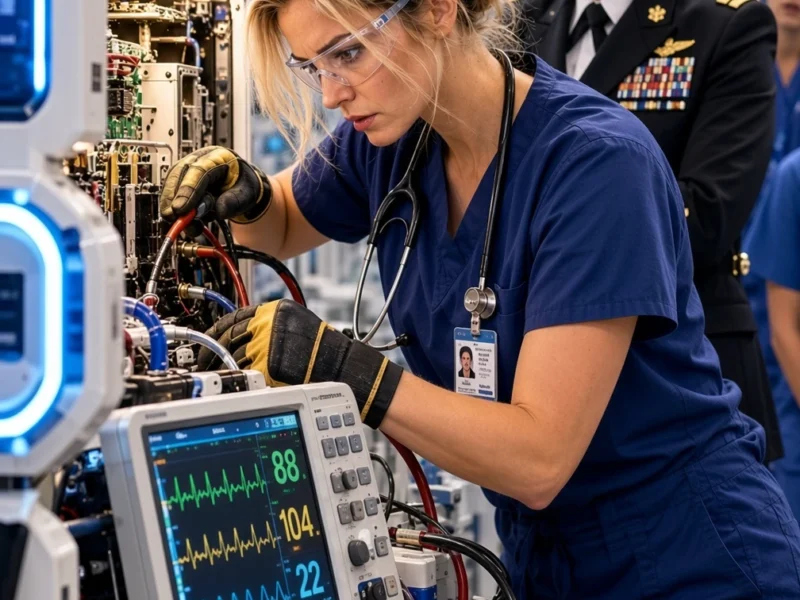
It clicked, a thin metallic click repeating every two seconds, and that sound alone was enough to bring Miriam O’Malley Tanner to her feet before the readout on the screen had even registered in her conscious mind.
Bed 12.
Lance Corporal Deion Whitfield, twenty-two years old, four days post-surgery after a training accident that had left a titanium rod threading through his left femur and a bruised spinal cord that the neurosurgeon was still not ready to call permanent.
The machine keeping his respiratory function regulated was a Vantec BioSync 9000, a piece of equipment that cost the federal government more than most rural hospitals spent on an entire wing.
Right now, its screen showed a single pulsing code in amber.
R9 relay.
Miriam stood still for exactly three seconds, reading the code the way other people read weather reports.
Not for the words, but for what the words meant underneath.
Then she pulled on a pair of nitrile gloves and stepped toward the machine.
“Don’t touch it.”
The voice came from across the room before she had taken two steps.
Thomas Quillen, the facilities head of biomedical equipment services, was already standing beside the unit with his tablet in one hand and his phone in the other.
Behind him, two junior technicians hovered near the wall like men who had learned to occupy the shape of helpfulness without quite providing it.
“That’s a relay fault. We’ve been troubleshooting it since midnight. We have a manufacturer call in forty minutes.”
“The patient’s respiratory rate just climbed four points,” Miriam said.
“I’m aware. He’s been on the unit for ninety-six hours without a clean cycle.”
“I said I’m aware, nurse.”
Quillen glanced at her badge.
“Tanner.”
She had been at Garfield Naval Medical Center for seven weeks, long enough to know which supply closets were never fully stocked and which physicians wrote orders they forgot to sign.
Not long enough for anyone to ask where she had come from before or why a woman with her obvious clinical instincts had accepted a night shift floor nursing position at a mid-tier facility when her resume listed a decade of vague contractor work that no one had looked at closely enough to question.
She stepped back, not because Quillen was right, but because the calculus in her head was still running.
R9 relay was not a relay fault.
She had known that from the first click of the alarm, the way a person knows a wrong note in a song they have played a thousand times.
She had seen that code on a predecessor model on a ship that no longer appeared in any public database, during a night that she had spent eleven years trying to file away in the part of her memory marked do not open.
She knew exactly what it meant.
And she knew that saying so would open a door she had been keeping shut with both hands since she had signed her discharge papers and walked out of a debriefing room in San Diego with a new Social Security number and the understanding that the version of herself she was leaving behind did not exist anymore.
Deion Whitfield’s oxygen saturation dropped another point.
Miriam looked at the number on the monitor instead of the technicians.
88.
She had held herself still through worse.
She had watched things that were worse.
She knew how to calculate the cost of staying quiet against the cost of speaking, and she had always been very good at math.
She stayed quiet.
The manufacturer call came and went at 2:30 in the morning, leaving Quillen with a downloaded diagnostic patch that changed nothing measurable on the machine and a new amber code that was slightly different from the first one.
His junior technicians had been through the machine three times by then.
The on-call physician, Dr. Asha Brennaman, had been awake since midnight and was working with the restraint of someone who had long since burned through her adrenaline reserves and was running on the flat, steady burn of professional discipline.
“If we can’t stabilize the ventilator circuit in the next window,” Dr. Brennaman said, her voice pitched low enough that only the nearest two people caught it, “I’m going to have to consider transferring him to manual ventilation. That means intubation under pressure with a spinal patient who has not been cleared for movement.”
Quillen set his tablet down on a supply cart.
“Give me twenty more minutes.”
“You’ve had six hours.”
“Give me twenty more minutes.”
Miriam stood at the far end of the unit, pretending to review a medication chart.
The words on the page had stopped meaning anything to her twenty minutes ago.
What she was actually doing was listening, not to the people in the room, but to the machine.
To the particular sound the BioSync made between its alarm cycles.
A half-second stutter in the compression rhythm that did not appear on any readout because it was too brief for the software to log.
She had been listening to it for the last forty minutes.
She knew that stutter.
She knew it the way she knew the sound of her own breathing.
The BioSync’s relay error was not a relay error.
It was a cascade fault originating in the internal timing module, a component that had been quietly failing in units manufactured during a specific production window, failing in a way that the manufacturer’s own field representatives had been unable to identify because the failure only presented under sustained load in high-humidity environments.
She knew this because she had been the one to write the technical brief on it eight years ago in a report that had never been declassified, filed under a name that no longer appeared on any active roster.
The name the report had been filed under was not Miriam Tanner.
She put the medication chart down and walked toward Quillen.
“I need to tell you something about that machine,” she said.
Quillen looked at her with the particular expression of a man who has been awake for six hours managing a crisis and does not have the bandwidth to absorb a new opinion from someone below his authority level.
“Nurse Tanner, the relay is not the problem.”
She kept her voice level the way she had been trained to keep her voice in rooms where panic was contagious.
“The alarm is presenting as a relay fault because the relay is the first downstream component the system scans when the timing module destabilizes. But if you look at the compression interval, not the readout, the actual mechanical interval between strokes, you’ll hear a micro-stutter about .4 seconds. It’s not logging because the threshold is set too high to catch it.”
Quillen stared at her.
“If you open the timing access panel on the left lateral face, not the primary service panel, the lateral face, you’ll find a capacitor bank. One of the secondary capacitors in that bank has been degrading under sustained load. At this humidity level, the degradation accelerates.”
She paused.
“I can show you exactly which one.”
Nobody in the room spoke for a moment.
“How do you know that?” Quillen said very carefully.
Miriam met his eyes.
“I’ve seen it before.”
“Where?”
She did not answer that question.
Dr. Brennaman had come up quietly behind them.
She was a small woman, precise in her movements, with the steady gaze of someone who had learned to read people faster than charts.
She looked at Miriam the way Miriam had not been looked at in seven years.
Not like a nurse with an opinion, but like a source of information that had not yet been fully mined.
“The patient saturation is at 86,” Dr. Brennaman said.
“Mr. Quillen, if you have exhausted your diagnostic options, I want to hear what Nurse Tanner has to say.”
Quillen opened his mouth, closed it, opened it again.
“She is not certified to open or service that unit.”
“She’s describing a failure mode you have not been able to identify in six hours. If she’s wrong, we have lost nothing. If she’s right—”
Dr. Brennaman did not finish the sentence.
The number on the monitor finished it instead.
85.
Quillen stepped back.
It cost him something.
She could see it in the set of his jaw, the way his hand tightened around the tablet, but he stepped back.
Miriam crouched beside the left lateral face of the BioSync and found the access panel by feel, the way she had been taught to find it in the dark, in a space that rocked and vibrated, with her hands shaking and someone talking in her ear.
The panel came off in twelve seconds.
Behind it, a capacitor bank the size of a hardcover book sat nested in a bracket that was slightly discolored on one end.
The particular dull rainbow of heat stress on coated metal.
There.
Third from the right.
She reached for it without hesitating and then stopped herself because her hands were bare and the capacitor bank was live.
She turned to one of Quillen’s junior technicians.
“I need insulated probe gloves, not nitrile, and a multimeter set to capacitance mode. And someone needs to hold the lateral panel clear of the compression housing.”
The technician looked at Quillen.
Quillen, after a pause that lasted only a second but felt much longer, nodded.
The gloves appeared.
The multimeter appeared.
Miriam positioned herself, and then the whole room went quiet in the way rooms go quiet when a thing is either about to work or about to fail and everyone present understands they have reached the point beyond which there are no more options.
She tested the third capacitor.
It was 0.03 microfarads.
Standard was 0.22.
“That’s your fault,” she said, her voice coming out steadier than she had expected.
“It’s reading at less than two percent of rated capacity. The timing module has been running compensated for, by my estimate, the last fourteen hours, which is why the fault didn’t cascade sooner. It’s compensating by borrowing cycle time from the relay circuit. That’s why you’re seeing a relay error.”
Quillen crouched beside her, reading the multimeter over her shoulder.
His voice, when it came, was entirely flat.
“We don’t carry spares for that capacitor on site. It’s a standard industrial-grade. What’s in your main equipment storage that uses a 250-volt bus?”
Thirty seconds later, one of the junior technicians was down the hall at a dead run toward the storage room.
The replacement capacitor came from a backup power regulator that the hospital kept in reserve for the radiology department.
Quillen installed it himself while Miriam talked him through the sequence, her voice steady and quiet as if she were describing something no more remarkable than a routine calibration.
She did not reach for the machine again.
She had done what she knew how to do and she was not going to take more than that.
The cascade cleared at 3:47 in the morning.
Deion Whitfield’s oxygen saturation climbed from 85 to 88 in the first minute, then to 92, then to 96.
The ambient sound of the room changed.
Someone exhaled.
Dr. Brennaman turned away from the monitor and pressed two fingers to her mouth for a long moment.
Quillen sat back on his heels and looked at the machine and did not look at Miriam.
Nobody heard the double doors open at the far end of the ward.
Vice Admiral Sandra O’Connell Bell had driven herself to the hospital.
Her aide had offered three times during the twenty-minute drive and she had refused three times because needing someone to drive you at 4:00 in the morning when your grandson is on a ventilator felt like a concession she was not prepared to make.
She was sixty-one years old and had commanded a carrier strike group in two operational theaters, and she had been to this building every day for the last four days, and none of that had made the drive any shorter.
The duty officer at the main desk recognized her and started to stand.
She waved him down without stopping.
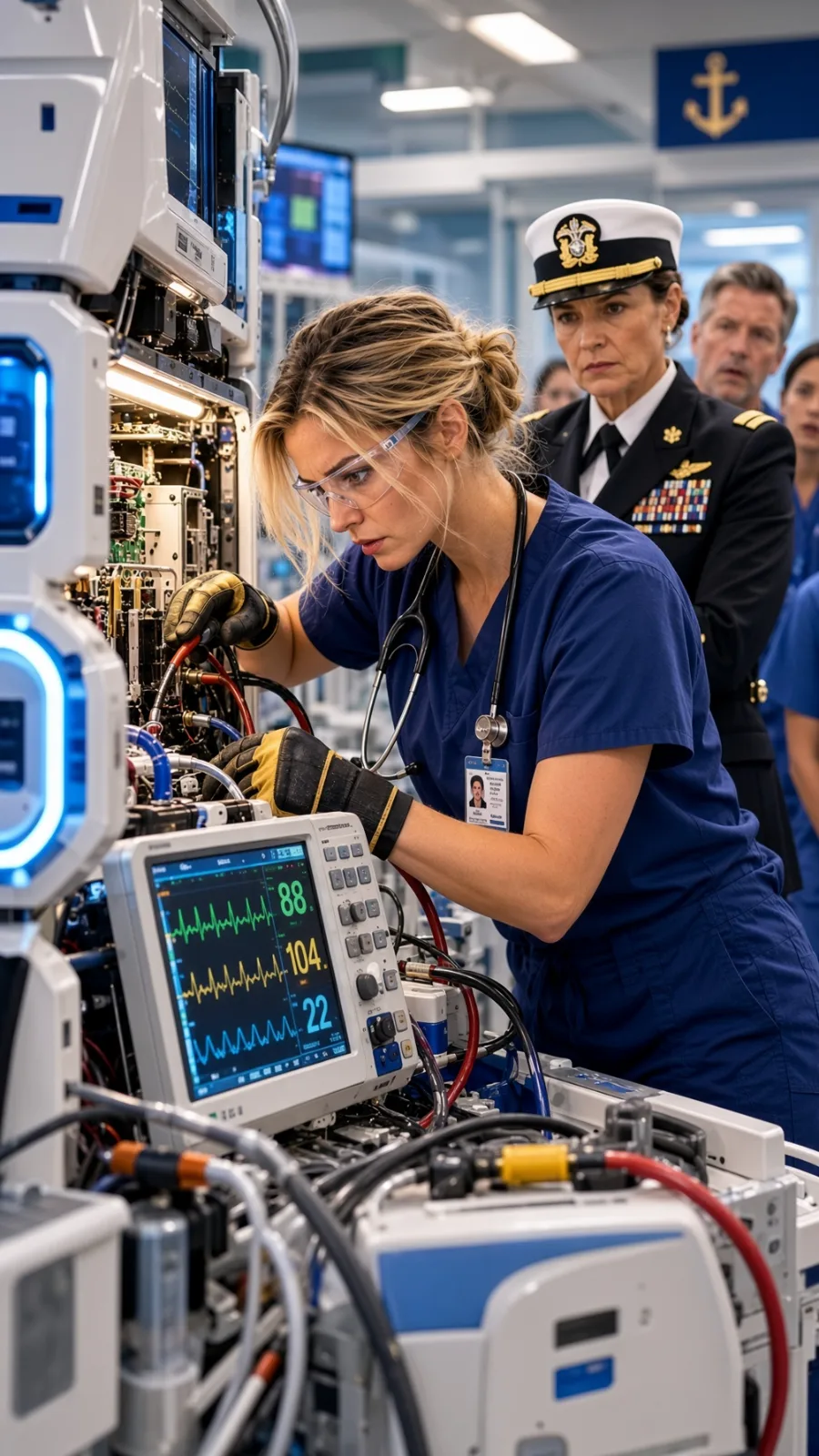
She found the ICU by memory, pushed through the double doors, and the first thing she saw was a small blonde woman in blue scrubs crouched on the floor beside Deion’s ventilator with her hands in an open panel and every other person in the room standing around her like they had all somehow forgotten what else they were supposed to be doing.
The second thing she saw was her grandson’s monitor.
96 and climbing.
She stood very still in the doorway for a long moment.
Dr. Brennaman came to her first, speaking quietly.
“Admiral, the unit experienced a cascade fault. We have stabilized it. Deion is stable.”
O’Connell Bell watched the woman in the scrubs accept a towel from someone and begin methodically cleaning her hands.
Watched the way she did it.
Efficiently.
Without any excess motion.
The way people move when they have spent years in environments where wasted motion was a liability.
“Who is that?” she asked.
“One of our night shift nurses, Miriam Tanner. She’s been here about two months. She fixed the machine. She identified the fault our engineering staff hadn’t been able to locate in six hours.”
“Fixed it.”
“Yes.”
O’Connell Bell studied Miriam Tanner from across the room.
Miriam Tanner was not looking at her.
Miriam Tanner was looking at the monitor with the quiet, removed attention of someone reviewing data they were not personally attached to.
But her right hand, the one holding the towel, had stilled.
The admiral crossed the room.
Everyone in the ICU found something to attend to in the opposite direction.
Miriam looked up when O’Connell Bell reached her.
She had gray eyes, the kind that registered everything without giving much back.
There was a controlled quality to her stillness that was not the stillness of a person who was calm.
It was the stillness of a person who was very carefully managing what her face was doing.
“My grandson,” O’Connell Bell said.
“Stable,” Miriam said.
“The fault is corrected. He should have a clean cycle for the rest of the night.”
“What was wrong with it?”
Miriam described it.
Quillen, standing a few feet away, listened to her describe it and did not interrupt or correct a single word.
O’Connell Bell listened to the description.
She had spent thirty years in environments built around specialized machinery, and she understood enough of the technical language to recognize that Miriam was not simplifying.
She was speaking to exactly the level the situation required, adjusting her register without condescension, the way people do when they have spent years briefing people at every level of a complex organization.
“Where did you learn to diagnose a fault like that?” O’Connell Bell asked.
Miriam met her eyes steadily.
“I’ve worked around that equipment before.”
“Where?”
Miriam held the admiral’s gaze for a moment.
“A long time ago.”
O’Connell Bell was silent.
She had built a career on reading rooms and reading people, and what she was reading right now was a woman who had decided, somewhere in the last thirty seconds, that this answer was going to be the whole answer, and that no amount of rank across from her was going to change that.
It was not defiance.
It was something older than defiance.
It was the particular posture of a person who has survived something by being invisible, and is not yet sure the danger is past.
She had seen that posture before.
A long time ago.
In a different facility.
In a different context.
She had been briefed on a program she did not have operational authority over, and she had read a file that described a young technical specialist who had been aboard a research vessel that no longer appeared in any public database.
The file had been sparse.
The photograph attached to it had been eleven years old.
O’Connell Bell did not look at the photograph in her memory and then look at the woman in front of her.
She did not do that because she had spent thirty years learning not to let recognition show on her face in real time.
She said, “He’s going to want to thank you when he’s conscious and able.”
“He doesn’t need to,” Miriam said.
“That’s not the point of a thank you.”
Miriam said nothing.
O’Connell Bell started to turn away, then stopped.
She spoke quietly enough that only Miriam could hear her.
“There was a report filed about eight years ago. Classified. It documented a failure mode in a Vantec predecessor model that nobody else had been able to replicate in a controlled setting.”
She paused.
“The report was authored under a field identifier, not a name. The identifier was Lark.”
Miriam’s jaw moved.
Almost nothing.
The kind of movement that happens when someone stops themselves from saying a word before it forms.
“The Lark report was what got that predecessor model recalled,” O’Connell Bell said, “eventually. After three years and a lot of institutional resistance. It saved lives. Quite a few of them, as it turned out.”
She paused again.
“Nobody ever found out who Lark was. The program that generated the identifier was sunset in a reorganization. The person behind it had already been discharged.”
Miriam said very quietly, “I appreciate you telling me that.”
“I thought you might.”
O’Connell Bell walked to her grandson’s bedside and put her hand over his.
The monitor read 98.
Quillen found Miriam at the nurses’ station at 5:00 in the morning, sitting with a cup of coffee that had gone cold and a chart she was not reading.
He stood across from her for a moment without speaking.
“I’ve been doing this for nineteen years,” he said finally.
“I know.”
“I’ve seen a lot of nurses. A lot of technicians. I don’t know where you came from or what you did before you got here.”
He paused.
“But I owe you an apology for the way I spoke to you earlier.”
Miriam looked up at him.
“You were protecting your patient.”
“I was protecting my jurisdiction.”
She held his gaze.
“Sometimes those look the same from the inside.”
Quillen pulled a chair out and sat down.
He had the specific exhaustion of a person who had been maintaining composure for six hours and had finally set it down.
“The fault you identified. The capacitor degradation under humidity load. I’ve worked on four units from that production batch. I’ve never seen that failure mode. It takes a sustained load in the right environmental conditions. Most facilities cycle down between patients. If a unit runs continuously, especially in coastal environments—”
He shook his head.
“That wasn’t in any documentation I’ve ever seen.”
“No,” Miriam said.
“It wasn’t.”
He looked at her for a moment.
“How long have you known about it?”
She thought about how to answer that.
Thought about a ship that no longer appeared in any database.
Thought about a testing protocol that had run for sixteen months under conditions that replicated sustained tropical-zone deployment.
Thought about the report she had submitted at the end of it under a field identifier to a program office in a building she had never been allowed to name.
“Long enough,” she said.
The morning shift change arrived at 6:00.
Miriam handed off her patients, completed her documentation, collected her bag from her locker.
She was almost at the elevator when she heard her name.
Deion Whitfield was not fully conscious, not by most clinical definitions.
He was aware enough, through whatever haze of sedation and exhaustion the night had left him, to have registered the face of the woman who had been near his machine in the dark hours.
He had asked the morning nurse about her by description.
His grandmother was in the doorway of his room when Miriam came back down the hall.
“He asked for you,” O’Connell Bell said.
Miriam went in.
Deion’s eyes were at half-mast, tracking slowly, but they found her face and stayed there.
“You fixed it,” he said.
His voice was rough from the tube.
“Your machine had a fault. We corrected it.”
“My grandmother said you knew what was wrong before anyone else.”
“I recognized the code.”
He looked at her for a moment.
Twenty-two years old, a titanium rod in his leg, a bruised spinal cord, and the particular young person’s quality of still not quite believing that the situation he was in was real.
“Are you a nurse?”
“Yes,” Miriam said.
He seemed to think about this.
“Just a nurse?”
Miriam glanced at O’Connell Bell, who was standing in the doorway with her arms crossed, watching this exchange with an expression Miriam could not fully read.
Then she looked back at Deion Whitfield.
“That’s a complicated question,” she said.
“I’ve got time,” he said.
The corner of his mouth moved.
“I’m not going anywhere.”
Miriam sat down in the chair beside his bed.
The chair was still warm from where his grandmother had been sitting all night.
“A long time ago,” she said, “I worked in a different kind of room with different kinds of equipment. And a person I trusted told me that the only thing that separates a machine that works from one that fails is whether someone is paying close enough attention to hear the difference.”
She paused.
“He said that most people stop listening when the readout looks normal. The machine fails twice. Once when it breaks, and once when the person watching it decides the numbers are enough.”
Deion was watching her steadily.
“Who told you that?”
“Someone who was very good at his job.”
She held the memory still for a moment, the way she had learned to hold difficult things.
Not tightly.
Not loosely.
Just present.
“He died doing it. In a situation not entirely unlike tonight. A machine that had a fault no one else had found.”
She paused.
“He found it. It cost him everything. And for a long time I thought that was my fault because I was the one who should have found it first.”
The room was quiet enough that the ventilator’s steady rhythm was the loudest thing in it.
“Was it your fault?” Deion asked.
“No.”
The word came out differently than it had in her head.
Steady.
Clear.
“I spent a lot of years believing it was. But the fault was in the machine before either of us ever touched it. A manufacturing defect that was known and undisclosed. And what he did, what he knew how to do, he passed it to me. I have been carrying it forward ever since.”
Deion was quiet for a moment.
“So tonight?”
“Tonight was just another room,” Miriam said, “another machine.”
He looked at her.
“Didn’t feel like that from in here.”
O’Connell Bell made a small sound from the doorway.
Not a word.
Just a sound that could have been agreement.
Miriam stood.
She picked up her bag from the floor where she had set it.
At the door she paused because O’Connell Bell was still there, and they were at the same height, and the admiral was looking at her with an expression that had stopped being unreadable.
“The Vantec batch,” O’Connell Bell said quietly. “The one with the humidity fault. Are there others in this facility?”
Miriam had checked the equipment logs at 2:00 in the morning between the first alarm and the second.
Unit 6 in the cardiac ICU.
Unit 2 in the step-down ward.
Same production window.
She paused.
“They’re both in low-use rotation right now. If they go to sustained load, I’ll make sure it’s flagged.”
Miriam nodded.
“Nurse Tanner,” O’Connell Bell said.
Miriam stopped.
The admiral looked at her for a long moment with the unhurried attention of a person who has something to say and is deciding exactly how to say it.
“The Lark report. The failure modes it documented. The work it took to produce it.”
She paused.
“That work mattered. The person who did it, the work they did, the cost it came at, it mattered. I want you to know that someone at a level where it could be verified has said that out loud.”
Miriam’s throat tightened.
She held it.
She had held harder things.
“Thank you,” she said.
She took the elevator down alone.
In the lobby, the automatic doors opened onto a parking lot just beginning to catch the first gray light of morning.
She stood at the threshold for a moment and breathed the outside air, cool and slightly salt-touched, the way the air always was this close to the coast.
The person who had taught her to listen for a machine’s distress before it became a crisis had also taught her, in the same lesson, delivered over a disassembled housing unit on a table that was bolted to the floor because the floor moved, that carrying knowledge forward was not the same as carrying blame.
That the only real failure was to stop paying attention when the numbers looked normal.
She had been paying attention for eleven years.
She walked to her car, started it, and drove home through streets that were still quiet into a morning that was, for the first time in a very long time, not weighted by the particular shape of a guilt that had never been hers to carry in the first place.
Three weeks later, a memo circulated through Garfield Naval Medical Center under the joint signatures of the chief medical officers and the head of biomedical engineering.
It described a new interdisciplinary protocol for cascade fault identification in high-load ventilation units and credited its development to a cross-functional team including a staff nurse who had demonstrated exceptional diagnostic competency.
Quillen read the memo twice.
Then he walked down to the supply closet where he kept spare capacitors.
Considerably more of them now.
Properly labeled in a dedicated organizer he had installed the morning after.
And he stood there for a minute with the memo in his hand and thought about nineteen years and what it meant that a rule he had never questioned was the thing that had almost cost a twenty-two-year-old his life.
He did not have a complete answer, but he had a better question than he had started with, which he had come to understand was usually the beginning of the useful work.
At the nurses’ station, Miriam Tanner was starting her second week on the day shift.
She had put a small photograph on the edge of her locker.
Not a photograph of herself or of anyone in the facility would recognize.
But of a ship at anchor in flat blue water, taken from the dock, looking out.
The angle made it impossible to identify the vessel.
She was the only person in the building who knew what ship it was.
Or what the water looked like in that harbor at 0600.
Or why the photograph was framed the way it was framed, cutting off the ship’s name just outside the right edge.
But she looked at it every morning when she arrived.
And it meant what it had always meant to her.
That the things you carry forward are not always the things you meant to keep.
Some of them choose you.
Some of them find a way into your hands at 3:00 in the morning in a room where everything depends on whether you are willing to know what you know.
She clocked in.
She pulled her first chart.
She listened.